How the chronological families fit together
Integrated working synthesis for C732–C831 · continuation of the C731 foundation · 28 September 2026
The chronological families can be explained as different measurements and transformations of ordered source paths. MT, LXX and SP supply the rows and their admitted states. Regular chronology measures effective begetting intervals; cumulative chronology measures selected lifespans. Rounded chronology transforms specified source measures and carries the resulting differences along the path. Calendar conversions and specified translations/reflections then relate particular realizations while preserving named quantities or shapes.
The central advance is that this explanation now reconstructs whole genealogical fields, including their intermediate differences. A source change can be invisible to one measurement and visible to another. A rounded total can agree while its internal boundaries move. A shared birth sequence can therefore coexist with different death and cumulative sequences, through one intelligible source construction.
This addresses the Strategy’s larger objective: a compact grammar that explains the differences among families as well as their agreements. The grammar retains the ordered rows, the measured quantity, the terminal anchor, the chosen state, and each boundary’s role. These are explanatory inputs. Exact reconstructions establish their mathematical consequences; historical transmission and the adopted providential interpretation remain distinct questions.
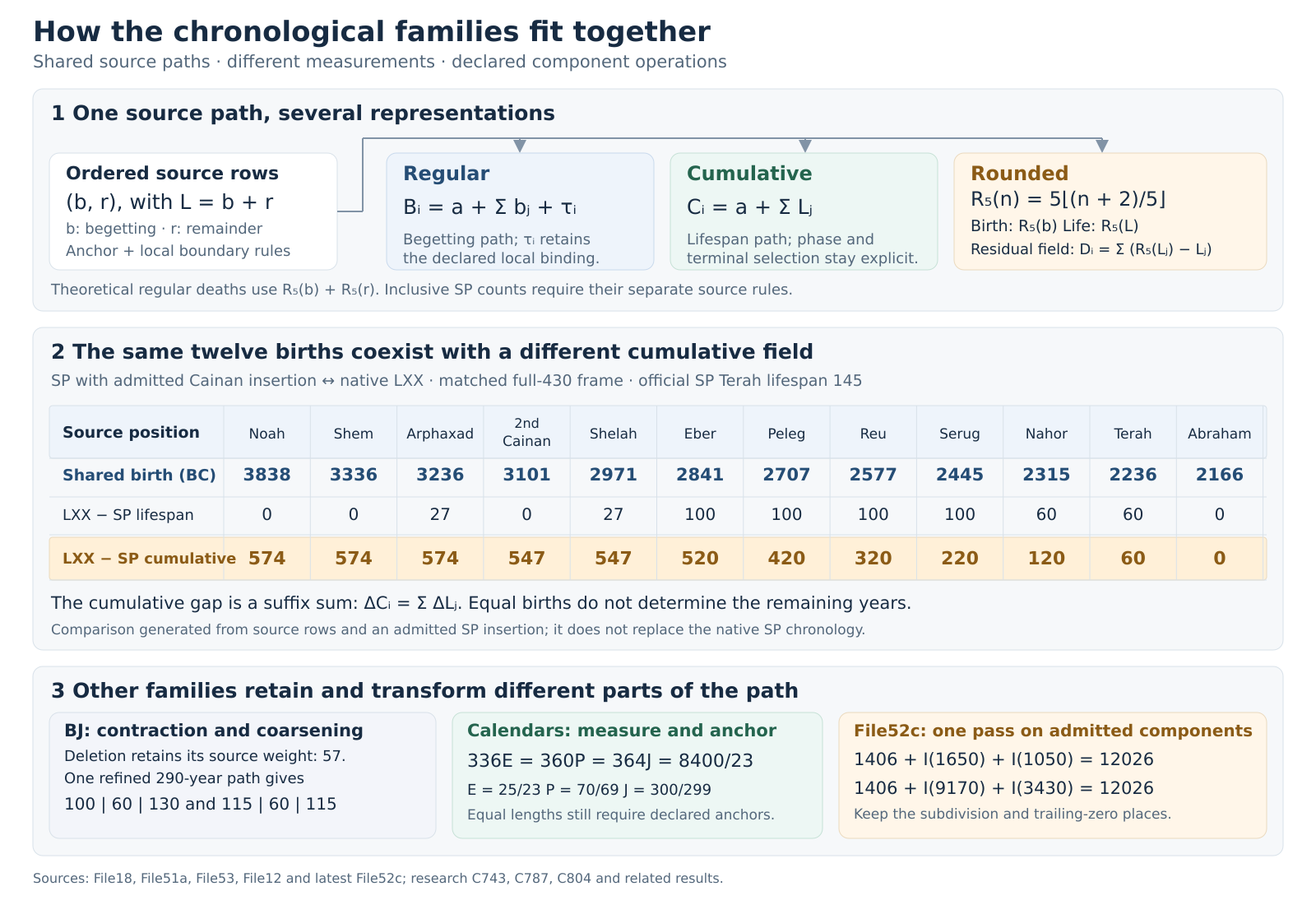
The family map
| Family | Shared operation | Reconstructed object | Source inputs still required |
|---|---|---|---|
| MT/LXX/SP | local b_eff/L selectors and suffix accumulation | whole mode-gap field | source rows and terminal conventions |
| finite variants | binary changes on declared supports | all admitted placements and interval responses | licensed switches and source row lift |
| Rounded | Q on selected rows; accumulate e | whole residual and bridge-change fields | rounding rule and source path |
| BJ | weighted contraction, residuals, coarsening | 22/23 index, deletion ledger,575/290 paths | source 57, calendar timestamps, role choices |
| calendar Keys | measure-scaled component transforms | declared day-volume and completions | calendar measure, held anchor and direction |
| ordered shape families | translation, scale, reflection on specified objects | full labelled interval shapes | object membership and phase chart |
| File52c | one-pass digit reversal on admitted components | two 12026 path evaluations | licensed subdivision and zero-placeholders |
The source path generates both regular and cumulative chronology
For a compatible biographical row, let be the begetting age, the remaining years, and the lifespan. A repartition
preserves the cumulative contribution while changing the regular contribution. Cainan’s supplies the complementary example: insertion contributes 130 to the regular path and 460 to the cumulative path.
The full relationship follows by comparing adjacent boundaries. Let and be the regular and cumulative coordinates at a named row, and its effective regular interval, including the declared binding or counting convention. Then
One terminal difference and the ordered local contributions determine the entire bridge. Conversely, adjacent differences recover those contributions. In linear terms, accumulation uses a triangular matrix with unit diagonal; with the terminal held, this ordered reconstruction is invertible. A single outer total loses the order. Exchanging two unequal contributions can preserve that total while changing an independently supplied intermediate boundary.
The same construction reproduces the complete retained native-Cainan profiles for all three traditions. Their Creation comparisons in the common full 430 regular frame are:
| Tradition and Cainan state | Regular completion | Lower cumulative completion | Cumulative minus regular |
|---|---|---|---|
| MT, OFF | 4114 | 14004 | 9890 |
| LXX, native ON | 5494 | 14894 | 9400 |
| SP, OFF, full 430 comparison | 4414 | 13396 | 8982 |
SP’s native 215 regular head is 4199; retaining that placement instead gives 9197. Likewise, cumulative Moses-center 14006 and regular completion 4114 give 9892, a different Adam-label pairing from the established 9890 completion bridge. Selecting the lower cumulative envelope translates the complete center profile by−2; it does not introduce separate adjustments at individual nodes.
The local conventions remain visible in the generator. Noah→Arphaxad-bound Shem has an effective 502 interval against the 500 begetting ledger. SP primary Lamech→Noah uses 52 completed units in the 53rd year. SP’s653 lifespan is an inclusive cumulative count; it is not silently replaced by 652 elapsed years. These distinctions make the shared recurrence precise.
Sources: File18 §§1.5–1.6,2–4,6A–6D; File09 cumulative controls; C733–C748. These reconstructed coordinates are dependent outputs of the source paths.
One shared birth family has two different cumulative realizations
The clearest positive cross-tradition example is the complete SP-with-Cainan/LXX birth suffix. Restoring the admitted 130 interval in regular SP aligns every birth position from Noah through Abraham with native LXX. The match persists through all four common Sojourn/Terah placement states because the two paths have the same begetting rows and the same variant supports.
The table uses the full 430 regular frame with no+60 Terah. Cumulative entries are Moses/Nisan centers reconstructed from official lifespan rows and the common Abraham 2435 boundary. SP Cainan is explicitly restored; LXX Cainan is native. Paired cells list SP / LXX.
| Row | Shared regular birth BC | Lifespans, SP / LXX | Cumulative centers BC, SP / LXX | Cumulative LXX−SP |
|---|---|---|---|---|
| Noah | 3838 | 950 / 950 | 6721 / 7295 | 574 |
| Shem | 3336 | 600 / 600 | 5771 / 6345 | 574 |
| Arphaxad | 3236 | 438 / 465 | 5171 / 5745 | 574 |
| Cainan | 3101 | 460 / 460 | 4733 / 5280 | 547 |
| Shelah | 2971 | 433 / 460 | 4273 / 4820 | 547 |
| Eber | 2841 | 404 / 504 | 3840 / 4360 | 520 |
| Peleg | 2707 | 239 / 339 | 3436 / 3856 | 420 |
| Reu | 2577 | 239 / 339 | 3197 / 3517 | 320 |
| Serug | 2445 | 230 / 330 | 2958 / 3178 | 220 |
| Nahor | 2315 | 148 / 208 | 2728 / 2848 | 120 |
| Terah | 2236 | 145 / 205 | 2580 / 2640 | 60 |
| Abraham, shared terminal | 2166 | 175 / 175 | 2435 / 2435 | 0 |
At a common birth, the greater lifespan moves the LXX death forward by exactly that excess. Thus Shelah’s27-year lifespan difference produces a27-year death difference, whereas cumulative chronology carries that 27 into every earlier boundary. The whole cumulative difference field is the ordered accumulation of the local lifespan differences. From Shelah downward, adjacent differences of 547,520,420,320,220,120,60,0 recover 27,100,100,100,100,60,60.
The familiar MT/LXX 430 alignment has the same kind of local explanation. When Cainan status is matched,430 is the constant cumulative displacement from Adam through Lamech. Noah through Arphaxad has 454, followed by 427 at Shelah and the subsequent changing values. For native LXX, the insertion response means theoretical OFF → native ON, never another insertion into an already ON path. Matching insertion status exposes the underlying lifespan differences; it does not make the entire genealogy one uniform translation.
Sources: File18 §§3.2,4.2,6B–6D; C742–C745,C778,C787. Generated cumulative rows and restored-SP comparisons retain that status; the table does not appoint new historical events.
A variant’s source operation determines its effect in each mode
Terah compresses this principle into three rows:
| Selected row | Begetting | Remainder | Lifespan | Regular birth/death with Abraham 1951 held | Cumulative birth with Abraham 2435 held |
|---|---|---|---|---|---|
| SP textual | 70 | 75 | 145 | 2021 / 1876 | 2580 |
| MT/LXX baseline | 70 | 135 | 205 | 2021 / 1816 | 2640 |
| 130/205 alternative | 130 | 75 | 205 | 2081 / 1876 | 2640 |
The first move adds 60 to the lifespan while retaining the begetting age. The second redistributes 60 inside the 205 lifespan. Their regular/cumulative effects are
The regular shift alone therefore cannot specify the cumulative response. The underlying row change must accompany the variant’s name. SP’s130/205 compatible biography remains a derived architectural construction; its official cumulative row is 145. File51a’s separately admitted cumulative+60 display blocks are a further operation with their own source scope, distinct from the zero cumulative effect of the MT/LXX lifespan-preserving repartition.
The broader regular family has three finite choices: Sojourn215, Terah 60 and Cainan 130. Their supports are nested. Sojourn placement reaches Abraham and the earlier rows; the Terah switch begins at Terah; Cainan insertion changes the common rows from Arphaxad backward. Cainan’s own newly inserted node is located from Shelah and has four placements. It does not receive another 130 insertion of itself.
For a common row , these choices have the form
where the masks record which source boundaries each choice affects, and the switches are binary. This gives eight upstream placements, four middle placements and two Abraham placements. A span is unchanged when its endpoints have identical masks; crossing a hinge measures exactly that hinge’s contribution. The switches commute on the admitted finite configurations, with their numerical direction reversed when switched back.
The raw MT/LXX cumulative projection retains the Cainan 460 choice but forgets the regular Sojourn placement and the 205-preserving Terah repartition. Eight regular state labels therefore yield two cumulative executions, while their full source labels remain available. Kohath and Amram’s unassigned regular pivots are not interpreted as fixed zero coordinates.
Sources: File18 §§1.3,1.6,2–4; File51a secondary blocks; C772–C786.
Rounded chronology carries a local residual along the source path
For a nonnegative integer duration, nearest-five rounding is
Three source procedures must be retained: for regular births, for theoretical regular lifespans, and for cumulative lifespans. Their distinction is generated by the finite residue rule
Both MT Methuselah and Reu have defect−5. Their source table values already retain this difference; the unrestricted statement that Methuselah is unique needs qualification. Main LXX Lamech182+571=753 supplies another−5 case. Its selected 182/753 remains controlling, with 777 confined to the appendix and 188 non-operative. SP inclusive cap rows remain count ledgers; their algebraic differences are not automatically ordinary elapsed biographies.
For cumulative chronology, let be Rounded minus Actual at boundary . With a fixed terminal,
This one residual field reproduces every printed MT cumulative boundary. Its zero Creation total coexists with internal displacements from−4 to+5. An interval changes by , so equal residuals identify complete families of preserved intervals. Noah, Shem and Arphaxad move together by+5; Terah, Abraham, Isaac and Jacob move together by−4. Their interval geometry survives while their node identities remain distinct.
The cross-tradition transfer needs only a small support of changed residuals:
| Comparison with MT | Changed local lifespan residuals | Resulting nonzero boundary-residual differences |
|---|---|---|
| LXX | Lamech+4; Arphaxad−2; Shelah−2 | Noah/Shem/Arphaxad−4; Shelah−2 |
| SP | Methuselah−1; Lamech+4 | Adam through Methuselah+3; Lamech+4 |
All other common-row boundary-residual differences are zero. Consequently, LXX’s total cumulative differential is retained even though part of its interior changes. SP’s actual−608 differential becomes−605 through the two stated residual changes. These LXX/SP Rounded columns are derived transfers of the source rule, not newly adopted canonical tables.
The aligned SP-with-Cainan/LXX family remains aligned in regular births under rounding because its begetting rows agree. Its two 27-year lifespan differences become 25, reducing the upstream cumulative difference 574 to 570 with official SP Terah 145 retained. The same source explanation survives the transformation.
Rounding is compatible with the admitted multiples-of-five changes because
This preserves the residuals under compatible 60,130,215 and 460 moves. Cainan’s130,330 and 460 have zero local residual, but his cumulative coordinate inherits the downstream residual:4853 becomes 4856 in the MT inserted state. A locally exact duration need not have an unchanged coordinate.
Rounding each already calculated date to a grid ending 1 or 6 is a different procedure. Actual Noah 6381 is already on that grid, yet source-row accumulation gives 6386. The retained subdivision also matters: cumulative Enoch→Terah has actual 5852; rounding its rows gives 5860, whereas rounding the total once gives 5850. Rounded chronology thus belongs to the source path and its selected operation, rather than to a universal map applied to date labels.
The two modes and rounding meet in a single relation:
The comparison must use its declared regular source path and cumulative column consistently. Rounded plus the residual field recovers Actual exactly; Rounded alone discards information. This is reconstruction from retained arithmetic data, not a second decimal inversion.
Sources: File51a §§2–3,16–17; File18 official rows; C749–C770,C784–C788.
Rounded residuals help explain the Strategy’s SP rectangle
The supplied SP rectangle compares regular 4206 and cumulative 13406 with Exodus1446 and Conquest 1406:
Both gains are 40, preserving the 9200 difference. The source-controlled rectangle already establishes this relation. The new residual analysis provides a conditional explanation of its cumulative head:
The first move selects the Moses center from the lower completion; the second is the SP row-rounding residual; the third selects the rounded Aaron 125 rather than Moses 120 terminal lifespan. That+5 is distinct from the exact Actual Aaron/Tishri phase separation 3.5. The route explains how the supplied+10 can arise, but its assignment as the source’s intended construction remains conditional. The regular 4206 branch retains its separate source basis in the Strategy’s −215/native regular frame.
SP also shows why interpretation must precede rounding:53 counted rounds to 55, whereas 52 completed rounds to 50. A source-adopted block cannot be reconstructed by rounding first and then subtracting one. The resulting 4411/4406 diagnostic helps explain the alternatives but does not itself establish ownership of their original construction.
Sources: Research Strategy §4.3; File18 §6C; File51a SP blocks and rounded terminal branches; C761–C764.
Jubilees extends the same path model
Jubilees adds index contraction, weighted duration contraction, and alternative subdivisions of retained paths. Its 22-head/work parallel is a structural interpretation in File53. Inserting Kainan at position 13 gives a 23-head list while preserving every surviving name’s order. The index change is one position; the associated chronological weight remains source-specific.
| Representation of the removed element | Weight | What it measures |
|---|---|---|
| Head index | 1 | Position |
| BJ secondary birth reconstruction | 57 | Years |
| File18 regular Cainan | 130 | Begetting interval |
| File18 cumulative Cainan | 460 | Lifespan contribution |
No BJ Kainan lifespan is supplied here, so the table does not infer a BJ cumulative 460. The supplied secondary deletion path changes Creation 3856 → Flood 2549 → Kainan 2482 → Shelah 2425 into 3799 → 2492 → 2425. It preserves the inherited Creation–Flood 1307 and contracts the total 1431 to 1374. The controlling SP-to-BJ 7+1300 construction remains inherited input, not independent corroboration.
The displayed 2450-to 2400 reduction combines two operations. Creation 3856 → Conquest 1406 and Fall 3849 → rest 1399 each span 2450. Removing57 from Creation gives 3799, whose span to rest is 2400. The reduction 50 is therefore 57−7, with the starting role changed. File53’s positive four-node reflection about 2599 uses original Noah/Shem/Flood comparison nodes 3149,2649,2549,2049 against compressed Creation 3799 and rest 1399. The2649/2049 values are source-implied comparison coordinates; the controlled BJ Shem 2650/2050 states remain distinct. It is a separately declared comparison object; the expunged ledger’s Flood 2492 does not replace 2549 in that reflection.
The complete post-Abraham paths supply an even clearer whole-family example:
| Ordered interval | Biological reconstruction | Surface ledger | Surface minus reconstruction |
|---|---|---|---|
| Abraham → Isaac | 100 | 111 | +11 |
| Isaac → Jacob | 60 | 59 | −1 |
| Jacob → Egypt entry | 130 | 125 | −5 |
| Egypt entry → Conquest | 285 | 280 | −5 |
| Whole Abraham → Conquest | 575 | 575 | 0 |
The boundary residuals are 0,11,10,5,0 AM years. Adjacent differences generate the four changes above, using the same difference/accumulation rule as the mode and rounding fields. The six supplied jubilee timestamps regenerate exactly from AM=49(j−1)+7(w−1)+y. That validates their arithmetic encoding; it does not explain historically why those particular timestamps were selected. The source prose’s Isaac–Jacob 70 conflicts with the literal 59, and the surface Jacob lifespan 142 conflicts with the stated 147. Both tensions remain. The generated reconstructed death 2183AM and literal surface death 2188AM still preserve the final 17 years after their respective Egypt entries.
Two partitions of the biological 290-year subpath also fit one refinement. The six nodes supplied in the project’s reconstructed biological/sacrifice path—1981,1881,1866,1821,1806,1691BC—have gaps 100|15|45|15|115. Selecting biological birth cuts gives 100|60|130; selecting sacrifice and death gives 115|60|115. The six nodes, including four internal boundaries, retain distinct roles.
The larger bookend path 3856 → 3396 → 1906 → 1446 → 1406 has gaps 460|1490|460|40. Expanding only the call-to-Exodus460 by 25/23 gives 500 and reaches Conquest 1406 while retaining the earlier 1950. The resulting path is 1950+500=2450: the 40-year gain supplies the existing wilderness completion, which is not added a second time. The source NT heads 5326 and 2876 share the 2450 duration as 35×70=50×49. That is a duration interface; it does not identify their events or transfer the BJ head list.
Sources: File20 §§7A2,7A.10,8; File53 §§2–3A,13A; File43 §4; C792–C810. BJ reconstructed, surface, and comparison states remain distinct.
Retained paths connect these results to File52c and the wider families
Latest File52c remains primary for the single-pass decimal-reversal study. Its principal MT paths to Conquest 1406 are:
| Admitted path | Source components | Reversed components | Evaluated endpoint |
|---|---|---|---|
| Regular Creation–Flood–Conquest | 1650+1050 | 5610+5010 | 12026 |
| Cumulative Creation–Flood–Conquest | 9170+3430 | 7190+3430 | 12026 |
The admitted continuation adds the 1400 Conquest-to-Nativity component. Its single-pass reversal is 4100; with the final 6BC anchor the full path evaluates to 6+5610+5010+4100=14726. The2700 shift from 12026 combines the changed anchor with the added transformed component. This preserves File52c’s two-stage 12026/14726 backbone without enlarging its statistical ledger.
The operation preserves trailing-zero placeholders and acts on the admitted components. Subdivision is essential: reversing an unsplit total gives a different result. This is the same structural lesson now demonstrated independently for rounding, although the two transformations remain distinct.
The strongest Actual–Rounded interface also retains an internal cut:
Expanding only the final 483 by 25/23 or expanding the whole 12558 by 300/299 gives the same 12600 outer span. Their internal junctions differ. With Creation held, both end at generated 1404; translating the endpoint pair by+2 gives Rounded14006/1406. Endpoint agreement therefore explains one shared measurement without declaring the entire transformed paths identical.
The same Actual/Rounded Creation pairs preserve
Their change satisfies . Source-row generation, path evaluation and weighted conservation therefore explain complementary parts of the connection.
The calendar and shape families extend this grammar. The exact Keys satisfy
They preserve a common schematic day-volume under the declared calendar measures. Common endpoints additionally require compatible held anchors and direction. File70’s identical Creation/Joseph7+7 rails generate their full cross-rail matrix from one translation. Its five-node Creation/Terah template scales the complete 6|1|6|1 refinement to 60|10|60|10. Supplement A’s690=23×30 core generates its retained-flank fields and micro/macro completions. These are examples of distinct invariants—measurement, ordered shape, midpoint or phase field—carried by precisely specified transformations.
The resulting model has a compact shared object: an ordered, state-labelled source path with its measures, roles and anchor. Regular and cumulative select different measures; finite variants change specified rows or placements; rounding carries residuals; calendar and affine operations preserve their declared quantities; decimal reversal evaluates the admitted component list. The model explains substantial whole-family structure while retaining the source premises that select each realization.
Sources: latest File52c §§3.3–3.4,3.11,3.14; Files12,61–63,68–70 and Supplement A; C731 synthesis and C789. The historical origin of the source choices remains a separate evidential question. The current scope retains the Noah/Shem/Flood Gear restriction; the quarantined primers,1486 and second decimal inversion remain outside this investigation.
Evidence and source control
This synthesis continues the C731 foundation and incorporates cycle C732–C831. Its tables and generated fields are reproducible in the accompanying step record and evidence packet. The exact local source snapshots are retained there. Latest File_52c remains the controlling inverse draft (SHA256 a5ea84562101158b60d0cf296765d6eff38e7a2abda4e74ad1b353dfd13b9530). Supplied sources were not rewritten.
The cycle’s reconstructed fields are dependent consequences of frozen inputs, not an independent-success tally. The present explanation establishes mathematical relationships within the supplied research model; it does not establish the historical origin of its numbers or remove the stated source tensions.