How the two 2,200-year spans fit the Rounded MT trunk
Twenty sequential tests on Working draft 3 · 19 November 2026
Genesis follows Noah’s household through the Flood and Shem’s line to Abraham. The Exodus and the entry into the promised land supply two distinct chronological anchors. Luke places Noah, Shem, Abraham and Jacob in the genealogy of Christ. This report follows those named points through the square, circle and Mirror already set out in Working draft 3.
Rounded Creation 4106 → Noah’s birth 3056 → Flood 2456 → Conquest 1406 BC gives 1,050 + 600 + 1,050. The two overlapping 1,650s supply Noah’s working circle, 3,300/1,050 = 22/7. Enoch’s working diagonal of 9,900 on a side of 7,000 gives 99/70, the upper approximation to √2. That diagonal is also three of Noah’s 3,300-year circumferences.
Regular Rounded MT is the starting chronology. Cumulative Moses dates include Shem 5436, Flood/Arphaxad 4836, Enoch 8496 and Peleg 3496 BC. Abraham 2436 and Jacob/Levi 1936 BC use the cumulative Aaron line. Projected dates retain their stated fixed anchor. Across the civil Mirror, elapsed years equal BC + AD − 1. The geometric checks use 22/7 as an approximation to π and 140/99 < √2 < 99/70.
Read the twenty decisions in order
Jared’s circle and the two Conquest Mirrors
The Exodus bisects a single 5,800-year interval. The same interval can also be read as a 1,400-year diameter followed by its 4,400-year working circumference.
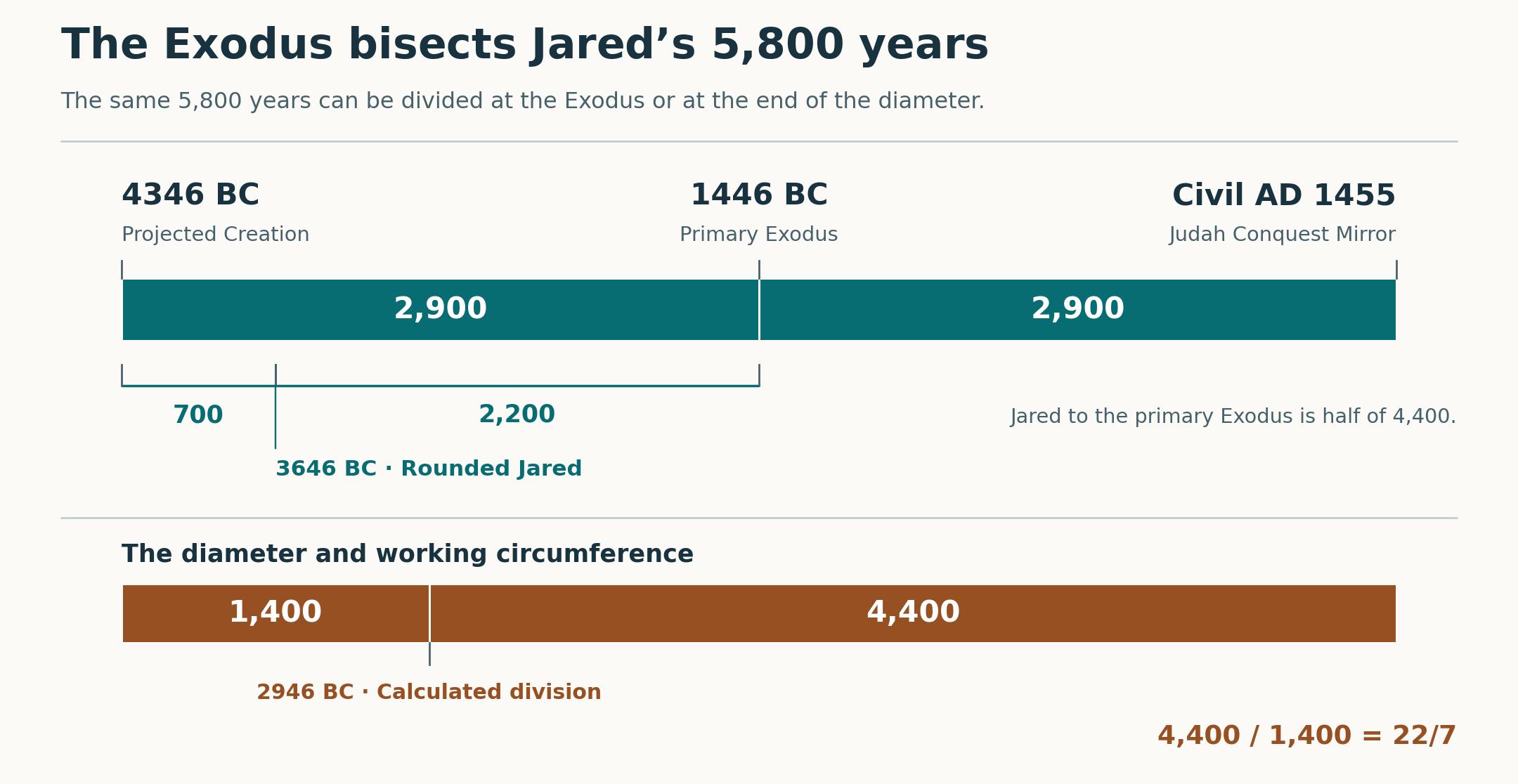
The first 2,900 runs from projected Creation at 4346 BC through Rounded Jared at 3646 BC to the primary Exodus at 1446 BC. The other 2,900 ends at civil AD 1455, Judah’s Conquest Mirror. Enoch’s square uses the other pairing, Judah’s Exodus in 1496 BC to the primary Conquest Mirror at civil AD 1405. Moving both endpoints 50 years aligns the crossings.
The 490-year shift has a different source. Cumulative Flood 4836 BC and Aaron-side Jacob/Levi 1936 BC both move forward 490 to give the first 2,900, from 4346 to 1446 BC. This is the dated link back to Shem. Algebraically the agreement follows from the working scale, since 700 + 2,200 = 9,900 − 7,000. The dates identify where each reading belongs.
Published √2 study, Rounded Jared and the calculated 2946 BC division · Published Key of 23 table, §§2–3 · File 34, Judah-route Exodus
Abraham’s place within Jared’s 2,200 years
The Exodus closes both Jared’s 2,200 and the final 990 from cumulative Abraham. That common endpoint puts Jacob’s whole working diagonal inside Jared’s span.
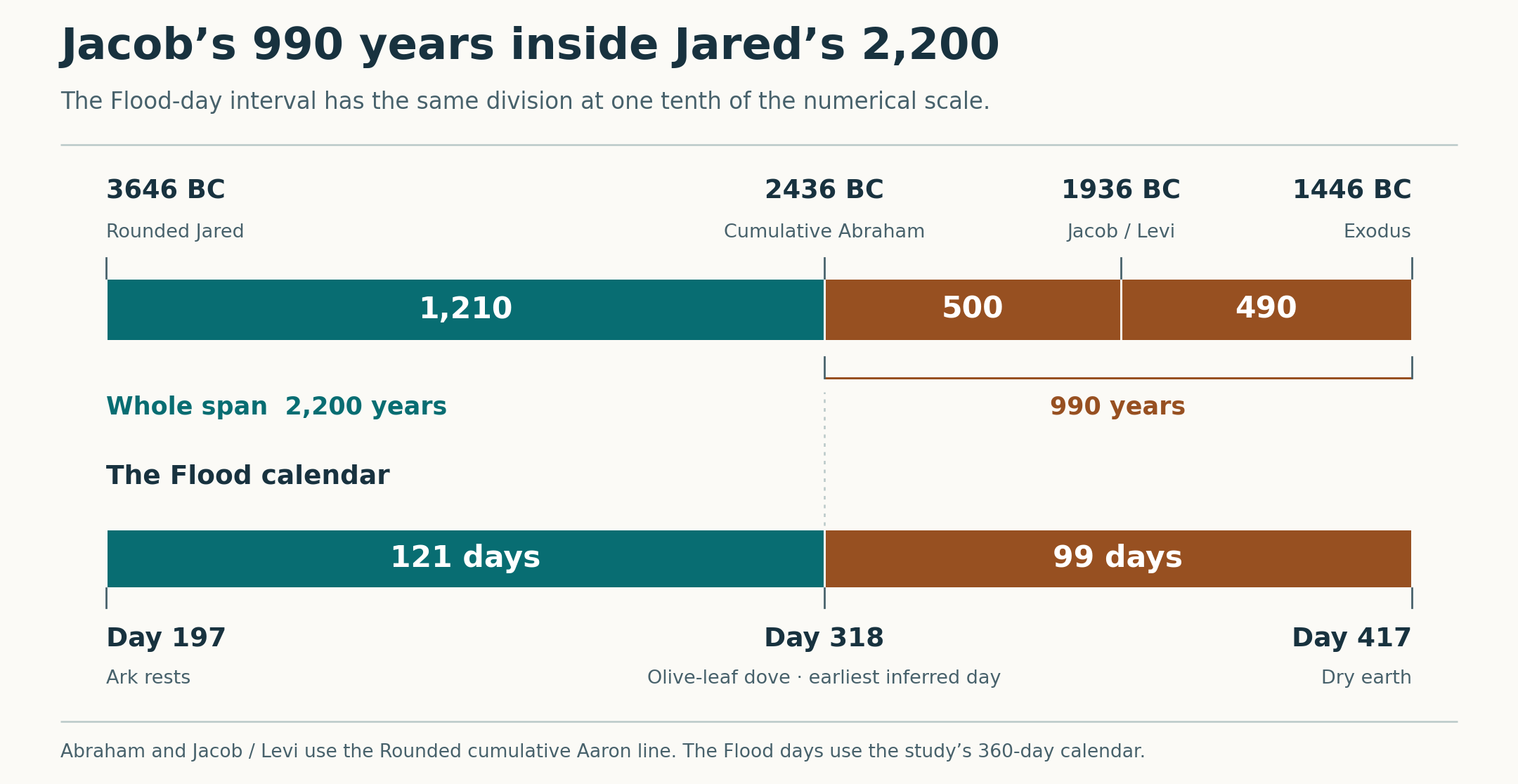
The Flood midpoint is already published. The π study obtains its 3646 BC date through an expanded LXX midpoint. The regular Rounded MT independently supplies Jared at 3646 BC for this report. The projected MT Flood at 2546 BC lies 1,100 years after Jared and 1,100 years before the Exodus. Cumulative Aaron Abraham at 2436 BC is 110 years later. Thus 1,100 + 1,100 also reads 1,210 + 990.
The 990 is the tabulated 500 + 490 through Jacob/Levi. On the study’s Flood calendar, ark rest to dry earth gives 220 days, divided as 121 + 99 at the earliest permitted olive-leaf return. The tenfold numerical correspondence is supporting evidence. The year calculation requires neither the day count nor the choice of day 318.
Published π study, Flood midpoint and Exodus · File 51a, regular tables and §16.3 cumulative comparisons · Joint π–√2 study, Flood days and the Enoch–Peleg division · Genesis 8, the ark and the dove
Shem, Lamech and Peleg at the Mirror
Shem to restoration and Peleg to the primary Conquest Mirror share the division 3,500 + 1,400. Their other internal dates do different work.
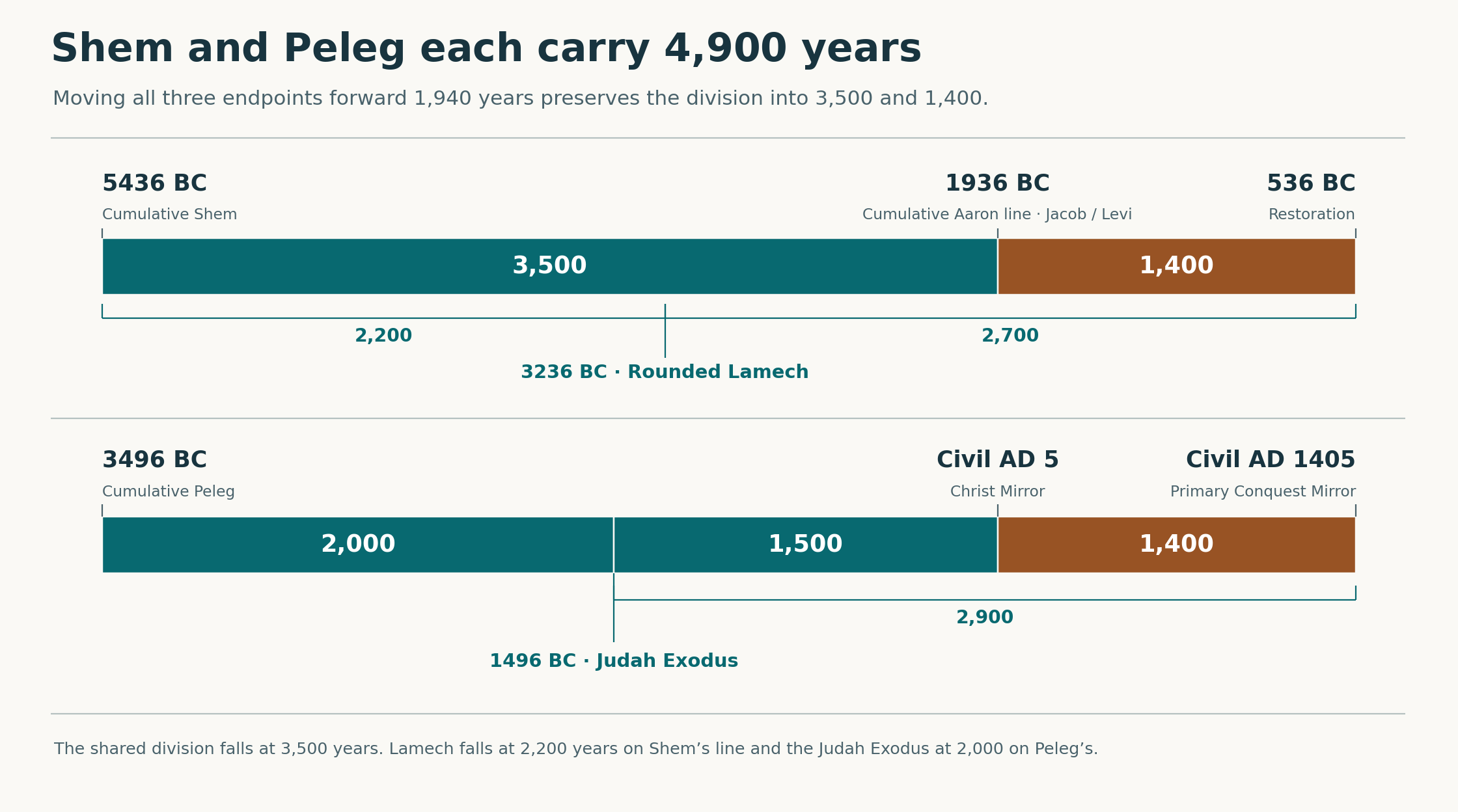
On Shem’s row, regular Rounded Lamech at 3236 BC cuts 4,900 into 2,200 + 2,700. Creation 4106 BC to Conquest 1406 BC already supplies that 2,700. On Peleg’s row, Judah’s Exodus and Christ’s Mirror divide 4,900 into 2,000 + 1,500 + 1,400. The 1,500 from 1496 BC to civil AD 5 belongs to both the translated 3,500 and Enoch’s terminal 2,900.
Advancing Shem, Jacob/Levi and restoration together by 1,940 elapsed years gives Peleg, Christ’s Mirror and the primary Conquest Mirror. This translation identifies three corresponding boundaries. The named cut at Lamech belongs to the upper row, and Judah’s Exodus to the lower. The 5,000 = 2,200 + 2,800 Pillars comparison currently has support at the level of lengths.
File 22 §3.3, cumulative Shem and Jacob · File 51b, Mirror conventions and Enoch §8 · Joint π–√2 study, Flood days and the Enoch–Peleg division · Creation Pillars, §§13–14
The shared ground of the two spans
1. Where the two circles intersect
Shem to Rounded Lamech and Rounded Jared to Exodus each measure 2,200. The second pair is 1,790 years later at both ends. Only the 410 years from Jared to Lamech occupy the same dates.
Next test. Locate Enoch and Peleg inside those 410 years.
2. Which fifty years they share
The overlap reads 100 + 50 + 250 + 10. The same 3546–3496 BC interval, from +60 regular Rounded Enoch to cumulative Peleg, is the overlap of the draft’s two 5,000s. The 3246 BC division uses projected Lamech.
Next test. Hold Jared and Exodus fixed and vary only the Lamech reading.
3. Three positions for Lamech
Rounded, Actual Gear 2 and projected Lamech partition Jared’s 2,200 as 410 + 1,790, 406 + 1,794 and 400 + 1,800. With the Exodus fixed, 1,794 = 6 × 299 expands to 1,800 = 5 × 360. The first partition gives the shared 410 and the third gives Lamech’s 360-year branch.
Next test. Check whether the same Exodus anchors a midpoint for Jared’s 2,200.
4. The Flood bisects Jared’s 2,200
The projected Gear 2 Flood at 2546 BC divides Jared to Exodus into 1,100 + 1,100, already printed in the π study. Projected Lamech at 3246 BC is exactly 700 before it. Two published projections from separate Actual spans share the fixed 1446 BC Exodus.
Next test. Compare this dated 700 with the radius and diameter already assigned to Jared.
5. Where Jared’s two 700s belong
The cumulative and regular Floods enclose 490 + 700 + 700 + 490. Rounded Jared at 3646 BC centers both the 1,400 diameter and the 2,380 Flood-to-Flood interval. The 2946 BC end of the diameter is a calculated division in the √2 study. Projected Lamech to projected Flood supplies a separate dated 700.
Next test. Read forward from projected Creation through Jared to the fixed Exodus.
File 51a, regular tables and §16.3 cumulative comparisons · Published Key of 23 table, §§2–3 · Published π study, Flood midpoint and Exodus
Following the two Floods and the Mirrors
6. A radius followed by a semicircumference
Projected Creation 4346 → Rounded Jared 3646 → Exodus 1446 BC reads 700 + 2,200 = 2,900. Jared is the actual boundary between those measurements. The total equals the diagonal less the side in Enoch’s square.
Next test. Test whether that 2,900 has a dated continuation across the Mirror.
7. The Exodus bisects diameter plus circumference
Projected Creation to Judah’s Conquest Mirror at civil AD 1455 measures 5,800. Exodus divides it as 2,900 + 2,900. The calculated 2946 BC boundary divides the identical dated interval as diameter 1,400 + circumference 4,400. The 700 need not lie inside the first 2,200 for both to belong to this one construction.
Next test. Substitute the primary Conquest Mirror to test which route gives that midpoint.
8. Why the two Conquest Mirrors matter
Substituting primary civil AD 1405 shortens Jared’s 2,900 and 4,400 to 2,850 and 4,350. Enoch’s square reaches that primary Mirror from Judah’s Exodus at 1496 BC in precisely 2,900. Shifting both ends 50 years later gives primary Exodus 1446 BC to Judah’s Mirror AD 1455.
Next test. Look for the other end of the same 2,900 in Shem’s already dated half-side.
9. Shem reaches Jared’s construction by 490
Cumulative Flood 4836 BC to Aaron-side Jacob/Levi 1936 BC moves forward 490 years at both ends to 4346–1446 BC. On the original row, cumulative Shem supplies the preceding 600. Thus Shem’s 3,500 = 600 + 2,900 meets the left half of Jared’s 5,800 through a specified translation.
Next test. Keep Shem’s endpoints and test where the first 2,200 divides his 4,900 to restoration.
10. Lamech leaves the length of the regular trunk
Shem 5436 → Rounded Lamech 3236 → restoration 536 BC reads 2,200 + 2,700 = 4,900. The last 2,700 has the exact length of regular Creation to Conquest, with both endpoints 870 years later. The interior division actually dated on this later row is 1,300 + 1,400 at Jacob/Levi.
Next test. Ask whether the draft’s other Creation Pillar explains why Enoch’s adjacent interval is 100 longer.
Published √2 study, Rounded Jared and the calculated 2946 BC division · File 22 §3.3, cumulative Shem and Jacob · File 34, Judah-route Exodus · File 51b, Mirror conventions and Enoch §8
Locating the internal dated divisions
11. How far the Creation Pillars explain the two halves
The apparent-age and base Creation Pillars supply 2,800 and 2,700 to the same Conquest. Adding 2,200 to each gives Enoch’s 5,000 and Peleg’s 4,900. Step 10 exhibits a dated cut for the latter on Shem’s row. The 5,000 comparison is an equality of lengths here, with no corresponding cut established on Enoch–Peleg.
Next test. Return to Peleg’s dated 4,900 and put its two documented internal points on one line.
12. The 1,500 years that the two Mirror readings share
Peleg 3496 BC → Judah’s Exodus 1496 BC → Christ’s Mirror civil AD 5 → primary Conquest Mirror civil AD 1405 gives 2,000 + 1,500 + 1,400. Shem’s translated 3,500 uses the first two parts. Enoch’s terminal 2,900 uses the last two. They share exactly the dated middle 1,500.
Next test. Test whether Jared’s 4,400 has an identifiable 1,500 before the corresponding 2,900.
13. The 1,500 in Jared’s measured circumference
Jared’s circumference runs 2946 BC → 1446 BC → civil AD 1455 = 1,500 + 2,900. Its first interval translates 1,450 years at both ends to Judah’s Exodus → Christ’s Mirror. Its 2,900 has the separate 50-year correspondence in step 8. The constituent intervals therefore require two different translations.
Next test. Use the common 1446 BC Exodus to locate Jacob’s 990 diagonal inside Jared’s own 2,200.
14. Abraham places Jacob’s diagonal inside Jared’s span
Rounded Jared 3646 → cumulative Aaron Abraham 2436 → cumulative Aaron Jacob/Levi 1936 → primary Exodus 1446 BC gives 1,210 + 500 + 490. File 51a already gives the last 990 as a compressed 5,000 + 4,900. Here that whole 990 is a dated terminal part of Jared’s 2,200; the Exodus serves as the same endpoint in both readings.
Next test. Compare the 2436 BC cut against the independently projected Flood midpoint.
15. Why 1,100 + 1,100 also reads 1,210 + 990
The projected Flood at 2546 BC is 110 years before cumulative Aaron Abraham at 2436 BC. Measuring from Abraham instead of the midpoint transfers those 110 years from the second part to the first. One 2,200-year interval has both named cuts.
Next test. Check that the compressed diagonal and circle genuinely have the same working side of 700.
Joint π–√2 study, Flood days and the Enoch–Peleg division · Creation Pillars, §§13–14 · File 51a, regular tables and §16.3 cumulative comparisons
Testing the geometry and choosing the order
16. One side for a diagonal and two circle readings
Jacob’s 990 is the working diagonal on side 700. The 2,200 is a full working circumference on diameter 700 and a semicircumference on 1,400. Rounded Noah’s death 2106 BC → Conquest 1406 BC directly measures 700. This verifies the unit without assigning all three lengths to one historical interval.
Next test. Test the proposed chronological analogy at the smaller Flood-day scale already in the draft.
17. The ark, the dove and dry earth
The published schematic Flood calendar gives days 197 → 318 → 417, or 121 + 99 = 220. Ten times those numbers gives Jared → Abraham → Exodus, 1,210 + 990 = 2,200 years. Day 318 is the earliest eligible olive-leaf return and is inferred. The comparison is between numerical proportions in years and in days.
Next test. Check whether the cited MT table already attaches the same 500 + 490 to regular Noah and Shem.
18. Noah, Shem and Isaac give the other 990
File 51a §16.3 gives regular Rounded Noah 3056 → regular Shem 2556 → Isaac 2066 BC = 500 + 490. Moving all three dates forward 620 years gives cumulative Aaron Abraham → Jacob/Levi → primary Exodus. This connects Jacob’s diagonal back to Noah through Isaac. Regular Shem here is distinct from cumulative Shem at 5436 BC.
Next test. Trace the other principal Jacob branch to the Christ datum and check what it actually preserves.
19. What survives at the age-thirty endpoint
Regular Noah 3056 BC and cumulative Jacob/Levi 1936 BC reach civil AD 25 in 3,080 and 1,960 years, a working 11/7 semicircle. The first 490 of Jacob’s four 490s ends at the same primary Exodus as Jared’s 2,200. The draft’s 980 + 560 + 980 preserves Noah’s overlap at 14/15 scale. Luke says about thirty; 30 elapsed years comes from the study’s 6 BC datum.
Next test. Weigh the proposed joins by which actual endpoints they share, then choose the order of a later rewrite.
20. Which pieces should carry the next draft
Retain regular Noah’s circle, cumulative Shem’s half-side, and Enoch–Peleg’s primary Conquest Mirror as the first reading. Give Jared a principal place at the primary Exodus, which closes Jacob’s 990 inside his 2,200 and bisects the 5,800 to Judah’s Mirror. Put regular Lamech at the end of Shem’s 2,200; introduce projected Lamech separately at the Key calculation and Enoch’s side. Read Jacob’s AD 25 semicircle as the Christological continuation. The Pillars’ 5,000 decomposition and the tenfold day pattern remain supporting comparisons.
Next editorial decision. Place the named cuts at the shared Exodus and Conquest Mirrors in the main reading. Keep the comparisons of scale with their supporting evidence.
Joint π–√2 study, Flood days and the Enoch–Peleg division · File 51a, regular tables and §16.3 cumulative comparisons · File 68, Appendix D · Luke 3, Jesus’ age and genealogy
Return to the working draft