Rounded MT trunk scratchpad
Before each trunk task, both Work windows read the newest entry here and follow Dean’s latest direction. After a test or draft change, prepend a dated entry naming the contributing window, the result, its source or notebook link, and the next question. Record an inconclusive test in a sentence. Return to the Jared–Flood section of the working draft
22 November 2026 · Publication of The Rounded MT Trunk
Agent 2-Trunk. The published study is available on 490d.com. Working draft 20 and its editable Word copy are archived here for the editorial record. Published study · Archived working draft 20 · Word copy
Next inquiry. Await Dean’s next observation.
22 November 2026 · Editorial review of the constants synthesis
Agent 2-Trunk · Working draft 20. The opening follows the promise from Eden through the Flood, Exodus and Conquest to Christ. The reading guide follows the chapter order. The two fixed anchors remain with the master map, and Appendix D now holds the detailed 100-, 70- and 40-year comparisons. The closing synthesis brings the common 7,000-year measure of the circle and square together with the Jubilee, Fibonacci and reciprocal-e findings. The revisions also clarify the distinction between reflecting about Shelah and reflecting about Christ, Isaac’s schematic midpoint, and the derived 10856 BC quarter point in the provisional ranking. Prior studies and open questions retain their credits and links.
Reading guide · What the map establishes · Generation lengths and calendar conventions · File 51a, Rounded chronology · Earlier Isaac observation
Next inquiry. Await Dean’s next observation.
22 November 2026 · Isaac and the midpoint from Adam to Christ
Agent 2-Trunk · Dean’s observation, Working draft 19.1. On Luke’s 75-century count the midpoint from Adam to Christ is 3,750 years from zero. On the positive Mirror, Isaac’s schematic opening at +2,000 is 5,500 years from Luke’s Adam at +7,500 and 1,750 from the midpoint at +3,750. Reflection preserves both distances. Their ratio is 22/7. The separate whole-to-half ratio, 7,500/3,750, is 2 or 22/11. The Shelah construction of 20 November already gives 5,500/1,750. Dean’s contribution here identifies Isaac’s opening and the half of the full Adam–Christ span as the boundaries that reproduce it on each side.
Draft 19.1 note · Earlier Shelah diagram · Luke’s 75-generation count · 1 Corinthians 15:45–47
Next inquiry. Await Dean’s next observation.
22 November 2026 · The reciprocal of e in working draft 19
Agent 2-Trunk · Draft revision. On the 100-year Gospel ruler the 5,500 years from Luke’s Adam to Matthew’s midpoint are 110/299 of the 14,950 to reflected Adam’s midpoint. The published e study §4 had already given this division at one twenty-fifth of the scale. Draft 19 follows the same radius to the thirteenth millennium and to Isaac’s midpoint. It records Dean’s Fall and Passover reading, the Isaac–Christ half-generation, and File 29’s 2,730-year Reconciled Week on Luke’s seventy-year ruler. The alpha conclusion in Draft 18.1 already places the 137/138 relationship at the root of the trunk.
Draft 19, reciprocal of e · Isaac and Christ · Reconciled Week · Published e study, §4 · File 29, §4.2 · Alpha conclusion
Next inquiry. Await Dean’s next observation.
22 November 2026 · Isaac’s midpoint and the Passover setting of his binding
Agent 2-Trunk · Dean’s observation. Abraham binds Isaac, but God stays his hand and Abraham offers a ram in his son’s place (Genesis 22:9–13). Jubilees sets Mastema’s challenge on the twelfth of the first month, has Abraham see the mountain on the third day, and recounts the ram’s substitution. Abraham later commemorates the journey and safe return with a seven-day festival (Jubilees 17:15; 18:3, 11–12, 18–19). This places the binding in a Passover setting. The exact day is inferred. VanderKam reckons the offering late on the fourteenth, Fitzmyer on the fifteenth. Genesis gives Isaac’s age at the binding no numerical value.
On the MT-based 27-name schematic with second Cainan retained, Isaac is the twenty-second generation. His century opens at −2,000 (2006 BC), reaches −1,950 at its midpoint (1956 BC), and closes at −1,900 (1906 BC). Translating the whole interval by +2,000 gives 0 → +50 → +100, the opening, midpoint and close of Christ’s allotted century. The preceding Mirror calculation also reaches Isaac’s reflected midpoint: +7,450 − 5,500 = +1,950. In this reading fifty belongs to each schematic century. Its units measure positions on the chart.
Isaiah’s servant is led like a lamb to slaughter and cut off from the land of the living. In Acts 8:32–35, Philip begins with this passage to proclaim Jesus. Dean reads Isaac’s deliverance through a substitute in the Passover setting as anticipating Christ giving his life. The correspondence of the two midpoints belongs to the proposed typology.
Genesis 22 · Jubilees 17–18 · VanderKam’s dating discussed by Streett · Fitzmyer, p. 215 · Isaiah 53 · Acts 8 · Isaac in the 27-name schematic · The three Gospel scales
Next inquiry. Await Dean’s next observation.
22 November 2026 · The thirteenth millennium and the Passover covering
Agent 2-Trunk · Dean’s observation. Genesis relates the Fall, Adam and Eve’s shame, and God’s clothing them (Genesis 3:6–7, 21). Exodus 12:6 dates the slaughter of the Passover lamb to the fourteenth of the first month. Paul calls Christ our Passover sacrifice (1 Corinthians 5:7). Genesis gives no calendar date for the Fall or the clothing.
The published Φ study §12 already divides 14006 → 7006 → 6 BC into 7,000 + 7,000 years. Drawing on Psalm 90:4 and 2 Peter 3:8, it reads the two spans as two symbolic Creation weeks. The joint π–√2 study §10 and canonical File 70 associate Creation Day/Year 13 with the Fall and Day/Year 14 with the covering that anticipates Passover. The master map uses cumulative Rounded MT Creation at −14,000 and Christ at zero (6 BC).
Dean now identifies the ±13,000 positions projected from Luke’s Adam by the 5,500-year radius as the completion of thirteen millennial days when counting outward from Christ. On either side the next thousand reaches ±14,000, completing the second week. He reads that last step as the passage from the Fall to restoration in Christ under the type of Nisan 14. The direction of counting matters. Travelling forward from −14,000 toward zero reaches −13,000 after one millennium and −1,000 after thirteen. The positive and negative coordinates are mirrored distances from Christ. The Fall and the Passover covering supply their proposed meaning.
Published Φ study, §12 · Joint π–√2 study, §10 · File 48, millennial architecture · File 70, §§3.4, 8 · Derivation of ±13,000 · Genesis 3 · Exodus 12 · 1 Corinthians 5:7
Next inquiry. Await Dean’s next observation.
22 November 2026 · Luke’s seventy-year generations and the Enochian Reconciled Week
Agent 2-Trunk · Dean’s observation. Genesis counts seven days through God’s rest. Luke traces Jesus’ ancestry to Adam and God. On File 54’s retained-Cainan count, the 75 intervals from Adam to Christ give 5,250 years at 70 per generation. The 6 BC Christ datum is zero. The division from −5,250 through Matthew’s midpoint at −1,400 to +5,215, the midpoint of reflected Adam’s generation, gives 3,850/10,465 = 110/299. Holding −5,250 fixed, the 300/299 expansion completes the span at +5,250. Carrying the 3,850-year radius outward from ±5,250 reaches ±9,100. Bringing +5,215 inward by the same radius reaches +1,365. Its reflection is −1,365.
| Pair centered on Christ | Full span in schematic years | Reading 364 years as one Enochian year of days | Measure on either side |
|---|---|---|---|
| −9,100 to +9,100 | 18,200 | 50 | 25 Enochian years, or 100 quarters |
| −1,365 to +1,365 | 2,730 | 7½ | 3¾ Enochian years, or 15 quarters |
Each quarter contains 91 = 7 × 13 units. The inner and outer complete spans stand in the ratio 3/20. The reciprocal 110/299 belongs to the Adam-to-midpoint division that generates the positions. “Half” here refers to bisecting a schematic span.
Canonical antecedent. File 29 §4.2 already calls 2,730 = 7½ × 364 = 21 × 130 the “Reconciled Week,” measured there from the Actual MT’s 4176 BC “Max Year 6” to the Exodus in 1446 BC. Section 6.4 also records 9,100 = 100 × 91. Dean’s reading places those measures on Luke’s signed ruler with Christ at the center. Exactly seven Enochian years would give 2,548, or 28 quarters. The Reconciled Week has 30 quarters, one additional quarter on either side of Christ when the same center is held. Genesis supplies the seven-day Creation week. The comparison with seven and a half is the project’s calendrical interpretation.
Genesis 2:1–3 · Luke 3:23–38 · File 54, Luke’s 70-year count · File 29, §§4.1–2, 6.4 · Published reciprocal study · Derivation on the three Gospel rulers
Next inquiry. Await Dean’s next observation.
22 November 2026 · John’s Temple saying and the fifty-year midpoint
Agent 2-Trunk · Dean’s observation. At the first Passover in John’s account of Jesus’ ministry, his hearers cite forty-six years of Temple construction. Jesus promises to raise the sanctuary in three days. John identifies the sanctuary as Jesus’ body and says the disciples understood the saying after his resurrection (John 2:13, 19–22). Later, during the exchange about Abraham, Jesus’ hearers say he is “not yet fifty years old.” Jesus answers by declaring his existence before Abraham, then leaves the Temple (John 8:56–59). Fifty is the threshold in their challenge. John gives no numerical age for Jesus at the Passion.
File 13 §8.1 already pairs the two sayings. Its priestly Key of 23 changes 46 × 25/23 = 50 and interprets Christ as the Priestly Temple. Section 6.5 treats the raising in three days. On the 100-year Gospel ruler, Christ’s allotted generation opens at 0 and reaches its midpoint at +50. Dean reads the death and raising of the Temple of Christ’s body at this symbolic half-generation as the meaning encoded by the two sayings. The present chart locates the earlier interpretation at its fifty-year midpoint. Fifty coincides with half a generation specifically on the leading century ruler. At 70 or 40 years per generation the chart’s halfway points are +35 or +20, while the two numbers in John remain forty-six and fifty.
John 2:13–22 · John 8:56–59 · Canonical File 13, §§6.5, 8.1 · Canonical File 42, §4 · Christ’s half-generation on the Gospel ruler
Next inquiry. Await Dean’s next observation.
22 November 2026 · Adam’s half-generation and the reflected midpoint in Matthew
Agent 2-Trunk · Dean’s observation. Isaiah 53:8 speaks of the servant being cut off from the land of the living. Acts 8:32–35 relates the passage to Jesus. On Luke’s 100-year Gospel ruler with second Cainan retained, +7,450 bisects Adam’s reflected century and +7,500 marks his reflected opening. Subtract the existing 5,500-year radius from both. The results are +1,950 and +2,000. Adding 14,950 (299 × 50) to the two projected outer positions, −13,000 and −12,950, reaches the same pair. The two readings translate the same construction.
On the 27-name MT schematic, +1,950 is reflected Isaac’s midpoint and +2,000 his opening. The latter is also Matthew’s reflected midpoint and the reflection of regular MT Jacob’s birth in 2006 BC. From +1,950 to Christ at zero are 1,950 = 15 × 130 years. From −1,950 to +1,950 are 3,900 = 30 × 130. Moving +1,950 and +2,000 back by 2,000 gives −50 and 0. Reflection gives 0 and +50, the first half of Christ’s allotted century. Dean reads this half-generation as an image of Christ’s life being cut short. The coordinates are signed distances from the 6 BC datum. Scripture supplies no age at death of fifty in those passages.
| Gospel generation | Adam’s reflected midpoint and opening | Radius | Subtract the radius | Half-generation either side of Christ |
|---|---|---|---|---|
| 100 years | +7,450 / +7,500 | 5,500 | +1,950 / +2,000 | ±50 |
| 70 years | +5,215 / +5,250 | 3,850 | +1,365 / +1,400 | ±35 |
| 40 years | +2,980 / +3,000 | 2,200 | +780 / +800 | ±20 |
At 40 years, for example, −3,000 + 5,980 = +2,980, and −3,000 − 2,200 = −5,200. The Gospel intervals scale together about Christ. The MT holds the Conquest at 1406 BC. At each scale the whole-to-radius ratio before completion is 299/110, whose reciprocal approximates 1/e. For an exponential decay with time constant τ, the physical half-life is τ ln 2. Here “half-generation” means one-half of the allotted genealogical period.
Previous reciprocal comparison · MT century table · Gospel midpoint · Two anchors · Published e study · Isaiah 53:8 · Acts 8:32–35
Next inquiry. Await Dean’s next observation.
22 November 2026 · The reciprocal of e from Luke’s Adam across the Mirror
Agent 2-Trunk · Dean’s observation. Genesis opens with God calling forth light. John’s prologue describes light shining in darkness. In Luke’s 100-year schematic with second Cainan retained and Christ at zero (6 BC), Adam opens at −7,500. The 5,500-year radius already drawn to −2,000 reaches Matthew’s midpoint and regular MT Jacob’s birth. Continue to +7,450, the midpoint of Luke’s reflected Adam century. The division 5,500 + 9,450 = 14,950 gives 110 + 189 = 299 in fifty-year units. This reproduces the published e study’s 220 + 378 = 598 at 25 times the scale. Its original schematic stations are 6666, 6446 and 6068 BC.
The radius is 5,500/14,950 = 110/299 ≈ 0.367893 of the whole, about 0.00368% above 1/e. Hold −7,500 fixed. Applying 300/299 to the 14,950-year span (13 × 1,150) gives 15,000 and carries +7,450 to Adam’s exact reflection at +7,500. The midpoint thereby moves from −25 to Christ at zero. The completed ratio is 5,500/15,000 = 11/30. Reading 5,500 outward instead gives −13,000 from −7,500. On the other side it gives +12,950 from +7,450 and +13,000 from +7,500. Those outer positions follow by addition or subtraction. A separate 13,000-year span already joins Luke’s Enoch century to reflected Shelah.
Dean reads the factor 13 in light of the curse Christ bears in Galatians 3:13. Under exponential attenuation, a light beam has 1/e of its initial intensity after one attenuation length. That physical analogy informs Dean’s reading of John 1:5. The Jubilee counts describe positions on the chronological diagram.
Published e study, §4 · Luke’s diameter and midpoint · Earlier 13,000-year span · Genesis 1:3 · John 1:5 · Galatians 3:13 · Optical attenuation length
Next question. Does either outer position at ±13,000 coincide with a boundary established independently of the 5,500-year extension?
22 November 2026 · Dean’s conclusion about alpha and the trunk
Agent 2-Trunk · Working draft 18.1. Dean places the 137/138 relationship at the root of the Rounded MT–Gospel trunk. His published alpha study proposed the relationship on 27 October. The 20 November geometry placed Shelah’s midpoint 2,750 years from Christ, one generational semicircumference plus one Noah semicircumference. On 22 November the counts from Creation to reflected Shelah gave 137 and 138 Jubilees, with doubled distances in Luke. Their agreement at positions fixed beforehand confirms the earlier hypothesis to Dean’s satisfaction. He distinguishes this chronological finding from his theological reading of the Creator’s signature.
Draft 18.1, alpha · Published alpha study, §12 · Earlier geometry · Later Jubilee counts
Next inquiry. Await Dean’s next observation.
22 November 2026 · Alpha and Phi in working draft 18
Agent 2-Trunk · Draft revision. From regular Rounded MT Creation, 137 Jubilees reach reflected Shelah’s midpoint and 138 reach his opening on the 27-name century schematic. Luke’s Adam measures twice the two lengths to the reflected Shelah–second Cainan boundary and second Cainan’s opening. The draft also traces Enoch’s whole century to reflected Shelah and identifies Dean’s reading of the 137 Jubilees as the Creator’s claim of authorship over sacred time. The supporting Φ section places the published 55-, 89- and 144-century spans on the same map, with second Cainan retained in Luke.
Draft 18, alpha · Draft 18, Phi · Published alpha study · Published Phi study, §18 · Prior Enoch and Shelah calculation
Next inquiry. Await Dean’s next observation.
22 November 2026 · Enoch’s century across the Mirror to Shelah
Agent 2-Trunk · Dean’s observation. Genesis says God took Enoch. On Luke’s 100-year ruler, with second Cainan retained and Christ at zero (6 BC), Enoch’s century runs from −6,900 to −6,800. Adding 13,000 years carries the entire century to +6,100 through +6,200, reflected Shelah from close to opening. The far endpoint is shared with reflected second Cainan.
| Starting boundary | Via Enoch’s opening (−6,900) to +6,100 | Via Enoch’s close (−6,800) to +6,200 |
|---|---|---|
| Adam, −7,500 | 600 + 13,000 = 13,600 | 700 + 13,000 = 13,700 |
| Figurative God, −7,600 | 700 + 13,000 = 13,700 | 800 + 13,000 = 13,800 |
Hold −7,600 fixed. A hundred times 137 and 138 reach +6,100 and +6,200. Adding a further ten times each (1,370 and 1,380) gives +7,470 and +7,580, the 110-fold endpoints. In Dean’s separate 1,300-year translation, +7,600, +7,500 and +7,470 become +6,300, +6,200 and +6,170. Moving down from +6,300 traces all of reflected second Cainan to +6,200, then 30 years into Shelah. The companion +7,580 becomes +6,280, 20 years inside Cainan.
Scripture gives 137 years to Ishmael, Levi and Amram. In the 26-name Actual MT Adam–Moses line, Levi and Amram share 137, and Peleg and Reu share 239. Including Abraham’s son Ishmael makes 137 the most frequent lifespan in that specified list, with three occurrences.
Genesis 5:23–24 · Genesis 25:17 · Exodus 6:16, 20 · Luke’s Gospel ledger · Published alpha study · Previous construction
Next inquiry. Await Dean’s next observation.
22 November 2026 · The centuries before Adam in Luke and the Rounded MT
Agent 2-Trunk · Dean’s observation. Luke calls Adam the son of God. On the century chart, with Christ at zero (6 BC), Luke’s figurative generation of God runs from −7,600 to −7,500, and its MT schematic counterpart from −4,200 to −4,100. Corresponding points stay 3,400 years apart throughout. The closing boundary of each pre-generation opens Adam’s century.
From −7,600, adding 110 × 137 reaches +7,470, and 110 × 138 reaches +7,580. The first is 130 years short of +7,600. It takes 30 years to reach Adam’s reflected opening (+7,500), then 100 more to the figurative God opening. The second is 20 years short. Dean hears an echo of Adam’s 130 years to Seth. In the published Actual MT construction, seven symbolic Creation years precede those 130 years (4121 → 4114 → 3984 BC).
From −4,100, adding 60 × 137 = 8,220 reaches +4,120, and 60 × 138 = 8,280 reaches +4,180. Within the reflected pre-generation (+4,100 to +4,200), those endpoints give 20 + 60 + 20, symmetric about +4,150. Half the two crossing lengths are 4,110 and 4,140 years. The published thirtyfold comparison already measures 30 × 137 and 30 × 138 from the fixed 6 BC datum.
Century table and figurative God position · Published alpha study, §§2, 12 · Quarter-century comparison
Next inquiry. Await Dean’s next observation.
22 November 2026 · Counting quarter-centuries between the two Adams
Agent 2-Trunk · Dean’s observation. On the same side of Christ at zero, Luke’s Adam opens at −7,500 and regular Rounded MT Adam at −4,100. The openings are 3,400 = 136 × 25 years apart. Hold Luke’s Adam fixed and count into the MT Adam century. Its first quarter mark (−4,075) gives 3,425 = 137 × 25. Its midpoint (−4,050) gives 3,450 = 138 × 25. The first quarter is a calculated division. Applying 70/69 to 3,450 gives 3,500 and reaches Adam’s close at −4,000. Matthew’s Abraham occupies −4,100 with the Jeconiah overlap and −4,000 when counted once.
| Starting point | 137 units | 138 units | 140 units and endpoint |
|---|---|---|---|
| Luke’s Adam −7,500, in 25s | 3,425 | 3,450 | 3,500 to MT Adam’s close, −4,000 |
| MT Adam −4,100, in 50s | 6,850 | 6,900 | 7,000 to mirrored MT schematic second Cainan, +2,900 |
| Luke’s Adam −7,500, in 100s | 13,700 | 13,800 | 14,000 to mirrored Luke Shem, +6,500 |
The lengths double twice. Each row retains its own starting point. The published alpha study §11 already gives 3,425 years as the sum of the last fifteen lives on the Actual cumulative MT Moses line, from 4831 BC to the 1406 BC Conquest. Holding the Conquest fixed, its 3,450-year comparison expands to 3,500 by 70/69. The present fit locates those lengths within the schematic century of Adam.
Two Gospel counts · Published alpha study, §11 · MT Mirror spans · Luke Mirror spans
Next inquiry. Await Dean’s next observation.
22 November 2026 · Luke’s 137 and 138 centuries across Cainan and Shelah
Agent 2-Trunk · Dean’s observation. Luke traces Shelah through second Cainan to Arphaxad and calls Adam the son of God. On the 100-year reading of that genealogy, with Christ at zero (6 BC), adding 13,700 years to every boundary carries two whole centuries across the Mirror. Reflection places the close of each mirrored century before its opening on the positive ruler.
| Luke’s schematic century | Add 13,700 to both ends | Reflected century, close → opening |
|---|---|---|
| Figurative God, −7,600 → −7,500 | +6,100 → +6,200 | Shelah |
| Adam, −7,500 → −7,400 | +6,200 → +6,300 | Second Cainan |
Hold Adam’s opening at −7,500. The reflected openings of Shelah at +6,200 and second Cainan at +6,300 are 13,700 and 13,800 years away, exactly double the earlier MT spans of 6,850 and 6,900. In Luke’s own century scheme those half-spans run from Enoch’s midpoint (−6,850) and opening (−6,900) to Christ at zero.
The published Φ study already measures 13,700 and 13,800 years from its projected 15806 BC to MT Gear 1 Noah’s death (2106 BC) and regular MT Jacob’s birth (2006 BC). On the signed ruler, −15,800, −2,100, −2,000 translate by +8,300 to −7,500, +6,200, +6,300. The same translation used in the Fibonacci entry places the published lengths on Luke’s named boundaries.
Gospel ledger, §5 · Published Φ study, §18 · MT half-centuries · Fibonacci translation
Next inquiry. Await Dean’s next observation.
22 November 2026 · 137 and 138 half-centuries from Creation to mirrored Shelah
Agent 2-Trunk · Dean’s observation. On the 27-name MT century reconstruction, which retains second Cainan, both spans begin at regular Rounded MT Creation (−4,100). Christ at 6 BC is zero. From Creation to Shelah’s reflected midpoint (+2,750) are 6,850 = 50 × 137 years. To the reflected opening of Shelah’s century (+2,800) are 6,900 = 50 × 138 years. The 50 is half a schematic century. On the original side, −2,750 bisects Creation to Conquest (−4,100 to −1,400). Shelah’s opening at −2,800 also bisects the 26 centuries from Creation to Moses’ opening at −1,500.
Counting two fifty-year Jubilees per schematic generation, Dean reads the 137 Jubilees to Shelah’s mirrored midpoint as the Creator’s signature and claim of authorship over sacred time and its geometry. In this theological conjecture, human scribes could have composed and transmitted the chronology under divine direction. Leviticus 25:8–10, 23
The published alpha study gives two separate expansions of 138. Applied to 6,900 with Creation held fixed, 6,900 × 70/69 = 7,000 reaches +2,900, the reflected opening of second Cainan. 6,900 × 25/23 = 7,500 reaches +3,400, the reflected close of Enoch and opening of Methuselah. The 650 from +2,750 to +3,400 equals 50 × (150 − 137), half the 1,300 years between Enoch’s close and Terah’s close in the preceding Φ comparison. The study also records 8 × 137 and 8 × 138 across Noah/Shem Gears. Here 137 is an exact integer count. The comparison with the inverse fine-structure constant, approximately 137.036, is interpretive.
27-name table · Published alpha study, §§9–10, 12 · Shelah and the Φ comparison
Next inquiry. Await Dean’s next observation.
22 November 2026 · Fibonacci spans on the Rounded MT–Gospel century map
Agent 2-Trunk · Supporting comparison. Enoch’s taking at Methuselah’s opening (−3,400) and Abram’s opening at Terah’s close (−2,100) lie equally far from Shelah’s center (−2,750) on the MT century scheme. Reflect Terah’s close across Christ at zero. The line −3,400 → 0 → +2,100 gives 34 + 21 = 55 centuries.
From cumulative MT Creation through Luke’s Adam and schematic MT Enoch to reflected Arphaxad/Flood, −14,000 → −7,500 → −3,500 → +3,000 gives 6,500 + 4,000 + 6,500 = 17,000. In units of 500 these are 13 + 8 + 13. Each overlapping 10,500 spans 21 units. The outer 6,500 and adjacent 10,500 give ten times the published Gear 2 SP Arphaxad → MT Arphaxad → Conquest division of 650 + 1,050.
From Luke’s Adam, follow −7,500 → −4,100 → −2,000 → +1,400 → +3,500 → +6,900. The boundaries are regular MT Creation/Matthew’s 41-interval Abraham, Jacob/the Gospel midpoint, then the reflected Conquest, MT Enoch and Luke Enoch. The steps are 34 + 21 + 34 + 21 + 34 centuries. From Adam, 55 reach Jacob, 89 reach the reflected Conquest, and 144 reach reflected Luke Enoch. The existing 11,000-year circle has equal 5,500-year radii around Jacob. On the same signed ruler, published Φ §18’s −15,800, −6,900, −4,800, −1,400 translate together by +8,300 to the chart’s −7,500, +1,400, +3,500, +6,900. Sending −6,900 to the reflected Conquest at +1,400 fixes the translation. The source’s 15806 and 4806 BC stations are generated dates. Its other division, −6,900 → −3,500 → −1,400, reads here as Luke Enoch → MT schematic Enoch → Conquest. Adding 3,500 to each point gives −3,400 → 0 → +2,100, the first division above. The shift equals the span from schematic MT Enoch to Christ and half the map’s 7,000-year square side.
On a common Gospel unit g, Luke’s Adam (−75g), Matthew’s midpoint (−20g) and reflected Luke Enoch (+69g) give 55g + 89g = 144g with second Cainan. Omitting him gives 54g + 88g = 142g. These are exact Fibonacci counts on the retained reading. Successive ratios approximate Φ.
Six whole generations · The Gospel midpoint · Century map · Published Φ study, §§5, 18 · Technical appendix P
Next test. At Dean’s direction, check which internal boundaries survive a change of count.
22 November 2026 · The schematic generation before Adam
Agent 2-Trunk · Endnote. The figurative generation before regular Adam opens at 1406 + 28g. At 70 years it runs from 3366 to 3296 BC. At 40 it runs from 2526 to 2486 BC. The 2456 BC date belongs to the regular Rounded MT Flood. From those two openings to 6 BC are 3,360 and 2,520 years, the same spans as regular Adam to the close of Christ’s allotted generation on each ruler.
Draft 17.3 endnote · Luke’s model
Next inquiry. Await Dean’s next observation.
22 November 2026 · The close of Jesus’ schematic generation
Agent 2-Trunk · Draft 17.2 endnote. The regular and cumulative 70-year projections span 3,360 and 10,290 years to civil AD 65. The 40-year projections span 2,520 and 6,480 years to civil AD 35. File 21’s quarter cycle is 6,480 = 18 × 360. Counting 126 forties back from the Conquest reaches 6446 BC, the point from which Dean’s published calculation expands 6,440 years to 7,000 with 6 BC fixed.
Endnote · Published calculation, §12 · File 21
Next inquiry. Await Dean’s next observation.
22 November 2026 · The MT midpoint and the two SKL base anchors
Agent 2-Trunk · Supporting observation. The 70- and 40-year regular MT projections, 3296 and 2486 BC, have their midpoint at 2891 BC, 405 years from either end. It falls 15 years after the SKL Short base (2906 BC) and 35 before the Long base (2856 BC). The SKL midpoint is 2881 BC, ten years later.
Translating the schematic five years forward to the 1 BC display gives 3291 and 2481 BC, centered at 2886 BC. Compared with the fixed SKL bases, that is 20 and 30 years from them. Translating both sets preserves the original 15 and 35. File 21 independently gives 2886 BC as its Babel/Peleg anchor under the Long +30 setting (2856 + 30). The numerical coincidence carries modest weight.
Conquest-anchored projections · Calendar convention · File 21, SKL anchors
Next inquiry. Await Dean’s next observation.
22 November 2026 · The final chart begins at cumulative Rounded MT Creation
Agent 2-Trunk · Dean’s reading order. Begin at 14006 BC and use the 100-year generation as the primary unit. Cumulative and regular Rounded MT Creation stand 126 and 27 centuries before the 1406 BC Conquest, respectively. In each comparison use the same generation length in the MT schematic, Matthew and Luke. The MT count is anchored at the Conquest (−1,400), and both Gospel counts at Christ in 6 BC (0). The recorded 70- and 40-year examples supply supporting comparisons. Dean closes the shorter-unit inquiry here.
Final chart and reading order · The two anchors · File 51a
Next inquiry. Await Dean’s next observation.
22 November 2026 · MT intervals from the Conquest and Gospel intervals from Christ
Agent 2-Trunk · Draft 17. Dean holds the Conquest at 1406 BC and counts back 27 or 126 MT schematic intervals. At 100, 70 and 40 years per interval the regular Creation readings are 4106, 3296 and 2486 BC. The corresponding cumulative readings are 14006, 10226 and 6446 BC. The century row gives the tabulated Rounded MT dates. Luke’s 75 intervals from Christ at 6 BC give Adam at 7506, 5256 and 3006 BC, respectively. Luke precedes regular MT schematic Adam by 3,400, 1,960 or 520 years. The 1,960 years equal four periods of 490. On the 70-year row Luke’s Jared at 4906 BC divides 10226 to 6 BC into 5,320 and 4,900 years. His equal halves belong to the century map. The 99g/70g proportion still holds for the MT Creation gap and Luke’s Jared-to-Christ span. A 4,900-year step from 10226 BC reaches 5326 BC, the coordinate of Luke’s figurative God opening. The actual midpoint, (10226 + 6)/2 = 5116 BC, is Luke’s Enosh opening in the published Gospel table, 210 years from both 5326 BC and Jared’s 4906 BC.
The three readings in Draft 17 · File 51a · Gospel count tables · Draft 16 correction
Next inquiry. Dean closed the shorter-unit inquiry in the final-chart decision.
22 November 2026 · Fixed MT dates and the Gospel expansion toward Matthew
Agent 2-Trunk · Dean’s correction, Draft 16. Regular Rounded MT Creation and Conquest are fixed at 4106 and 1406 BC. Noah’s 1,050 + 600 + 1,050 and the 27 schematic centuries retain those endpoints. The earlier Conquest readings of 986 and 566 BC are withdrawn. The three generation lengths apply to Matthew and Luke. For the 75 + 40 count, fix Luke at +75g and assign the entire gain from 115g to 125g to Matthew. His projected endpoint moves from −40g to −50g. Its reflection at +50g gives widths of 10,000, 7,000 and 4,000 years for 100-, 70- and 40-year generations. The 74 + 41 count instead yields 102g between the projected Matthew endpoint and its reflection.
Corrected dates and Gospel table · Three Gospel expansions · File 51a · File 43 §§5.1–5.2
Next inquiry. Await Dean’s explanation of how the Gospel readings interact with the fixed MT dates.
22 November 2026 · The Key of 23 adds ten Gospel generation lengths
Agent 2-Trunk · Draft 15.3. The 25/23 expansion carries 115 generation lengths to 125. It adds 1,000 years to 11,500, 700 to 8,050, or 400 to 4,600. File 43 already records the 70-year case, and File 15 lists the three tenfold units. Dean reads these gains beside the lifespans from Adam to Noah, God’s rest on the seventh day, and the 400 years foretold to Abram, which also equal four centuries. Jubilees 4:29–30 explicitly reckons Adam’s life as 70 short of a thousand.
The comparison in Draft 15.3 · File 43 §§5.1–5.2 · File 15 §§2.2–3
Next inquiry. Await Dean’s next observation.
22 November 2026 · The 115 Gospel intervals at three generation lengths
Agent 2-Trunk · Draft 15.2. Across the Mirror from Luke’s Adam to Matthew’s Abraham, 75 + 40 and 74 + 41 both give 115 intervals. The first pairing retains second Cainan and counts Jeconiah once. The second omits Cainan in Luke’s schematic count and uses Matthew’s exile overlap. At 100, 70 and 40 years per interval the distances are 11,500, 8,050 and 4,600 years. File 43 §5.1 already gives the 70-year sum of 5,250 + 2,800.
The comparison in Draft 15.2 · File 43 §5.1 · Earlier two-count comparison
Next inquiry. Await Dean’s next observation.
22 November 2026 · Draft 15.1 names the century as the core map’s leading unit
Dean’s correction, 22 November 2026. The MT rescaling in this historical entry is withdrawn. Regular Rounded MT Creation and Conquest stay at 4106 and 1406 BC. The 100-, 70- and 40-year comparison applies to Matthew and Luke. Current scope
Agent 2-Trunk · Dean’s clarification. Regular Rounded MT Creation at 4106 BC and the Conquest at 1406 BC are 2,700 years apart. The core map reads these years as 27 equal centuries from Adam to Moses, including second Cainan. The corresponding line in the transmitted MT has 26 names. The 70- and 40-year displays scale this century drawing by 7/10 and 4/10. Other constructions have their own starting units, including the 70-year Gospel count in File 43.
Draft 15.1, why the century leads here · 27-name table · File 15 · File 43 · Editable Word draft
Next inquiry. Await Dean’s next observation.
22 November 2026 · Working draft 15 states the generation scaling law
Dean’s correction, 22 November 2026. The MT rescaling in this historical entry is withdrawn. Regular Rounded MT Creation and Conquest stay at 4106 and 1406 BC. The 100-, 70- and 40-year comparison applies to Matthew and Luke. Current scope
Agent 2-Trunk · Draft revision. File 15 grounds the 100-, 70- and 40-year generation lengths in the call-to-death spans of Abraham, Jacob and Moses. With Christ fixed at 6 BC and the same interval count at each boundary, changing the unit from g to h multiplies every signed distance by h/g. The draft checks the law on the regular Rounded MT lengths from Creation to Noah, the Flood and the Conquest, and keeps the source chronology distinct from its scaled readings.
Generation scaling law in Draft 15 · File 15 · Editable Word draft
Next inquiry. Await Dean’s next observation.
21 November 2026 · Fixed SKL anchors and separately scaled Gospel dates
Agent 2-Trunk · Dean’s clarification. Matthew opens with Abraham and Luke traces Christ’s ancestry back to Adam. Dean’s assessment on 22 November 2026 is that this numerical comparison is incidental and carries little weight for the proposed SKL enlargement. Dean compares their separately scaled dates with the SKL terminals held at 2906 BC (Short) and 2856 BC (Long) in their base settings. The SKL retains its source reign lengths. With Christ fixed at 6 BC, Matthew’s 4106/4006 BC century positions become 2876/2806 BC at 70 years per interval. Luke’s 7506 BC century position becomes 3006 BC at 40 years per interval.
| Gospel figure and count | Scaled date (BC) | Years from SKL Short (2906 BC) | Years from SKL Long (2856 BC) |
|---|---|---|---|
| Matthew’s Abraham, Jeconiah overlap (41 × 70 + 6) | 2876 | 30 | 20 |
| Matthew’s Abraham, Jeconiah counted once (40 × 70 + 6) | 2806 | 100 | 50 |
| Luke’s Adam, second Cainan included (75 × 40 + 6) | 3006 | 100 | 150 |
| Luke’s Adam, second Cainan omitted (74 × 40 + 6) | 2966 | 60 | 110 |
An exact midpoint in this comparison. From Luke’s 3006 BC to the SKL Short anchor at 2906 BC and then to Matthew’s 2806 BC are 100 + 100 years. The Long anchor at 2856 BC bisects the second hundred, 50 + 50. That century, 2906–2806 BC, is also second Cainan’s allotted century on the MT-based 27-name schematic. The two Gospel endpoints come from different generation lengths.
Earlier opening-date test · Gospel count tables · Generation scales in the draft · File 24, Kish terminals · Cainan’s century and the two SKL anchors
Next inquiry. Await Dean’s next observation.
21 November 2026 · Testing 2856 BC against the Gospel opening dates
Agent 2-Trunk · Bounded test. Matthew opens with Abraham and Luke traces Jesus’ ancestry back to Adam. On the 70-year scale, Matthew’s two counts place Abraham at 2876 or 2806 BC. The proposed 2856 BC lies between them, 20 years from the first date and 50 from the second. On the 40-year scale Luke’s Adam, with second Cainan, opens at 3006 BC, 150 years earlier. The remaining opening dates, including the 100-year readings, do not sustain 2856 BC as a common approximation across the three uniform scales.
The date already has an exact role in the MT-based century schematic. It bisects second Cainan’s 2906–2806 BC generation. The SKL Long reconstruction also uses 2856 BC as a terminal. Dean’s subsequent clarification gives the intended scales and fixed SKL anchors.
Published Gospel count tables · Draft 14.1 generation scales · Cainan’s midpoint and the SKL terminal
21 November 2026 · Draft 14.1 distinguishes Christ’s date from the calendar origin
Dean’s correction, 22 November 2026. A change of calendar origin can relabel a fixed date or illustrate an abstract pair. The primary MT Conquest remains at 1406 BC. Current scope
Agent 2-Trunk · Draft clarification. Dean’s fixed-Christ key gives the calendar origin first, then Christ on the 100-, 70- and 40-year scales. In elapsed years before astronomical zero the row reads 0 | 5 | 5 | 5. In civil years it reads 1 BC | 6 BC | 6 BC | 6 BC. The signed astronomical value for 6 BC is −5. In the generation table, Christ is zero intervals from himself on every scale. Separately, the optional five-year translation of the whole schematic preserves its ±1,400 pair, which becomes 1401 BC and civil AD 1400. File 51a §10.8 gives the corresponding inverse anchors.
Draft 14.1 addendum · Three generation scales · File 51a · Editable Word draft
Next inquiry. Await Dean’s next observation.
21 November 2026 · Working draft 14 sets out the three uniform generation scales
Dean’s correction, 22 November 2026. The MT rescaling in this historical entry is withdrawn. Regular Rounded MT Creation and Conquest stay at 4106 and 1406 BC. The 100-, 70- and 40-year comparison applies to Matthew and Luke. Current scope
Agent 2-Trunk · Draft revision. The live draft now gives the 100-, 70- and 40-year positions of seven boundaries, all measured from Christ at 6 BC. Scaling the 126 intervals from cumulative Rounded MT Creation to the Conquest gives 12,600, 8,820 or 5,040 years. Holding the same dated 12,600-year span fixed yields 126 centuries, 180 seventies or 315 forties. The source chronology and the projections are identified in the text.
Draft 14 table and formula · MT list of 27 centuries · Dean’s counting rule · Published Gospel table · Editable Word draft
Next inquiry. Await Dean’s next observation.
21 November 2026 · One century per generation in the MT schematic
Dean’s correction, 22 November 2026. All three counts of the fixed 12,600-year span below remain valid. The equal centuries assigned to the MT-based 27-name table stay in place when a Gospel unit changes. Current scope
Agent 2-Trunk · Dean’s counting rule. The MT-based 27-name schematic runs from regular Rounded MT Creation at 4106 BC to the Conquest at 1406 BC. From Adam through Moses, each name occupies one consecutive 100-year generation. These centuries are schematic. Genesis supplies the patriarchs’ individual ages. The secondary comparisons use either 70 years throughout or 40 years throughout.
One span in three units. From cumulative Rounded MT Creation at 14006 BC to the same Conquest are 12,600 years. The least common multiple of 40, 70 and 100 is 1,400, equal to 35 × 40, 20 × 70 or 14 × 100. Nine such spans give 12,600 = 315 × 40 = 180 × 70 = 126 × 100. Each count measures the same endpoints with one unit throughout. The Sumerian King List retains its source regnal spans.
MT table of 27 centuries · Master map · File 51a
Next inquiry. Await Dean’s next observation.
21 November 2026 · Two Gospel scales and the place of Arphaxad
Dean’s correction, 22 November 2026. The different Gospel midpoints below coincide with two fixed MT dates. The Conquest stays at 1406 BC and Jacob’s birth at 2006 BC. Any relation between the two systems beyond the stated coincidences awaits Dean’s direction. Current scope
Agent 2-Trunk. Genesis 11:10 puts Arphaxad’s birth two years after the Flood. Luke 3 includes Arphaxad, Shem and Noah in the genealogy of Jesus. The following comparisons use Luke’s count with second Cainan and the study’s 6 BC origin.
Dean’s assessment. This is a supporting comparison across two generation lengths. Multiplying all signed coordinates about the 6 BC origin by 10/7 maps the 70-year model onto the 100-year model. The operation preserves ratios by construction. The Arphaxad and second Cainan comparison likewise combines Adam’s position on the 70-year scale with their positions on the 100-year scale. Dean judges that the present map may already contain the essential trunk. Many further patterns may be branches.
From seventy years to a century. Luke’s Adam (5256 BC, −5,250) to the reflected regular Rounded MT Flood (+2,450, civil AD 2445, reflecting 2456 BC) spans 7,700. Its midpoint is −1,400, the 1406 BC Conquest and Luke’s model position for Zerubbabel. Multiplying the signed coordinates by 10/7 gives the existing century span from Luke’s Adam at −7,500 to mirrored schematic Enoch at +3,500. Its midpoint is −2,000, regular MT Jacob’s birth at 2006 BC. These spans can be read as diameters between their endpoints. As working circumferences paired with 2,450 and 3,500, they also give 7,700/2,450 = 11,000/3,500 = 22/7. The π study gives the first ratio. The scaling applies to the diagram’s coordinates, leaving the source MT dates in their own chronology.
The fourth point on the Flood–Mirror row. Composing the earlier 10,500-year translation with reflection about zero gives the local reflection x ↦ −10,500 − x about Luke’s 70-year Adam at −5,250. It sends (−14,000, −7,000, −4,100, −3,000) to (+3,500, −3,500, −6,400, −7,500). Each row preserves 7,000, 9,900 and 11,000 from its first point. Regular Rounded MT Creation (−4,100) pairs with Luke’s century Arphaxad (−6,400), since (4486 − 6) × 10/7 = 6,400. The shared genealogy places him twelfth from Adam. The separate 4206 BC pillar (−4,200) pairs with his son, schematic second Cainan at −6,300. From +3,500 the spans to Cainan and Arphaxad are 9,800 and 9,900.
Reflection about schematic Enoch at −3,500 gives (+7,000, 0, −2,900, −4,000). These positions are mirrored Luke’s Jared, Christ, schematic second Cainan, and Matthew’s Abraham on the forty-interval count. File 51b §9.4 independently supplies civil AD 6995, or signed +7,000.
A check within regular Rounded MT. File 51a tabulates Creation at 4106 BC, Noah’s birth at 3056 BC and Jacob’s birth at 2006 BC. The intervals are 1,050 + 1,050 years on this chronology alone. Thus Jacob’s birth at 2006 BC (signed −2,000) already has a dated place independent of the Gospel rescaling. Reading it as the center of the proposed Gospel circle uses both generation lengths.
Next inquiry. This test produced a supporting comparison. If a bounded inquiry yields no alignment of comparable strength to the trunk, record that result in its own right. Any proposal to add this comparison to the chart would first need support on a single generation scale. Await Dean’s next observation.
Genesis 11:10 · Luke 3 · Gospel count tables · File 51a §4.1 · File 51b §9.4 · Published π study · Earlier Flood–Mirror question · Existing Luke circles
21 November 2026 · The derived quarter point stays in the supporting audit
Agent 2-Trunk · Dean’s decision. Dean closes the proposal to add −10,850 and −7,700 together to the main chart. The quarter point at 10,856 BC (−10,850) is calculated from the 12,600-year Creation–Conquest span. Its 3,150 years and the 9,900-year circumference remain in the supporting audit. The published 7706 BC midpoint (−7,700) retains its own 7,700/2,450 comparison. The next inquiry awaits Dean’s observation.
Supporting audit · Published midpoint comparison
21 November 2026 · Two ruler marks to test on the trunk map
Agent 2-Trunk · Map audit. From cumulative Rounded MT Creation (−14,000), six spans of 1,650 reach regular Rounded MT Creation (−4,100). A seventh reaches the Rounded Flood (−2,450). Another 1,050 reaches the Conquest (−1,400), making 12,600 in all. File 51a gives this sequence in §§16.2 and 16.10.1. A quarter of the span is 3,150, which places the first quarter at −10,850. Its midpoint at −7,700 lies 7,700 years from Christ at zero.
Two uses of 9,900. Draft 13 already gives 9,900/7,000 = 99/70 for the square and 9,900/3,150 = 22/7 for the circle. The published π study gives 7,700/2,450 = 22/7 on its whole-year scale. Its Actual MT Gear 1 Flood, with Arphaxad fixed, and the regular Rounded MT Flood both read 2456 BC here. Subtracting the two circumferences and the two diameters gives 2,200 and 700, the century-generation circle.
Two coordinate checks. Luke’s unshifted 70-year Enoch at 4836 BC coincides with the cumulative MT Flood at Shem’s close. Scaling Luke’s signed −4,830 to centuries gives −6,900. The cumulative MT Flood retains its own date. In Enoch’s separate 5,510-year translation, civil AD 1405 is signed +1,410 relative to 6 BC.
Decision. Dean closed the proposal to add the two marks to the chart. Quarter-point decision
File 51a §§16.2 and 16.10.1 · Draft 13, Noah’s diameter · Draft 13, Enoch’s translation · Published π study · Joint square-and-circle study · File 69 §3.2
21 November 2026 · Working draft 13 adds two views of the Mirror
Agent 2-Trunk · Draft revision. The master-map section now pairs the enlarged negative side with the full two-sided plate. Read the 7,000, 9,900 and 11,000 years on the straight ruler, then follow the curves across Christ at zero. The inset locates Shelah at −2,750, midway between regular Rounded MT Creation and the Conquest. The next question is which junction on this map Dean wants to examine.
Working draft 13 · Negative side · Two-sided plate · Interactive master map · Editable Word draft
21 November 2026 · Cumulative Creation to Christ on the negative side
Agent 2-Trunk. The one-sided chart doubles the linear scale of the comparison plate. It runs from cumulative Rounded MT Creation at −14,000 (14006 BC) to Christ at zero (6 BC). Curves that cross the Mirror remain visible up to zero.
Two-sided comparison plate · Established interactive master map
21 November 2026 · A comparison plate for the Rounded MT–Gospel master map
Agent 2-Trunk. This alternate rendering uses the same geometry and Mirror reflections as the established master map, with equal horizontal and vertical scales. An enlarged view of the 2,700 years from Creation to the Conquest locates the MT detail. The labels align Luke’s Adam and Jared with their dates. A straight ruler shows the 7,000-, 9,900- and 11,000-year spans separately from the circle and arc readings. The two placements of the 14,000-year triangle are marked as proposals.
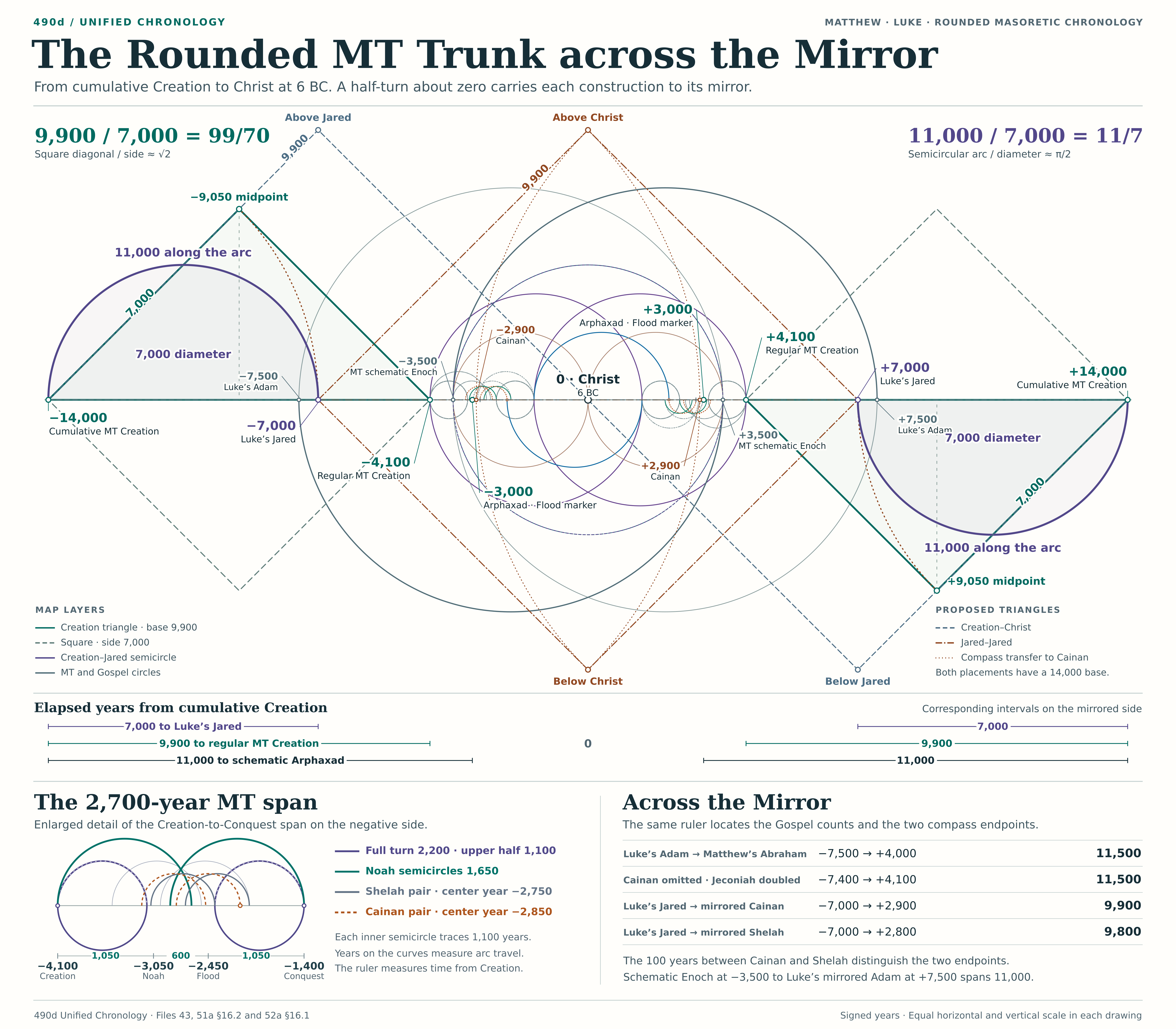
Dean will compare legibility with the established map before deciding which version to use. Established interactive master map · Master map in Draft 12
21 November 2026 · Working draft 12 distinguishes the trunk and its branches
Agent 2-Trunk · Draft revision. Dean identifies regular and cumulative Rounded MT together with Matthew and Luke as the core trunk. The SP and native LXX comparisons are secondary branches whose geometric measurements derive from the fixed MT–Gospel map. The SKL remains a proposed enlargement of the core map. Its calculations are in the scratchpad, and the inquiry is paused pending Dean’s direction.
Working draft 12 · SP and native LXX branches · Closing SKL observation · Editable Word draft
21 November 2026 · The projected SKL diagonal and the Flood–Exodus spans
Agent 2-Trunk. The Flood and the Exodus supply the dated comparison for Dean’s final SKL observation. File 21 gives Alulim’s accession at 268566 BC (Long) and 262086 BC (Short). On either track the first six reigns span 201,600 = 560 × 360 years. The trunk’s 99/70 square ratio projects a diagonal of 285,120 = 792 × 360. Elapsed years across the civil BC/AD boundary equal BC + AD − 1.
Long accession. From 268566 BC the diagonal reaches civil AD 16555, which lies 16,560 years (23 × 720) after 6 BC. From 2886 BC to this endpoint are 19,440 years, matching the Short Flood at 20886 BC to the 1446 BC Exodus.
Short accession. From 262086 BC the diagonal reaches civil AD 23035, which lies 23,040 years (64 × 360) after 6 BC. From the same 2886 BC anchor are 25,920 years, matching the Long Flood at 27366 BC to the 1446 BC Exodus.
File 24 places the Long terminal of 2856 BC at 2886 BC in +30 mode. The terminal at 2886 BC and the Exodus at 1446 BC stand 720 years on either side of Abram’s birth in the Actual MT at 2166 BC. The civil AD endpoints are projected coordinates. Dean pauses the SKL study here as a plausible enlargement of the Rounded MT trunk.
File 21 · File 24 · File 27 · Dated side and projected diagonal · Earlier Flood–Exodus comparison
21 November 2026 · Abram’s 318 and the first seven SKL reigns
Agent 2-Trunk. In Genesis 14:14 Abram musters 318 trained men born in his house to rescue Lot. File 32 compares the Hebrew חֲנִיכָיו (“his trained men”), from חנך, with the name Enoch (חֲנוֹךְ). Genesis gives a count of men. Its application to 700-year units at the reign of the king compared to Enoch is Dean’s chronological reading.
Through the seventh reign. File 21, Table 6.1, gives the Long sequence 268566 → 66966 → 45966 BC and the Short sequence 262086 → 60486 → 39486 BC. In each, 201,600 years from Alulim to En-men-dur-ana’s accession are followed by his 21,000-year reign. When Ubara-Tutu succeeds him, 288 + 30 units of 700 have elapsed, giving 222,600 = 318 × 700.
The Long midpoint. File 32 already gives 111,300 years (318 × 350) from its P46 base at 157266 BC to Ubara-Tutu’s accession at 45966 BC. Measuring back to Alulim at 268566 BC adds an equal first half. The full Long sequence is 268566 → 157266 → 45966 BC, or 111,300 + 111,300. The P46 midpoint belongs to the Long calculation. Await Dean’s next observation.
Genesis 14:14 · File 32, P46 · File 21, Table 6.1 · The first six reigns
21 November 2026 · The first six SKL reigns as a square side
Agent 2-Trunk. Genesis 5 traces the line from Adam to Enoch. In the Sumerian King List the first six kings reign before the seventh, En-men-dur-ana. Using the Adam and Enoch correspondences in File 21, Table 6.1, the Long reconstruction gives 268566 → 66966 BC and the Short gives 262086 → 60486 BC. Each spans the same six reigns, 201,600 years = 560 × 360. The 6,480-year shift moves both endpoints.
The dated side. The 201,600 years equal 16 × 12,600 and 8 × 25,200. The first unit spans Rounded cumulative MT Creation to Conquest (14006 → 1406 BC). File 21 §11.4 measures the second from the Long SKL Flood to Abram’s birth in the Actual MT (27366 → 2166 BC). Both comparisons use the unrounded BC intervals directly.
The proposed diagonal. The MT trunk’s working ratio of diagonal to side gives 792/560 = 99/70. Applied to the dated side, it yields 285,120 years = 792 × 360. The exact Euclidean formula gives 201,600 × √2 ≈ 285,105.45 years. Can an independently dated interval establish the proposed 285,120-year diagonal?
Genesis 5 · Oxford King List · File 21, Table 6.1 and §11.4 · Published √2 study · The two Flood diameters
21 November 2026 · The seventh king’s reign and the Temple foundation
Agent 2-Trunk. In 1 Kings 6:1 Solomon begins the Temple in Ziv, the second month of his fourth year. The regular Actual MT chronology places the foundation at 966 BC, 480 years after the Exodus at 1446 BC.
One starting date, two measures. On the Long SKL, En-men-dur-ana’s accession at 66966 BC to Ubara-Tutu’s accession at 45966 BC gives the seventh king’s 21,000-year reign. Comparing the succession to Enoch’s ascension is typological. From that same starting date to the Temple foundation are 66,000 years, including 45,000 years after the succession. Dean reads the reign as diameter and the span to the foundation as circumference. Both measures are three times the 7,000 and 22,000 pair, so 66,000/21,000 = 22/7.
Source check. File 70 §E.5C.2 gives 65,520 years from 66966 BC to the Exodus. The final 480 years complete 66,000. The Long Flood divides the same span into 39,600 years to the Flood, 25,920 to the Exodus, and 480 to the foundation. The next step in placing the proposed outer circle awaits Dean’s direction.
1 Kings 6:1 · Kings of Judah chronology · Oxford King List · File 21, Table 6.1 · File 70 §E.5C.2 · File 27 · The preceding Flood comparison
21 November 2026 · From the seventh king to the Flood
Agent 2-Trunk. Genesis 5:24 recounts God taking Enoch before the Flood. File 21, Table 6.1, compares the seventh Sumerian king, En-men-dur-ana, with Enoch, and Ubara-Tutu with Noah. “Birth” and “ascension” are typological readings of En-men-dur-ana’s accession and the end of his reign. The King List supplies the reign lengths. The BC dates belong to 490d’s reconstruction.
Long (BC) 66966 → 45966 → 27366. Short (BC) 60486 → 39486 → 20886. On both tracks En-men-dur-ana reigns 21,000 years (3 × 7,000). Ubara-Tutu succeeds him and reigns 18,600 years to the Flood. Together they give 39,600 = 110 × 360.
The proposed outer circle. At 22/7, a full circumference of 39,600 corresponds to a diameter of 12,600 (35 × 360). A semicircular arc of 39,600 corresponds to a diameter of 25,200 (70 × 360). The Rounded cumulative MT Creation at 14006 BC and Conquest at 1406 BC supply the first diameter. File 21 §11.4 already measures the second from the Long Flood at 27366 BC to Abram’s birth in the Actual MT at 2166 BC. The sequence 66966 → 27366 → 2166 BC thus joins 39,600 and 25,200 at the same Flood, giving exactly 11/7 on unrounded BC dates. This is Dean’s proposed connection to the Rounded MT trunk. The placement of the outer figure awaits Dean’s direction.
Genesis 5:24 · Oxford translation of the Sumerian King List · File 21, Table 6.1 and §11.4 · MT Creation to Conquest · Earlier SKL Flood entry
21 November 2026 · The two SKL Floods, the Exodus and the Mirror
Agent 2-Trunk. With the Exodus fixed at 1446 BC, Files 27 and 34 give an exact sequence in the chronology. The Long Flood (27366 BC) precedes the Short Flood (20886 BC) by 6,480 years. The Short Flood precedes the Exodus by 19,440 years. Together these give 25,920 = 4 × 6,480. The established terminal dates are 2906 BC (Short) and 2856 BC (Long), each with its ±720-year positions.
Across the Mirror. On the signed axis with 6 BC at zero, −27,360 to +20,880 spans 48,240 years. The century projections −27,400 to +20,900 span 48,300. Applying 70/69 to this projected span yields 49,000. The link to the MT–Gospel map is seven repetitions of its 6,900 → 7,000 expansion, for a total gain of 700. The Key of 23 Capstone tables already give 48,300 → 49,000 for a different LXX comparison.
Dean reads the SKL as the next larger scale. Its two Flood dates constrain the scale of the proposed outer circle and square. Their placement remains open pending Dean’s direction.
Corrected SKL outer-scale entry · File 27 · File 34 · Key of 23 Capstone tables · MT–Gospel master map
21 November 2026 · The SKL as a possible outer circle and square
Agent 2-Trunk. Genesis 9:29 gives Noah 950 years. Dean retains the Rounded MT–Gospel master map as drawn. The SP and native LXX remain companion studies. The Sumerian King List (SKL) suggests a possible outer circle and square.
Source dates. File 24 §4 gives the 23 kings of Kish 17,980 years, from 20886 to 2906 BC. The companion terminal is 2856 BC. File 21 places the Long Flood at 27366 BC, 6,480 years earlier. Using the unrounded BC dates, 20886 − 14006 = 6,880 = 16 × 430, and 20886 − 4116 = 16,770 = 39 × 430 = 43 × 390.
Century diagram. Relative to 6 BC, the two Floods are −20,880 and −27,360, rounded here to −20,900 and −27,400. From −20,900, cumulative MT Creation (−14,000) is 6,900 years away, Luke’s schematic Enoch (−6,900) is 14,000 away, and the close of Christ’s schematic century (+100) is 21,000 away. To Christ at zero, 20,900 = 22 × 950 = 19 × 1,100. The projected LXX poles (−5,500, +5,500) are 14 and 24 units of 1,100 away. The projected SP poles (−4,400, +4,400) are 15 and 23 units away.
Correction from Dean. On Luke’s century scale, Adam’s Creation is −7,500. The interval from the projected Long Flood at −27,400 to Adam is 19,900 years. Dean withdraws the earlier −17,500 coordinate and its proposed 9,900-year link.
Genesis 9:29 · File 24 §4 · File 21 · Luke’s table · Rounded MT–Gospel master map
21 November 2026 · Working draft 11 follows the master map
Agent 2-Trunk · Draft revision. Working draft 11 takes the Rounded MT backbone map as its organizing figure. Its two MT Creation dates, 14006 and 4106 BC, are read against Christ at zero alongside Luke’s Adam and Matthew’s Abraham. The six-generation semicircles and the projected SP–LXX comparison explain how Peleg and Moses meet the larger map. The earlier diagrams remain available for reading individual constructions.
Working draft 11 · Editable Word draft · Interactive master map · Six generations · SP and LXX · Peleg and Moses
Next question. Which feature of the master map should the next observation test?
21 November 2026 · The master map and its companion studies
Agent 2-Trunk. Dean designates the full Rounded MT backbone map as the organizing diagram. Read cumulative MT Creation at 14006 BC and regular Rounded MT Creation at 4106 BC together with Luke’s Adam and Matthew’s Abraham on the axis centered on Christ. Use the six-generation semicircles and the SP–LXX comparison, including Peleg and Moses, as companion studies that explain the master map. Await Dean’s next observation. Interactive master map · Master-map entry · Six generations · SP and LXX · Peleg and Moses
21 November 2026 · Six whole generations sustain the two semicircles
Agent 2-Trunk. Genesis relates Enoch’s taking, the Flood covenant, division in Peleg’s days and the promise to Abram. Moses sees the promised land at his death. The 27-name century scheme places Enoch’s taking where Methuselah’s century opens and Abram’s opening where Terah’s century closes. It uses Arphaxad’s opening as a Flood marker. Genesis 11:10 places his birth two years after the Flood. Peleg supplies a Babel-generation marker under the reading of Genesis 10:25 alongside 11:1–9.
Two sets of complete centuries. Forward from Adam (#1), Methuselah (#8) lies 700 years away and Arphaxad (#12) lies 1,100 away. Backward from Moses (#27), Terah (#20) and Peleg (#16) give the same distances. Openings, midpoints, closes and every matched position in between give the same two ratios. With 22/7, two arcs of 1,100 make a circumference of 2,200 on a single reference diameter of 700. The earlier six-boundary entry established the endpoint pattern. 27-century table · Earlier six boundaries · Peleg and Moses on the two manuscript rulers · File 69 §3.4A
The Shelah midpoint. On the signed axis the reflection x ↦ −5,500 − x has center −2,750, midway through Shelah’s century. It exchanges Adam with Moses, Methuselah with Terah, and Arphaxad with Peleg, reversing opening and close. It carries −3,400 (Enoch taken / Methuselah opens) to −2,100 (Terah closes / Abram opens). The same center bisects projected native LXX Creation at −5,500 and Christ at zero.
Where SP and LXX meet the centuries. From −4,400 SP and −5,500 LXX, 7,000 years reach the mirrored openings of Peleg (+2,600) and Moses (+1,500). At t years into either schematic generation, the mirrored distance is 7,000 − t, down to 6,900 at both closes. The 1,100 between the two Creation projections runs through the full Peleg–Moses pair.
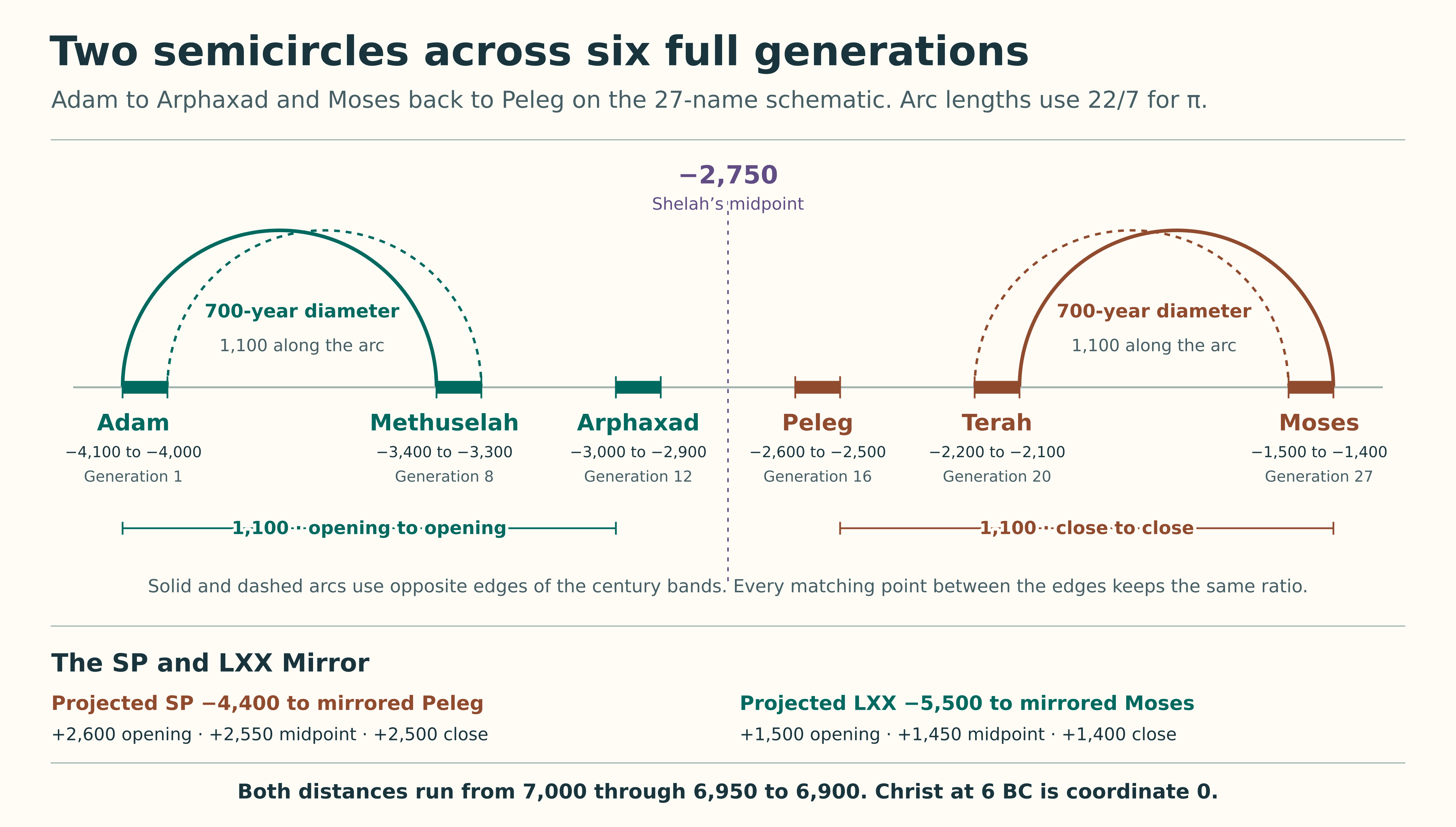
Next question. Which presentation makes both the 11/7 age-matched counts and their reversed correspondence about Shelah clearest on the backbone map?
21 November 2026 · Peleg and Moses between the SP and LXX Creation poles
Agent 2-Trunk. Genesis 10:25 places the division of the earth in Peleg’s days. Genesis 11:1–9 recounts the scattering at Babel. Dean tests Peleg’s schematic opening as the earliest permissible boundary for Babel. The text leaves the precise point within his days open. Moses’ closing century boundary at 1406 BC marks his death and the Conquest threshold.
The 1,100-year shift. With second Cainan in the MT-based 27-name century scheme, Peleg occupies 2606–2506 BC and Moses occupies 1506–1406 BC. Moving all four signed coordinates (−5500, +1400, +1500, +4400) forward 1100 gives (−4400, +2500, +2600, +5500). From the LXX century projection, the intervals of 6900 and 7000 reach mirrored Moses’ close and opening. From the SP projection, the same intervals reach mirrored Peleg’s close and opening. In both cases 9900 reaches the opposite manuscript’s mirrored Creation. Genesis 10:25 · Genesis 11:1–9 · 27-name generation table · File 51a §17 · SP and native LXX century projections
Which endpoint stays fixed? Exactly 6900 × 70/69 = 7000. Holding LXX at −5500 moves the Moses endpoint from +1400 to +1500. Holding +1400 instead moves the LXX endpoint from −5500 to −5600, the projection independently reached by applying 25/23 to the 1380-year native LXX–MT difference.
Open question. Does the narrative give Peleg’s opening or close priority for the Babel comparison? The distances preserve both boundaries.
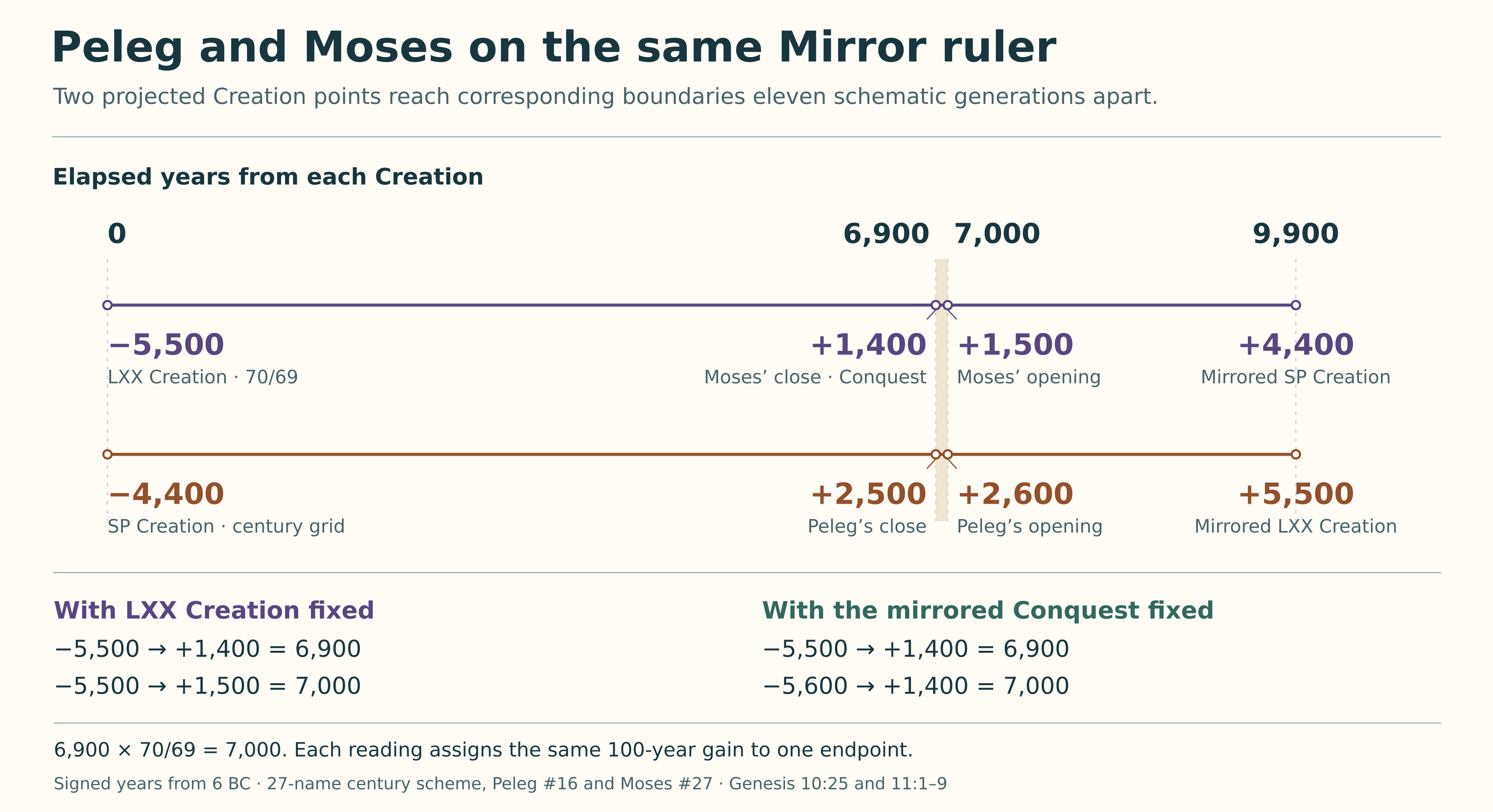
21 November 2026 · SP and native LXX Creation on the MT century map
Agent 2-Trunk. Taking Creation toward Christ at zero, Dean compares the regular Rounded MT, transmitted SP and native LXX lower Creation boundaries of 4106, 4411 and 5486 BC. On the signed axis these are −4100, −4405 and −5480. For this century schematic Dean rounds the SP offset of 305 to 300 and places SP at −4400. The native LXX keeps second Cainan’s 130 years, with the +60 Terah option off.
Two LXX readings. Hold MT at −4100 and convert its 1380-year gap to native LXX independently by 70/69 or 25/23. The resulting gaps of 1400 and 1500 give −5500 and −5600. The three proposed Mirror spans are 8800 for SP and 11000 or 11200 for LXX. Report IV §37 already gives the 25/23 conversion. File 51a §17 · Report IV §37 · Published square-and-circle study · MT backbone map
The 8,500-year translation. Add 8500 to each date in the earlier sequence −14000, −7000, −4100, −3000. This gives −5500, +1500, +4400, +5500. From −5500 the successive distances are 7000 to the opening of mirrored Moses’ schematic century, 9900 to mirrored SP Creation, and 11000 to LXX’s own Mirror. Thus the same dated comparison gives 9900/7000 = 99/70 ≈ √2 and 11000/7000 = 11/7 ≈ π/2. On the other LXX reading, −5600 to +1400 measures 7000 to the close of mirrored Moses’ century at the Conquest.
The square and its inscribed circle. On the 2800-year interval between the MT Conquest poles, a circle at 22/7 has circumference 8800 (SP), while its enclosing square has perimeter 11200 (LXX, 25/23). From schematic MT Enoch at −3500 to Christ at 0, the corresponding measures are 11000 (LXX, 70/69) and 14000 (cumulative Rounded MT Creation to Christ). The second construction is exactly 5/4 the size of the first.
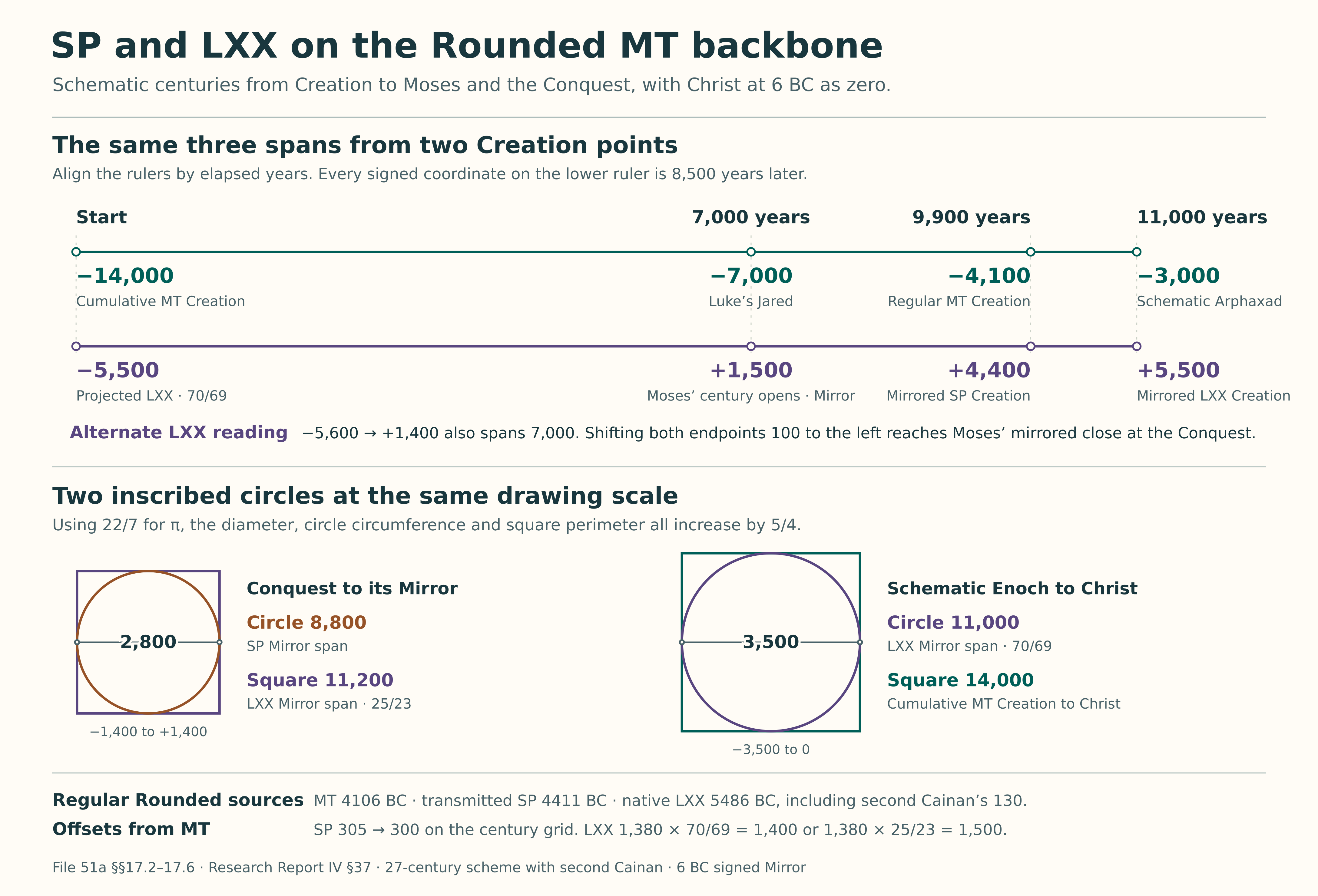
Next question. Which named interval should set the position of each secondary circle or square when these readings are added to the main map?
21 November 2026 · The square-and-circle backbone across the Mirror
Agent 2-Trunk. The map follows the two Rounded MT Creation dates through Jared, Enoch and the Flood to the Christ anchor at zero. It places the existing circles and squares on one signed ruler with both proposed positions of the 14,000-year triangle. Each construction has its companion under a half-turn about zero.
How to read the triangles. The established 9,900-year bases run between cumulative and regular Rounded MT Creation. Each carries two sides of 7,000. For the proposed larger triangle the side is 9,900 and the base is 14,000. The interval from −14,000 to 0 centers the first placement on Luke’s Jared at −7,000. Translating that base by +7,000 gives −7,000 to +7,000, centered on Christ at 0. In the latter placement, the two 9,900 sides are drawn from the exact spans between Jared and the opposite second-Cainan opening on the 27-name century grid. File 52a §§3, 16.1 · Published square-and-circle study · Jared, Cainan and Shelah · Earlier composite
Open question. Which placement, if either, has priority in the biblical narrative? The ruler fixes the spans and their midpoints. An independent chronological identification for an apex remains open.
21 November 2026 · Jared across the Mirror to Cainan and Shelah
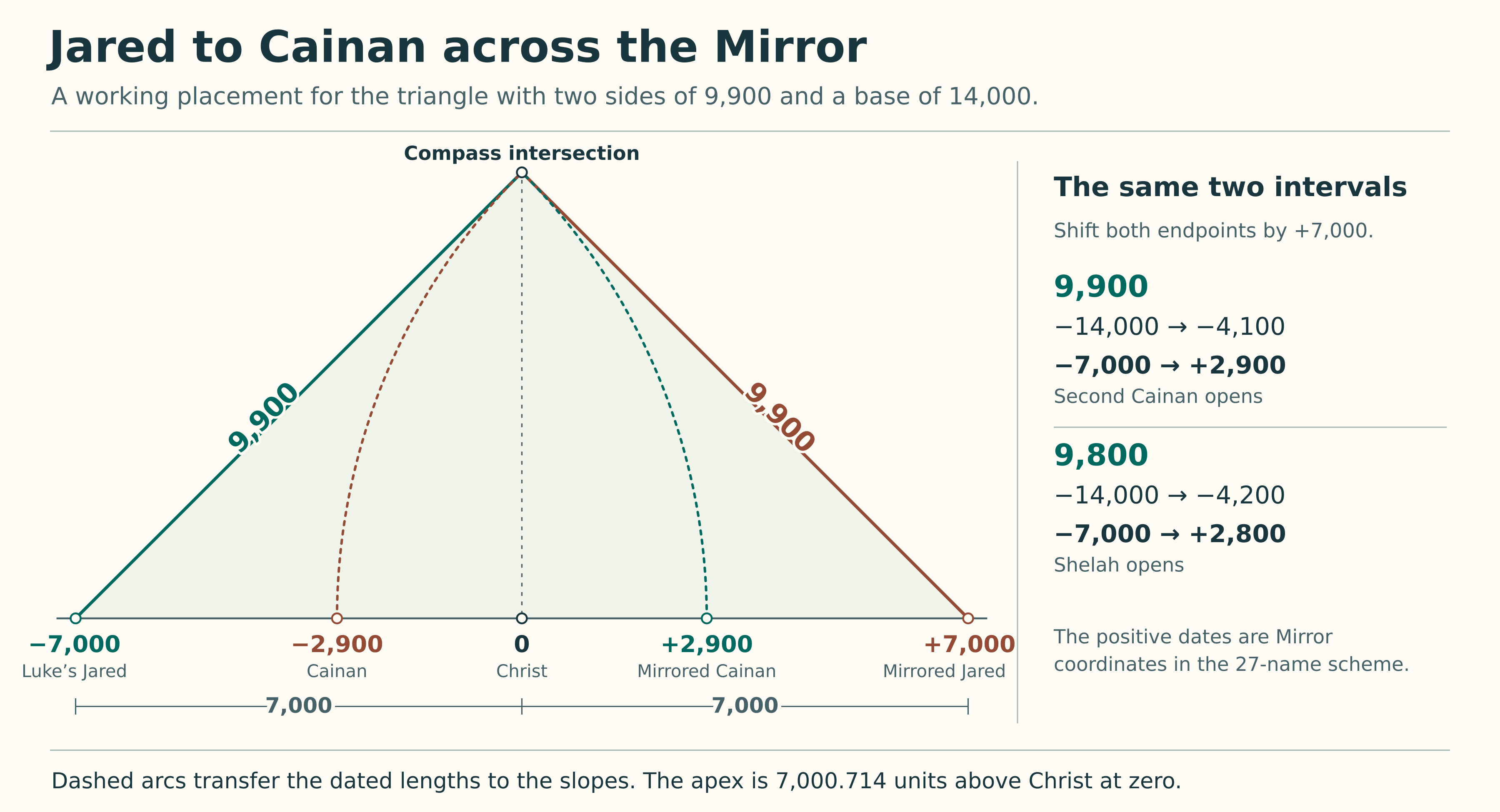
Agent 2-Trunk. Luke traces Shelah through Cainan to Arphaxad. On the MT-based 27-name century table, second Cainan opens at 2906 BC and Shelah opens at 2806 BC. Their reflected openings are +2,900 and +2,800 on the signed ruler from 6 BC. The century belongs to this schematic count. Second Cainan’s 130 years to the next birth belong to the native LXX chronology.
Two exact spans. Move each point in (−14,000, −4,200, −4,100) forward by 7,000. The three become (−7,000, +2,800, +2,900). The 9,800 from cumulative Rounded MT Creation to the separate 4206 BC pillar becomes the distance from Luke’s Jared to mirrored Shelah’s opening. The 9,900 to regular Rounded MT Creation becomes the distance from the same Jared to mirrored Cainan’s opening. Reversing all signs gives the companion spans. 27-name table and Cainan count · File 69 §3.4A · Creation Pillars appendix · Earlier composite
Working construction. The same translation carries the proposed 14,000 base from [−14,000, 0] to [−7,000, +7,000], between the Jared poles. Swing the two 9,900 spans about those poles. They can meet on the vertical through Christ at zero, at a height of about 7,000.714. The ruler establishes the two spans. Their placement as inclined sides is a proposal. The open question is whether the chronology independently identifies the apex.
21 November 2026 · The two Creation squares on the full Flood–Mirror diagram
Agent 2-Trunk. Creation, Jared, Enoch and the Flood now appear on one signed ruler with Christ at zero. The composite adds the two dated triangles and their corresponding squares to the full MT and Luke circle diagram. The separate square plate gives the simpler reading of the same two triangles.
The shared measure. On the Moses line the 9,900-year base joins cumulative Rounded MT Creation at −14,000 to regular Rounded MT Creation at −4,100. From cumulative Creation to Jared in Luke’s Cainan-retaining century scheme is 7,000. That span supplies a triangle side and the diameter of the Flood semicircle. The opposite side turns through 180° about zero. File 52a §§3, 16.1 · Clean square plate · Flood–Mirror plate
Held for later. Dean notes a possible further triangle with a base of 14,000 from −14,000 to 0 and two sides of 9,900. The next review concerns the two triangles already drawn.
21 November 2026 · The two Creation dates and the 7,000-year side
Agent 2-Trunk · The two Creation dates and Jared’s 7,000. Genesis places Jared before Enoch and the Flood. Luke carries their genealogy back from Christ. On the signed ruler from 6 BC, cumulative Rounded MT Creation on the Moses line is −14,000 (14006 BC) and regular Rounded MT Creation is −4,100 (4106 BC). The published √2 study already gives the 9,900 between them and the 7,000 from cumulative Creation to the midpoint at 7006 BC. In the century scheme for Luke that retains second Cainan, that midpoint is Jared’s opening at −7,000. The ruler reads −14,000 → −7,000 → 0, giving two consecutive spans of 7,000 to the Christ anchor. File 52a also gives the midpoint of the two Creation dates at 9056 BC. Genesis 5:18–24 and Luke 3:37 · Published √2 study · File 52a §§3, 16.1
What the new plate shows. Draw the 9,900-year span as the horizontal base. Swing the 7,000 from cumulative Creation to Jared upward with a compass. Its tip meets a second side of exactly 7,000 above the base midpoint −9,050. The 180° reflection places the opposite apex below +9,050. Jared stays on the time axis. In the preceding Flood plate the same 7,000 serves as the semicircle’s diameter, paired with a working half-circumference of 11,000. Thus 9,900/7,000 = 99/70 and 11,000/7,000 = 11/7 share a dated measure. The perimeter 7,000 + 7,000 + 9,900 = 23,900 is one hundred times the published 70 + 70 + 99 perimeter of 239. Flood and Jared plate · Published joint π–√2 study
Exact geometry. A square of side 7,000 has diagonal 7,000√2 = 9,899.494937…, about 0.505063 shorter than the dated base. Holding both 7,000 sides and the full 9,900 base gives an isosceles triangle with an apex angle of 90.0058465°. The geometry establishes how closely the two constructions agree. Dean’s interpretation is that this shared 7,000 belongs to the trunk’s square and circle.
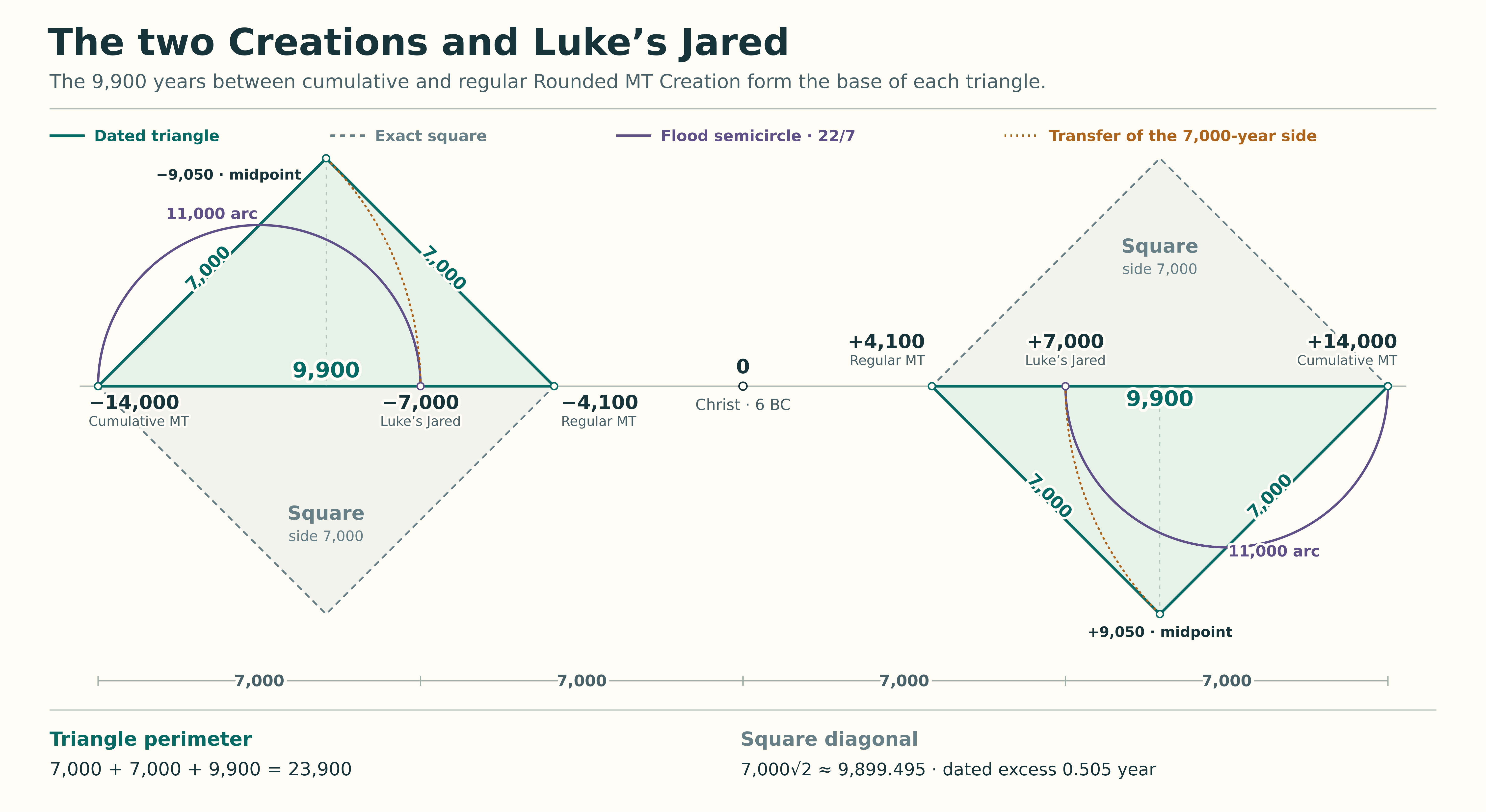
The open question is whether a further dated trunk boundary identifies the other inclined 7,000 side as directly as Jared’s opening identifies the first.
21 November 2026 · Cumulative Creation, Luke’s Jared and the schematic Flood boundary
Agent 2-Trunk · A translation of three boundaries. Genesis follows Jared and Enoch through Shem to Arphaxad after the Flood. Luke carries the same names back from Christ. On the existing diagram, the signed row (−3,500, +3,500, +7,500) runs from the MT-based Enoch boundary through its reflection to Luke’s reflected Adam. Subtract 10,500 from all three and the row becomes (−14,000, −7,000, −3,000). The first segment still measures 7,000 and the second 4,000, making 11,000 in all. Add 10,500 to the reflected row (+3,500, −3,500, −7,500) to obtain (+14,000, +7,000, +3,000). The corresponding semicircles move from center 0 to centers −10,500 and +10,500. Genesis 5:18–24 and 11:10 · Luke 3:35–38 · Earlier print plates
Whose coordinates these are. Zero is the study’s 6 BC Christ anchor. −14,000 is cumulative Rounded MT Creation at 14006 BC on the Moses line. −7,000 is Jared’s opening in the century scheme for Luke that retains second Cainan, five centuries after Luke’s Adam at −7,500. It also falls precisely halfway from cumulative Creation to zero. −3,000 is Arphaxad’s opening and Shem’s close in the MT-based 27-name schematic, a representative Flood boundary. Genesis 11:10 places Arphaxad’s birth two years after the Flood. On the negative side, the semicircle’s straight diameter runs from Creation to Jared. Its arc measures 11,000 under 22/7, equal to the straight span from Creation to the schematic Arphaxad boundary. The positive side has the same dimensions. Rounded MT square and its midpoint · Twenty-seven schematic centuries · File 54
The same row also arises by enlargement. Hold −3,000 fixed and multiply all distances from it by ten. MT schematic Adam at −4,100 becomes cumulative Creation at −14,000, Enoch’s close at −3,400 becomes Luke’s Jared at −7,000, and Arphaxad’s −3,000 stays fixed. The smaller 700 + 400 becomes 7,000 + 4,000. The two spans from Creation to the same Arphaxad endpoint differ by 11,000 − 1,100 = 9,900, the established separation of the two Creation dates. Both transformations are exact within the named schemes. Dean reads the shared boundaries as part of the trunk. Published square-and-circle study
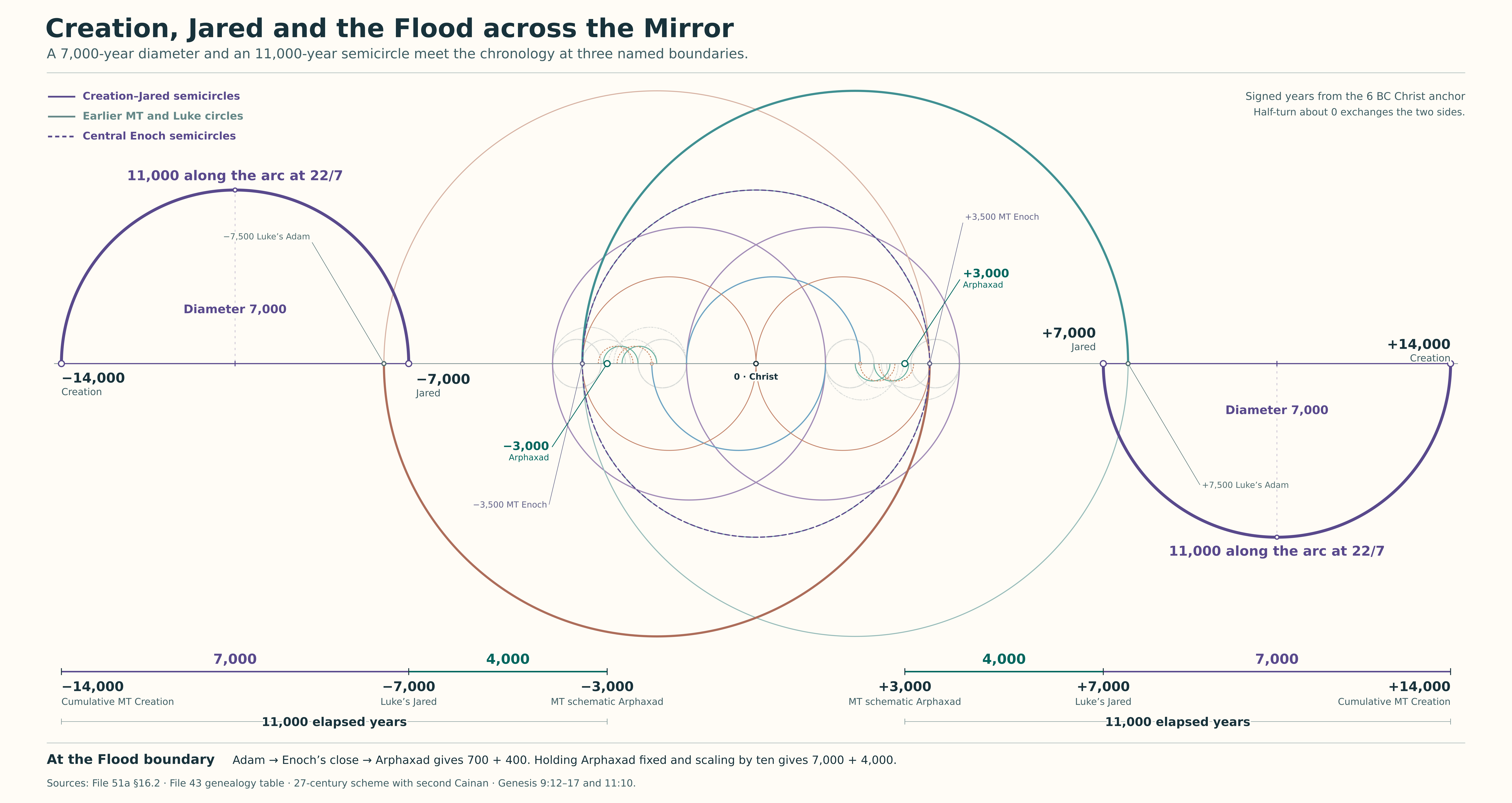
The next question is whether Luke’s own Arphaxad, opening at −6,400 in his Cainan-retaining century grid, supplies an independent correspondence.
21 November 2026 · The two large Luke circles across the Mirror
Agent 2-Trunk · New print plate. On the right, the straight diameter runs from −3,500 to +7,500, centered at +2,000. It carries a full circle and its upper semicircle. Rotate the construction 180° about zero. The diameter now runs from +3,500 to −7,500, centered at −2,000, with a full circle and its lower semicircle. Each diameter measures 11,000, and each radius measures 5,500. The earlier, smaller circles retain the two arc readings of 11,000, once around a diameter of 3,500 and halfway around a diameter of 7,000 in the working 22/7 construction. These are century-scheme coordinates for Luke and the Rounded MT Mirror. Earlier print plates and chronology settings
The three-page PDF opens with the full 36 × 32 inch plate. The two earlier plates follow. Full-size poster PNG · Three-page print PDF · Print package with editable SVG
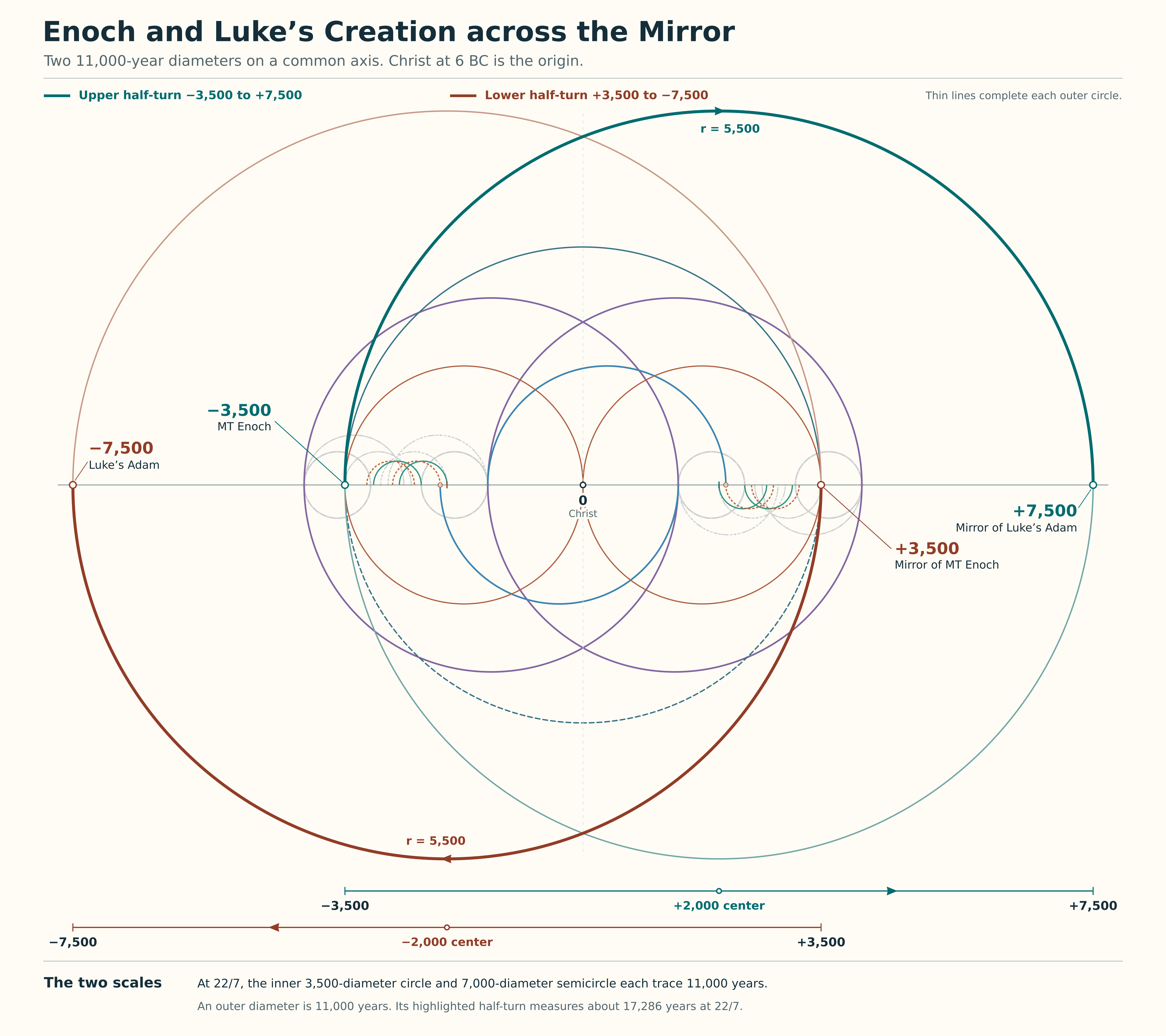
The open question from the draft remains whether an early independent witness interprets either Gospel genealogy in 100-year units. Working draft 10
21 November 2026 · Working draft 10 brings the generational circle and the Mirror together
Agent 2-Trunk · Draft revision. Working draft 10 traces the 27 schematic centuries from Adam to Moses through the two Cainan positions, then follows Enoch across the Mirror into Luke’s and Matthew’s genealogies. The two Luke print plates show which intervals serve as arc lengths and which serve as diameters. The revised account also follows Jacob through the twenty-second generation and Tishri 22, and distinguishes Joshua’s published 110/70 from its proposed tenfold counterpart at the Temple foundation. Working draft 10 · Luke’s two print plates · Christ’s allotted century · Isaac and Joshua
The century assigned to each Gospel generation is a comparative reading. File 54 supplies the established seventy-year scheme for Luke. The next open question is whether an independent early witness explicitly counts either Gospel genealogy in units of one hundred years. File 54
21 November 2026 · Isaac, Joshua and the Temple foundation at two scales
Agent 2-Trunk · From promise to land to sanctuary. Abraham is 100 when Isaac is born. Genesis sends Abraham and Isaac into the land of Moriah, and Chronicles calls Solomon’s Temple site Mount Moriah. Joshua marks Israel’s crossing of the Jordan with twelve stones for the twelve tribes and dies at 110. First Kings dates the start of Solomon’s Temple to his fourth regnal year, the 480th year after the Exodus. The regular MT tables place Abraham’s and Isaac’s births at 2166 and 2066 BC in both Actual and Rounded chronology. Use the project’s 966 BC cardinal foundation, distinct from the Temple dedication. The regular reconstruction places Joshua’s birth at 1476 and his death at 1366 BC. Scripture gives his lifespan, while his age at entry and the BC dates depend on the reconstruction. Genesis 22:2, 2 Chronicles 3:1 and Joshua 4:1–8 · Genesis 21:1–5 · Joshua 4:19 and 24:29 · 1 Kings 6:1 · File 51a, regular MT tables · File 63 §3.6
The same 11/7 in two dated progressions. From Joshua’s proposed birth in 1476 BC, entry in 1406 BC is 70 years and death in 1366 BC is 110. The published √2 study already gives 110/70 = 11/7 and its fifteenfold regular Rounded MT counterpart 1,650/1,050. Dean identifies a tenfold form sharing Joshua’s death boundary. From Isaac’s birth in 2066 BC, Joshua’s proposed death is 700 years and the Temple foundation is 1,100 years. Thus 1,100/700 = 110/70 = 11/7, the half-circumference-to-diameter ratio when the full circumference uses 22/7. The same 1366 BC closes the shorter 110 and the larger 700. All these comparisons use Joshua’s regular reconstruction. File 63 keeps the cumulative 1296 BC endpoint in its own register. Published √2 study, “The fifteenfold counterpart in the Rounded trunk” · File 18, chronological tables · Joshua’s modeled ages and endpoints
Two ways to count back from the same foundation. From 966 BC, twelve 100-year units reach Abraham in 2166, and twelve 40-year units reach the Exodus in 1446. At eleven units the corresponding boundaries are Isaac in 2066 and the Conquest in 1406. File 08 already records the 400 years from Joshua’s proposed death in 1366 to the foundation in 966, or 10 × 40. Thus 1,200 and 480 each measure twelve units in their respective schemes, and 1,100 and 440 each measure eleven. Going backward, 1406 opens the twelfth forty-year block toward 1446. Going forward from 1446, 1406 closes the first block, and 966 closes the twelfth. These are schematic units. File 08, double 400 · Regular chronology tables · File 63, Temple foundation and its ordinal/cardinal states
The open question is what evidence independently fixes Joshua’s death forty years after the crossing. That placement determines whether the 110 and the 700 close together at 1366 BC.
21 November 2026 · Jacob at Bethel and Solomon at the Temple
Agent 2-Trunk · The two sanctuaries. On the twenty-second of the seventh month, Jacob intends to consecrate Bethel permanently. The Creator calls him Israel and promises him descendants and kings. An angel gives Jacob seven tablets, then directs him to leave Bethel and forgo the permanent temple he had planned there. Jacob observes an additional day and attaches it to the festival’s seven. At Jerusalem, after Solomon has built the Temple and the people have celebrated, the Lord tells Solomon that he has chosen this place as a house of sacrifice. Chronicles dates the assembly to the eighth festival day and the dismissal to the twenty-third. It leaves the later divine appearance undated. Jubilees 32:16–29 · 2 Chronicles 7:8–12
How the three weeks fit. Dean reads Tishri 1–7 as a figure of the Creation week. File 63, Appendix D.6, already records the Temple’s two sevens. At Solomon’s dedication the text specifies seven days for the altar and seven for the feast. With Booths on Tishri 15–21 and the assembly on 22, a consecutive reading puts the preceding seven days of dedication on 8–14. Thus the dedication fills the middle week on this occasion. Jacob’s twenty-second day and seven tablets supply an independent number pair within the Bethel scene. Dean’s reading relates them to Jacob’s place as the twenty-second head and to 22/7. File 63, Appendix D.6 · Leviticus 23:34–36 · File 53 §2 · Tishri 22 and the whole twenty-second generation
Creation imagery in the Temple. First Kings describes cherubim, palms and open flowers carved on the Temple walls. A comparison with Eden has a textual basis in Genesis’ garden and its guardian cherubim. Jubilees 8:19 calls Eden the Holy of Holies and Zion the earth’s center, linking Creation and sacred place within Jubilees itself. Kings also attributes to Solomon knowledge of plants, animals, birds and fish. These details give context for Dean’s reading of Creation at the dedication. Solomon’s use of 22/7 as a design remains an inference. Jubilees 8:19 · Genesis 2:8–9 and 3:24 · 1 Kings 6:29 · 1 Kings 4:33, English numbering
The open question is whether the Bronze Sea supplies an independent geometric test of the proposed 22/7 at the dedication, starting with the dimensions actually given in each textual witness. Earlier Bronze Sea comparison
21 November 2026 · Tishri 22 and the whole twenty-second generation
Agent 2-Trunk · Dean’s schematic count. God completes his works in six days and rests on the seventh. Jubilees 2:23 pairs twenty-two works with twenty-two ancestral heads from Adam through Jacob. Dean overlays the Creation week on Tishri 1–7. Here 0 is the opening boundary before Tishri 1, and 7, 14, 21 and 22 mark completed days. The three seven-day blocks end on Tishri 21, giving 21/7 = 3. The added day completes 22/7 = 3 + 1/7, the working approximation to π. This overlay has its own phase. In File 07’s actual regular chronology Adam’s Day 6 falls on Tishri 1. File 58’s fixed-week calendar begins Tishri on Wednesday, with Sabbaths on the 4th, 11th and 18th. Jubilees 2 · File 07 · File 58
The whole twenty-second generation completes the count. Tishri 22 occupies the interval from 21 to 22 elapsed days. Likewise, generation 22 occupies years 2,100–2,200 in the century scheme. With Rounded MT Creation fixed at 4106 BC, the entire span 2006–1906 BC belongs to Jacob’s ordinal position when counted from Adam without second Cainan. These dates mark his schematic century. File 53 compares Jacob’s position in Jubilees’ sacred list of twenty-two heads. If second Cainan is counted at the same origin, Isaac occupies position 22 and Jacob position 23. The whole twenty-second unit carries the role of completion. Its opening and closing ratios are 21/7 and 22/7, respectively. File 53 §§2–3
The festival and the dedication. Leviticus dates Booths to the 15th and prescribes seven days, then an assembly on the eighth. Thus Tishri 15–21 inclusive supplies the third seven, and Tishri 22 the assembly. At Solomon’s Temple dedication, 2 Chronicles distinguishes seven days of altar dedication from seven of festival. Reading these consecutively puts the dedication on 8–14, followed by Booths on 15–21, the assembly on 22 and dismissal on 23. The second week’s identification with the dedication belongs to that occasion. Leviticus 23:34–36 · 2 Chronicles 7:8–10
Jacob at Bethel. On the twenty-second of the seventh month the Creator names Jacob Israel, and an angel gives him seven tablets. Jacob celebrates one further day and calls it “Addition.” Jubilees explicitly adds this day to the festival’s seven. The earlier Creation count 7 | 1 | 7 | 7 becomes 7 | 7 | 7 | 1 on a circle read from work 9: Days 3–4, Days 5–6, Day 1, then the sole work of Day 2. The rotation is exact. The Creation tally counts works and the festival tally counts days. Reading the two orders as a shared design is Dean’s proposal. Jubilees 32:16–29 · Earlier Creation circle
The open question is how Jacob’s seven tablets and the twenty-second day at Bethel relate to Solomon’s dedication, given the express instruction in Jubilees 32:22 about building a permanent sanctuary at Bethel.
21 November 2026 · The round Sea, its twelve oxen and the four quarters
Agent 2-Trunk · Dean’s reading of the four directions. In Jubilees 2:4 the firmament, Day 2’s sole work, divides the waters into equal parts above and below, over the whole earth. The gathering of the seas belongs to Day 3. The MT describes one round Bronze Sea resting on twelve oxen in four groups of three. They face outward, three north, three west, three south and three east. Dean reads the four directions as the four corners of the earth beneath the round firmament. The compass directions come from the Temple description. Identifying them with the corners of the earth is his interpretation. Jubilees 2:4–7 · 1 Kings 7:23–25, 44 · 2 Chronicles 4:2–4
Ancient comparisons. In 1 Enoch 18:2–3 the four winds bear the firmament. In 76:1–3 Enoch sees twelve wind gates, three in each quarter. Josephus describes the Temple basin as hemispherical and assigns three oxen to each of the four winds. Read together, these passages give early parallels for the supporting winds and the four groups of three. 1 Enoch 18 · 1 Enoch 76 · Josephus, Antiquities 8.79–80
An explicit later interpretation. Midrash Tadshe §2 explains the roundness of the Bronze Sea in 1 Kings 7:23 with the words שהרקיע עגול, “for the firmament is round.” Section 6 of the same work counts the firmament as the sole work on Day 2 among twenty-two works of Creation and counts twenty-two ancestral heads to Jacob. This medieval witness, dated to the eleventh century by the Posen Library, brings the Sea, the firmament and the twenty-two works together. The circumference-to-diameter reading in Jubilees remains Dean’s proposal. Midrash Tadshe §2 · Midrash Tadshe §6 and its parallels in Jubilees · Previous Bronze Sea finding
The open question is whether a Second Temple source explicitly identifies the Bronze Sea with the firmament of Day 2.
21 November 2026 · The Bronze Sea and the single work that brings twenty-one to twenty-two
Agent 2-Trunk · Dean’s comparison. On Day 2 God makes the firmament and divides the waters into two equal parts. Jubilees calls it the day’s only work, the eighth in the sequence. In Solomon’s sanctuary the MT gives the Bronze Sea a diameter of 10 cubits and a circumference of 30. On a diameter of seven the stated ratio becomes 30/10 = 21/7. The lampstand offers a separate count. Three almond cups on each of six branches and four on the central shaft yield three for each of seven stems plus one extra, 21 + 1 = 22 cups, alongside seven lamps. In Jubilees the six days group as 7 | 1 | (4 + 3) | (3 + 4). Dean compares the single work on Day 2 to the extra cup on the central shaft. It adds one circumference unit per diameter of seven when moving from 21/7 to the approximation 22/7. Jubilees 2:3–4 · 1 Kings 7:23 and 2 Chronicles 4:2 · Exodus 25:31–37
Why exactly one matters. Keep the other five days’ counts fixed and let Day 2 contribute x works. The circumference contains 21 + x works. The arc from the end of Day 1 to the end of Day 5 contains 10 + x. Its endpoints are diametrically opposite precisely when 2(10 + x) = 21 + x, whose unique solution is x = 1. On the regular Rounded MT comparison at 150 years per unit, 3,150 + 150 gives a circumference of 3,300 on a diameter of 1,050. The established arcs 0→11 and 7→18 each span 1,650 years and overlap by 600, covering 2,700 years from Creation to Conquest. The equality establishes how the figures fit at this scale. The literary connection is Dean’s proposal. Earlier circle and dates · File 53 §§2, 6 · Published square-and-circle study §2
Other readings of the Sea. Greek 3 Kingdoms 7:10 gives 33 cubits around and 10 across. Hollenback reconstructs an outside diameter of 10½ cubits. On his reconstruction, 33/10½ = 22/7 = 3,300/1,050. The later Jewish treatise Mishnat ha-Middot 5.3–4 gives 22 for the circumference, 11 for half of it and 3½ for half the diameter, then discusses the Sea’s 30 cubits and the extra seventh in light of the vessel’s brim. Its disputed date falls after Jubilees. Hollenback, Biblica 79, p. 410 · Gandz’s translation, §§5.3–4 · Mishnat ha-Middot
The open question is whether Jubilees itself connects the firmament with the sanctuary in terms that would support direct literary influence.
21 November 2026 · Early witnesses to seven, twenty-two and the circle
Agent 2-Trunk · Independent witness check. The earliest scriptural comparison is the lampstand. Exodus prescribes three almond-blossom cups on each of six branches, four on the central shaft, and seven lamps. Thus 6 × 3 + 4 = 22 cups on the same object as the 7 lamps. Philo later explains the lamps as the seven wandering heavenly bodies, with the sun in the middle. The numbers in Exodus count objects. To turn them into lengths for a circumference and diameter requires an additional interpretive step. Exodus 25:31–37 · Philo, Life of Moses 2.102–103
What the early witnesses connect. Around the middle of the second century BC, Aristobulus connects the creation week and Sabbath with seven heavenly orbs. The sixth of the Qumran Songs of the Sabbath Sacrifice supplies seven angelic princes. Philo reads Eden’s two cherubim as the outer heaven of fixed stars and the inner heaven of seven planetary orbits. He also offers a reading in which the cherubim signify opposite hemispheres. These are independent precedents for parts of Dean’s reading. Aristobulus, fragment 5, in Eusebius, Preparation for the Gospel 13.12 · Qumran Songs of the Sabbath Sacrifice · Philo, On the Cherubim §§21–26
The closest explicit diagram located is much later. In the third century AD, Origen describes a diagram in which Eden’s flaming sword appears as a diameter. The diagram also depicts seven ruling powers in circles. He gives no numerical dimensions for them. Among the witnesses examined, no source as early as Jubilees measures seven angels along a diameter or assigns twenty-two to the circumference. The loss of Alexandrian writings leaves the surviving record incomplete and supplies no evidence for a particular lost text. Origen, Against Celsus 6.33, 35 · Previous Enoch observation
A later Jewish creation commentary explicitly makes the numerical connection. Sefer Yetzirah 2:4 places the twenty-two letters on a wheel. Commenting on 1:1 in the eighteenth century, the Vilna Gaon applies the circle ratio to the seven double letters and the full alphabet: ולשבע ההיקף הוא כ״ב (“for seven the circumference is twenty-two”). His interpretation concerns letters. The historical link to Jubilees’ angelic orders remains open. Sefer Yetzirah 2:4 · Vilna Gaon’s commentary on 1:1
The next question is how early the Vilna Gaon’s interpretation of the seven and twenty-two can be documented in Jewish commentary.
21 November 2026 · The seven angelic orders within Day 1 and Enoch at daylight
Agent 2-Trunk · Dean’s reading of the two sevens. In Jubilees 2:2–3 the spirits God creates on the first day praise him for his works. Jacques van Ruiten independently identifies seven kinds of angels within the seven works of Day 1. He sees a probable hierarchy headed by the angels of the presence and the angels of holiness. In File 53 §2 the spirits occupy work 4, the middle of the seven. They are followed by the depths (5), night (6) and daylight (7). In the file’s parallel list Enoch, seventh from Adam, corresponds to daylight. His role fits that reading. In Jubilees 4:17, 21, angels show Enoch how the heavens and the earth are ordered, and Enoch records the heavenly signs so people can reckon the seasons. Jubilees 2:2–3 · Jubilees 4:17, 21 · File 53 §2 · Van Ruiten, pp. 588–89
How this fits the circle. The first seven works occupy the opening arc. Within its fourth work lies a second seven, the seven angelic orders that Dean assigns to the diameter. This is a relationship between two counts. On the diagram the original diameter meets the circumference at 0/22 and 11. Mark 7 completes the first day’s arc. Dean reads the depths and night in one symbolic direction and Enoch’s daylight in the other. Enoch’s journey in 1 Enoch 17:4–8 brings together sunset, winter darkness and the waters of the deep. The solar account in 72:5 gives a northern return route at night and leaves its relation to Sheol unspecified. The paired sevens and Enoch’s calendar role support the comparison. An inherited angelology organized around π remains Dean’s historical hypothesis. Existing circle · 1 Enoch 17 · 1 Enoch 72
The open question is whether a witness as early as Jubilees independently connects seven angelic orders with a circle, its circumference, or the proportion 22/7.
21 November 2026 · The twenty-two works of Creation and the two arcs of the Rounded MT
Agent 2-Trunk · Dean’s reading of Jubilees 2. God completes Creation in six days and rests on the seventh. Jubilees counts the works by day as 7, 1, 4, 3, 3, 4 and connects their total of twenty-two with the twenty-two ancestral heads through Jacob. Dean reads the ordered works around a circumference as 7 | 1 | (4 + 3) | (3 + 4). The seven days supply the diameter in the working ratio 22/7. He also reads the diameter as the invisible angelic order, taking the ministering spirits in 2:2 in seven groups. The text includes those spirits collectively as the fourth work on Day 1. The circle and the assignment of the spirits to its diameter are Dean’s interpretation. Jubilees 2:1–23 · File 53 §2
Where the diameter meets the works. Start at 0 and go clockwise. The six days end at 7, 8, 12, 15, 18 and 22, which returns to 0. The opposite point, 11, falls inside Day 3. Reflection across this diameter pairs the end of Day 1 at 7 with the end of Day 4 at 15. Each is four arc units from 11 and seven from the starting point by the shorter route.
Direct link to the regular Rounded MT. Days 2–5 run from 7 to 18 and total eleven works. The two semicircular arcs 0→11 and 7→18 share four units, from 7 to 11. Align 0 with Creation at 4106 BC and allow 150 years per unit. Marks 0, 7, 11, 18 then give 4106, 3056, 2456, 1406 BC (Creation, Noah’s birth, Flood, Conquest). Each arc measures 1,650, the diameter measures 1,050, and their overlap measures 600. The successive intervals therefore read 1,050 + 600 + 1,050. Day 6 supplies the remaining four units back to the start. The scale compares the proportions of the two records. Jubilees itself assigns works to these marks. Rounded MT trunk · File 51a · Published square-and-circle study
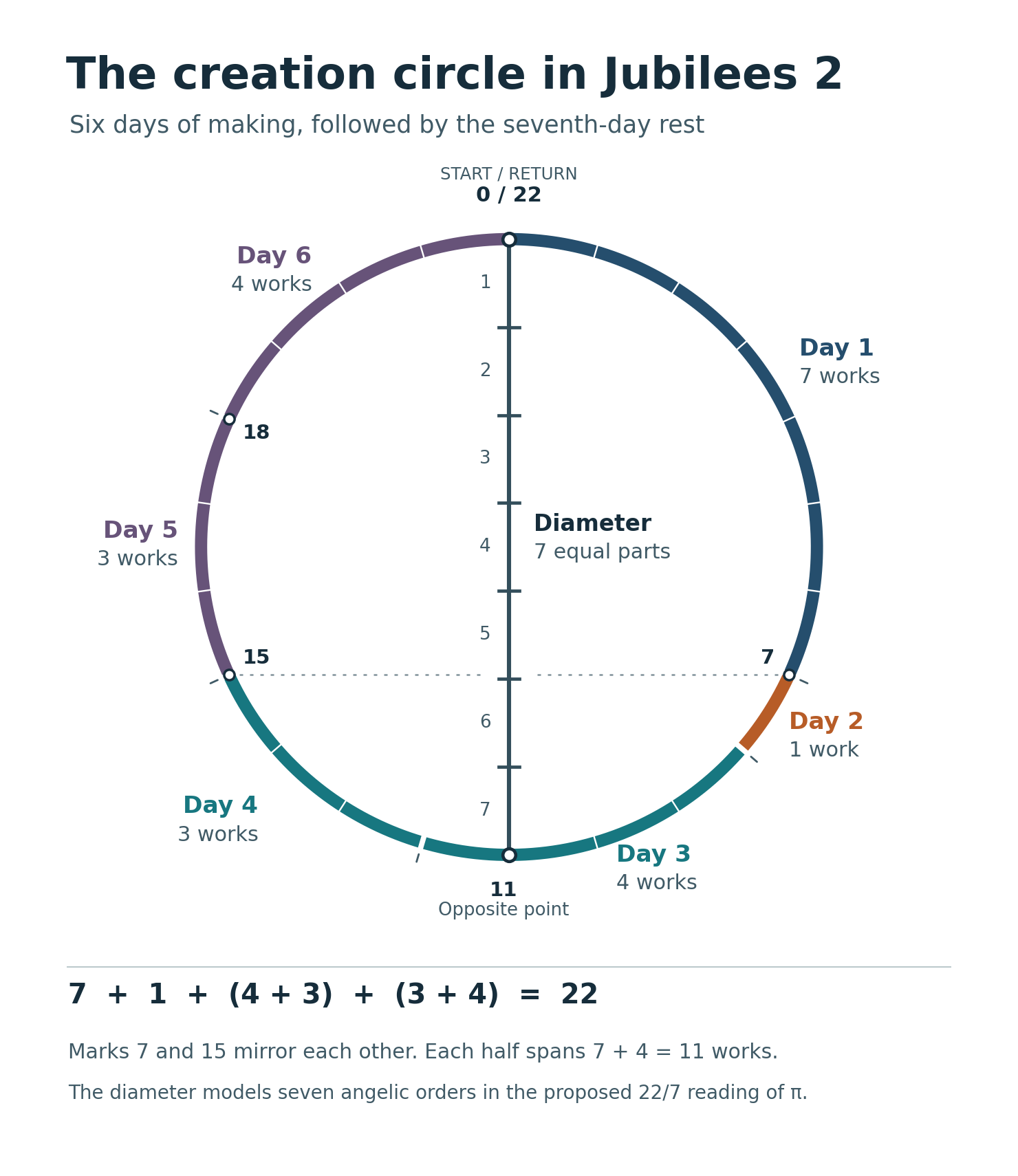
The open question is whether Jubilees’ treatment of Jacob gives independent support for reading the twenty-two works as a circumference.
21 November 2026 · Shelah’s two positions and the Passover reading of 13–14
Agent 2-Trunk · Dean’s typological reading. Genesis 3:21 says that God clothed Adam and Eve in skins. It supplies neither a day for the clothing nor an account of a sacrifice. Exodus dates the slaughter of the Passover animal to twilight on the fourteenth. Blood marks the houses to be passed over when Egypt’s firstborn die. The spared Israelite firstborn are consecrated to God. Later God takes the Levites in place of Israel’s firstborn. Paul identifies Christ as the Passover sacrifice. Dean reads the model’s transition from exposure on Day/Year 13 to covering on Day/Year 14 in light of this passage from judgment to life. Genesis 3:21 · Exodus 12:3–14, 29; 13:1–2, 15 · Numbers 3:12–13; 1 Corinthians 5:7 · File 70 §3.4
Count Adam as 1. Arphaxad is 12th in both lists, so his immediate son is 13th in each. In the MT that son is Shelah. In the selected LXX and Luke, the son is second Cainan, followed by Shelah, 14th, Arphaxad’s grandson. In the retained-Cainan century scheme, Cainan’s closing boundary is Shelah’s opening boundary. With Moses’ close fixed at 1406 BC in the MT-based reconstruction, Shelah opens at 2806 BC in both counts: 4106 − 13 × 100 = 4006 − 12 × 100 = 2806. Dean reads Shelah’s two ordinal positions as a genealogical counterpart to the Day/Year 13–14 transition. The ordinal counts follow from the lists. The Passover correspondence is his interpretation. Genesis 11:12–15 in the MT · Luke 3:35–36 · File 54 §12.3 · File 69 §3.4A
The open question is how to label Shelah’s two positions at the shared boundary in the trunk diagram.
21 November 2026 · How Jubilees bears witness to the two sevens
Agent 2-Trunk · Dean’s method. Dean takes Genesis in the MT and LXX, together with Luke, as the scriptural controls for this study. He places Jubilees outside his canon of inspired Scripture and reads it as a providentially preserved historical witness to how some Second Temple Jews interpreted numbers in Scripture. Its value here lies in the calculations and explanations its author actually gives. Genesis 1:26–2:3; 3:17–21 · Luke 3:23–38
Genesis places humanity’s creation on Day 6 and God’s rest on Day 7. Dean infers a second sixth position at 6 + 7 = 13 and reads both one-day transitions together. 6 → 7 completes Creation in Sabbath rest. 13 → 14 moves from the Fall to covering and reconciliation, which he reads in light of Christ. Genesis narrates the Fall and the covering without dating them. File 69 §§2.15, 5B · File 70 §3.4
Leviticus 12 gives 7 + 33 = 40 days after a male birth and 14 + 66 = (7 + 7) + (33 + 33) = 80 after a female birth. Jubilees 3:8–14 explicitly connects those periods with Adam’s and Eve’s entry into Eden. It places the woman’s presentation in the second week, which File 53 §5 narrows by inference to Day 13. Jubilees 3:15–17 places the serpent’s approach after seven years in Eden. Dean’s reading is that Jubilees brings the repeated sevens and the doubling into the foreground, making the two single-day transitions less visible. This describes the emphasis he sees in the surviving text. Leviticus 12:2–5 · Jubilees 3 · File 53 §§5–6
The open question is how the two completions should be shown beside Jared and second Cainan at the sixth place in successive groups of seven. Preceding observation
21 November 2026 · Jared and second Cainan at the sixth place in two heptads
Agent 2-Trunk · Dean’s Creation and restoration reading. Genesis 1 places the creation of humankind, male and female, on Day 6. Genesis 2–3 recounts the woman’s formation, the Fall and God’s provision of clothing. Genesis gives no numbered day for the Fall. File 07 §§3.2–3.4 places Eve’s separate formation and the Fall on Day/Year 13 in its MT-based projection. File 70 reads Day 14 as covering and reconciliation. Jubilees distinguishes the second-week appearance of the woman from the serpent’s approach after seven years in Eden (Jubilees 3:15–17). Genesis 1:26–31; 2:21–25; 3:17–21 · File 07 §§3.2–3.4 · File 53 §6 · File 70 §3.4
Counting Adam as 1 and retaining second Cainan, Jared is 6th, Enoch 7th, and second Cainan 13th. Jared and second Cainan are therefore seven positions apart, each sixth in his own group of seven. File 69 §3.4A already associates Jared’s sixth position with Day 6 and gives both divisions of the thirteen rows: 6 + 7 and 7 + 6. Dean reads the correspondence of positions 6 and 13 with Days 6 and 13 alongside the preceding Christ–Enoch comparison. File 69 §3.4A · Christ’s allotted generation
On Luke’s century scale the two independent expansions of 6900 produce 7000 (×70/69, gain 100) and 7500 (×25/23, gain 600). Holding Christ’s opening at 0 with second Cainan retained gives Enoch −6900 → Jared −7000 → Adam −7500 as one reads backward. Holding Christ’s schematic close at +100 in the omission comparison gives Enoch −6800 → Jared −6900 → Adam −7400. Each reading takes one century back to Jared, then five more to Adam. The shared 1 + 5 counts schematic generations. File 54 §6.1 · Earlier fixed-endpoint calculation
The question for the trunk diagram is how to show the two sixth positions alongside the one-plus-five return to Adam.
21 November 2026 · Christ’s allotted generation and the return to Enoch’s coordinate
Agent 2-Trunk · Dean’s typological interpretation. Genesis says that God took Enoch, and Hebrews describes his escape from death through faith. First Peter says Christ suffered for sins to bring us to God, “the righteous for the unrighteous.” Dean reads Christ’s whole allotted generation as supplying the century lost when second Cainan is omitted from the schematic count. Genesis 5:21–24 · Hebrews 11:5 · 1 Peter 3:18
With second Cainan retained, Enoch’s opening at −6900 reaches Christ’s opening at 0 in 6900 years. With Cainan omitted for comparison, Enoch’s opening at −6800 reaches the close of Christ’s allotted century at +100 in the same 6900 years. Holding +100 fixed and applying 6900 × 70/69 = 7000 gives +100 − 7000 = −6900. This recovers the position at which Enoch opens in the retained count. In the omission count, Jared still opens at that position and Enoch at −6800. The operation changes the measured span; the omission count still has one fewer name. File 43 §3.4 · File 46 §1 L2 · Prior comparison of Enoch’s opening
The open diagram question is how to mark the recovered −6900 coordinate while retaining its different names in the two counts.
21 November 2026 · From Enoch’s opening to either boundary of Christ’s generation
Agent 2-Trunk · Dean’s clarification. Luke names Enoch in Jesus’ ancestry. Dean starts at Enoch’s opening in both counts. On the century scale, retaining second Cainan gives −6900 → 0 = 6900, from Enoch’s opening to Christ’s opening. Omitting second Cainan for comparison gives −6800 → +100 = 6900, from Enoch’s opening to Christ’s closing. Both ends move forward one century. The named starting event and the elapsed span are preserved.
File 43 §3.4 supplies the retained 70-year rows, Enoch at 4836–4766 BC and Christ at 6 BC–AD 65. In the century comparison, +100 denotes the completion of Christ’s allotted generation. Luke 3:23–38 · File 43 §3.4 · Earlier matched-boundary calculation
The next diagram question is how to show both arrows beginning at Enoch’s opening while identifying the two different Christ boundaries.
21 November 2026 · Enoch and Christ at the two ends of their allotted generations
Agent 2-Trunk · Dean’s boundary observation. Genesis says God took Enoch; Luke names Enoch in Jesus’ genealogy. On the selected Luke count with second Cainan retained, File 43 gives Enoch the allotted generation 4836–4766 BC and Jesus the generation 6 BC–AD 65. Both beginnings and both endings stand 69 intervals apart. The dates measure positions in the model’s genealogy. Genesis 5:21–24 · Luke 3:23–38 · File 43 §3.4, both dated rows · File 54 §§4.1, 6.1
| Enoch → Christ | Luke at 70 years per interval | Same rows at 100 years per interval |
|---|---|---|
| Opening → opening | 4836 BC → 6 BC = 4830 | −6900 → 0 = 6900 |
| Closing → closing | 4766 BC → AD 65 = 4830 (4766 + 65 − 1) | −6800 → +100 = 6900 |
Advancing both ends by one interval preserves the distance. Advancing only Christ’s end gives −6900 → +100 = 7000, the forward counterpart to holding Christ at 0 and going back to Jared at −7000. Both realize 6900 × 70/69. File 46 already gives the forward 70-year example, 4836 BC → AD 65 = 4900. File 46 §1 L2
When second Cainan is omitted for comparison, Enoch’s row is −6800 to −6700. Both matched-boundary spans to Christ are then 6800. The earlier number 6900 still occurs from −6800 to +100, now pairing Enoch’s opening with Christ’s closing. The open question is which of these correspondences Dean wants to carry into the trunk diagram. Earlier Enoch boundary comparison
21 November 2026 · Which Enoch boundary moves when second Cainan is omitted?
Agent 2-Trunk · Dean’s clarification. Luke traces Jesus’ descent back through Enoch, Jared, Mahalalel and Adam to God. In File 43’s selected list, which retains second Cainan and counts one Ram, Jared’s allotted row closes when Enoch’s opens. With Christ fixed at 0 and 100 years per interval, omitting second Cainan for comparison moves every earlier named boundary one century toward Christ. Luke 3:23–38 · File 43 §§2.2, 3.4 · File 54 §§4.1, 6.1
| Signed year | Second Cainan retained | Second Cainan omitted for comparison |
|---|---|---|
| −7600 | Figurative God row opens | Outside the count |
| −7500 | Adam opens | Figurative God row opens |
| −7400 | Seth opens | Adam opens |
| −7100 | Mahalalel opens | Kenan opens |
| −7000 | Jared opens | Mahalalel opens |
| −6900 | Jared closes; Enoch opens | Mahalalel closes; Jared opens |
| −6800 | Enoch closes; Methuselah opens | Jared closes; Enoch opens |
Dean’s Enoch-close to Enoch-opening correspondence occurs at −6800. At −6900, the two openings belong to Enoch and Jared respectively. Measured from Christ, 6900 × 70/69 gives 7000, and 6900 × 25/23 gives 7500 in either count. The retained count reads Adam → 500 → Jared → 100 → Enoch; the omission comparison reads figurative God row → 500 → Mahalalel → 100 → Jared. File 54 §6.1 records the retained-count result at 70 years per interval. Dean’s interpretation pairs the two sequences on the century scale. In File 69 the God row represents Luke’s closing words about Adam’s sonship; assigning that row a boundary makes no claim about God’s age. File 69 §3.4B · Earlier Jared–Enoch comparison
The open question is which Enoch boundary Dean wishes to emphasize on the existing Mirror diagram.
21 November 2026 · Luke’s Jared–Enoch boundary and the two 6,900-year expansions
Agent 2-Trunk · Dean’s Jared–Enoch comparison. Genesis places Enoch after Jared and tells how God took him. Luke traces Christ’s line back through Enoch and Jared to Adam and God. In the selected Luke count, with second Cainan retained, File 54 gives Jared’s row as 4906–4836 BC. The close of Jared’s allotted row and the opening of Enoch’s row share 4836 BC. Genesis gives Jared a lifetime of 962 years. Genesis 5:18–24 · Luke 3:23–38 · File 54 §4.1
File 54 §6.1 already gives the two results with Christ fixed at 6 BC. From Enoch’s 4,830 years, multiplication by 70/69 gives 4,900 to Jared’s opening at 4906 BC, and multiplication by 25/23 gives 5,250 to Adam at 5256 BC. File 46 also illustrates the 4,900 by holding Enoch at 4836 BC and advancing to AD 65. Changing from 70 to 100 years per interval multiplies these lengths by 10/7, giving 6900, 7000 and 7500. File 54 §6.1 · File 46 §1, L1–L3 · File 43 §2.2 · File 15 §6.1
| Fixed endpoint | Older endpoint at 6900 | At 7000 (×70/69) | At 7500 (×25/23) |
|---|---|---|---|
| Luke, Christ at 0 | −6900, Enoch opens | −7000, Jared opens | −7500, Adam opens |
| MT-based Mirror, +3400 | −3500 | −3600 | −4100 |
| MT-based Mirror, +3500 | −3400 | −3500 | −4000 |
From the common input, the gains are 100 and 600. Looking forward from Luke’s Adam, five centuries reach Jared’s opening and one more reaches Enoch’s. The +3400 Mirror row preserves those named positions in the 27-generation MT-based scheme. The +3500 row uses the other Enoch endpoint; −4000 is the shorter scheme’s Creation coordinate. Dean’s contribution is the comparison of the Luke and MT readings at different fixed endpoints. The early names share the same order, so the two appearances of the five-plus-one sequence depend in part on the same genealogy. Earlier MT Mirror test
In the regular Rounded MT, Adam at 4106 BC to Jared at 3646 BC gives 460 years, which ×25/23 gives 500. In the Luke comparison omitting second Cainan while keeping Christ fixed, Enoch opens at −6800. The five-plus-one sequence persists, but only the retained-Cainan reading gives 6,900 here. File 51a §8.1
The open question is what the MT crossing adds to the Jared–Enoch relationship already expressed on Luke’s side of Christ.
21 November 2026 · Two 11,500-year spans between Luke’s Adam and Matthew’s Abraham
Agent 2-Trunk · Dean’s genealogy comparison. Matthew traces Abraham’s line forward to Christ. Luke traces Christ’s line backward through Abraham and Adam to God. On the diagram, Adam from Luke and Abraham from Matthew can therefore be placed on opposite sides of the Christ origin. Dean reads this reversal as a possible sign of providential design. Matthew’s own list ends at Abraham when read backward. Matthew 1:1–17 · Luke 3:23–38 · Direction of the two lists
| Century-scale comparison | Luke’s Adam | Matthew’s Abraham across the Mirror | Elapsed years |
|---|---|---|---|
| Second Cainan retained in Luke; Jeconiah counted once in Matthew | −7500 | +4000 | 11,500 |
| Second Cainan omitted for comparison; Jeconiah counted at both exile boundaries in Matthew | −7400 | +4100 | 11,500 |
File 43 §5.1 already adds the two 70-year spans, 5250 + 2800 = 8050. Changing the unit from 70 to 100 scales that sum by 10/7 to 11,500 = 5 × 2300. This establishes the first row directly. Dean’s second row moves both endpoints 100 years to the right: one interval leaves Luke’s count and one enters Matthew’s count. The difference between the endpoints stays fixed. The selected Luke inventory in the files retains second Cainan. The 74-interval row is a controlled comparison made by omitting him from that inventory. The exile-bearing head follows File 69 §3.4B. File 43 §§2.2, 3, 5.1 · File 69 §3.4B · File 15 §6.1
The midpoint moves with the span. The first pair centers at −1750, already the center of the Enoch-to-Christ diameter from −3500 to 0. The second centers at −1650. Luke–Enoch diagram
The open question is what this one-century shift contributes to the existing Mirror construction.
21 November 2026 · Matthew and Luke read in opposite directions
Agent 2-Trunk · Dean’s clarification. Matthew traces the line forward from Abraham to Jesus Christ. Read backward from Christ, his list stops at Abraham. Luke begins with Jesus and follows the line back through Abraham to Adam, then to God. Dean compares these opposite literary directions with the two directions across the Mirror. The −4000 and −4100 correspondences in the previous entry align Matthew’s Abraham with the two schematic Adam positions on the chart. The alignment belongs to the comparison; Matthew gives no pre-Abraham genealogy or indication that he intended such an extension. Matthew 1:1–17 · Luke 3:23–38 · Earlier arithmetic and sources
The open diagram question is how to label Abraham and Adam at the shared coordinates while showing each genealogy’s own direction.
21 November 2026 · Matthew’s Abraham at the two Adam positions
Agent 2-Trunk · Dean’s Matthew comparison. Matthew begins with Abraham and counts three groups of fourteen to Christ (Matthew 1:1, 17). Counting Jeconiah once gives 41 distinct figures and 40 intervals. Counting him on both sides of the exile gives 42 positions and 41 intervals. On the repository’s 70-year scale, Abraham’s ordinary head is 2806 BC and the exile-overlap head is 2876 BC. Measured from the 6 BC birth hinge, these are −2800 and −2870. At 100 years per interval they become −4000 and −4100, the two Adam positions on Dean’s reconstruction with Moses fixed at −1400. The shorter count omits second Cainan; the longer includes him. The dates coincide on the chart; Matthew’s genealogy itself starts with Abraham. Matthew 1:1–17 · File 43 §§3.1–3.3 · File 69 §3.4B · File 15 §6.1
File 69 §3.4D identifies 1406 BC as the midpoint of both 2806 BC → 6 BC and 2876 BC → AD 65. Applying the same 10/7 scaling about 6 BC to both ends gives −4000 to 0 and −4100 to +100, each centered at −2000. Luke’s −7500 to the mirrored Enoch opening at +3500 already has this midpoint. The reflected center is +2000. The −2000 represents the rescaled Matthean midpoint; the MT Conquest marker still stands at −1400 on its own ruler. File 69 §3.4D · Luke–Enoch diagram
On the longer Enoch scheme, the 11,000 years from −7500 to +3500 divide at Enoch’s opening (−3500) into 4000 + 7000, or at his close (−3400) into 4100 + 6900. Matthew thus supplies two genealogically counted lengths already present within the Luke–Enoch span.
The next question is how best to label Matthew’s two Abraham positions and their common midpoint on the existing diagram.
21 November 2026 · Luke and Enoch on the common horizon
Agent 2-Trunk · Dean’s requested diagram. In the 100-year scheme with second Cainan included, Luke’s Adam stands at −7500, the MT-based Enoch opens at −3500, and Christ stands at 0. From −3500 to the Mirror of Luke’s Adam at +7500 is 11,000 years. The reflected span runs from −7500 to +3500. Their midpoints are +2000 and −2000 respectively, the same signed dates as the inward Shelah endpoints. Luke’s 75 intervals and the two Enoch rows · Shelah’s dated endpoints
The first drawing uses the working value 22/7. A circle between Enoch and Christ has diameter 3,500 and circumference 11,000. Its reflected partner lies on the other side of zero. The two Enoch openings at −3500 and +3500 give a diameter of 7,000. Its upper semicircle and lower reflection each have arc length 11,000. In the companion drawing each 11,000-year span itself serves as a straight diameter. The two resulting circles have radius 5,500 and centers at the signed Shelah endpoints. Both drawings retain the preferred common-horizontal construction.
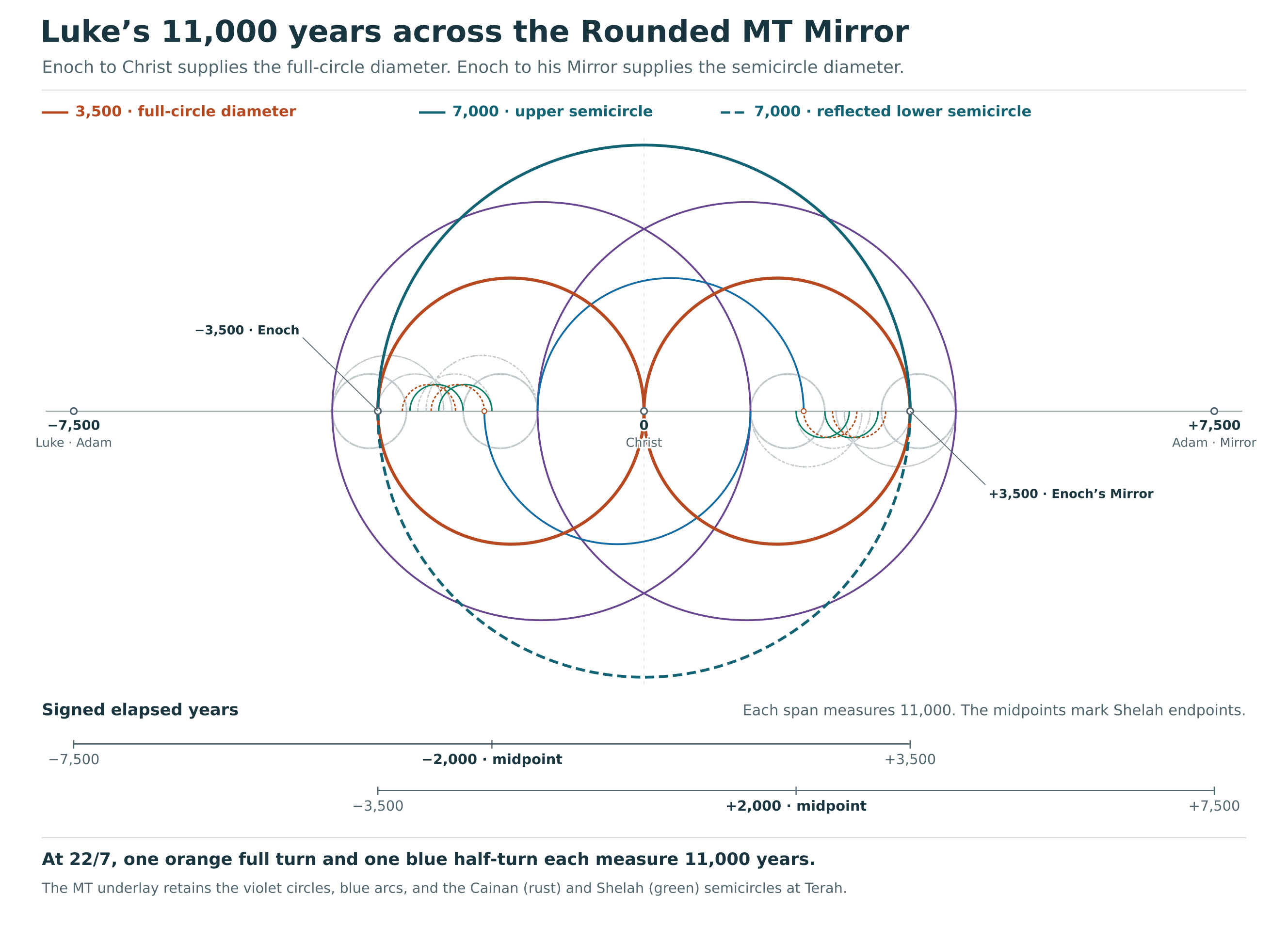
Full-size diagram · Circles centered at the two Shelah endpoints · Both drawings as a PDF · Drawing source
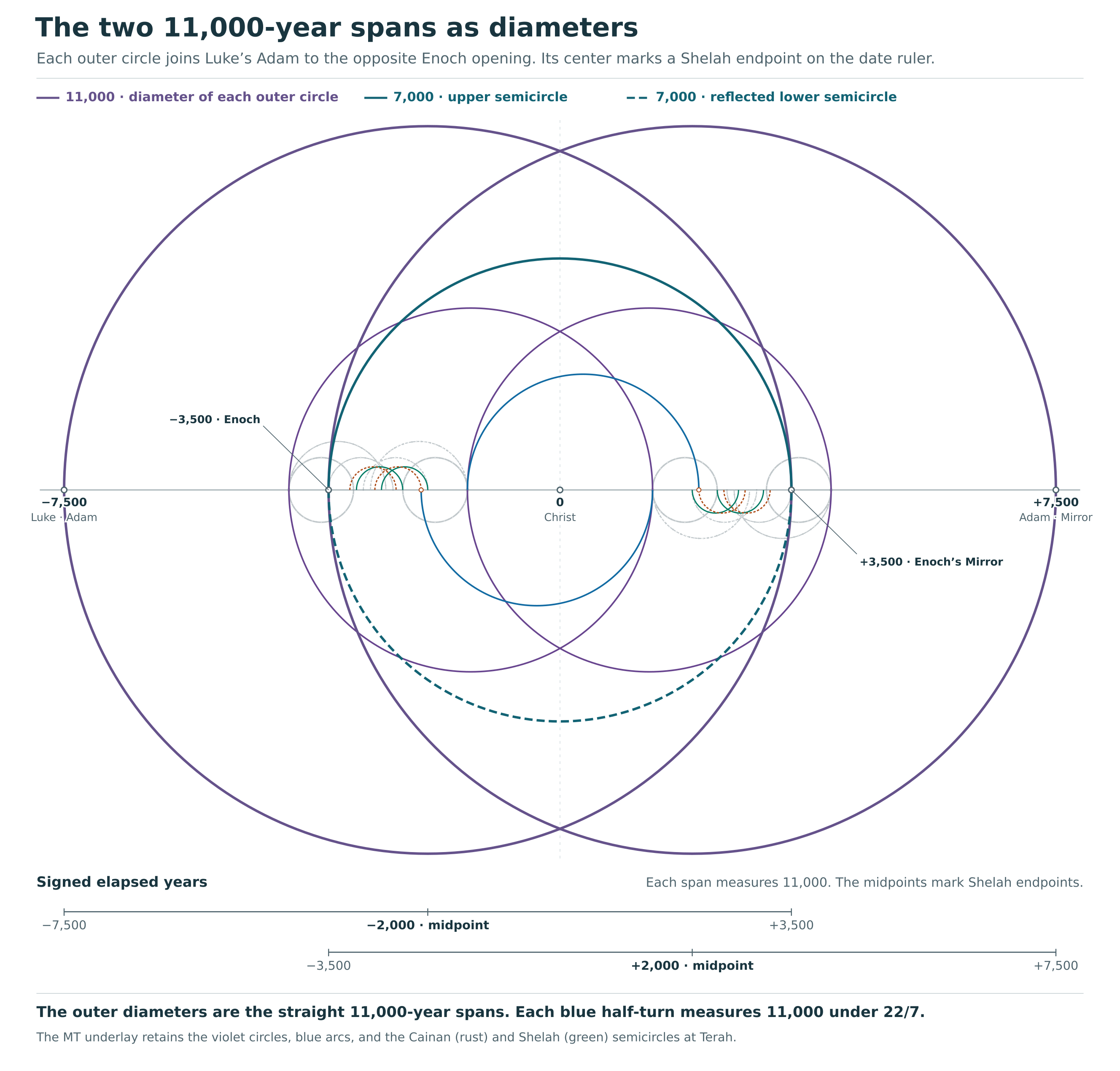
The next question is what the shared ±2000 position contributes to Dean’s reading of the Shelah and Cainan pairs.
21 November 2026 · Luke’s 75 intervals and Enoch across the Mirror
Agent 2-Trunk · Dean’s Luke comparison. Luke 3:35–38 includes second Cainan and traces the genealogy through Enoch and Adam to God. On the repository’s 6 BC birth hinge, the selected count has 75 intervals from Adam to Christ. At 70 years per interval Adam stands at 5256 BC, signed −5250. Dean reads the same 75 intervals in centuries on the trunk chart. Adam then stands at −7500, preceded by the schematic “God” generation opening at −7600. The gospel supplies the names. These year assignments come from the model. Luke 3:23–38 · File 43 §2.2 · File 54 §§2, 4 · File 15 §2.2
With second Cainan included in the 27-century reconstruction on the Rounded MT anchors, the signed sequence is Luke Adam −7500 → 3400 years → MT-based Adam −4100 → 700 years → Enoch taken −3400 → 3400 years → Christ at 0. Luke’s own century-scale Enoch slot, −6900 to −6800, lies 3,400 years earlier than the corresponding −3500 to −3400 slot throughout.
The cross-Mirror span from Enoch’s opening at −3500 to the reflection of Luke’s Adam at +7500 measures 11,000 years. Its reflection runs from −7500 to +3500. At the working ratio 22/7, 11,000 is one circumference for a diameter of 3,500, or half a circumference for the 7,000 between the two Enoch openings. The earlier Mirror diagram already has a 3,500 diameter and a 5,500 half-circumference. What Luke adds here is a genealogically counted endpoint for twice that arc. Preferred Mirror diagram · Enoch’s 6,900-year comparison
The next question is how the ±2000 midpoints of the two 11,000-year spans fit the previously plotted Shelah endpoints.
21 November 2026 · Enoch’s two 6,900-year Mirror diagonals
Agent 2-Trunk · Dean’s Jared–Enoch observation. Genesis 5:18–24 places Enoch after Jared. With Moses’ close fixed at −1400, the 27-century reconstruction opens Creation at −4100, assigns Jared −3600 to −3500 and Enoch −3500 to −3400. Enoch’s birth on one side to his close on the other gives 6,900 in either direction. Schematic generations
| Fixed Mirror endpoint | Original BC-side endpoint | After 70/69 (7,000) | After 25/23 (7,500) |
|---|---|---|---|
| +3500 | −3400 | −3500 | −4000 |
| +3400 | −3500 | −3600 | −4100 |
Each multiplication starts with 6,900. Holding −3400 instead gives +3500 → +3600 or +4100. The 600-year gain comprises Jared’s century and the five centuries from his opening back to Creation. In the long scheme that backward count is −3500 → −3600 → −4100. In the 26-century comparison without second Cainan it is −3400 → −3500 → −4000. Jared occupies the long table’s Enoch slot in this shorter comparison. Short-table Enoch occupies −3400 to −3300 and gives 6,700 across the mixed birth/close endpoints. These are schematic generations of 100 years. Moses-fixed comparison
File 22 §7.10 already derives 6,900 = 4,600 + 2,300 = 15 × 460 from its Jared-to-restored-Cainan-birth composite and applies both multipliers. Dean’s proposal relates those established operations to Enoch’s Mirror endpoints, the one-generation change of name and the five-plus-one count. The 7,000 route between −3500 and +3500 measures twice the established 3,500-year Terah–Conquest diameter. The question is whether that shared measure gives any further independently dated connection to the circle. File 22, Cumulative MT Harmonics · Mirror diameter at Terah
21 November 2026 · Preferred diagram for the one-generation shift
Agent 2-Trunk · Dean’s figure choice. Use the common-horizontal diagram first to show how the Cainan-centered path meets the large Mirror semicircle at Terah. Keep the staggered diagram alongside it to show the Cainan and Shelah crossings one century apart.
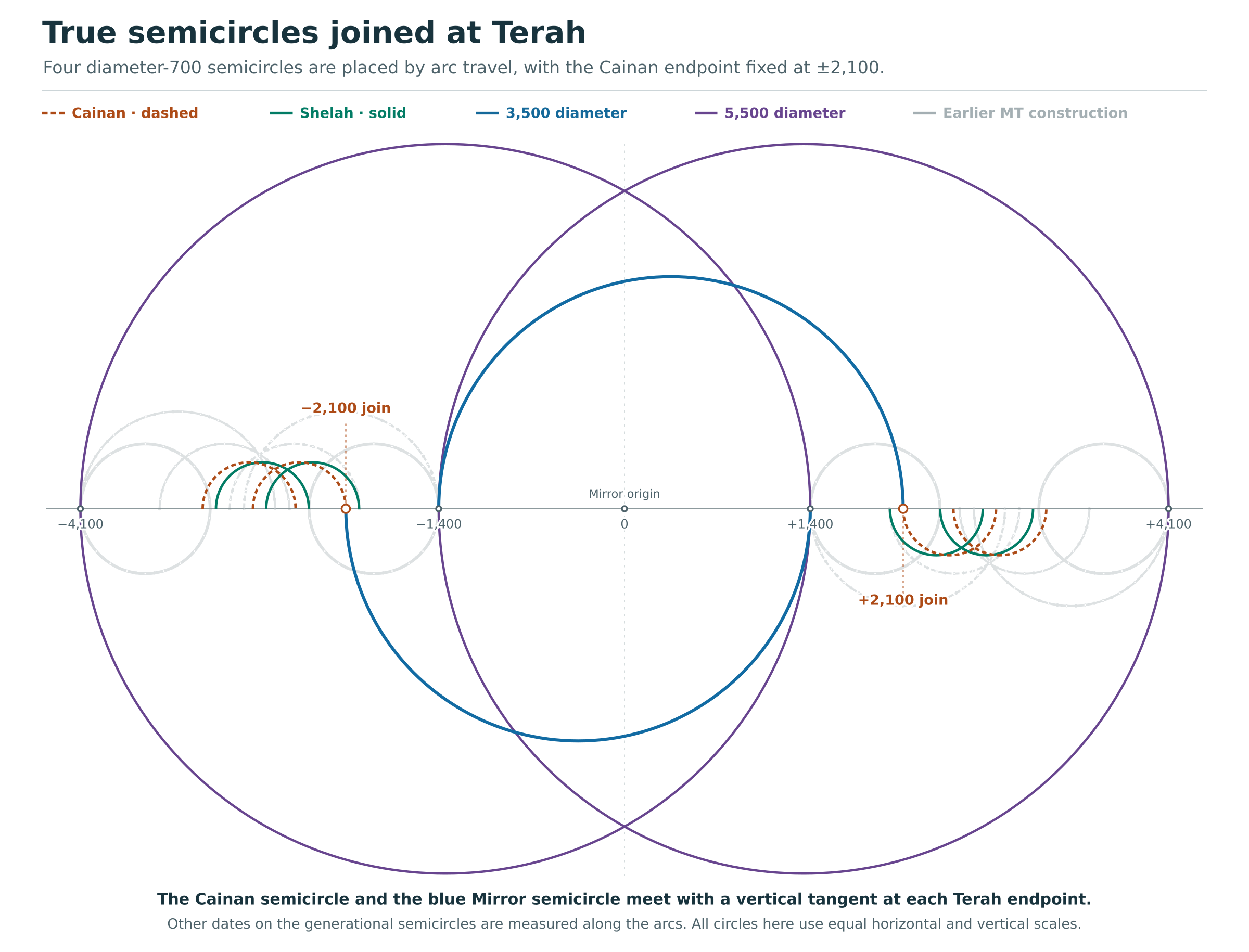
21 November 2026 · Cainan and Shelah in the staggered Mirror drawing
Agent 2-Trunk · Dean’s diagram. The smaller figures use the earlier staggered placement. The Noah and Shelah arcs cross on the central line at −2750 and +2750. A parallel pair of generational semicircles crosses that line a century farther out, at −2850 and +2850, the Cainan midpoints. The side figures are related by a half-turn about zero.
Each large circle joins Creation on one side to the opposite Conquest, across a diameter of 5,500. The upper blue semicircle runs from −1400 to +2100 and the lower from +1400 to −2100. Each has diameter 3,500 and a semicircumference of 5,500 under the 22/7 reckoning. Terah’s schematic date, read along the small Cainan arc, corresponds to the ±2100 endpoint on the blue arc. The staggered placement puts those marks at different heights. The drawing joined at Terah shows their common tangent when the endpoints are placed together. Previous author’s note · File 51a
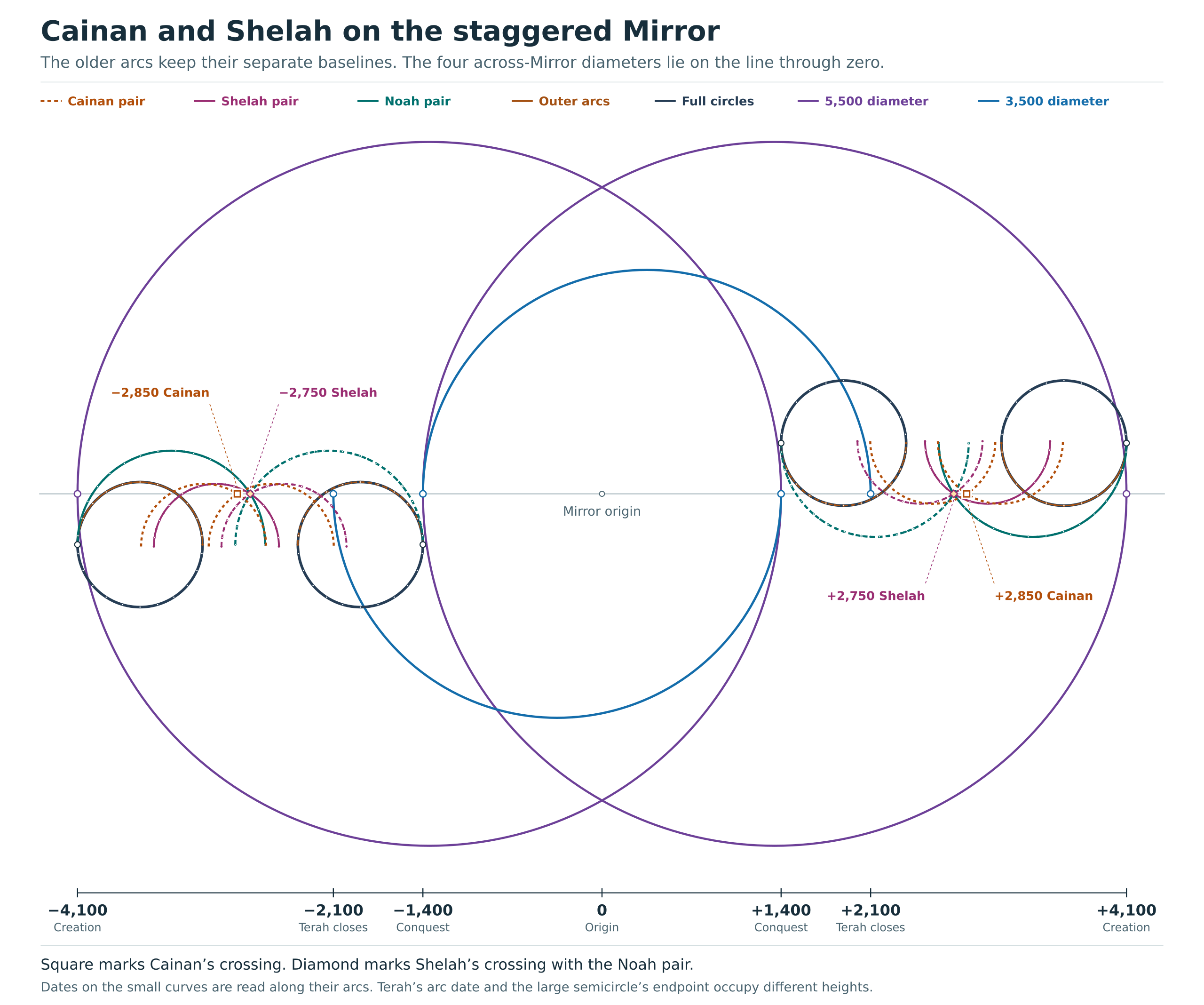
Full-size PNG · Enlarged detail · Two-page PDF · Vector drawing · Drawing source
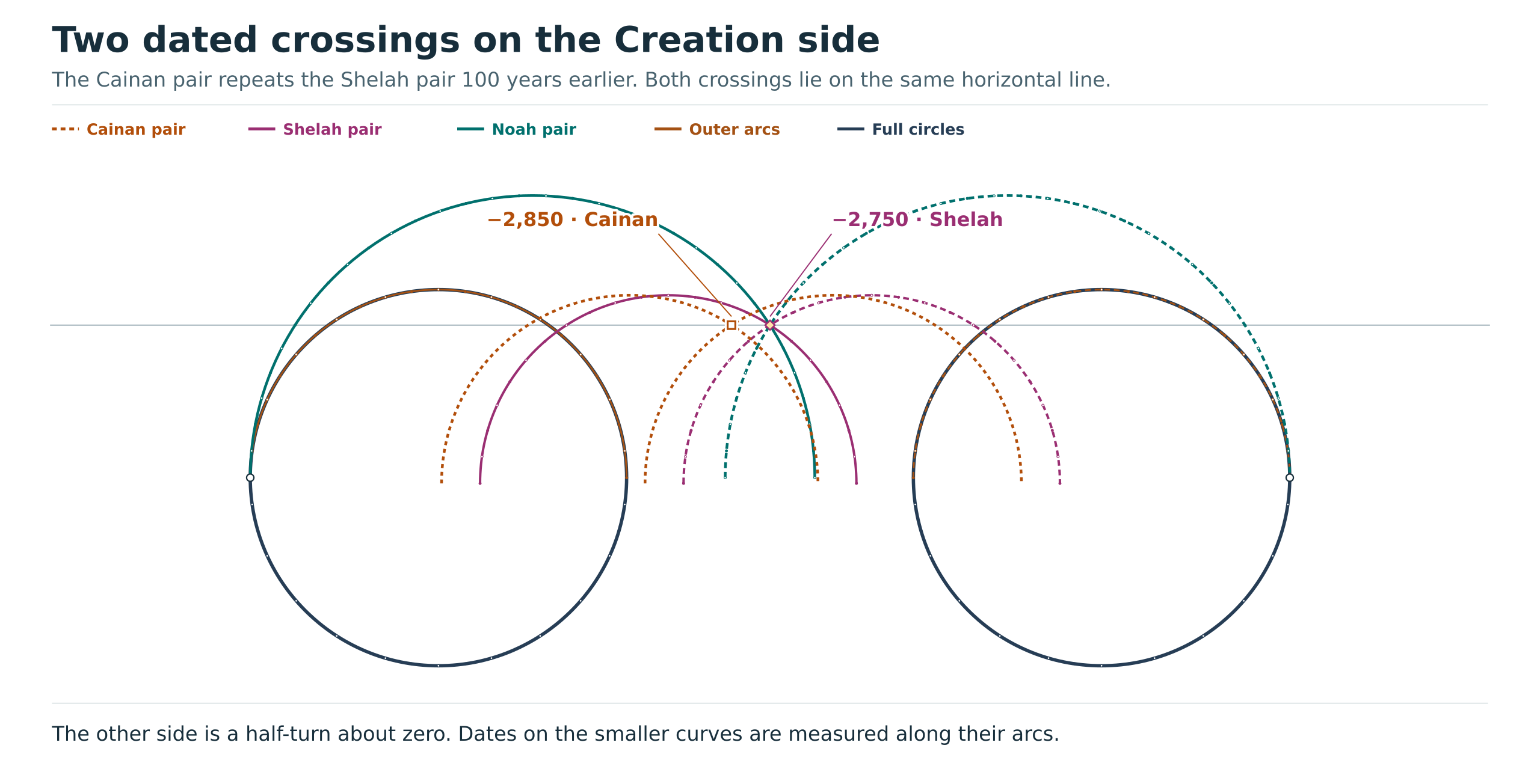
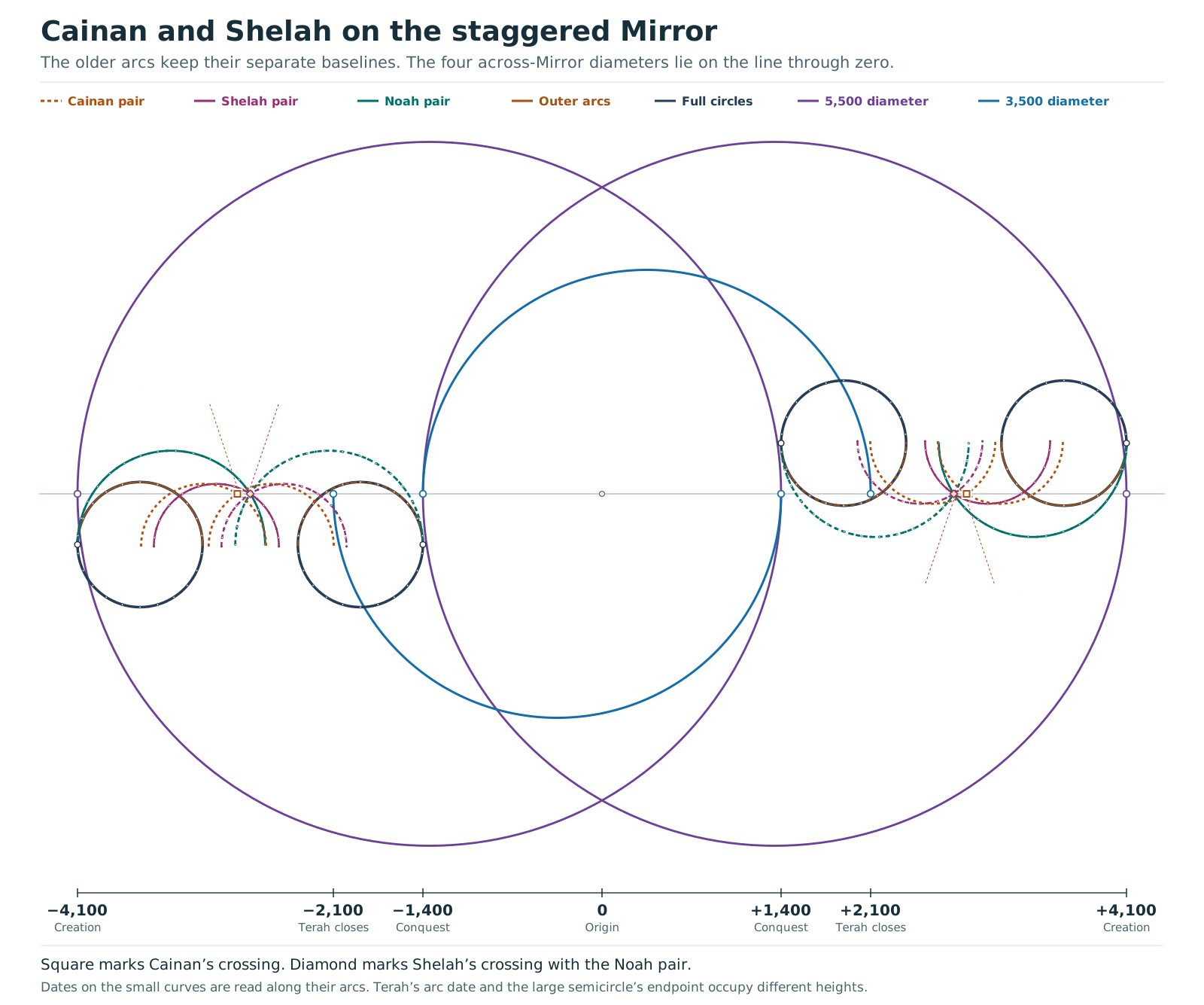
21 November 2026 · The one-generation shift across the Mirror
Agent 2-Trunk · Dean’s reading. Dean reads the small same-side figures as showing a deliberate one-generation displacement between the reckonings with and without second Cainan. The paired drawing uses one 27-name schematic grid to show its effect. Its two overlap centers, Cainan at 2,850 and Shelah at 2,750, stand a century apart. Across the Mirror, the Cainan-centered path reaches Terah at +2,100, where the large semicircle continues to the Conquest at −1,400. The reflected path joins at −2,100 and continues to +1,400. The shared endpoint restores alignment across the Mirror while the one-century difference remains visible on either side. Paired drawing and calculation · True semicircles at Terah
21 November 2026 · Cainan and Shelah on the same Mirror
Agent 2-Trunk · Dean’s paired reading. On the 27-generation schematic, each pair contains two 1,100-year paths. Reading the positive Mirror coordinates, Shelah’s pair spans 3500–2400 and 3100–2000. One century earlier on the BC side, the corresponding Cainan pair reads 3600–2500 and 3200–2100 in the Mirror. Each pair shares 700 years. The overlap runs from 2400 to 3100 about Shelah at 2750 and from 2500 to 3200 about second Cainan at 2850.
Cainan’s second path meets the large blue semicircle at +2100 on the date axis. From there the blue arc reaches the Conquest at −1400. The opposite side gives the same join at −2100. Shelah’s corresponding path ends at ±2000, a century away. The large semicircle repeats the generational measure fivefold. Its diameter is 3,500 = 5 × 700, and its semicircular arc under 22/7 is 5,500 = 5 × 1,100. Previous Mirror drawing · Generational boundaries · Working draft
The overview places each elapsed year on the signed date axis. The small arcs therefore span their full 1,100 years horizontally there. The second PDF page draws true generational semicircles with diameter 700 and places Cainan’s terminal point at ±2100. There the small and large arcs share a vertical tangent. The other generational dates on that page are read along the arcs. Dean’s proposal is that the two placements were intended to be read together.
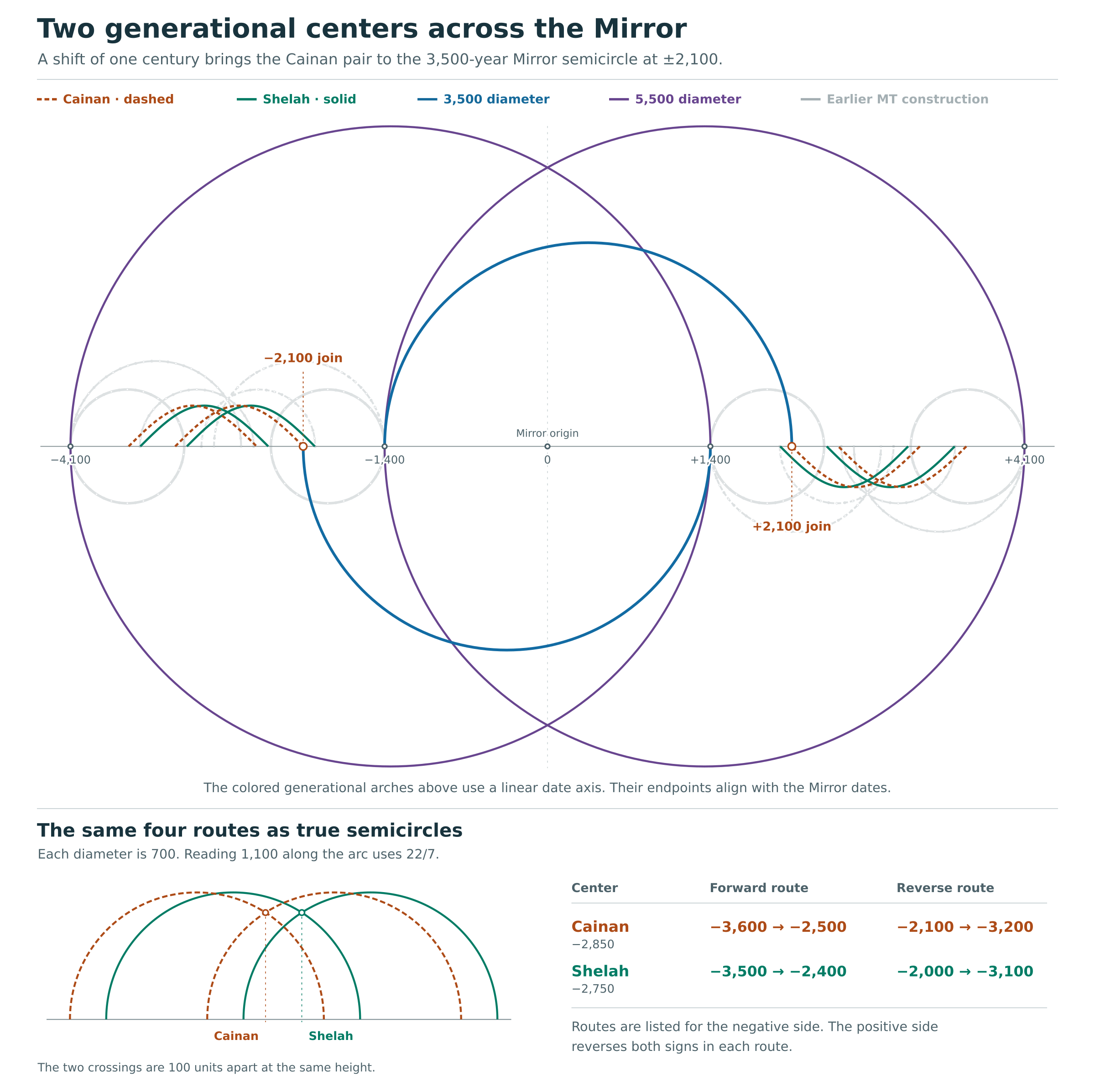
Date-axis drawing · True semicircles at the join · Both drawings in PDF · Vector drawing · Drawing source
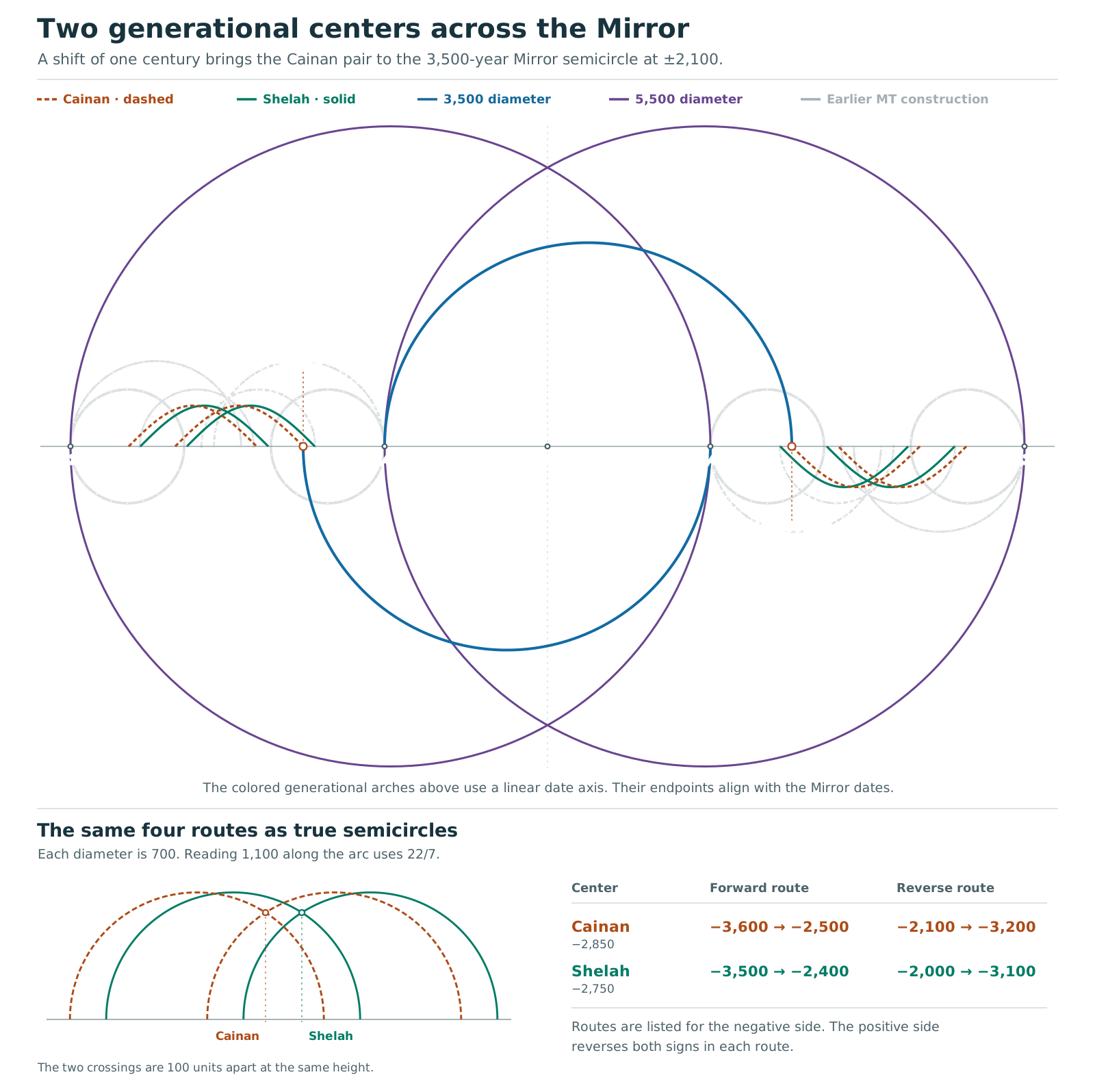
The remaining question is what, in the narrative, would call for reading both generations together.
21 November 2026 · Creation and Conquest on opposite sides of the Mirror
Agent 2-Trunk · Dean’s shifted circles. From Rounded MT Creation (4106 BC, signed −4100) to the Mirror of the Conquest (+1400) the diameter measures 5,500. Its reflected counterpart joins −1400 to +4100. On the common horizon, the semicircle from −1400 to +2100 runs above the axis. Its reflection from +1400 to −2100 runs below. Each diameter measures 3,500, so under the 22/7 reckoning either semicircular arc measures (3,500/2) × (22/7) = 5,500, one full-circle diameter.
On the 27-generation schematic with second Cainan included, −2100 is Terah’s close and Abram’s opening (2106 BC). Enoch’s opening (3506 BC, signed −3500) is 2,100 years before Moses’ close at −1400. The same 2,100 thus occurs as a signed magnitude at Terah and as an elapsed interval from Enoch. Schematic generation boundaries · Original common-axis drawing · File 51a, Rounded MT scaffold
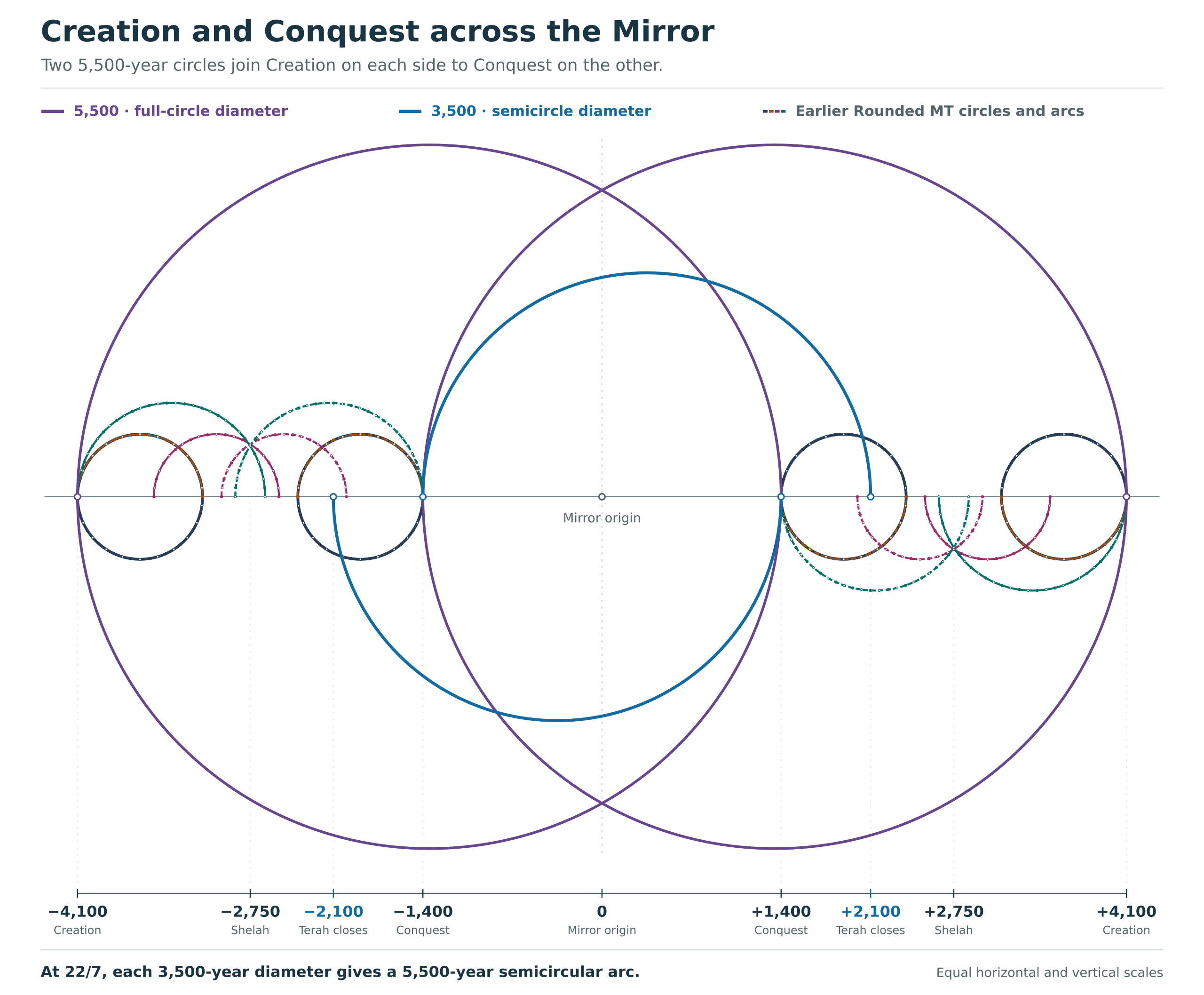
Full-size PNG · Print PDF · Vector drawing · Drawing source
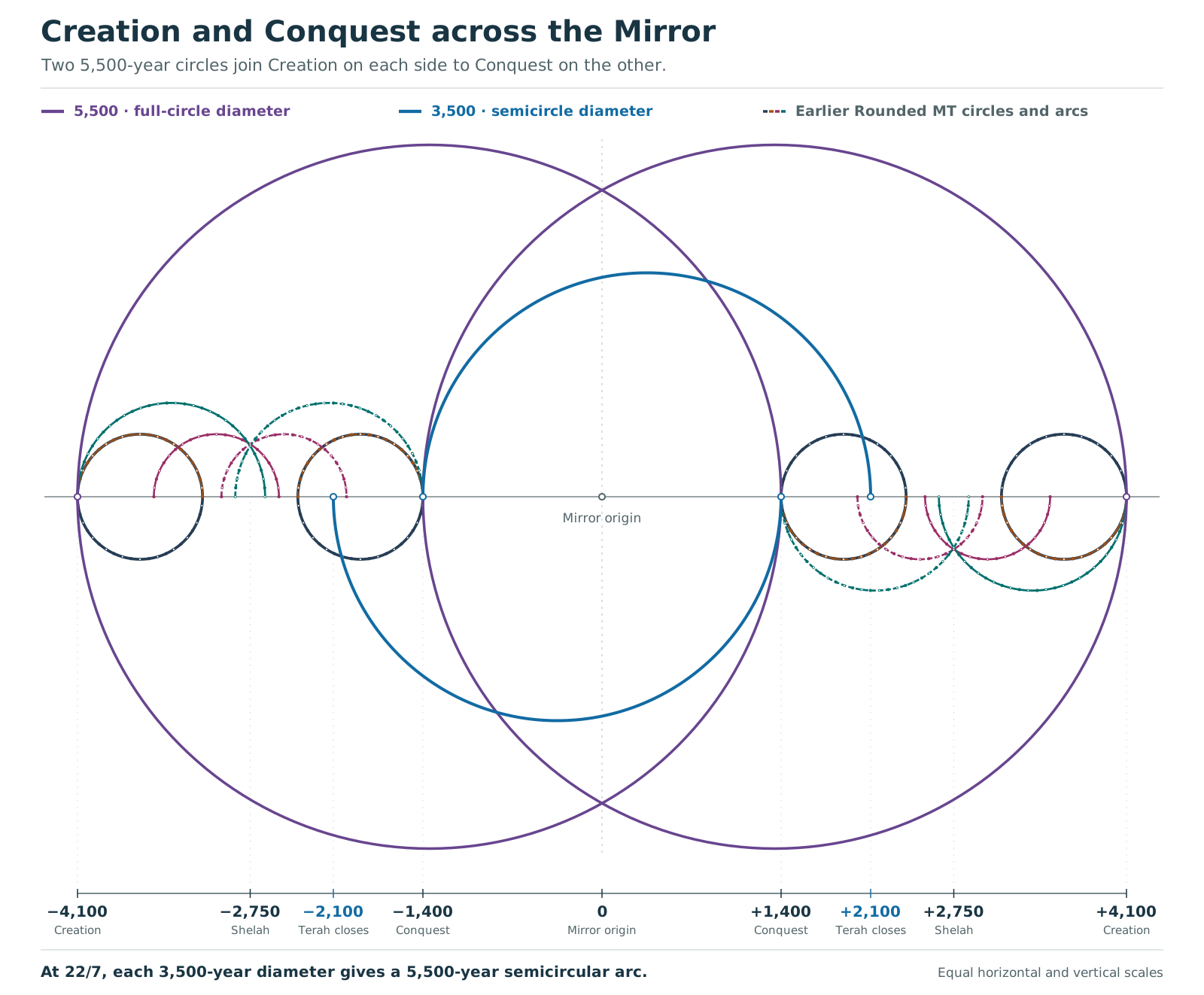
The open question is how Dean intends to relate the two readings of 2,100.
20 November 2026 · The complete circle on one horizontal axis
Agent 2-Trunk · Dean’s full-scale view. The circle centered at the Mirror origin has radius 2,750. Its horizontal diameter joins the two Shelah points at −2750 and +2750. Its highest and lowest points are the same distance above and below the horizon. The drawing uses one scale in both directions and shows the complete circumference. The two circles of diameter 1,750 touch it from within at the Shelah points. Common-horizon construction · Dean’s decision on the two perspectives
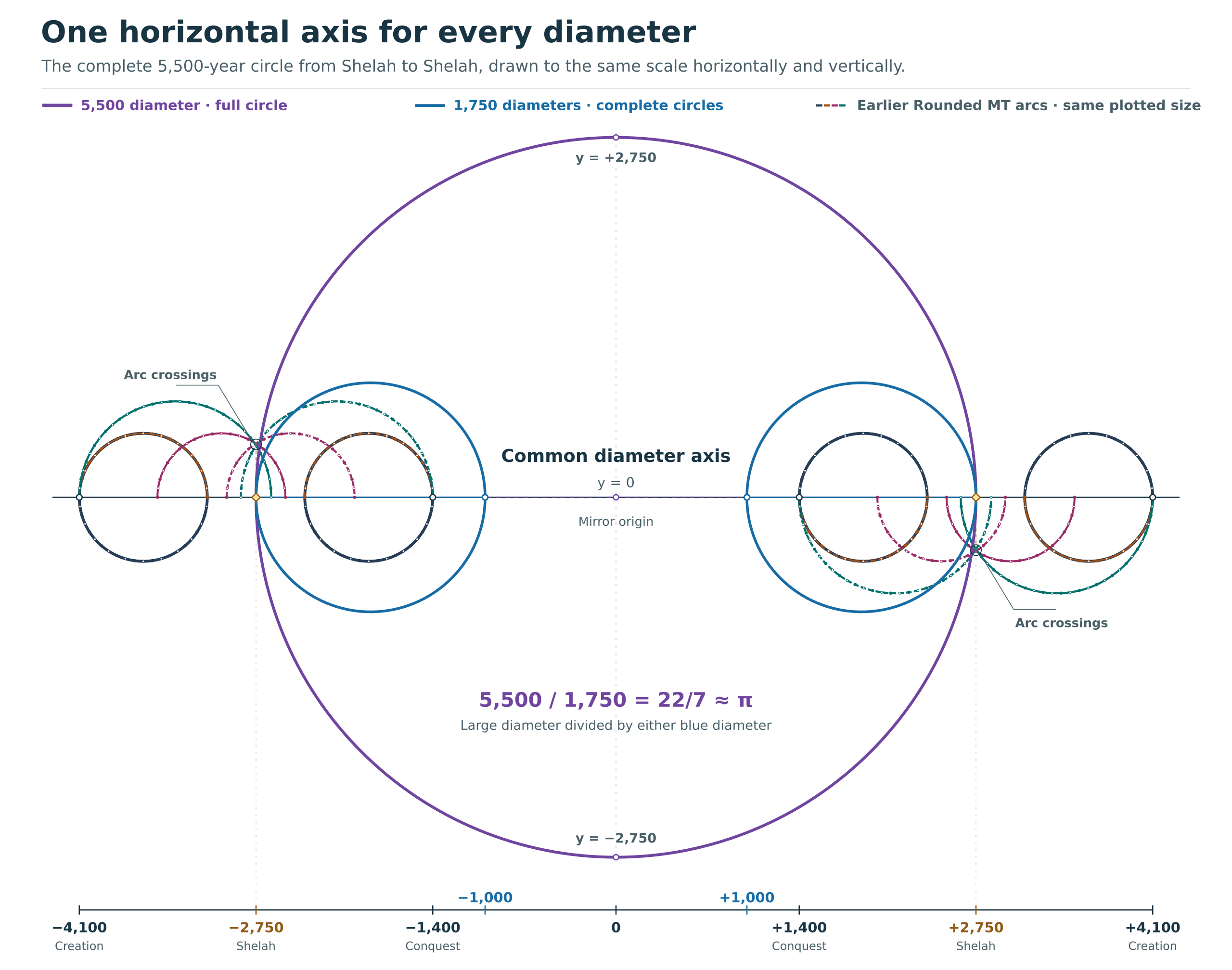
Full-size PNG · Print PDF · Vector drawing · Drawing source
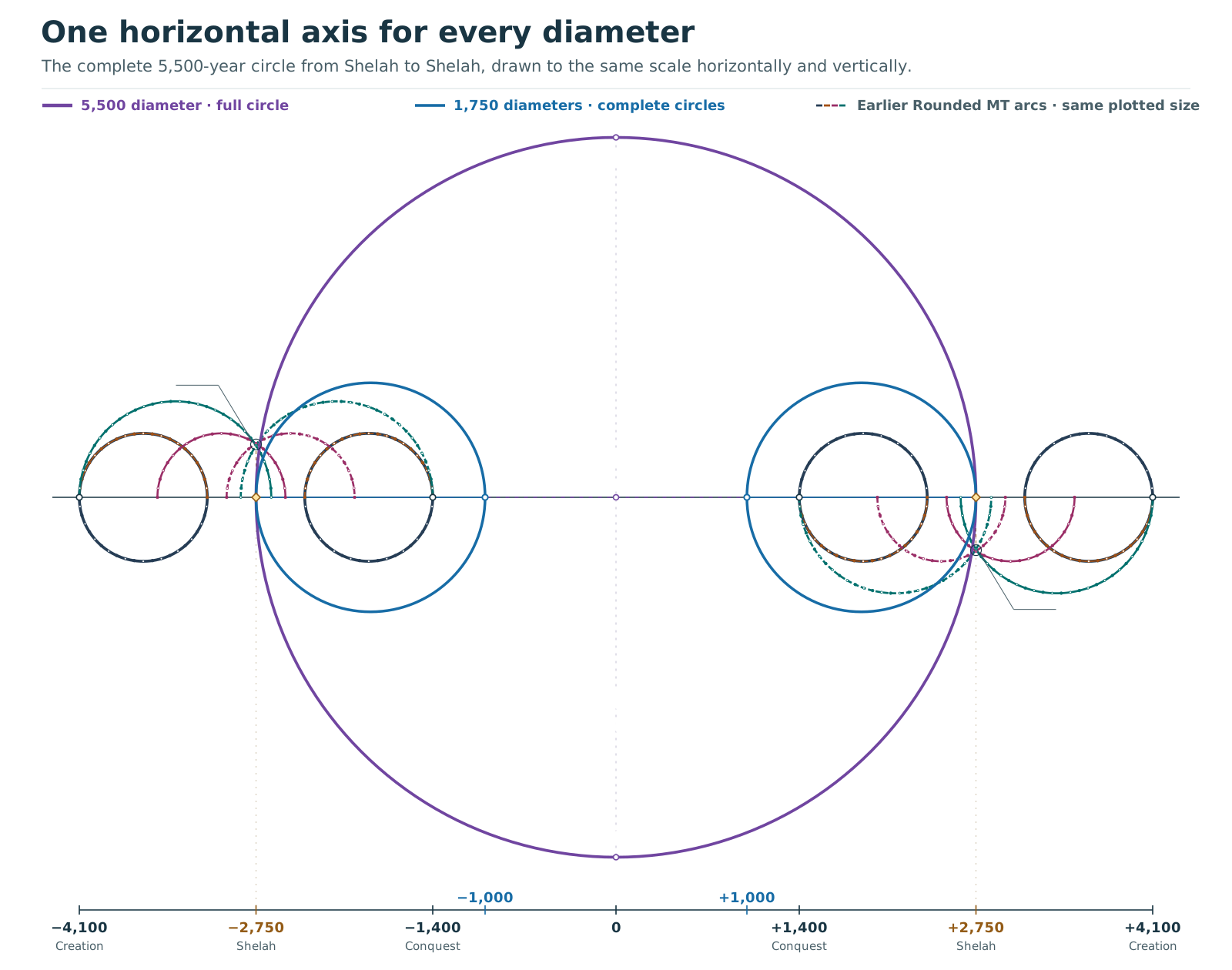
The open question remains whether the inward endpoints at ±1000 have independent chronological support.
20 November 2026 · Two views of Shelah at the center
Agent 2-Trunk · Dean’s decision. Both drawings are equally valid perspectives on the same Mirror construction. In the first, the older arcs cross where the blue and purple circles touch, at −2750 and +2750 on the horizon. In the second, every horizontal diameter lies on the horizon. The same Shelah dates mark the center of each figure, with the older arcs crossing directly above −2750 and below +2750. In both views the two Shelah points span 5,500 years and 5,500/1,750 = 22/7. View with crossings at Shelah · View with a common horizon
20 November 2026 · One horizontal axis for every diameter
Agent 2-Trunk · Dean’s question about the horizon. The earlier drawing placed the inner generational arcs and the Noah arcs so that their Shelah crossings coincided with the tangencies at −2750 and +2750. The three new circles already had their centers on this horizon. Moving each earlier curve vertically until its center also lies on the horizon puts every horizontal diameter on one line.
In this view the two pairs of older arcs still cross at the signed Shelah dates. Their crossings are at different heights above the line on the left and below it on the right. The new circles still touch on the line itself. The radii, the 180° reflection, and the exact ratio 5,500/1,750 = 22/7 hold in both drawings. Earlier placement of the Shelah crossings · Original calculated curves and placement options · File 51a, Rounded MT scaffold
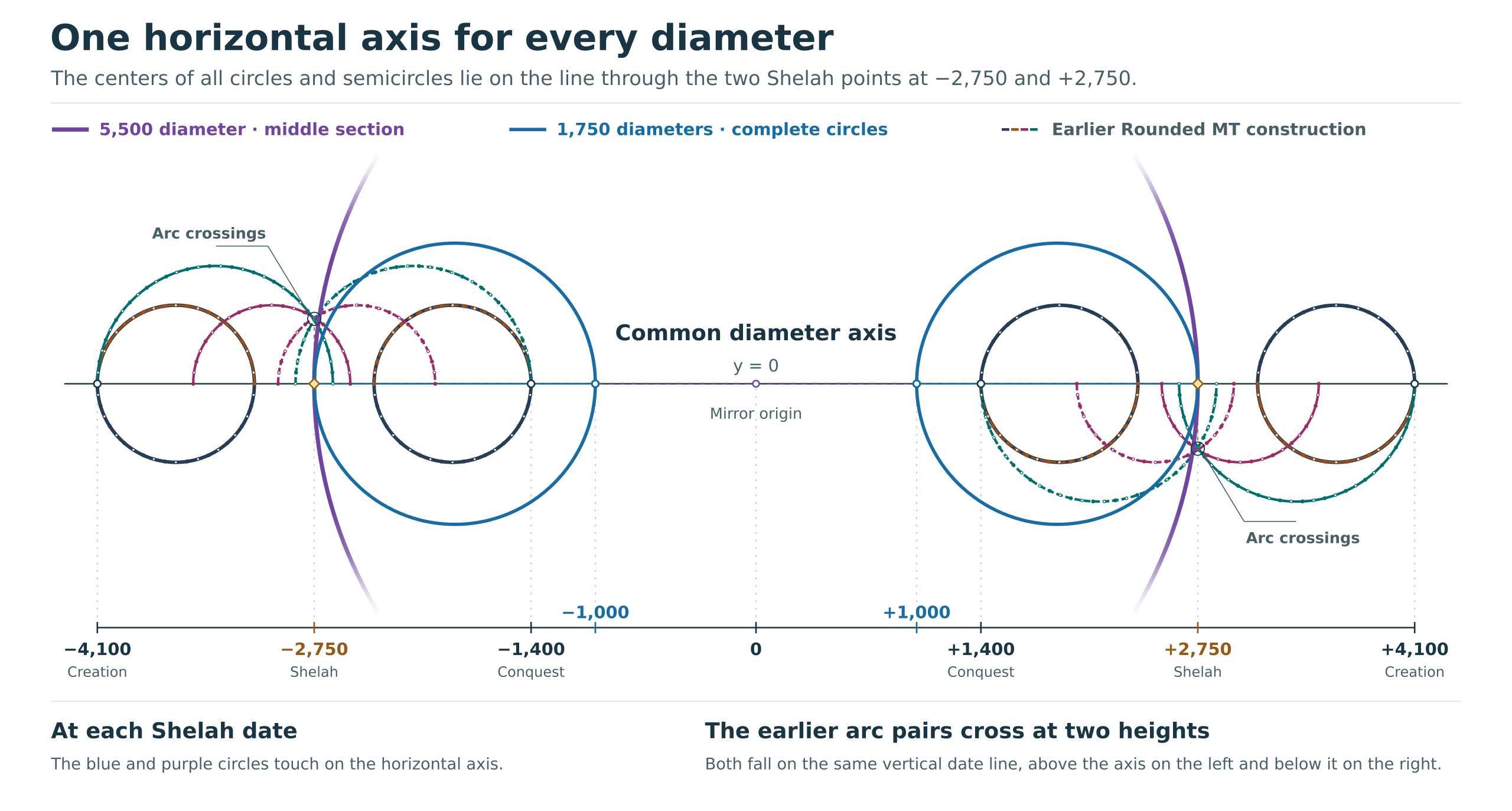
Full-size PNG · Print PDF · Drawing source
The next question remains whether the inward endpoints at ±1000 have independent chronological support.
20 November 2026 · One circumference across the Shelah Mirror
Agent 2-Trunk · Dean’s circle construction. On the Creation–Conquest chart, the two Shelah midpoints at −2750 and +2750 define a diameter of 5,500 through the 6 BC origin. Each also marks the outer end of a smaller circle. The left diameter runs from −2750 to −1000 and the right from +1000 to +2750. Each measures 1,750, with radius 875. Each smaller circle is internally tangent to the large circle at its Shelah point.
The two trunk diameters add to 700 + 1,050 = 1,750. Their two circumferences under the 22/7 convention add to 2,200 + 3,300 = 5,500. Thus 5,500/1,750 = 22/7 exactly. The same 5,500 that serves as the large circle’s diameter represents one smaller circle’s full circumference in the chronology’s rational scheme. A Euclidean circle of diameter 1,750 has circumference 1,750π ≈ 5,497.79. The new circles use the existing signed scale. The drawing shows the middle band of the large circle and both complete smaller circles. Corrected chart and scale · Previous 5,500-year result · File 51a, Rounded MT scaffold · Published square-and-circle study
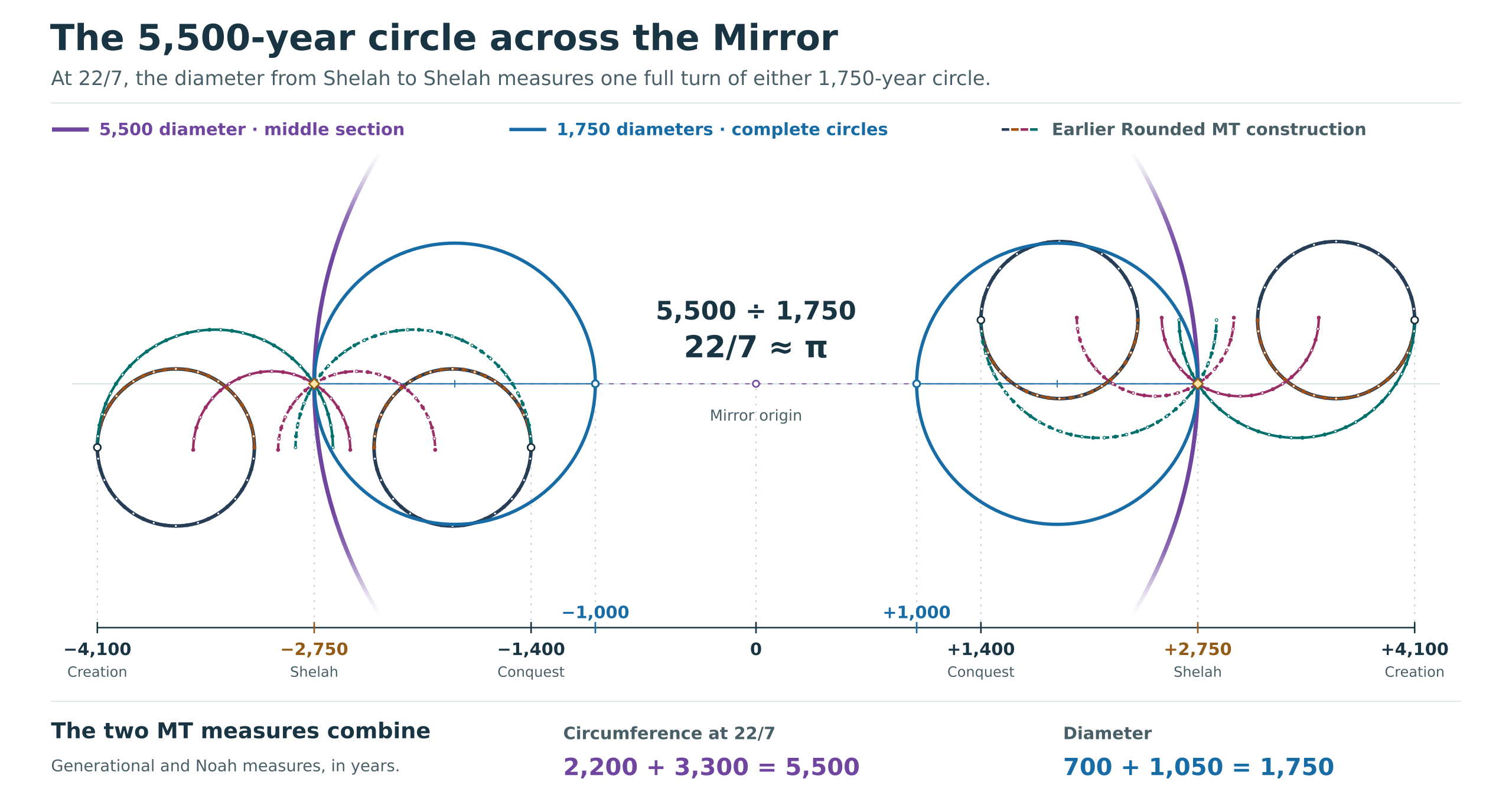
Full-size PNG · Print PDF · Drawing source
The next question is whether the inward endpoints at ±1000 have independent chronological support.
20 November 2026 · Horizontal spacing of the two Mirror figures
Agent 2-Trunk · Dean’s spacing correction. In the previous drawing the two Shelah points were correctly set 5,500 units apart. Each drawn figure was about 1,934.094 units wide when measured on the axis. This left a visible gap of about 3,565.906, or 1.844 figure widths. On the signed time scale, each Adam–Moses span covers 2,700 years and the space between the two nearest ends is 2,800 years. The gap is therefore 28/27 of a figure width, only 100 years wider than one figure.
| Signed Adam boundary | Shelah center | Signed Moses boundary | Gap across zero | Mirrored Moses boundary | Shelah center | Mirrored Adam boundary |
|---|---|---|---|---|---|---|
| −4100 | −2750 | −1400 | 1,400 + 1,400 | +1400 | +2750 | +4100 |
The signed origin is 6 BC. Resizing each whole figure about its Shelah point by 2,700/1,934.094… ≈ 1.396 in both dimensions keeps the circles circular and locates the two boundaries and center of each figure on one horizontal scale. On the first plate, inner dates are read along their respective curves. The second PDF plate projects every dated point onto its exact horizontal time coordinate. Center to center, 1,350 + 2,800 + 1,350 = 5,500, still the sum of the 2,200- and 3,300-year circumferences. The copies have opposite orientations. Previous geometric drawing and the 5,500-year result · Generational and Noah measures · File 51a
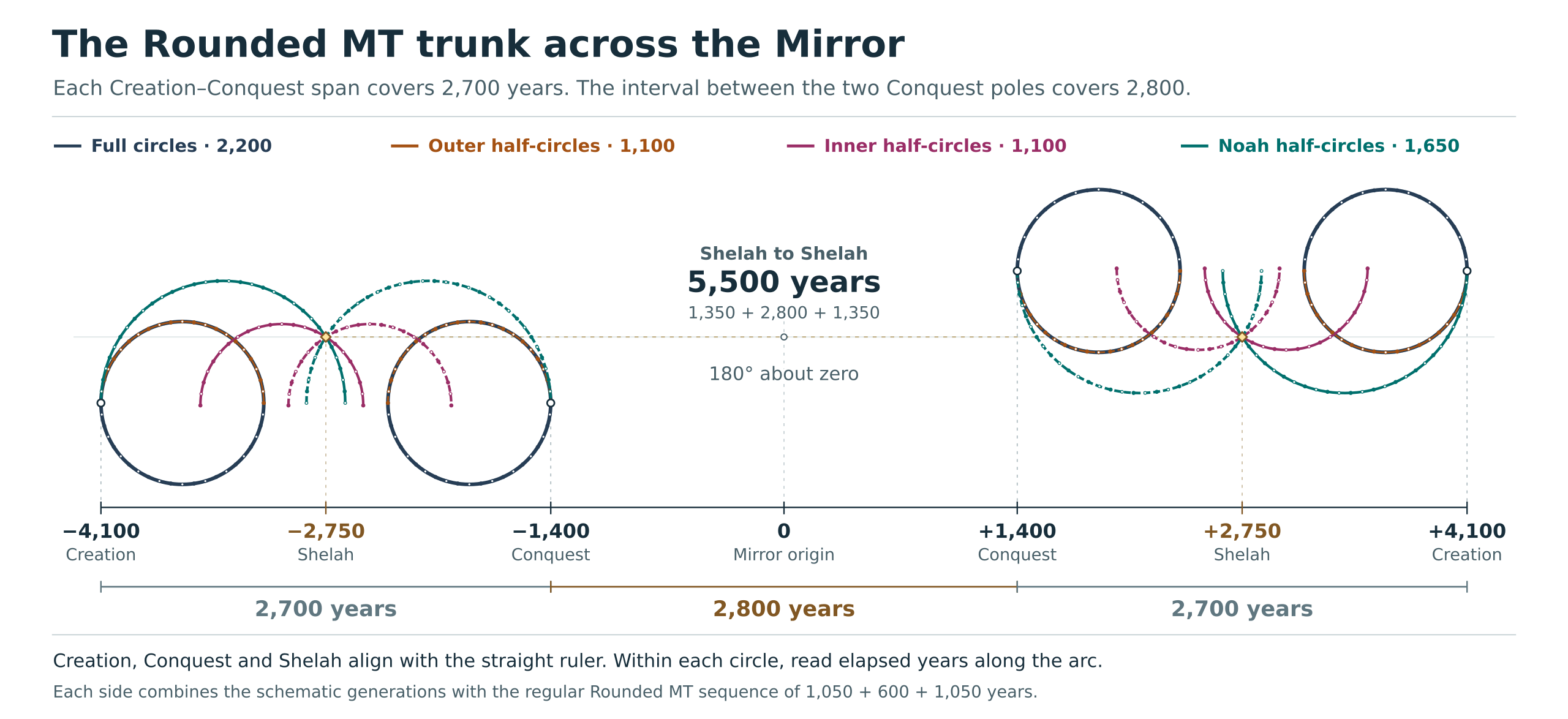
Full-size drawing · Print PDF · Source files
The next question is where the five successive 1,100-year intervals fall on this corrected horizontal scale.
20 November 2026 · Shelah’s 5,500 years across the signed Mirror
Revision note. For the horizontal placement of the two figures, see the corrected spacing. The 5,500-year distance between the two Shelah dates and its division into the two trunk circumferences still hold.
Agent 2-Trunk · Dean’s signed-coordinate test. The figure places 6 BC at zero. A year labelled B BC has astronomical coordinate 1 − B and signed coordinate s = (1 − B) + 5 = 6 − B. Its reflected coordinate is −s. For this diagram all positive and negative labels are distances in years from 6 BC.
Shelah’s schematic midpoint at 2756 BC lies at −2750. Its reflected point lies at +2750, so the horizontal distance between them is 5,500 years = 5 × 1,100 = 2½ × 2,200. Starting at zero, either Shelah point lies 1,100 + 1,650 = 2,750 years away, the sum of one generational semicircumference and one Noah semicircumference. Across the Mirror, 2,200 + 3,300 = 5,500 sums the corresponding full circumferences, or (700 + 1,050) × 22/7. If the 5,500-year span is divided into five equal 1,100s, zero bisects the middle interval into 550 + 550.
Second Cainan’s midpoint at 2856 BC gives −2850 to +2850 = 5,700 years. The centurial succession puts Shelah 100 years nearer the origin on each side and reduces the separation by 200.
Each copy retains the 27-century Adam–Moses schematic with second Cainan included. Its endpoints, 4106 and 1406 BC, are each 1,350 years from Shelah’s center. The regular Rounded MT birth of Noah at 3056 BC and Flood at 2456 BC are each 300 years from it. The second copy is inverted about the origin, with the two Shelah points aligned horizontally. The drawing establishes the separation under this coordinate convention. The dated curves · The 27-name center · File 51a · 6 BC reference in the trunk draft
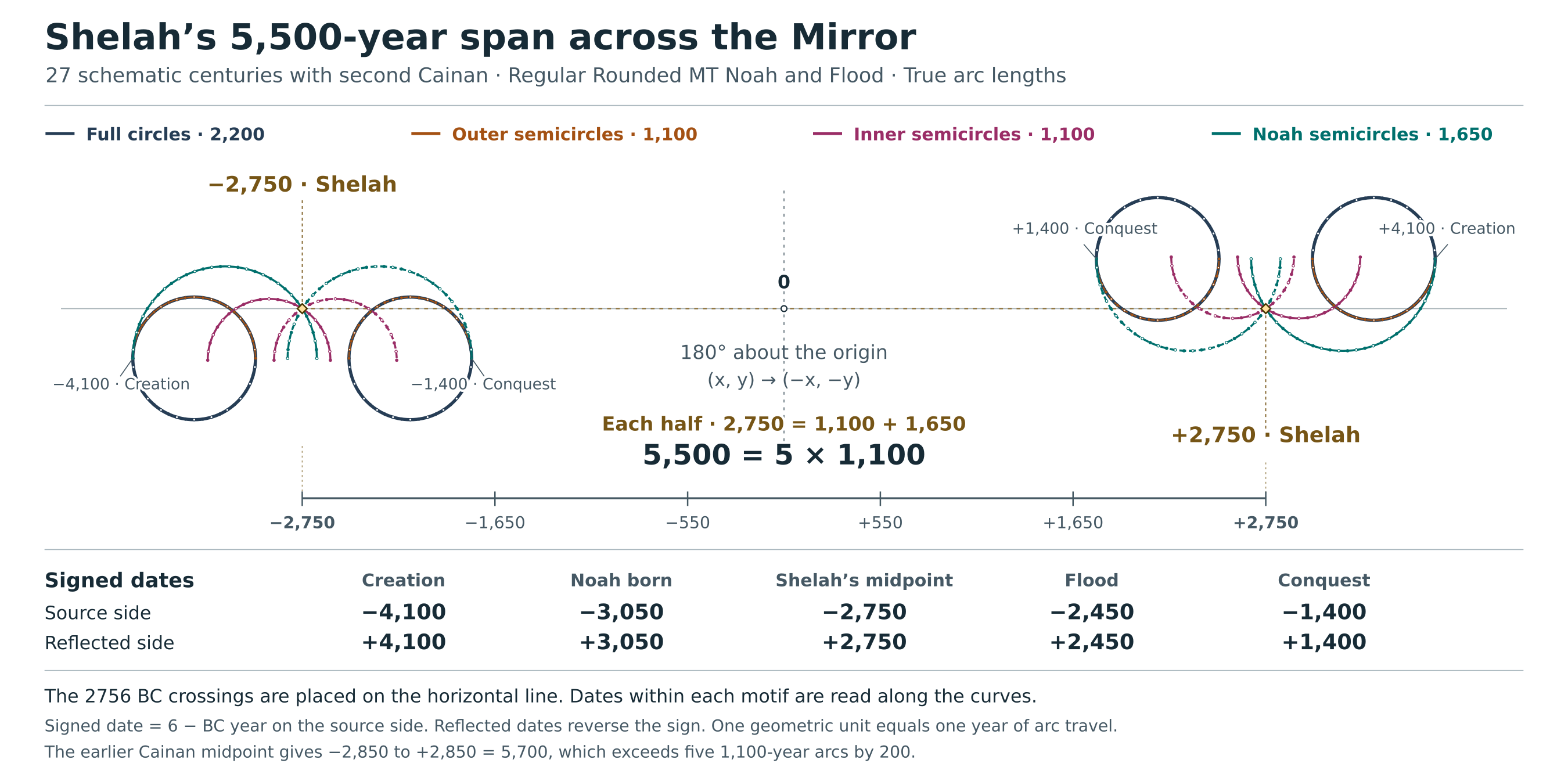
Full-size diagram · Print PDF · Source files
The next question is whether the intervening 1,100-year divisions also reach independently named chronological points.
20 November 2026 · The dated nodes on the eight circles and semicircles
Agent 2-Trunk · Dean’s chart at 2756 BC. The script places all 28 century boundaries and 27 midpoints on every curve that reaches them. The two full circles and four generational semicircles use Dean’s 27-name schematic with second Cainan. The two 1,650-year semicircles use the regular Rounded MT Creation, Noah, Flood and Conquest. On the revised inner pair, the midpoints of Noah (3156 BC), Shelah (2756 BC) and Serug (2356 BC) lie on one horizontal line. Each side measures 400 years around the arc and 378.601 units across the chord.
With horizontal diameters on one baseline, the inner and Noah pairs reach 2756 BC at heights of 294.557 and 283.951 arc-year units. Lowering the inner pair by 10.607 puts both crossings at one point. The chart allows either placement. It uses exact arc lengths and Euclidean π. The 22/7 diameter scale differs by a uniform factor of 7π/22. The open question is whether another dated constraint fixes the relative height of the pairs. Inspect the chart by year · Two-page PDF · Python script, coordinates and crossings · Dean’s five substitutions · File 51a
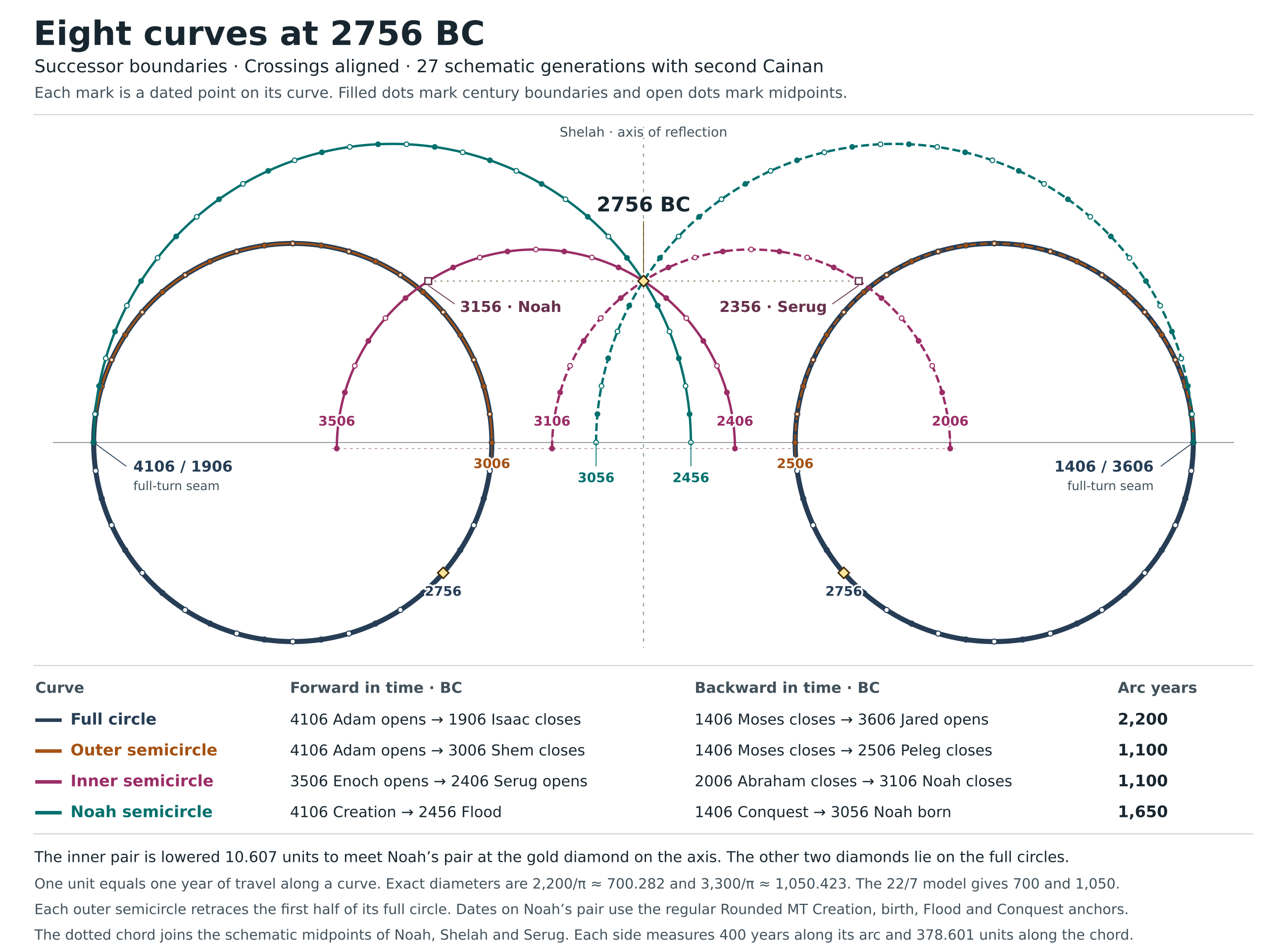
20 November 2026 · The eight aboard the ark
Agent 2-Trunk · Dean’s observation. Enoch and Noah walked with God. Peter recalls eight people saved through the water. On the 27-name schematic, Noah (#10) stands four generations before Shelah (#14) and Serug (#18) four after him. Dean reads those eight steps around the 2756 BC center as an echo of the ark. The Watchers and their followers are out of step with God. Dean leaves the comparison here pending his next observation. Genesis 5–7 · 1 Peter 3:18–21 · Jubilees 7:20–21 · The 27-name table and its center
20 November 2026 · Shelah’s fourteenth generation at the center
Agent 2-Trunk · Dean’s revised reading. Luke 3:35–36 names Shelah, Cainan and Arphaxad in reverse descent. In the single 27-name reconstruction with second Cainan included, Adam opens at 4106 BC and Moses closes at 1406 BC. Shelah’s fourteenth century is 2806–2706 BC. Its midpoint of 2756 BC divides the 2,700 years into 1,350 + 1,350, leaving thirteen complete generations on each side of Shelah. This is also the midpoint of Noah’s regular Rounded MT 600 years to the Flood, 3056 → 2756 → 2456 BC. Dean gives this 27-name reading priority over the earlier 4006–2706 experiment.
Move each marked event one generation forward on that same table, preserving whether it marks an opening, a midpoint or a close. All five move exactly 100 years later. Dates are schematic BC boundaries.
| Position in the century | First reading | Successor, 100 years later |
|---|---|---|
| Opening | Jared · 3606 | Enoch · 3506 |
| Close | Lamech · 3206 | Noah · 3106 |
| Midpoint | Second Cainan (#13) · 2856 | Shelah (#14) · 2756 |
| Opening | Reu · 2506 | Serug · 2406 |
| Close | Terah · 2106 | Abram · 2006 |
Measured midpoint to midpoint, the first three names spaced seven centuries apart are Jared (#6), Cainan (#13) and Terah (#20), at 3556, 2856 and 2156 BC. Their successors are Enoch (#7), Shelah (#14) and Abram (#21), at 3456, 2756 and 2056 BC. The SKL Long comparison’s original arcs, 3606–2506 and 3206–2106 BC, move to Enoch’s opening → Serug’s opening (3506–2406) and Noah’s close → Abram’s close (3106–2006). Each spans 1,100 years. Their shared 3106 → 2756 → 2406 divides into 350 + 350, with the regular Rounded Noah overlap 3056 → 2756 → 2456 = 300 + 300 inside it. On this same 27-name table, the three evenly spaced midpoints are Shem’s (#11), Shelah’s (#14) and Reu’s (#17). The outer two coincide with the regular Rounded dates of Noah’s birth and the Flood.
In Dean’s theological reading, the successors extend the narrative from the Watchers’ descent in Jared’s day to Enoch’s testimony, from Lamech to Noah’s preservation, and from Terah’s household to Abram’s call. First Peter 3:18–20 places Christ’s suffering for others alongside the memory of Noah’s generation. Dean reads the succession in light of that substitution. The dates and relationships are arithmetical; any moral interpretation depends on what the sources say about each person. Genesis 5 · Genesis 11 · Luke 3 · 1 Peter 3 · Jubilees 4 · File 18 §1.6 · The common-center drawing
File 69 already records both 14 + 13 and 13 + 14 across a 27-name genealogy. File 70 §3.4 reads Day/Year 13 as exposure and curse and Day/Year 14 as covering and reconciliation. Section 8.1 compares that sequence with the Passover sacrifice on Nisan 14. These provide precedents for Dean’s reading of the transition from Cainan (#13) to Shelah (#14). Applying those precedents to this sequence of five successors is his present proposal. File 69, Appendix A.4A · File 70 §§3.4, 8.1
The next question is what textual evidence links the Cainan-to-Shelah and Reu-to-Serug successions to the same reading.
20 November 2026 · Withdrawn trunk proposal: the 2706 BC midpoint
Superseded at Dean’s direction. The 26-century exercise gives 4006 → 2706 → 1406 BC = 1,300 + 1,300 with Moses fixed. Dean withdrew that choice of endpoints for the trunk. It remains a comparison of how a shortened table behaves. The current reading keeps the full 27-name genealogy and the symmetric 4106 → 2756 → 1406 BC. Dean’s revised reading
20 November 2026 · Cainan, Shelah and Noah’s midpoint
Research history. Dean’s subsequent 27-generation clarification supersedes the 26-century interpretation below as a proposal for this trunk.
Agent 2-Trunk · Dean’s genealogy test. In the MT, Arphaxad fathers Shelah (Genesis 11:12). Luke 3:35–36 puts second Cainan between them. Using centuries for schematic generations, the restored 27-name sequence puts Cainan at #13, midway through 2906–2806 BC at 2856 BC. Shelah is #14, midway through 2806–2706 BC at 2756 BC. That is also the exact midpoint of Noah’s regular Rounded MT birth-to-Flood span, 3056 → 2756 → 2456 BC. Genesis 7:6 gives Noah’s age of 600 at the Flood. Genesis 11:12 · Luke 3:35–36 · File 51a, regular Rounded scaffold
| Century reconstruction | Adam opens; Moses closes (BC) | #13 and its midpoint (BC) | Shelah’s own century (BC) | Midpoint of the full span (BC) |
|---|---|---|---|---|
| 27 names, Cainan included | 4106 → 1406 | Cainan · 2856 | #14 · 2806–2706 | 2756 |
| 26 names, Moses held at 1406 | 4006 → 1406 | Shelah · 2756 | #13 · 2806–2706 | 2706 |
| 26 names, Adam held at 4106 | 4106 → 1506 | Shelah · 2856 | #13 · 2906–2806 | 2806 |
Holding Moses fixed, the same three generation numbers move together. Counting from Adam, positions #6, #13 and #20 have midpoints seven centuries apart in both lists:
| Reconstruction | #6 | #13 | #20 |
|---|---|---|---|
| 27 centuries | Jared · 3556 BC | Cainan · 2856 BC | Terah · 2156 BC |
| 26 centuries, Moses fixed | Jared · 3456 BC | Shelah · 2756 BC | Abram · 2056 BC |
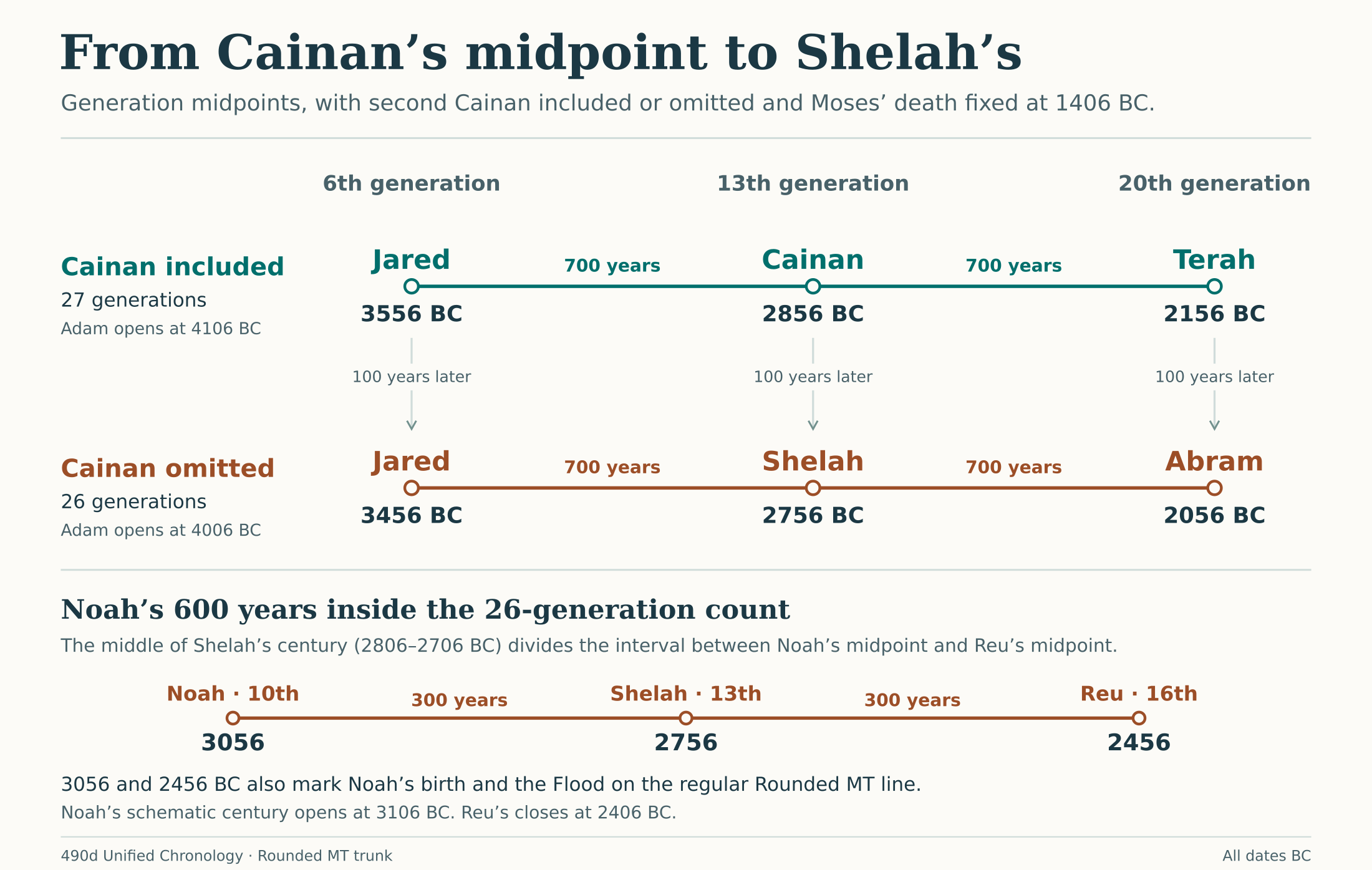
Full-size diagram · Print PDF · Editable SVG · Zipped SVG
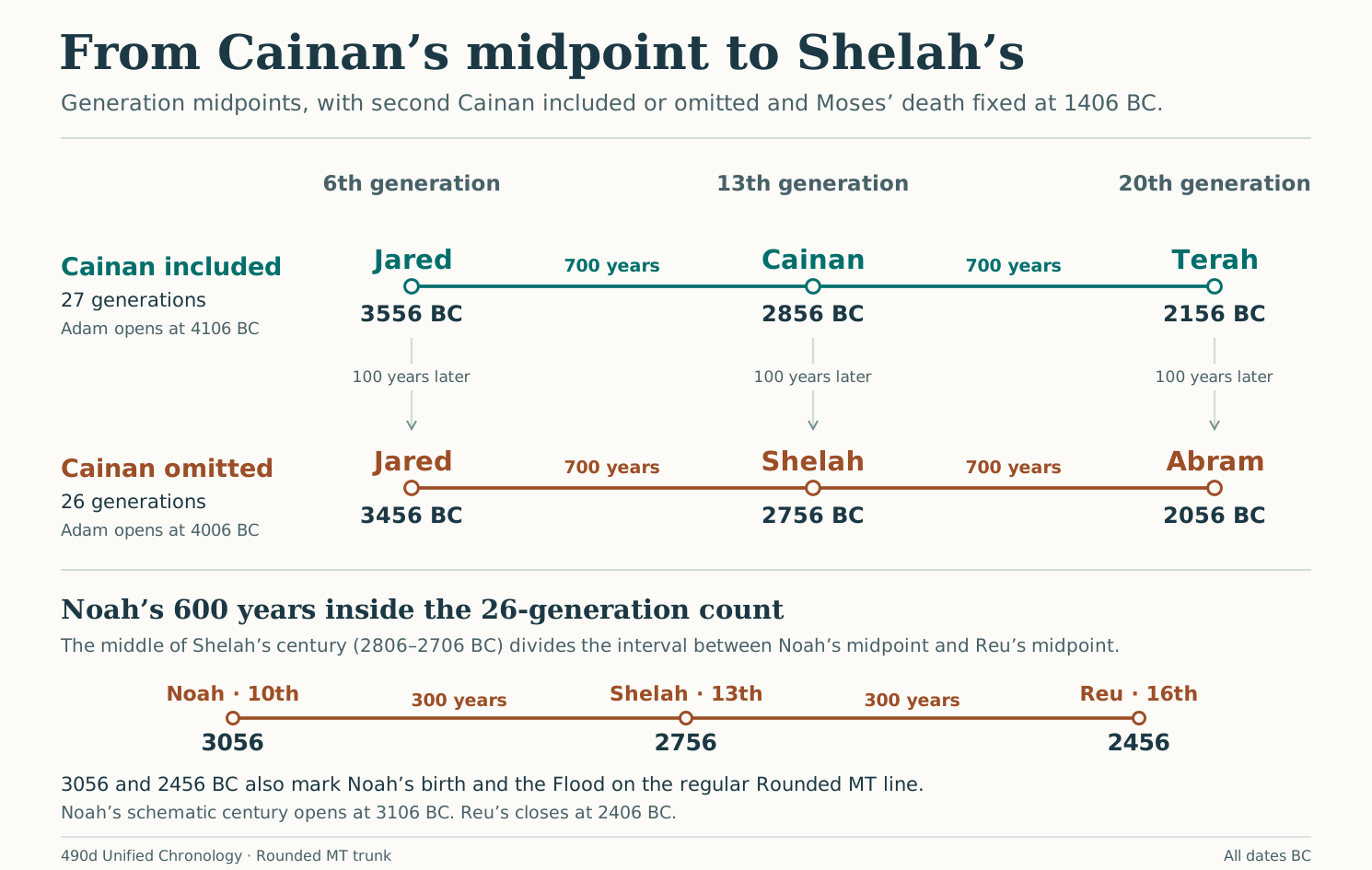
Each ordinal midpoint falls 100 years later in the shorter reconstruction. This supplies a genealogical basis for comparing the SKL Long center of 2856 with Noah’s midpoint of 2756. Shelah himself keeps his dates and changes from #14 to #13. Arphaxad now occupies 2906–2806 BC, Cainan’s former dates. With Adam fixed instead, Shelah takes both Cainan’s ordinal place and his former 2856 BC midpoint. File 18 §1.6 gives the analogous fixed-downstream arrangement at the canonical scales of 130 years on the regular chronology and 460 cumulatively. A 100-year step belongs to the century model. The LXX already includes Cainan. File 18 §1.6
The translated Long arcs in the common-center diagram also acquire named boundaries on the 26-century, Moses-fixed table. 3506–2406 BC runs from Jared’s opening to Reu’s close. Counting backward, 2006–3106 BC runs from Abram’s close to Noah’s opening. Their overlap divides 3106 → 2756 → 2406 = 350 + 350 about Shelah’s midpoint. The 50-year contraction at each end is also dated. On the 26-century table, Noah (#10) occupies 3106–3006 BC, Shelah (#13) 2806–2706 BC, and Reu (#16) 2506–2406 BC. Their midpoints are 3056 → 2756 → 2456 BC = 300 + 300. The midpoint of Noah’s century is the regular Rounded MT date of Noah’s birth. The midpoint of Reu’s century is the regular Rounded MT Flood date. Moving from Noah’s opening and Reu’s close to the midpoints of those same two centuries accounts for the change from 350 + 350 to 300 + 300. These three centurial midpoints can be read directly from the 26-century table.
The shift from the SKL Short center to 2756 BC is 150 years: 2906 → 2856 → 2756, from Cainan’s opening to his midpoint, then to Shelah’s midpoint. The shared center at 2756 bisects Noah’s regular Rounded birth-to-Flood span and the 27-century Creation-to-Conquest span. The 26-century table’s own overall midpoint is 2706 BC. The next question is how Genesis 11 and Jubilees 8 present the narrative transition from Arphaxad through Cainan to Shelah.
20 November 2026 · Comparing the arcs around 2756 BC
Agent 2-Trunk · Dean’s common-center drawing. Noah is 600 when the Flood comes (Genesis 7:6). On the regular Rounded MT chronology, 2756 BC bisects both Noah’s birth-to-Flood interval, 3056–2456 BC, and the full Creation-to-Conquest interval, 4106–1406 BC. The two Noah arcs, the two full generational circles, and the two outer generational semicircles keep their original coordinates. Only the inner pair is moved for comparison. All dates in the table are BC.
| Inner pair | Original chronological spans | Shift toward the Conquest | Plotted spans | Shared interval about 2756 |
|---|---|---|---|---|
| SKL Short comparison, centered at 2906 | 3606–2506 and 3306–2206 | 150 years | 3456–2356 and 3156–2056 | 3156–2356 = 400 + 400 |
| SKL Long comparison, centered at 2856 | 3606–2506 and 3206–2106 | 100 years | 3506–2406 and 3106–2006 | 3106–2406 = 350 + 350 |
| Noah on the regular Rounded MT line, centered at 2756 | 4106–2456 and 3056–1406 | 0 years | 4106–2456 and 3056–1406 | 3056–2456 = 300 + 300 |
The common axis shows three nested intervals. On each side of 2756 BC the Short comparison reaches 400 years, the Long reaches 350, and Noah’s reaches 300. Each successive interval closes inward by 50 years at either end. The nesting follows from matching the axes of the three spans.
The Short comparison uses the 27-century reconstruction throughout. Its original 3306 BC closes Methuselah’s century and 2206 BC opens Terah’s. In the Long comparison, Jared’s 3606 BC opening belongs to the 27-century count. Naming 3206 BC as Methuselah’s close uses the 26-century count with Cainan omitted and Moses fixed. At 3206 the 27-century table closes Lamech. The plotted coordinates align the centers geometrically. The original patriarchal boundaries and both SKL anchors retain their dates. The equal 1,650-year Noah arcs belong to the regular Rounded MT line. Genesis 7:6 · File 18 §§6–7 · File 51a · The two SKL readings · Composite before alignment
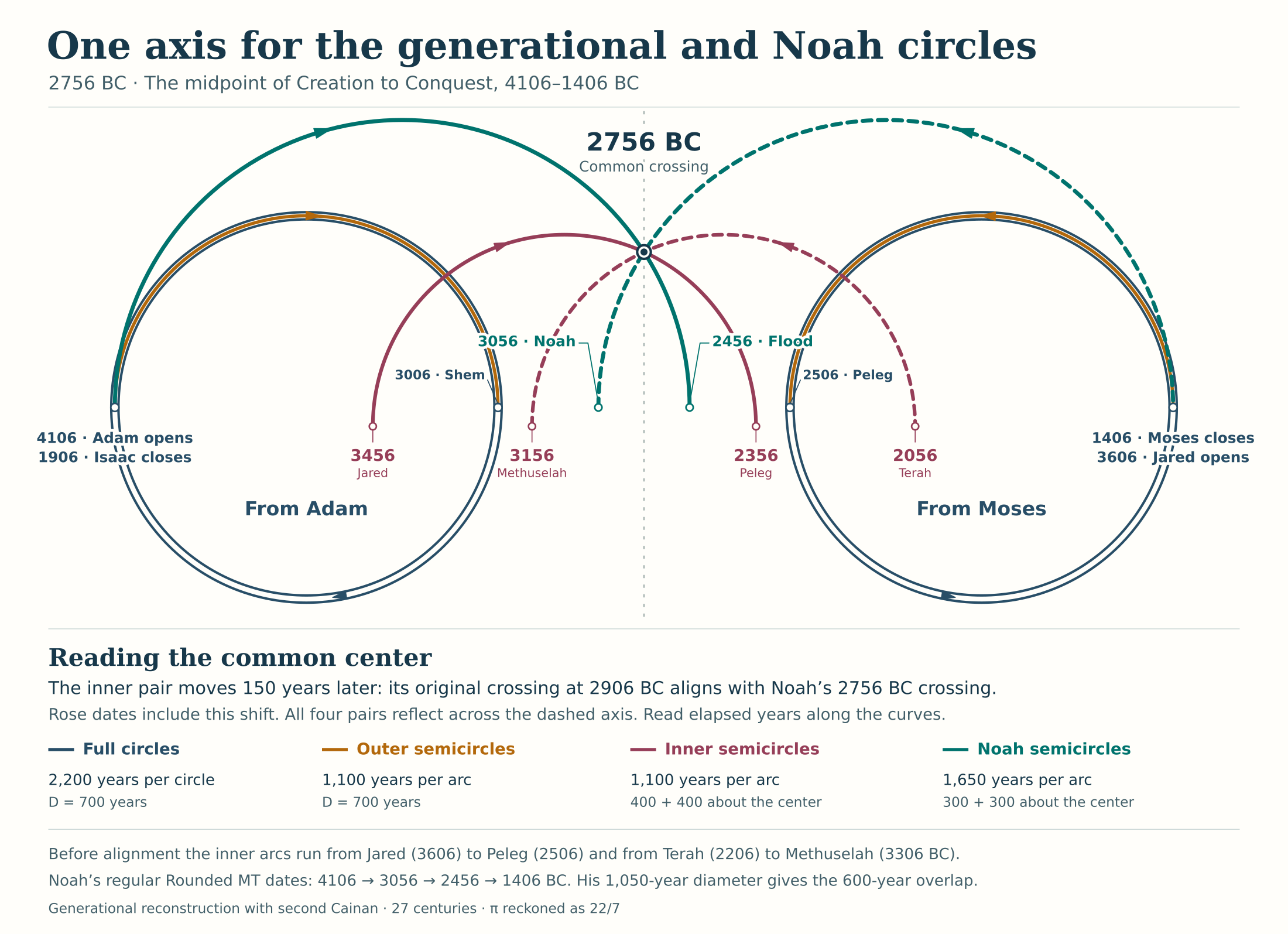
Full-size geometric drawing · Print PDF · Editable SVG · Zipped SVG
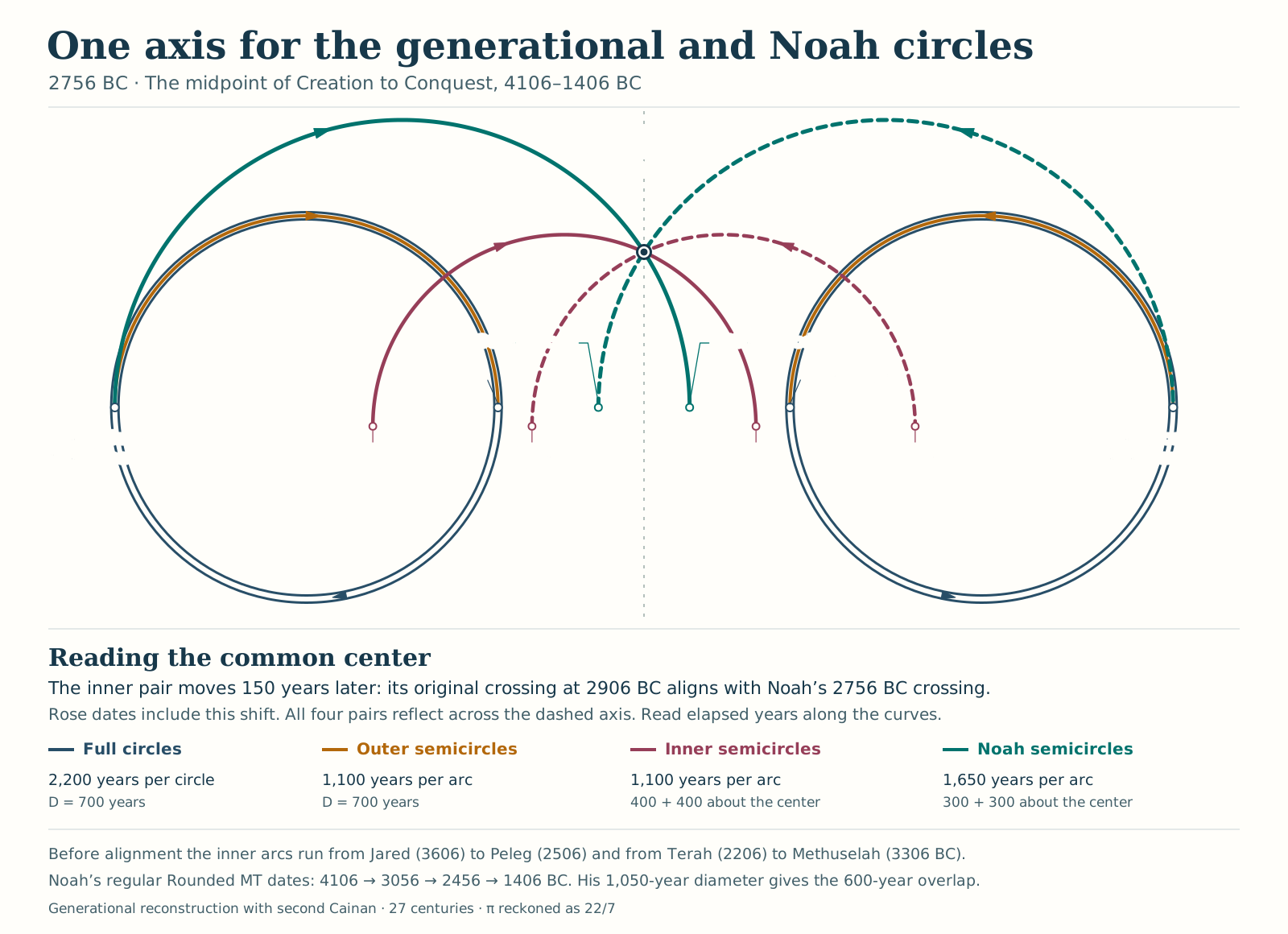
Short comparison on the time axis · Short PDF · Short SVG · Long comparison on the time axis · Long PDF · Long SVG
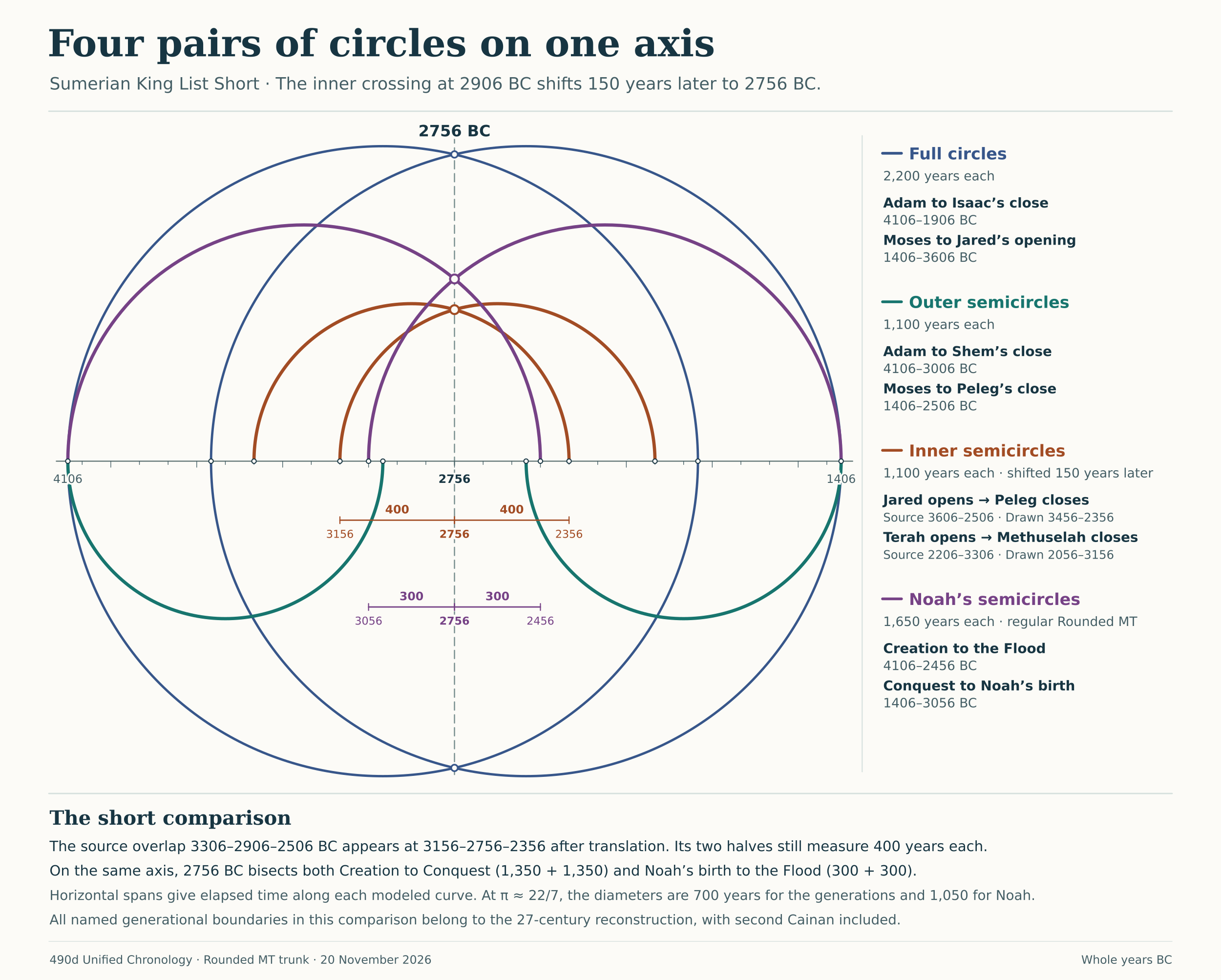
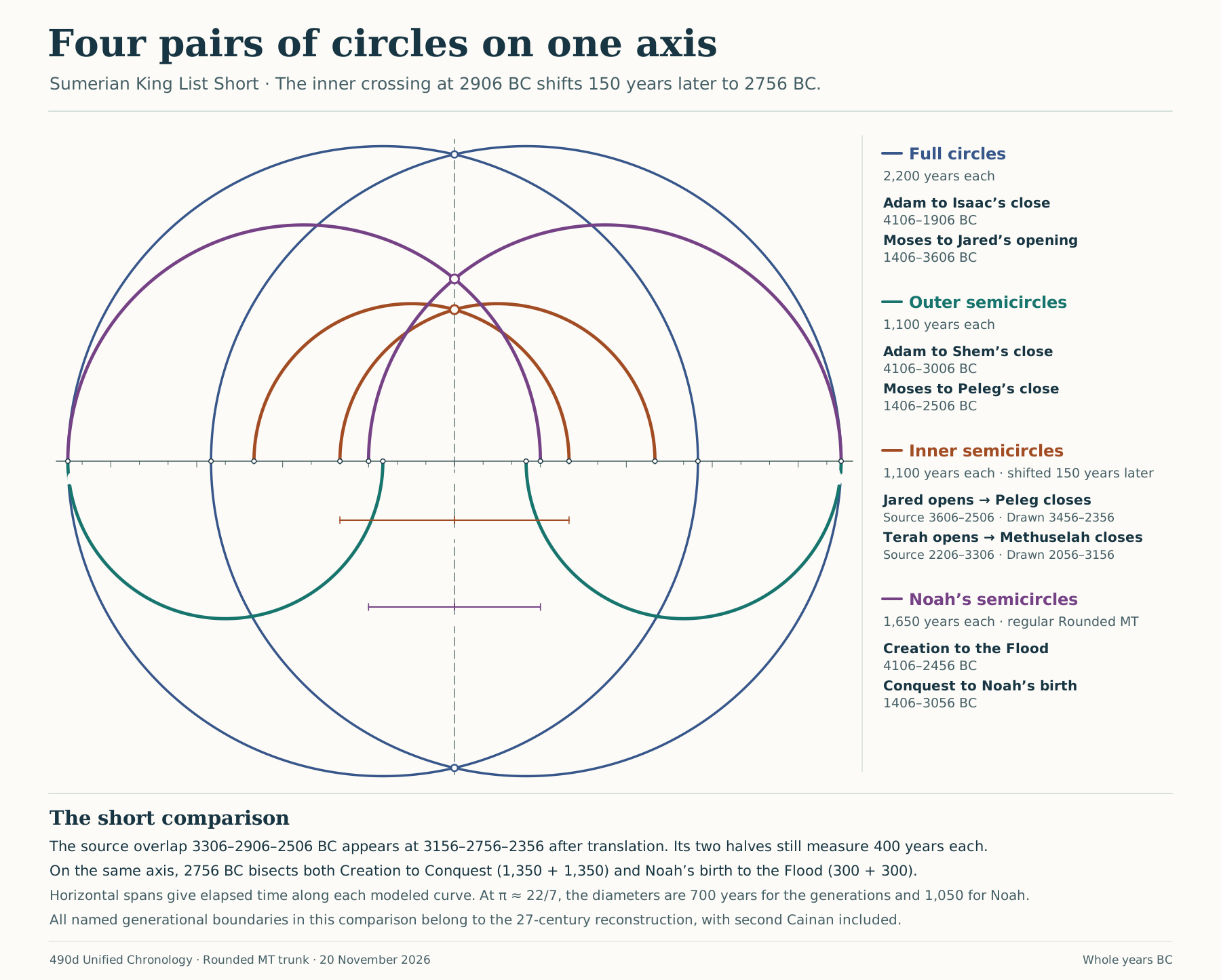
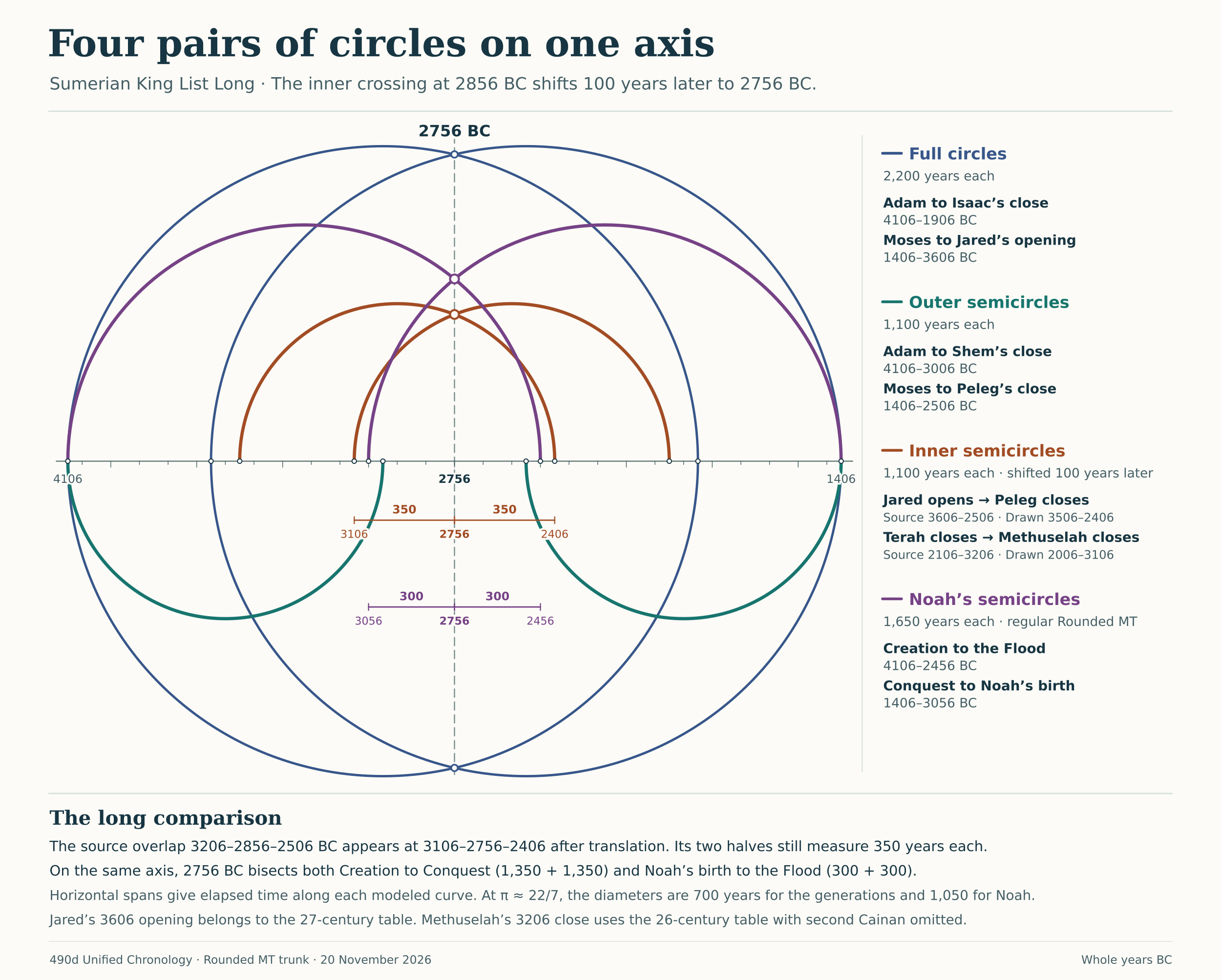
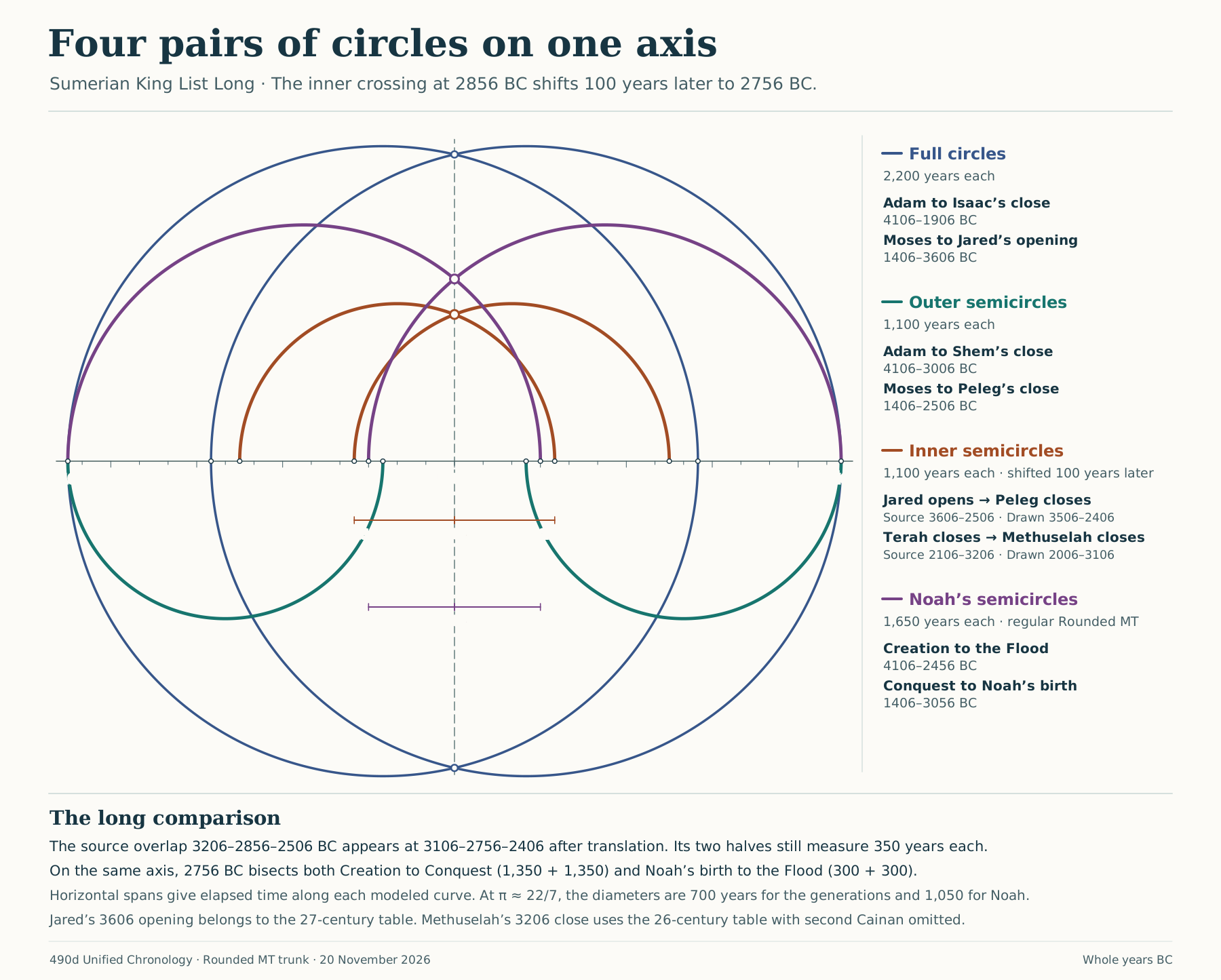
The next question is what chronological evidence, beyond the shared geometric axis, might give either shift a place in the trunk.
20 November 2026 · The generational circles and Noah’s two arcs
Agent 2-Trunk · Dean’s combined diagram. Genesis 7:6 gives Noah’s age at the Flood as 600. The regular Rounded MT dates put that interval at the center of the 2,700 years from Creation to the Conquest. The two semicircles run from Creation (4106 BC) to the Flood (2456 BC) and from Noah’s birth (3056 BC) to the Conquest (1406 BC). Each spans 1,650 years on a schematic diameter of 1,050. Their shared interval divides at 2756 BC into 300 + 300. Counting the 600 years once yields 1,050 + 600 + 1,050 = 2,700.
The composite joins these two arcs to the six curves of the 27-century reconstruction with second Cainan included. Its two middle arcs span Jared’s opening to Peleg’s close (3606–2506 BC) and Terah’s opening back to Methuselah’s close (2206–3306 BC). The overlap divides at the SKL Short Babel anchor, 3306 → 2906 → 2506 = 400 + 400. This center precedes the center of Noah’s overlap by 150 years. At the working fraction 22/7, the respective diameters and semicircular arcs are 700 and 1,100 for the generational figure, and 1,050 and 1,650 for Noah. In the first drawing, years are read along the curves. The companion drawing projects the same eight elapsed spans onto one BC axis.
The corresponding Actual MT Gear 2 dates, with +60 Terah off, are 4114 → 3058 → 2458 → 1406 BC, giving 1,056 + 600 + 1,052. Its two overlapping spans measure 1,656 and 1,652 years. The exact equal arcs use the Rounded scaffold. Genesis 7:6 · File 51a · Working draft, generational π · Earlier six-curve drawing
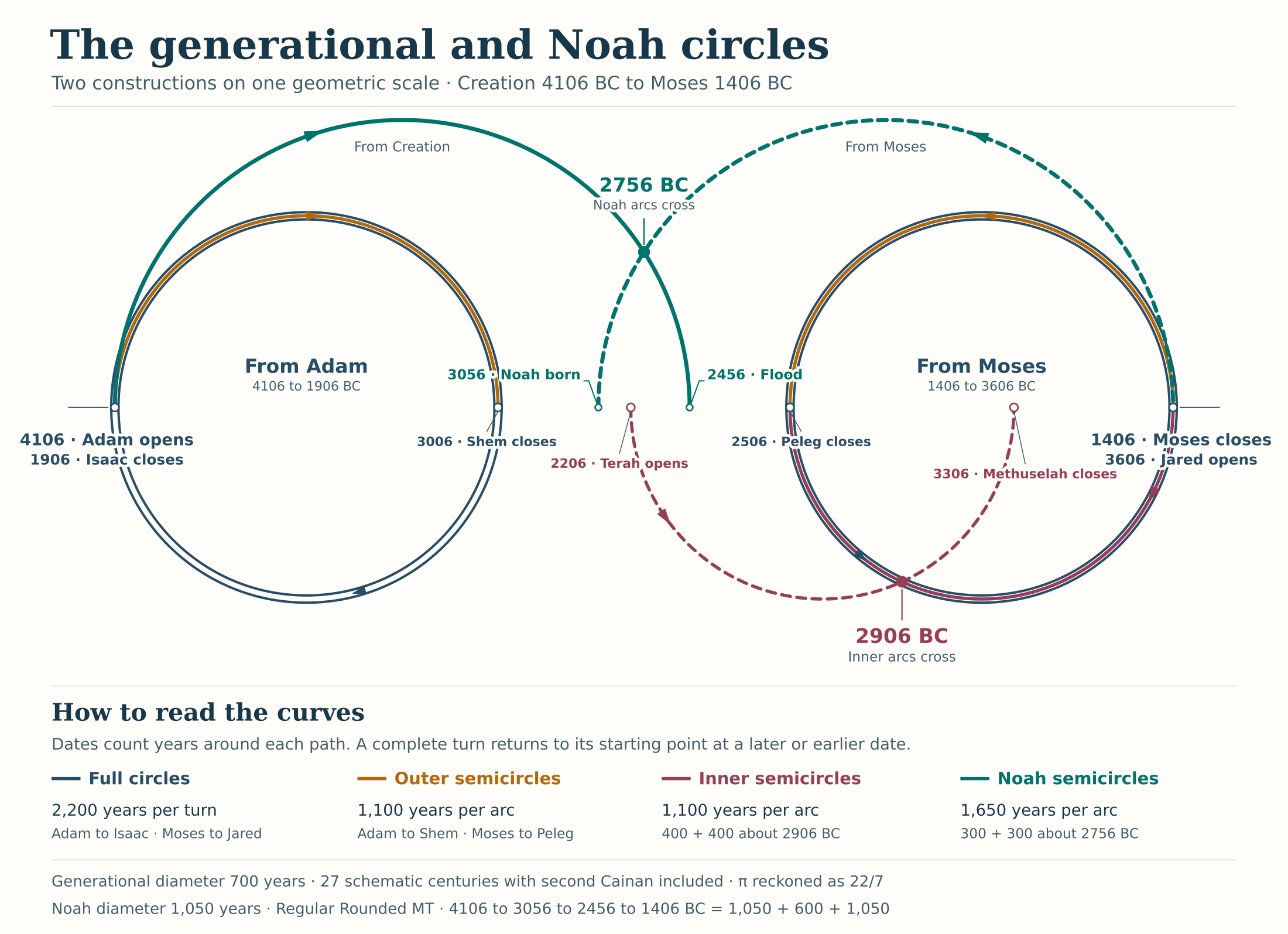
Six generational curves before adding Noah · Full-size composite · Print PDF · Editable SVG · Zipped SVG
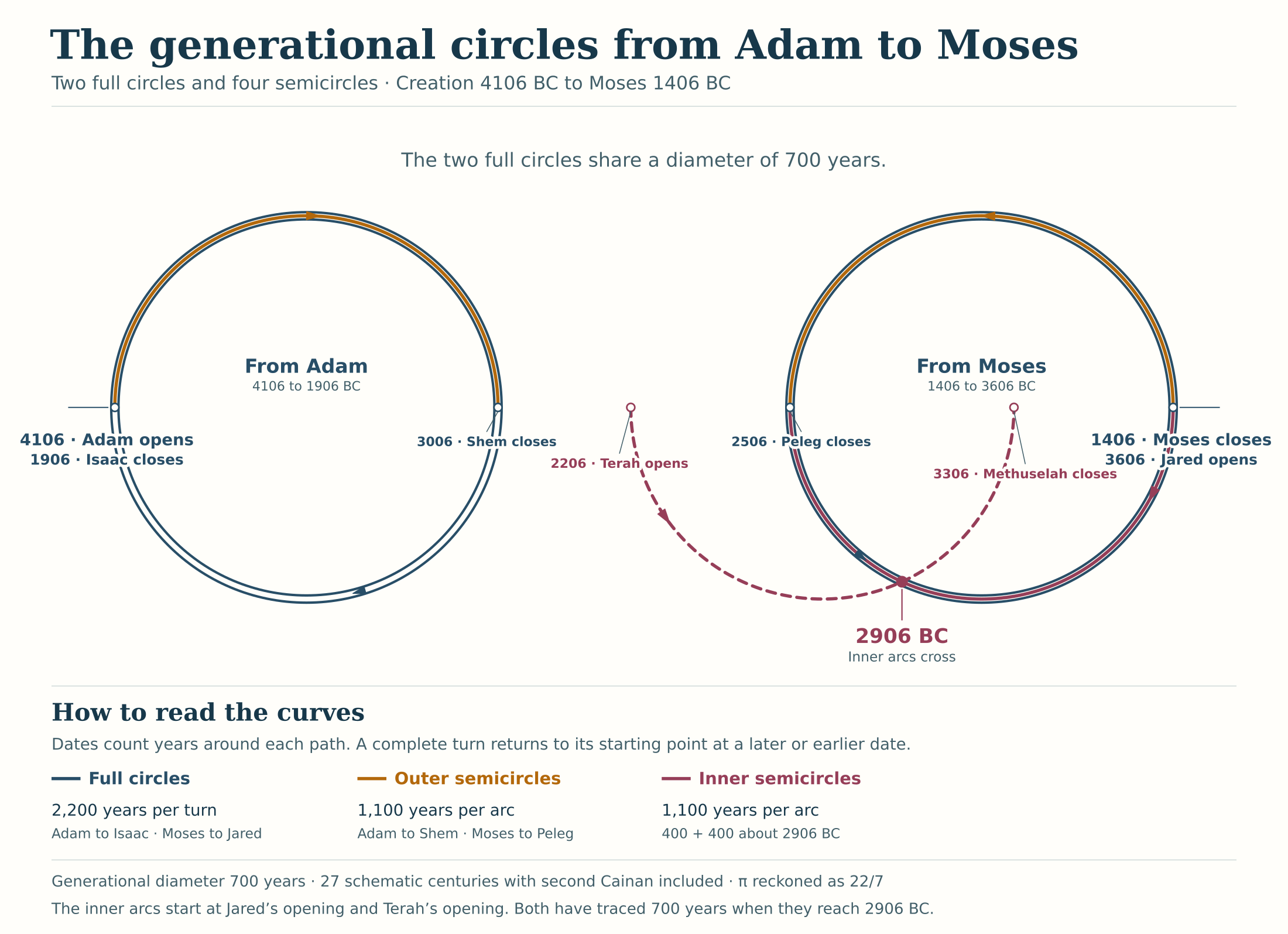
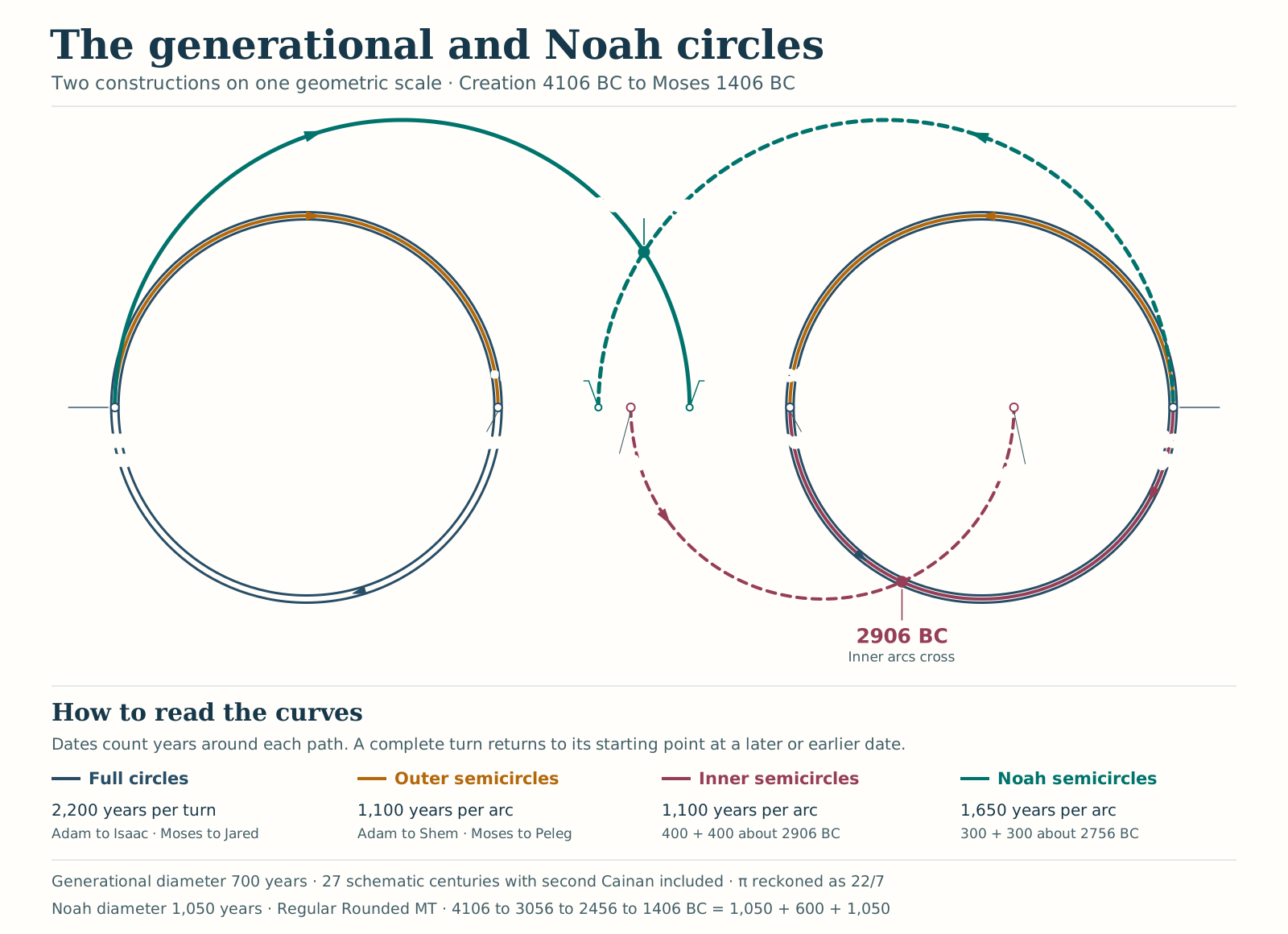
All eight spans on a common BC axis · Time-axis PDF · Time-axis SVG · Zipped time-axis SVG
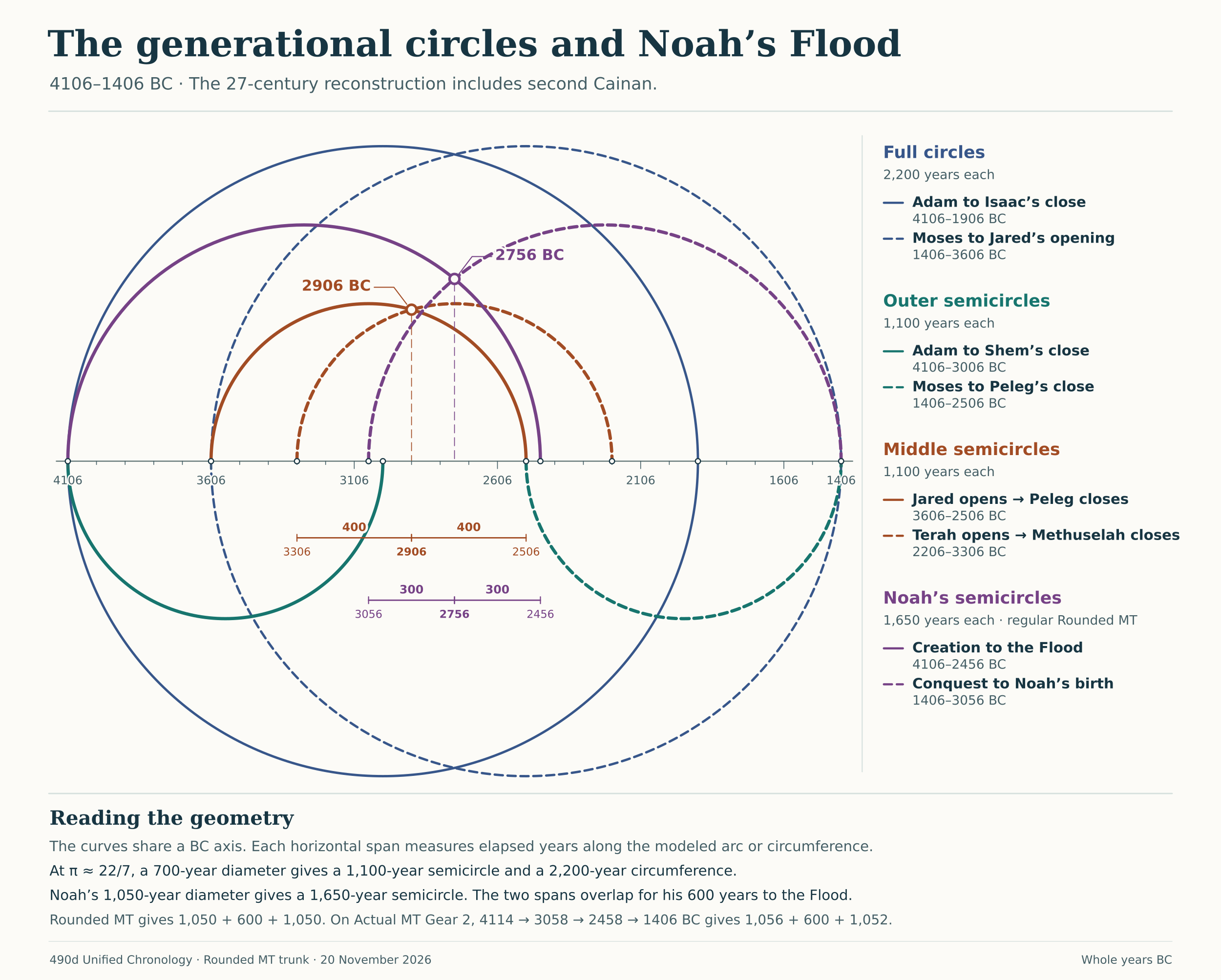
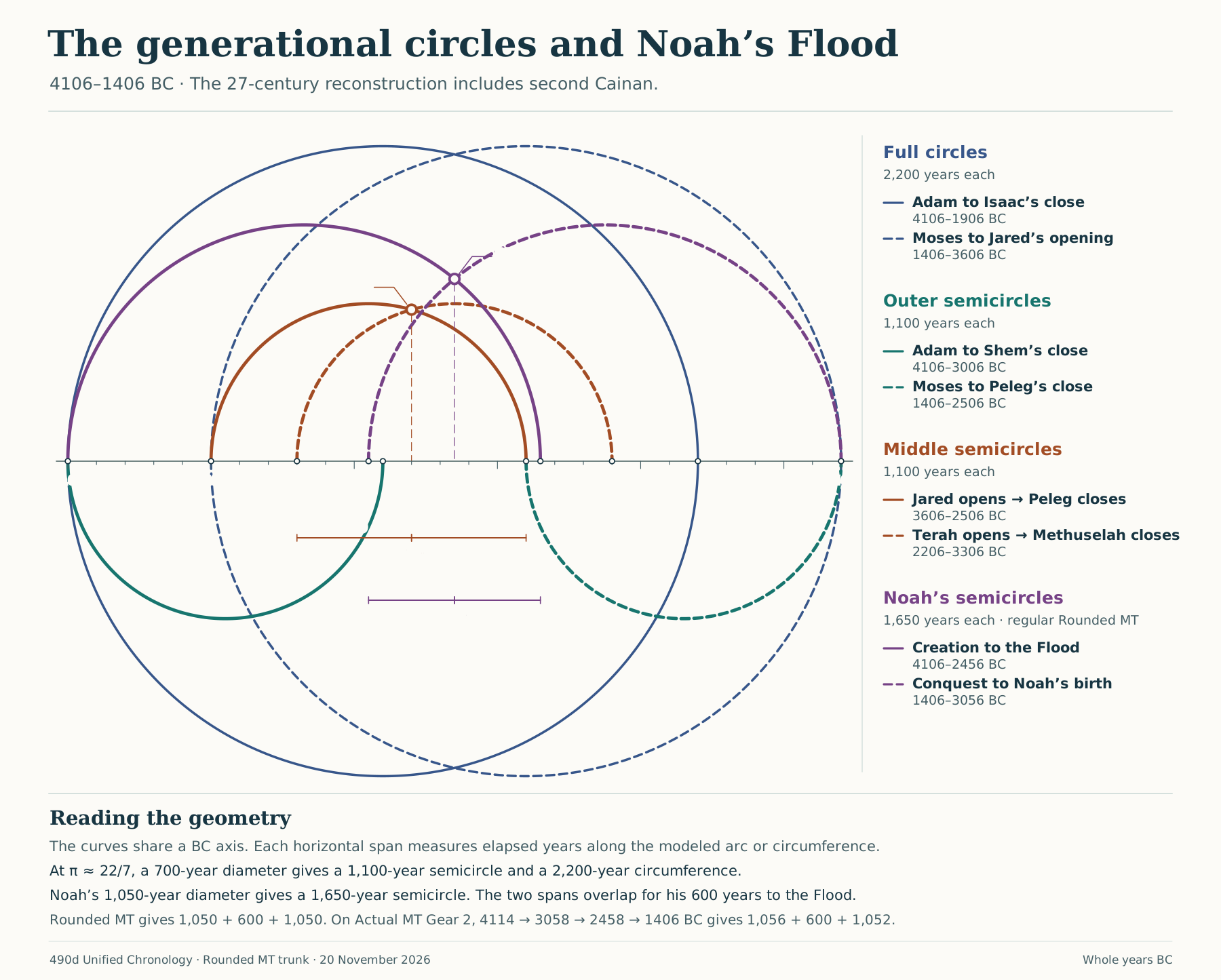
The next question is whether the 150-year distance between the two centers has an independent place in the narrative chronology.
20 November 2026 · Six circles and semicircles from Adam to Moses
Agent 2-Trunk · Dean’s six-curve diagram. On the 27-century reconstruction with second Cainan included, read inward from Creation at 4106 BC and Moses’ death at 1406 BC. The two outer semicircles reach Shem’s close at 3006 and Peleg’s close at 2506. The two full circles reach Isaac’s close at 1906 and Jared’s opening at 3606. Each semicircle measures 1,100 years and each full circle 2,200 on the schematic diameter of 700.
The interior semicircles run from Jared’s opening (3606) to Peleg’s close (2506), and from Methuselah’s close (3306) to Terah’s opening (2206). Their common years divide as 3306 → 2906 → 2506 = 400 + 400. The Short SKL Babel comparison at 2906 is also the opening of second Cainan’s schematic century. The 800 measures the time shared by the arcs. The arc-to-diameter relation remains 1,100/700 = 11/7. All dates in the drawing belong to this one generational reconstruction. Generational outline · File 18 §7.1, SKL anchors · Two SKL axes
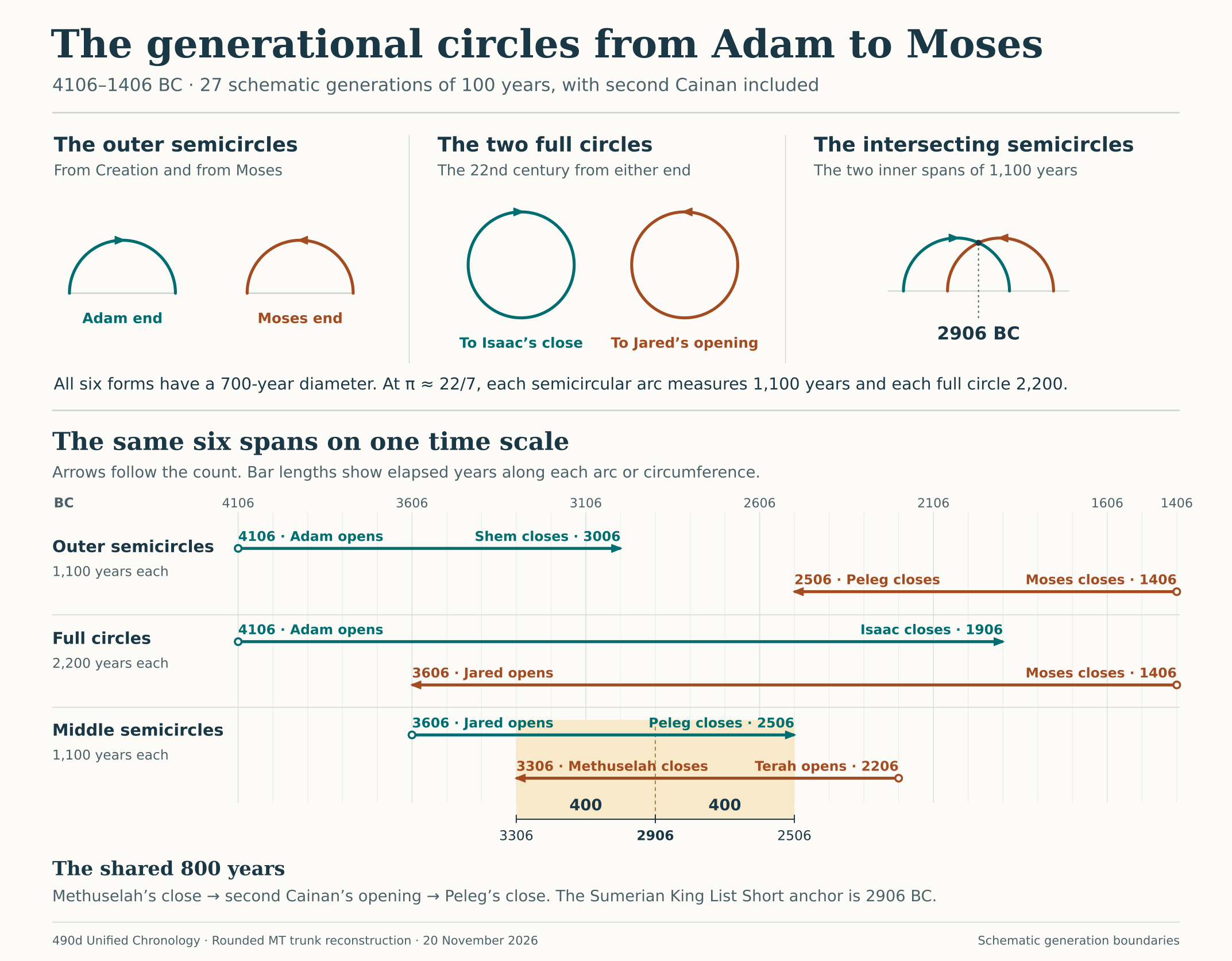
Open the full-size diagram · Download the print diagram
Next question: what does the placement of second Cainan’s opening at the center contribute to the narrative correspondence between the Flood and the division in Peleg’s days?
20 November 2026 · Isaac hands Abraham’s blessing to Jacob
Agent 2-Trunk · Dean’s narrative reading. Isaac is the son promised to Abraham through Sarah (Genesis 17:19). God renews the promise of numerous descendants to Isaac (26:3–4). Isaac himself asks that Jacob be fruitful and multiply and receive “the blessing of Abraham” (28:3–4). Jacob’s twelve sons give the promise a family form. Exodus 1:5–7 names Jacob’s descendants, records the passing of Joseph’s generation and describes Israel’s multiplication with the same Hebrew intensifier, בִּמְאֹד מְאֹד, used in the promise to Abram (Genesis 17:2). Thus the forward 22nd-century close at Isaac with second Cainan included, or at Jacob with him omitted, falls on successive bearers of one promise.
Genesis 6:1–4 introduces the sons of God taking wives as humankind begins to multiply. Jubilees 4:15 dates the Watchers’ descent to Jared’s days, and 4:22 makes Jared’s son Enoch a witness against their unions. Dean reads the 27-century reverse count to Jared’s opening as a contrast between the Watchers’ taking and the offspring God promises and gives. In the 26-century count the full reverse span reaches Mahalalel’s opening. Galatians 3:16, 29 gives the Christian reading its horizon in Christ and the heirs of the promise. Next question: how can the trunk diagram show Isaac blessing Jacob alongside Jared’s association with the Watchers’ descent? Genesis 28 · Exodus 1 · Jubilees 4 · Generational arithmetic
20 November 2026 · Jared’s century and three diameters to Moses
Agent 2-Trunk · Dean’s reverse-circle observation. In the 27-century reconstruction, Jared’s opening at 3606 BC is 2,200 years from Moses’ death at 1406 BC. Jared’s close at 3506 BC initiates three successive 700s to the closes of second Cainan at 2806, Terah at 2106, and Moses at 1406. Thus the entire circumference divides into Jared’s century plus three diameters: 100 + 3 × 700 = 2,200. Its last diameter counts Abram, Isaac, Jacob, Levi, Kohath, Amram and Moses. The dates are schematic generation boundaries.
With second Cainan omitted and Moses fixed, Jared’s century is 3506–3406 BC. The shared date 3506 is Jared’s close with Cainan included and his opening with Cainan omitted; in either case it stands 2,100 years from Moses. On the 26-century table the full reverse 2,200 reaches the opening of Mahalalel, Jared’s father, at 3606. Forward from Adam the 22nd close moves from Isaac (4106 to 1906) to Jacob (4006 to 1806). In both directions the 22/7 measure survives, while the names occupying its boundaries depend on the genealogy. Next question: how should the trunk diagram label the shared 3506 BC boundary so that both roles are visible? Working draft, generational π · Isaac and Jacob · Second Cainan’s century · Genesis 5:15–20
20 November 2026 · The SKL variant bisects Cainan’s century
Agent 2-Trunk · Dean’s observation. On the 27-generation reconstruction with second Cainan included, each generation occupies a schematic century. Jared opens at 3606 BC, Cainan at 2906 and Terah at 2206. Their respective midpoints are 3556, 2856 and 2156 BC, again 700 years apart. File 18 §7.1 gives the SKL Short and Long Babel comparison anchors at 2906 and 2856 BC. The 50 years between them move from the opening of Cainan’s century to its midpoint, followed by 50 to its close at 2806. Reflection about 2856 exchanges Jared’s entire century (3606–3506) with Terah’s (2206–2106), opening for close, and exchanges the two halves of Cainan’s century. This statement uses one reconstruction throughout. Relating that symmetry to the placement of the SKL variants is Dean’s interpretation.
The same 2856 BC already bisects the proposed 700-year Flood-to-dispersion interval (3206–2506). Next question: how should the draft show that shared center while keeping the genealogical centuries and the distinct Flood-marker readings explicit? File 18 §7.1 · Published SKL comparison · SKL axes and arcs
20 November 2026 · Shem and Methuselah mark the Flood in two ways
Agent 2-Trunk · Dean’s clarification. Genesis 5:25–27 and 7:6 place Methuselah’s death in the Flood year by elapsed-age arithmetic (187 + 182 + 600 = 969). Shem survives and fathers Arphaxad two years after the Flood (Genesis 11:10–11). File 18 §6D explicitly assigns the cumulative MT two Flood markers, Methuselah’s death and Arphaxad’s birth. On the MT trunk Dean gives priority to the end of Shem’s 600 years, which opens Arphaxad’s row when the lifespans are laid end to end. On File 51a’s Moses/Nisan line, Methuselah’s close at Lamech’s opening is 7158 BC Actual and 7161 BC Rounded. Shem’s close at the tabulated Flood/Arphaxad row is 4831 BC Actual and 4836 BC Rounded. File 18 separately gives Methuselah priority in the cumulative LXX and leaves the death-side choice open in the cumulative SP.
Consequence for the 2856 BC axis. The century table places Methuselah’s close at 3206 BC with second Cainan omitted and Moses fixed. His Flood association supplies the narrative reason for selecting him; his name at that date still requires the 26-century reconstruction. At the same boundary the 27-century table closes Lamech, whom the published Anchors of Time also treats as a secondary Flood-era anchor because his regular MT death precedes the Flood by five years. The seven centuries from 3206 to Peleg’s close at 2506 can therefore be read as Flood to dispersion in either table, with different patriarchs and different degrees of proximity to the Flood. Next question: does the Lamech reading on the 27-century table suffice for the arc, with the 26-century Methuselah reading reinforcing it? File 18 §§6A, 6D · File 51a §3.4 · Anchors of Time, Flood sub-anchors · Two SKL axes
20 November 2026 · The two SKL Babel anchors as axes of the generational arcs
Agent 2-Trunk · Dean’s SKL comparison. Jubilees 4:15 associates Jared’s days with the descent of the Watchers. In 8:1–4, second Cainan copies their teaching about celestial omens. Joshua 24:2–3 sets Terah’s household worship of other gods against God’s call of Abram. File 21 supplies the Short and Long whole-year model boundaries at 2906 and 2856 BC for comparison with Babel. Applying ±720 gives 3626 / 2906 / 2186 and 3576 / 2856 / 2136 BC. On the 27-century reconstruction, Jared, second Cainan and Terah open at 3606 / 2906 / 2206 BC; their midpoints are 3556 / 2856 / 2156 BC. Both schematic rows have two 700-year intervals. Each SKL row differs from its matching row by 20 years at the outer ends.
Endpoint check. 3606 to 2406 is 1,200 years. The 1,100 from Jared’s opening reaches Peleg’s schematic close at 2506. Keeping Dean’s second interval of 3206 to 2106 gives two spans of 1,100 with a 700-year overlap, from 3206 to 2506. The Long anchor 2856 bisects both the overlap and the full 3606–2106 extent, reflecting the spans into one another. Methuselah closes at 3206 only on the 26-century reconstruction with Moses fixed at 1406 and Adam at 4006. On the 27-century table it is Lamech who closes at 3206. There is also a comparison wholly within that table: Jared opens at 3606, Methuselah closes at 3306, Peleg closes at 2506 and Terah opens at 2206. Here 3606–2506 and 3306–2206 are each 1,100, reflected about the Short anchor 2906, with 800 years shared. Terah’s opening supplies that second endpoint. The exact axes strengthen the case for comparing these dates; the numerical relationships alone do not establish a historical link between texts. Next question: which reading does Dean intend for Methuselah and Terah, the two closes across reconstructions or the close and opening on the 27-century table? File 21 · SKL source comparison · Working draft, generation states · Jubilees 8 · Joshua 24
20 November 2026 · The generational circle leads the working draft
Agent 2-Trunk · Draft revision at Dean’s direction. Working draft 9 introduces the generational π outline before Noah’s circle. At the 4106 and 1406 BC endpoints, the two 1,100-year arcs leave a 500-year gap. Enlarging the diameter, arc and circumference by 3/2 gives 1,050, 1,650 and 3,300. The two enlarged arcs overlap for Noah’s 600 years. The common ratio is exact; Dean considers the century outline the likely earlier design. Esau’s second heading contributes to the literary count of eleven. Its specific numerical purpose remains open. The next question is how far Noah’s and Shem’s ages independently account for the 1,100-year measure and the 600-year overlap. Working draft 9 · File 51a · File 52b §5.4.3 · File 70, Appendix B.1
20 November 2026 · Esau’s second heading and the seven centuries from Terah to Moses
Agent 2-Trunk · Dean’s proposed semicircle. Genesis 36:1 introduces Esau’s family in Canaan and its move to Seir. The repeated heading in 36:9 introduces Esau as the father of Edom in Seir. File 70, Appendix B.1, counts eleven heading occurrences across ten major sections. Terah opens the sixth section (11:27). Ishmael’s heading (25:12) is the seventh and marks the far boundary of Terah’s section, after Abraham’s burial. Five headings follow Terah’s own heading: Ishmael, Isaac, Esau, Esau, Jacob. This yields five on either side of Terah.
Measuring back from Moses at 1406 BC, the century table reaches the Terah–Abram boundary at 2106 BC (700 years) and the Peleg–Reu boundary at 2506 BC (1,100 years). These dates survive either treatment of second Cainan with Moses fixed. The ratio 1,100/700 = 11/7 is the semicircular arc divided by its diameter when π is reckoned as 22/7. The eleven headings supply a literary counterpart to the eleven centuries. Assigning them geometric intent is Dean’s interpretation. Next question: does Genesis supply an independent reason to read the seventh heading at the close of Terah’s section as a counterpart to the seven generations from Abram through Moses? File 70, Appendix B.1 · Genesis 36
20 November 2026 · Isaac and Jacob each close the 22nd schematic century
Agent 2-Trunk · Dean’s comparison. Hold Moses’ death at 1406 BC. With second Cainan retained, 27 schematic centuries put Adam at 4106 BC and the 22nd close at 1906 BC, the generation of Ishmael and Isaac. Omitting Cainan leaves 26 centuries, placing schematic Adam at 4006 BC and the 22nd close at 1806 BC, the generation of Esau and Jacob. The regular Rounded MT Creation anchor remains 4106 BC. Both forward counts preserve 700 years to Enoch’s close, 1,100 to the Shem–Arphaxad boundary, and 2,200 to the 22nd close. The forward dates change by 100 years, while the reverse semicircle keeps its dates because Moses is fixed. The brothers share a schematic generation. Genesis pairs them at their fathers’ burials: Isaac and Ishmael bury Abraham (25:9), then Esau and Jacob bury Isaac (35:29).
File 70 Appendix B.1 counts ten major Genesis generations sections and eleven heading occurrences because Esau’s heading appears twice (36:1, 9). The last four sections are Ishmael, Isaac, Esau and Jacob. Interpreting their paired placement as marking a circumference is Dean’s proposal. Next question: how does Jacob’s final heading, which immediately introduces Joseph (37:2), bear on the 1806 BC close, also Joseph’s Rounded death? File 70 · File 51a · Genesis 25 · Genesis 35 · Genesis 36 · Genesis 37
20 November 2026 · Peleg appears on both sides of Babel, and Moses sees a second census
Agent 2-Trunk · Dean’s literary observation. File 70 distinguishes the heading for all three sons of Noah (Genesis 10:1) from the heading for Shem alone (11:10). The first gives the Table of Nations and associates Peleg with the earth’s division (10:25). After Babel (11:1–9), the second retraces Shem’s line through Arphaxad and returns to Peleg, this time as Reu’s father (11:18–19), before the heading for Terah (11:27). That double appearance gives the Peleg–Reu schematic boundary a literary basis independent of the century arithmetic. Enoch likewise falls under Adam’s heading (5:1); the framework operates through sections.
Numbers 3:1 explicitly names the generations of Aaron and Moses. The Sinai census taken by Moses and Aaron gives way to the Moab census taken by Moses and Eleazar. Of the earlier enrolled men, Numbers 26:63–65 singles out Caleb and Joshua as survivors. Deuteronomy 2:14–16 calls the departed fighting men a generation (דור). Moses later dies and Joshua leads the next generation into the promised land. Dean reads this succession as the narrative conclusion to the generations outline. Next question: how does the promised fourth generation of Genesis 15:16 relate to the generation counted to receive the land in Numbers 26? File 70 · Genesis 10 · Genesis 11 · Numbers 3 · Numbers 26 · Deuteronomy 2
20 November 2026 · Death, preservation and inheritance on the two 7/11 semicircles
Agent 2-Trunk · Dean’s proposed core outline. In the 27-century reconstruction the six boundaries are 4106 BC (Adam opens; the Fall supplies the death theme), 3406 (Enoch closes; taken), 3006 (Shem closes / Arphaxad opens; Flood covenant), 2506 (Peleg closes / Reu opens; dispersion), 2106 (Terah closes / Abram opens; promise of land), and 1406 (Moses dies; Joshua leads Israel into the land). The intervals read 700 + 400 + 500 + 400 + 700. At either end, the first seven centuries give a diameter and the first eleven a semicircular arc using 22/7. The central five centuries separate the two arc endpoints. File 51a places regular Rounded Enoch’s taking at 3121 BC and base Terah’s death at 2031 BC. The century boundaries represent generational transitions. Acts 7:4 links Terah’s death to Abram’s move into the land; Rashi on Genesis 10:25, citing Seder Olam, links Peleg’s death to the dispersion. Romans 5:12–21 gives the Adam–Christ horizon.
A count-only check locates second Cainan’s effect. With Cainan retained the group sizes are 7 + 4 + 5 + 4 + 7 = 27. With his name omitted they become 7 + 4 + 4 + 4 + 7 = 26. Both outer sevens and elevens survive. The absolute dates above belong to the 27-century table. Next question: what independently ties the additional schematic century to the 1406 BC endpoint? File 18 · File 51a · Rashi on Genesis 10:25
20 November 2026 · The reverse 1,100 reaches the boundary between Peleg and Reu
Agent 2-Trunk · Dean’s proposed reading. Counting backward from Moses’ death gives 1406 → 2506 → 3606 BC in two equal spans of 1,100. In the century table with second Cainan retained, 2506 closes Peleg’s 16th century and opens Reu’s 17th. This parallels the forward 1,100 + 1,100 division at 3006 BC, where Shem’s century closes and Arphaxad’s opens. File 51a’s Rounded cumulative Moses line supplies a precedent for both transitions: Shem 5436 → Arphaxad 4836 completes Shem’s 600 years and marks the cumulative Flood; Peleg 3496 → Reu 3256 completes Peleg’s 240 years. On the regular Rounded line Peleg dies in 2116 BC. Genesis 10:25 places the division of the earth during Peleg’s lifetime; Rashi, citing Seder Olam, places the dispersion in the year of his death. That tradition supports the choice of event. Its placement at 2506 BC belongs to Dean’s schematic. Next question: does the proposed division at Peleg’s close also inform the reading of the Conquest end of the reverse span? File 51a · Genesis 10:25 · Rashi on Genesis 10:25
20 November 2026 · Arphaxad opens the second half of the 2,200-year circumference
Agent 2-Trunk · Dean’s schematic reading. Genesis 9:12–17 gives the bow as the sign of the covenant after the Flood. Genesis 11:10 places Arphaxad’s birth two years after the Flood. The Rounded cumulative Moses line provides precedent for using Arphaxad to mark the Flood at its own 4836 BC coordinate. In the century table the anchor is Adam at 4106 BC. Enoch’s seventh century closes at 3406 BC (700 elapsed); Shem’s eleventh closes and Arphaxad’s twelfth opens at 3006 BC (1,100 elapsed). That boundary is exactly halfway from 4106 to the previously proposed 22-century boundary at 1906 BC. Taking 700 as the diameter and 22/7 as the working approximation to π gives an upper arc of 1,100 and a full circumference of 2,200. The arithmetic locates the midpoint. Identifying the upper arc with the covenant bow is Dean’s interpretation. Next question: how does the same 3006 BC midpoint connect the Flood family and the completion of Jacob’s family in the second 1,100 years? File 51a · Genesis 9 · Published π study
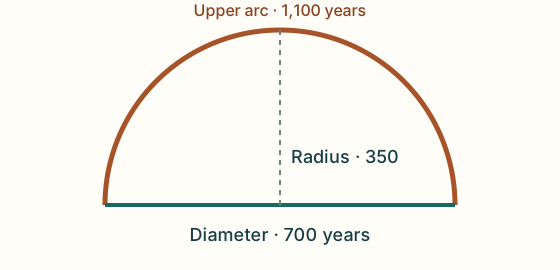
20 November 2026 · Both generation scales measure the 9,800 years to the upper Creation pillar
Agent 2-Trunk · Dean’s comparison. On the cumulative scale, File 22 §8.4 derives 12,558 × 70/69 = 12,740 = 26 × 490. File 09 §3A.5.3 supplies a 27th unit through second Cainan’s 460-year cumulative lifespan plus the separate 30-year apparent-age allowance: 12,740 + 460 + 30 = 13,230 = 27 × 490. On Dean’s regular schematic each human generation occupies a century. The published Creation Pillars appendix measures 14006 → 4206 BC = 9,800 = 20 × 490 = 98 × 100. This is twice the smallest common interval, 4,900 = 10 × 490 = 49 × 100. From 4206 to Moses’ death at 1406 BC are another 2,800 years (28 centuries), completing the 12,600-year span. The 4206 pillar uses the regular Actual MT Year-6 opening with +60 Terah and +30 apparent age. Base regular Rounded Creation remains 4106 BC, 9,900 years from cumulative Rounded Creation. Next question: do independently documented cumulative generational boundaries mark the midpoint of the 9,800 as well as its ends? File 22 §8.4 · File 09 §3A.5.3 · Creation Pillars appendix
20 November 2026 · Luke’s “son of God” and the century between the Creation pillars
Agent 2-Trunk · Dean’s schematic reading. Luke 3:38 traces Adam to God. File 69 already gives 27 human positions from Adam to Moses with second Cainan retained, and 28 (14 + 14) with the figurative God position. Dean assigns the century before Adam in his table, 4206–4106 BC, to this opening position. In the Creation Pillars appendix, 4206 is the Actual regular MT Year-6 opening with +60 Terah and +30 apparent age; 4106 is base regular Rounded MT Creation. The appendix already records the distances from cumulative Rounded Creation (14006 BC): 9,800 and 9,900 years, respectively. Treating them as 98 and 99 schematic centuries, the two pillars divide the same span to Moses’ death (1406 BC) as 98 + 28 = 99 + 27 = 126. The 28-century sequence divides at 2806 BC: the close of second Cainan’s century and the opening of Shelah’s, 1,400 years from either end. The proposed fit with Luke gives the century a genealogical meaning; its dates come from Dean’s model. Next question: does the Cainan–Shelah division clarify the 1,400-year radius already obtained in the published pillar construction? Luke 3:38 · File 69 · Creation Pillars appendix
20 November 2026 · Eleven centuries from Noah’s birth to Shem’s death
Agent 2-Trunk · Dean’s century-scale observation. File 52b §5.4.3 already gives the regular Rounded MT sequence Noah born 3056 → Shem born 2556 → Flood / Arphaxad 2456 → Shem dies 1956 BC: 500 + 100 + 500 = 1,100. The century in the middle counts once in the full span and belongs to both Noah’s 600 years to the Flood and Shem’s 600-year life. Genesis 11:10–11 places Arphaxad two years after the Flood in the textual chronology. On the Rounded scaffold the two events share a year label. Genesis 9:28 independently gives Noah 350 years after the Flood, corresponding to 2456 → 2106 BC. Thus 1,100/350 = 22/7; doubling both yields the 2,200/700 used in the Creation-to-Conquest schematic. The dates establish the proportion. Its reading as π is interpretive. Next question: does the doubling explain how the Flood family’s proportion reappears from both ends of the larger chronology? File 52b §5.4.3 · File 51a · Genesis 9:28 and 11:10–11
20 November 2026 · The forward and backward 22/7 on the Rounded MT century scale
Agent 2-Trunk · Dean’s working model. From Rounded Creation (4106 BC), 700 years reaches 3406 BC, the proposed close of Enoch’s seventh schematic century, and 2,200 reaches 1906 BC, the proposed close of Jacob’s twenty-second. From Moses’ death (1406 BC), counting back 700 reaches Noah’s Rounded death (2106 BC) and 2,200 reaches the converted Jared date (3606 BC). File 52b already establishes 4106 → 3646 = 460 and 460 × 25/23 = 500. Both directions therefore give 2,200/700 = 22/7. The two complete partitions are 500 + 200 + 1300 + 200 + 500 and 500 + 200 + 1400 + 200 + 400. Their middle spans end at Noah’s death (2106) and Jacob’s birth (2006). The 1,700 from 3606 to 1906 belongs to both 2,200-year spans.
File 51a places Enoch’s Rounded taking at 3121 BC and Abram’s birth at 2166 BC. Their generational roles give meaning to the 700s at a schematic level. The transmitted MT counts seven names inclusively from Abram to Moses and 21 from Jared to Moses (positions 6–26). Counting second Cainan in his ancestral position adds one only to the longer list. Counting Joseph’s double portion globally after Abram would affect both lists. Dean’s proposed redemptive replacement is therefore a local interpretation of the extra century. Noah’s Rounded birth to Shem’s death supplies the exact 1,100 (3056–1956 BC). The proposed 500 + 1100 + 500 gives 2,100 before any overlap. File 52b supplies the full 2,700 as 500 + 550 + 1100 + 550. Next question: which textual counting rule would give the longer reverse count an extra position while preserving Abram’s seven? File 52b · File 51a · File 18 · Genesis 48:5 and Joshua 14:4
20 November 2026 · Jubilees places Abram’s call and death on the same two MT dates
Agent 2-Trunk · Dean’s BJ comparison. Jubilees 11:14 places Abram’s birth in AM 1876, or 1,875 elapsed years from Creation. On File 20’s BJ chronology, 3856 → 1981 BC gives 1,875 = 25 × 75. Another 75 years to the call in 1906 BC gives 1,950 = 26 × 75. File 20 §7B and File 53 §11 already record the remaining 100 + 400 = 500 from Abram’s call through his death (1806 BC) to the Conquest (1406 BC). Dean’s comparison with the Rounded MT keeps these three dates fixed: 1906 is Benjamin’s proposed birth there, 1806 is Joseph’s Rounded death, and 1406 is the common land-entry boundary. The 100 + 400 pattern is exact on these dates. Deliberate reuse by the author of Jubilees remains an interpretation. Next question: how does the seven-generation backward count from Moses to Abram bear on this shared Conquest endpoint? File 20 · File 53 · File 01 · File 51a
20 November 2026 · Joseph’s two tribal portions and the four centuries to Moses
Agent 2-Trunk · Dean’s proposed reading. In Genesis 48:5 Jacob counts his grandsons Ephraim and Manasseh alongside his sons Reuben and Simeon for inheritance. Joshua 14:4 names the resulting two tribes. On the regular Rounded MT line, Joseph’s death (1806 BC) to Moses’ death (1406 BC) is exactly 400 years, comprising 360 to the Exodus and 40 in the wilderness. The Actual MT interval from 1805 BC is 399 years. Measured from Rounded Creation (4106 BC), the earlier reading gives 22 centuries to Benjamin’s proposed birth and four more to 1506 BC. The companion gives 23 centuries to Joseph’s death and four more to Moses’ death. Both ends of the four-century interval move by 100 years. Dean proposes that Joseph’s house, one in descent and two in the allotment, gives narrative meaning to the additional schematic century. The MT genealogy through Levi still counts 26 people from Adam to Moses. File 61 already relates Joseph’s double inheritance to a separate pair of 110-year spans. Next question: does the backward count from Moses to Abram independently support the century scale? File 03 · File 51a · File 61
20 November 2026 · Abram’s call and Joseph’s birth measure 22 blocks from Creation
Agent 2-Trunk · Dean’s Actual MT observation. Abram leaves Haran in 2091 BC. Jacob sets out for Haran in 1929 BC, fourteen years before Joseph’s birth in 1915 BC. Holding the close of Creation Year 6 at 4115 BC, the interval to Abram’s call is 2024 = 22 × 92. The Key of 23 ratio 25/23 converts each 92 to 100, giving 22 × 100 = 2200 years and reaching Joseph’s Actual birth. The gain is 22 × 8 = 176. The Haran dates divide that gain into 162 + 14, while Abram’s call to his death in 1991 BC provides an independent century within the family narrative. The conversion is exact. Reading the 22 blocks as the 22 father-to-son steps from Adam to Joseph is Dean’s interpretation. Next question: how does the backward count to Abram relate to these 22 forward steps? File 01, Abram · File 04, Haran · File 03, Joseph · File 71, Creation and conversion ratios
20 November 2026 · Jacob’s 22nd century and four more to Moses’ generation
Agent 2-Trunk · Dean’s Rounded MT observation. Counting Adam as 1, Jacob is 22nd and Moses is 26th in the MT genealogy without second Cainan. With a schematic century per generation, Rounded Creation at 4106 BC places Jacob’s birth at the opening of century 22 (2006 BC) and Benjamin’s proposed birth at its close (1906 BC). Four further centuries, read alongside the promise of Genesis 15:13–16, close at 1506 BC: 2,200 + 400 = 2,600 years. The close of century 26 precedes Moses’ death and the Conquest in 1406 BC by 100 years. On the −215 sojourn reckoning, 3891 → 1691 → 1291 BC gives the same 2,200 + 400. The 1291 BC endpoint falls 115 years after the fixed 1406 BC Conquest. These are schematic century boundaries. The age-100 Benjamin placement is inferred. Next question: how does Dean’s backward count from Moses to Abram relate to this forward count? File 18, MT count and fixed anchors · File 51a, Rounded Creation and −215 state · File 01, Benjamin
20 November 2026 · Creation’s six working years reach Reuben through Joseph
Agent 2-Trunk · Dean’s MT observation. Jacob is generation 22 from Adam. His twelve sons share generation 23, after 22 father-to-son steps. In Genesis 15:13–16, the 400 years and return in the fourth generation motivate a schematic century per generation. On the regular Actual MT chronology, translating the six years 4121–4115 BC forward by 2,200 gives 1921–1915 BC, from Reuben to Joseph. Levi (1919) and Judah (1918) fall inside that interval. The span covers the first eleven sons as a group. For Benjamin the comparison uses Rounded Creation 4106 BC and the proposed birth at Jacob’s age 100, 1906 BC, again 2,200 years. On the Rounded line Jacob’s birth (2006), Benjamin’s proposed birth (1906), and Joseph’s death (1806) stand 2,100, 2,200, and 2,300 years after Creation. On the Actual line the end of Year 6 to Joseph’s death gives 4115 − 1805 = 2310 = 21 × 110. Daniel 8:14 supplies a comparison in evenings and mornings. Next question for Dean’s MT-first inquiry: does the backward count to Abram supply an independently dated seven-century counterpart to the 22 centuries? File 51a · File 03 · File 01 · File 62 · File 71
20 November 2026 · The Conquest and the Exodus govern the consolidated trunk
Agent 1-Trunk · Working draft 8. At Dean’s direction, Joshua’s crossing in 1406 BC and Moses’ Exodus in 1446 BC share rank 2, just after Noah’s six hundred at the Flood. The Conquest comes first for its reach in the cumulative chronology and through its civil Mirror at AD 1405. Three intervals of 1,400 years move as wholes. Jacob/Levi to restoration is 1936 → 536 BC, Exodus to the schematic Enochic calendar close is 1446 → 46 BC, and Conquest to the Nativity is 1406 → 6 BC. Both ends move first by 490 years, then by the forty years in the wilderness. The six dates that move 1,470 years from Abraham’s family to the Temple, exile, return and civil AD 25 now belong to the main reading. The revision brings Joseph’s oath and the ancient testimony about Jared, Enoch and Lamech into the narrative. Five appendices hold the detailed constructions and open tests. The next question is whether a single Temple and Gospel calendar setting preserves both the Temple midpoint and the translated family geometry. Reorganization outline · Working draft 8 · Word edition · Corrected ranking
20 November 2026 · Ranking the trunk places Solomon’s Temple between Jacob and Christ
Agent 1-Trunk · Research priorities for Dean and Agent 2. The 38 ranked entries give biblical narrative and independent dated boundaries first weight. The Temple at 966 BC comes seventh. It bisects Jacob/Levi 1936 BC to Christ’s civil Mirror AD 5. A uniform 1,470 years also carries Abraham → Jacob/Levi → Exodus onto Temple 966 → calendar 466 → ministry AD 25, preserving 500 + 490. On that same move Sarah reaches Hezekiah’s 686, and the covenant and Jacob reach exile 606 and return 536. The Temple row contains the 220/70 circle and shares the AD 25 endpoint of a 990/700 square. Whole-year and month-specific evidence are distinguished. Next, test the Temple and Gospel endpoints at their stated calendar precision. Full ranking · The dated comparison · Second Temple testimony
20 November 2026 · Two Creation dates recover Peleg’s birth and Noah’s death
Agent 1-Trunk · Core review 71–75. File 51b §9.6 independently fixes 11106 BC, the opening of the second 7,000-year side. Quartering the Creation–Conquest span fixes 10856 BC. The same 250 years move through 5596–5346 BC onto regular Peleg 2356 BC to Noah’s death 2106 BC. The smaller three 330s also fit when File 01’s adjusted Abraham death at 1776 is explicitly selected. Working draft 7 gives the continuous reading and three new diagrams. Five questions and sources · Illustrated reading · Working draft 7
20 November 2026 · Dean’s Joshua–Jacob circle closes the third 3,300
Agent 1-Trunk · Core review 66–70. Enoch’s three circumferences now have dated divisions at 5196 and 1896 BC. The first comes from Noah’s death on the ten-to-one Abraham row. For the last circumference, reverse and reflect Dean’s Joshua–Jacob crossing, then move both ends forward 110 years. File 68’s translated Weeks 1 and 4 also date one internal position on each 9,900. The final batch returns these results to the original cumulative Creation chronology. Five questions and sources
20 November 2026 · Shem and Jared supply the dated overlap of Abraham’s two sides
Agent 1-Trunk · Core review 61–65. The actual 410 years shared by Shem’s and Jared’s 2,200-year circles move forward 1,500 years to 2146–1736 BC, the overlap of the two 700-year sides on Abraham’s 990. At ten times the scale the 4,100 shared by Enoch’s two sides divides into two of the established 2,050s. The calendar and family also recover both positions on Lamech’s circle. Next we test where the three complete Noah circumferences fall on these same rows. Five questions and sources
20 November 2026 · Regular Peleg and Noah’s death give Enoch his side and diameter
Agent 1-Trunk · Core review 56–60. Noah to his death and Peleg to the Conquest are two 950-year spans. The Flood and Jacob divide them as 600 + 350 and 350 + 600. On Enoch’s row the image of Peleg starts the second 7,000, and the image of Noah’s death gives a 3,150-year diameter from Enoch himself. The whole 9,900 now has both a working circle and square measured from one beginning. Next, test the two 7,000s against Abraham and Jared. Five questions and sources
20 November 2026 · Abraham’s 290 years locate both ends on Lamech’s circle
Agent 1-Trunk · Core review 51–55. The existing fixed-Exodus and fixed-Flood Keys give no direct whole-year solution. Abraham’s independently recorded 290 years to the Egyptian entry, applied to File 68’s 3476–46 BC count, give 3766 and 336 BC together. On Lamech’s 9,900 these boundaries support two 7,000s overlapping by 4,100. Next, check the same boundaries on the regular Noah–Peleg chronology. Five questions and sources
19 November 2026 · Enoch and Jared meet at the 46 BC terminus
Agent 1-Trunk · Core review 46–50. File 68’s original 70- and 72-year counts have symbolic starting boundaries at regular +60 Enoch 3546 and regular Jared 3646 BC. Both end at 46 BC. Jared → primary Exodus → 46 BC gives a dated 2,200 + 1,400, followed by 70 to civil AD 25. The alternate 8501/3501 pair preserves the outer diagonal but does not reproduce Noah’s two positions with the same source dates. Working draft 6 incorporates the findings and three diagrams. Five questions and sources · Illustrated reading · Working draft 6
19 November 2026 · Lamech’s circle recovers Shem’s restoration years
Agent 1-Trunk · Core review 41–45. Enoch’s diagonal moves bodily 1,830 years to Lamech’s reflected circumference. Its Joshua point becomes restoration’s civil Mirror, AD 535. The closing 2,700 are therefore the reflected Lamech-to-restoration years already inside Shem’s 4,900. Neither possible end of a separate 7,000-year side has a named MT event in the checked sources. Next we check the other published Enoch–Peleg placement to identify how far the result travels. Five questions and sources
19 November 2026 · The Creation Pillar between the two Noah spans
Agent 1-Trunk · Core review 36–40. Enoch’s 7,000-year side closes at Judah’s Exodus. The square already supplies the same 2,050 that carries Jared’s primary Exodus to Peleg. The named 4206–1406 BC Creation Pillar also lies between the two 2,800s around Noah, by whole-interval shifts of 1,050 and 1,150. The four-boundary fit is specific to the stated Rounded placement. Next we test where Lamech’s other 9,900 meets this one. Five questions and sources
19 November 2026 · Sarah and Lamech on the smaller diagonal
Agent 1-Trunk · Core review 31–35. File 51a’s ten-to-one comparison places Sarah’s birth at the position corresponding to 5696 BC. File 68’s 2216 BC schematic boundary corresponds to 6296 BC. On the same scale Joshua’s 1296 BC corresponds to 1716 BC, independently the midpoint of the reflected 9,900-year Lamech circle. The full 990 and 9,900 now have five corresponding intervals. Next come the side of Enoch’s square and the two Exodus dates. Five questions and sources
19 November 2026 · Noah’s six hundred inside Enoch’s five thousand
Agent 1-Trunk · Core review 26–30. Enoch and Peleg move together to two sourced schematic boundaries when projected Lamech at 3246 BC is aligned with 6 BC. On this translated row the regular Rounded birth of Noah and the Flood divide 5,000 as 2,200 + 600 + 2,200. Restoring the 3,240-year offset gives 6296 and 5696 BC as calculated boundaries. Jared’s already established Exodus-to-Peleg translation also generates 5696 and Dean’s 4596. The next check uses Abraham’s smaller diagonal. Five questions and sources
19 November 2026 · Joshua closes Noah’s circle at Jacob’s Mirror
Agent 1-Trunk · Core review 21–25. Dean’s 1296 BC → civil AD 2005 gives one elapsed 3,300 on the 1,050 from Noah to Jacob. It begins exactly where Peleg’s 2,200 ends. The 980, 1,050 and 1,120 diameters all start at Noah and reach three pre-existing family dates, giving 3,080, 3,300 and 3,520. The derived AD endpoint is civil AD 4595, or symmetric Rounded AD 4596. The independent inner cut on Enoch’s original 5,000 remains the next question. Questions and sources · Illustrated reading · Working draft 5
19 November 2026 · How far the dated trunk reaches
Agent 1-Trunk · Core review 16–20. Working draft 5 now follows Noah’s 600 through Shem and Enoch to Peleg, Joshua, the primary Exodus and civil AD 25. From conventional 796 BC, the primary Conquest Mirror divides two dated Pillars readings into 2,200 + 2,700 and 2,200 + 2,800. The interior of Enoch’s original 5,000 remains open. The next goal is one independent source-defined test of that cut. Questions and sources · Illustrated reading · Working draft 5
19 November 2026 · The full circle from Peleg to civil AD 25
Agent 1-Trunk · Core review 11–15. Peleg to civil AD 25 gives 3,520 on the internal diameter of 1,120 from Noah to Jacob/Levi. The same 3,520 measures the difference between Jared’s two semicircumferences. Moving both ends forward 2,050 yields the primary Exodus to the covenant Mirror. The common stretch is the Exodus to civil AD 25, exactly 1,470 years. The remaining test concerns Enoch’s original 5,000. Questions and sources
19 November 2026 · Lamech’s division on Peleg’s own line
Agent 1-Trunk · Core review 6–10. Moving Shem, Lamech, Jacob/Levi and restoration forward 1,940 years gives Peleg, Joshua’s cumulative 1296 BC endpoint, civil AD 5 and civil AD 1405. The sequence 2,200 + 1,300 + 1,400 survives at all four named boundaries. On Enoch’s separate row File 18 identifies 796 BC inside the closing 2,900. The next test follows Peleg to civil AD 25. Questions and sources
19 November 2026 · The circle inside Abraham’s diagonal
Agent 1-Trunk · Core review 1–5. Sarah’s 220 years occupy the middle of the 990 from cumulative Abraham to the primary Exodus. Shem’s 2,900 also gains a sourced division. Moving the cumulative Flood, the local 4136 BC Creation overlay and Jacob/Levi forward 490 years gives projected Creation, Jared and the primary Exodus. The next test follows Lamech’s boundary onto Peleg’s line. Questions and sources
19 November 2026 · How to read the Mirror in the trunk
Agent 1-Trunk · Method memo for both windows. A Rounded width can carry two AD display labels. A mixed crossing can fall on or off the five-year grid. The Year 6 diagram shows why moving one seasonal boundary changes a span by half a year. Step 26’s attribution of age 100 is a separate textual issue. Use these comparisons when reviewing an apparent discrepancy. Read the memo · Download as Markdown
19 November 2026 · From Noah’s six hundred years to Christ
Agent 1-Trunk · Steps 46–50 of 50. All fifty questions are complete. The strongest dated connection is Jacob/Levi 1936 BC → primary Exodus 1446 BC, the same 490 in Jared’s circle, Abraham’s diagonal and Jacob’s four 490s. The 20-year Joshua correspondence ends at civil AD 25. The remaining Pillars test is an independent event at 6296 or 5696 BC. The companion includes the three diagrams, a printable reading and the numbered record. Five questions, findings and sources · Illustrated reading
19 November 2026 · Peleg’s 3,500 reaches Joshua and civil AD 25
Agent 1-Trunk · Steps 41–45 of 50. Moving Peleg 3496 BC → Judah’s Exodus 1496 BC → civil AD 5 forward 20 years gives File 68’s 3476 BC schematic head → Joshua born 1476 BC → civil AD 25. Both rows measure 2,000 + 1,500. Within the latter, Joshua’s 30 years to Exodus and the Nativity’s 30 years to ministry also translate together by 1,470. Next test where the 20-year correspondence ends. Five questions, findings and sources
19 November 2026 · Jacob’s four 490s and Noah’s closing semicircle
Agent 1-Trunk · Steps 36–40 of 50. The common 1936–1446 BC interval opens four 490s to civil AD 25. Noah and Jacob/Levi reach that endpoint in 3,080 and 1,960 years, or 11/7. File 68 prints the final 1,470 and the corridor dates. Their midpoint relationships are derived. Next test the open division inside Enoch’s 5,000. Five questions, findings and sources
19 November 2026 · The same 490 years at the primary Exodus
Agent 1-Trunk · Steps 31–35 of 50. The intersection of Jared’s 2,200, Abraham’s 990 and Jacob’s 1,960 is precisely 1936–1446 BC. Substituting Moses-line Abraham and Levi leaves 985 to the fixed Exodus. The two successful Mirror crossings both contain the following 1,470 to AD 25. Next check which dates and relationships File 68 actually prints. Five questions, findings and sources
19 November 2026 · Why Enoch and Jared use different Conquest Mirrors
Agent 1-Trunk · Steps 26–30 of 50. The four crossings measure 2,900, 2,950, 2,850 and 2,900. Only Judah’s Exodus → primary Conquest Mirror and primary Exodus → Judah’s Conquest Mirror preserve 2,900. Their boundaries translate by 50. The record also flags File 22 §7.12’s misassigned age of 100. Next locate Jacob’s path inside the successful crossings. Five questions, findings and sources
19 November 2026 · How Lamech divides the common years
Agent 1-Trunk · Steps 21–25 of 50. Peleg to Rounded Lamech to Jacob/Levi gives 260 + 1,300 within File 22’s 1,560. Peleg also divides the 410 shared by Shem’s and Jared’s two 2,200s as 150 + 260. Projected Lamech 3246 BC has a distinct role at three quarters of Enoch’s side. Next compare the projections with the Flood and Exodus held fixed. Five questions, findings and sources
19 November 2026 · Abraham inside Peleg’s interval and Jared’s circle
Agent 1-Trunk · Steps 16–20 of 50. Jared 3646 → Peleg 3496 → Abraham 2436 → Jacob/Levi 1936 → primary Exodus 1446 BC gives 150 + 1,060 + 500 + 490. Peleg’s entire 2,050 and Abraham’s entire 990 end at Jared’s Exodus. The tenfold link to Enoch is proportional. Next compare this 2,200 with the one ending at Lamech. Five questions, findings and sources
19 November 2026 · Peleg and Jacob share 1,560 dated years
Agent 1-Trunk · Steps 11–15 of 50. The two 3,500s overlap from cumulative Peleg 3496 BC to Jacob/Levi 1936 BC. File 22 §3.5 already names this 1,560 = 12×130 and appends 490 to the primary Exodus. The selected Rounded branches retain those dates. This supplies a direct route from Peleg toward Jared’s Exodus. Next place both Exodus dates inside it. Five questions, findings and sources
19 November 2026 · The 2,900 years after Shem’s Flood
Agent 1-Trunk · Steps 6–10 of 50. Shem’s 600 and the next 2,900 share 4836 BC. Reaching exactly 3,500 requires Moses-line Shem and Aaron-line Jacob/Levi at 1936 BC. Either single Rounded line gives 3,505. Moving the three Creation-side boundaries by 5,510 gives Enoch, Judah’s Exodus and the primary Conquest Mirror. Next compare the two dated 2,900s. Five questions, findings and sources
19 November 2026 · Noah’s six hundred years and the two Flood rows
Agent 1-Trunk · Steps 1–5 of 50. The regular Rounded ages give 2,700 elapsed years, or 3,300 when both overlapping spans are counted. Cumulative Moses-line Shem’s 5436–4836 BC translates at both ends by 2,380 years to regular Noah’s 3056–2456 BC. Next we test where the 2,900-year difference of the square begins on Shem’s row. Five questions, findings and sources
19 November 2026 · Where the two 2,200-year spans join the trunk
Agent 1-Trunk · Twenty-step report. Both 2,200s have dated internal divisions. From cumulative Moses-line Shem 5436 BC through regular Rounded Lamech 3236 BC to restoration 536 BC are 2,200 + 2,700. Jacob/Levi at 1936 BC divides the same whole into 3,500 + 1,400. Those three boundaries recur at Peleg 3496 BC, Christ’s Mirror civil AD 5, and the primary Conquest Mirror civil AD 1405. Peleg’s crossing places Judah’s Exodus 1496 BC inside the 3,500, yielding 2,000 + 1,500 + 1,400. Shem and Peleg diagram
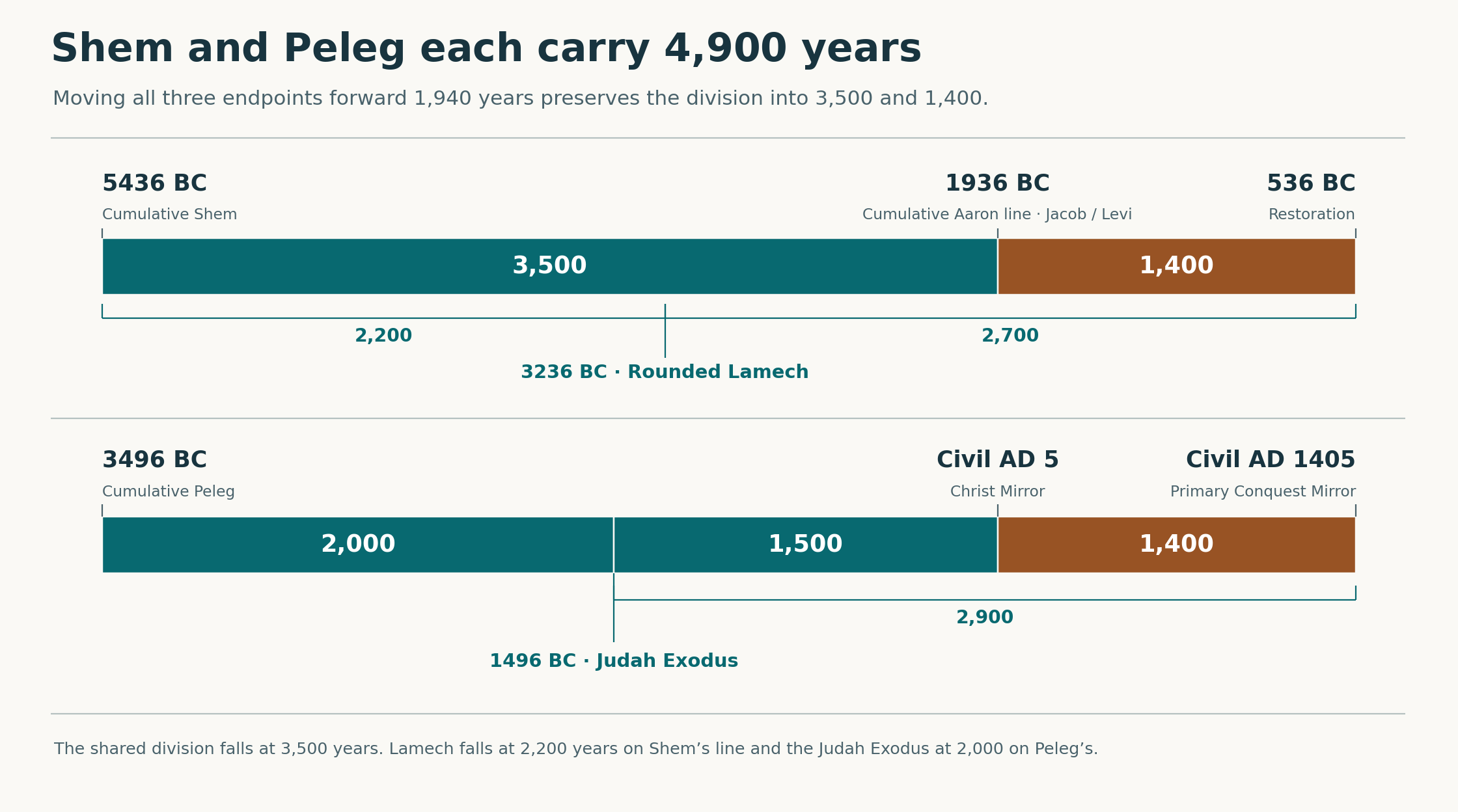
Jared at the Exodus. Rounded Jared 3646 BC, cumulative Aaron-line Abraham 2436 BC, Jacob/Levi 1936 BC, and the primary Exodus 1446 BC give 1,210 + 500 + 490 = 2,200. Thus the full 990 working diagonal on 700 lies inside the span. The published projected Flood midpoint at 2546 BC gives another division, 1,100 + 1,100. Across the Mirror, projected Creation 4346 BC → primary Exodus 1446 BC → Judah’s Conquest Mirror at civil AD 1455 gives 2,900 + 2,900. The calculated 2946 BC division gives 1,400 + 4,400 between the same endpoints. Twenty results, decisions, diagrams and sources · Illustrated PDF
Next review. Read the reorganized working draft from Noah through Shem and Peleg to the two Conquest Mirrors. Check whether the shared dates at Lamech, Abraham and the Exodus make those branches intelligible on the first reading. The 5,000-year Pillars decomposition and the tenfold Flood-day correspondence remain comparisons of lengths or proportions. Working draft
19 November 2026 · Fitting cumulative Shem to the trunk
Agent 1-Trunk · Dean’s revised direction. Working draft 3 now assembles the Rounded MT trunk and its cardinal branches from dates already in the draft. The earlier AD 65 proposal is deferred. Read the draft through Noah, cumulative Shem, Enoch, Peleg and the Conquest Mirror before following the principal branches at Lamech, Jared and Jacob. Reorganized outline · Cardinal branches
Shem’s place. On the cumulative Rounded Moses line 5436 → 4836 BC is Shem’s 600-year lifespan, closing at the cumulative Flood / Arphaxad. Its endpoints move forward 2,380 to regular Noah and Flood (3056/2456 BC) and another 1,050 to regular Jacob and Conquest (2006/1406 BC). Both columns give 3,430 = 7 × 490. From the cumulative Flood to the Aaron-side Jacob/Levi boundary at 1936 BC are 2,900. The combined 600 + 2,900 = 3,500 measures half of 7,000. The first part equals Noah’s working semicircumference less his diameter. The second equals Enoch’s working diagonal less its side. File 22 supplies the whole Shem–Jacob interval. Reading its two parts together is the proposed fit. Peleg to Christ’s civil Mirror at AD 5 carries the whole 3,500 on the way to the Conquest Mirror. Shem in the working draft · File 51a §16.2 · File 22 §3.3
Next fitting goal. Trace where the two existing 2,200-year measurements attach. Compare Shem to Lamech with Jared to Exodus, retaining their respective roles as a circumference on 700 and a semicircumference on 1,400. Draft agenda
19 November 2026 · Lamech and Jacob added to the working draft
Agent 1-Trunk · Draft revision. The second working draft collects Lamech’s death and the Flood at 7 × 1,650 = 11 × 1,050, his projected birth on Enoch’s 7,000 and 9,900, and the +60 Flood Mirror on his 360-year divisions. Jacob’s 1936 BC brings together the Exodus-held projection and the cumulative Aaron date. His 500 + 490 and the 3,500 + 1,400 division connect to Peleg. The 3,080/1,960 semicircle ending at civil AD 25 includes the 14/15 copy of Noah’s original intervals. The draft labels Sarah’s family circle, the LXX parallels and the 6666 BC midpoint as supporting comparisons. Lamech’s death · Lamech on Enoch’s square · Jacob’s square · Noah and Jacob at AD 25
Next goal. At Dean’s direction, check whether the proposed counterpart at civil AD 65 has dated MT support at both 3016 and 1896 BC. The present draft records it as an open test. Source of the question
19 November 2026 · Noah and Jacob reach the age-thirty date at AD 25
Agent 1-Trunk · Dean’s observation. At Bethel, God promises Jacob a return to the land. Daniel 9 gives seventy sevens for his people. Luke names Jacob and Noah in the genealogy following his statement that Jesus began his ministry at about thirty. From the study’s early birth in 6 BC, civil AD 25 marks 6 + 25 − 1 = 30 elapsed years. Genesis 28:12–15 · Daniel 9:24–27 · Luke 3:23–36 · File 01 §5.2
Four spans of 490. Jacob’s journey in 1929 BC is 483 = 69 × 7 years before Exodus. With 1446 BC fixed, 483 × 70/69 = 490 = 70 × 7 gives 1936 BC, also the Aaron-side cumulative Jacob-death/Levi-birth date. Dean reads the additional seven as a precedent for Daniel’s pattern. File 68 Appendix D already gives the five closing dates 1936 BC → 1446 BC → 956 BC → 466 BC → civil AD 25. The sanctuary and restoration windows close schematically at 956 and 466 BC. Published Key table · File 22 §3.3 · File 68 Appendix D.2–D.4
The semicircle also selects AD 25. To that endpoint, regular Rounded Noah at 3056 BC gives 3,080 and Jacob/Levi at 1936 BC gives 1,960 = 490 + 1,470. The ratio is 11/7. Run it backward. The 1,120 years between the starts account for 11 − 7 = 4 equal units. One unit is 280. Seven units forward from 1936 BC recover AD 25 before using the birth date. The reciprocal Mirror spans, in civil labels, run from 26 BC to AD 3055 and AD 1935, respectively. Noah’s Rounded dates · File 51b, civil and symmetric Rounded displays
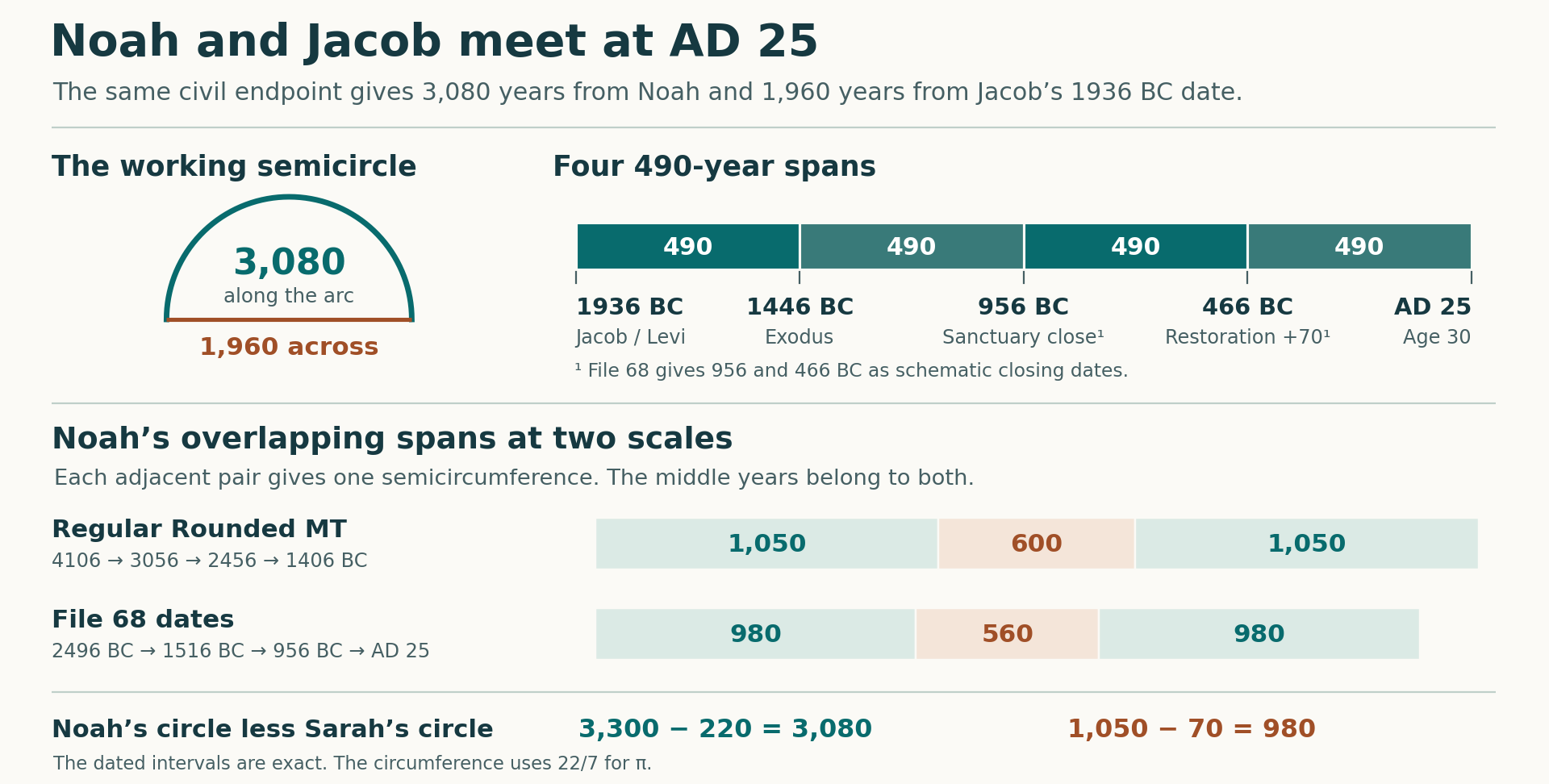
The same overlap at 14/15 scale. File 68 D.4 supplies all three midpoints. 2496 BC bisects Noah to Jacob/Levi, 1516 BC bisects Noah to AD 25, and 956 BC bisects Jacob/Levi to AD 25.
| Four dates in order | Three successive spans | Two overlapping spans |
|---|---|---|
| Rounded Creation 4106, Noah 3056, Flood 2456, Conquest 1406 BC | 1,050 + 600 + 1,050 | 1,650 + 1,650 = 3,300 |
| File 68 dates 2496 BC → 1516 BC → 956 BC → civil AD 25 | 980 + 560 + 980 | 1,540 + 1,540 = 3,080 |
Subtract Sarah’s 220 circumference and 70 diameter from Noah’s 3,300 and 1,050. The resulting 3,080/980 = 22/7 gives the full circle. On the doubled diameter 1,960, that same 3,080 gives Dean’s semicircle. Sarah’s branch · Noah’s original overlap · File 68 Appendix D
Earlier 1736 BC test. The predicted year falls inside Kohath’s 1801–1666 BC on the Rounded cumulative Aaron line. That table gives no named event at 1736. File 52b reaches it through Terah’s inverse lifespan. File 51a §16.2 · File 52b
Next goal. File 68 also measures three 490s from the Conquest at 1406 BC to civil AD 65. Test whether 3016 and 1896 BC, the starts required to preserve Dean’s circle there, have independently attested MT roles.
19 November 2026 · Sarah’s circle and Shem’s semicircle at Jacob’s 1936 BC
Agent 1-Trunk · Dean’s two observations. Genesis 17 gives Abram’s age as 99 at the covenant that names Abraham and Sarah and promises Isaac. Genesis 25 brings that promise to Jacob’s generation. Luke places Abraham, Isaac, Jacob, Shem and Noah in the genealogy of Jesus. Genesis 17:1–21 · Genesis 25:26 · Luke 3:34–36
Sarah’s branch on the regular MT. From Sarah’s birth in 2156 BC to Isaac’s birth in 2066 are 90 years. Isaac is 60 at Jacob’s birth in 2006. Jacob’s first 70 years reach 1936. Sarah’s 220 = 90 + 60 + 70 therefore contains its own 70-year diameter at the end. Abram, ten years older, gives 2166 − 1936 = 230 = 10 × 23. His 99 years to the covenant in 2067 BC supply the working diagonal for the same side-70 square. Family dates · Genesis 21:1–5 · Published square and circle
With the 1446 BC Exodus fixed, the covenant span 621 → 630 projects 2067 to 2076 BC, and the Bethel span 483 → 490 projects 1929 to 1936 BC. Both use 70/69. The two projections frame ordinary Jacob’s birth as 2076 → 2006 → 1936 BC = 70 + 70. This supplies the 140 in the published bounds 140/99 < √2 < 99/70, alongside Sarah’s 220/70 = 22/7. His age of 70 is measured on the ordinary biography. Published Key table · Jacob at 1936 BC
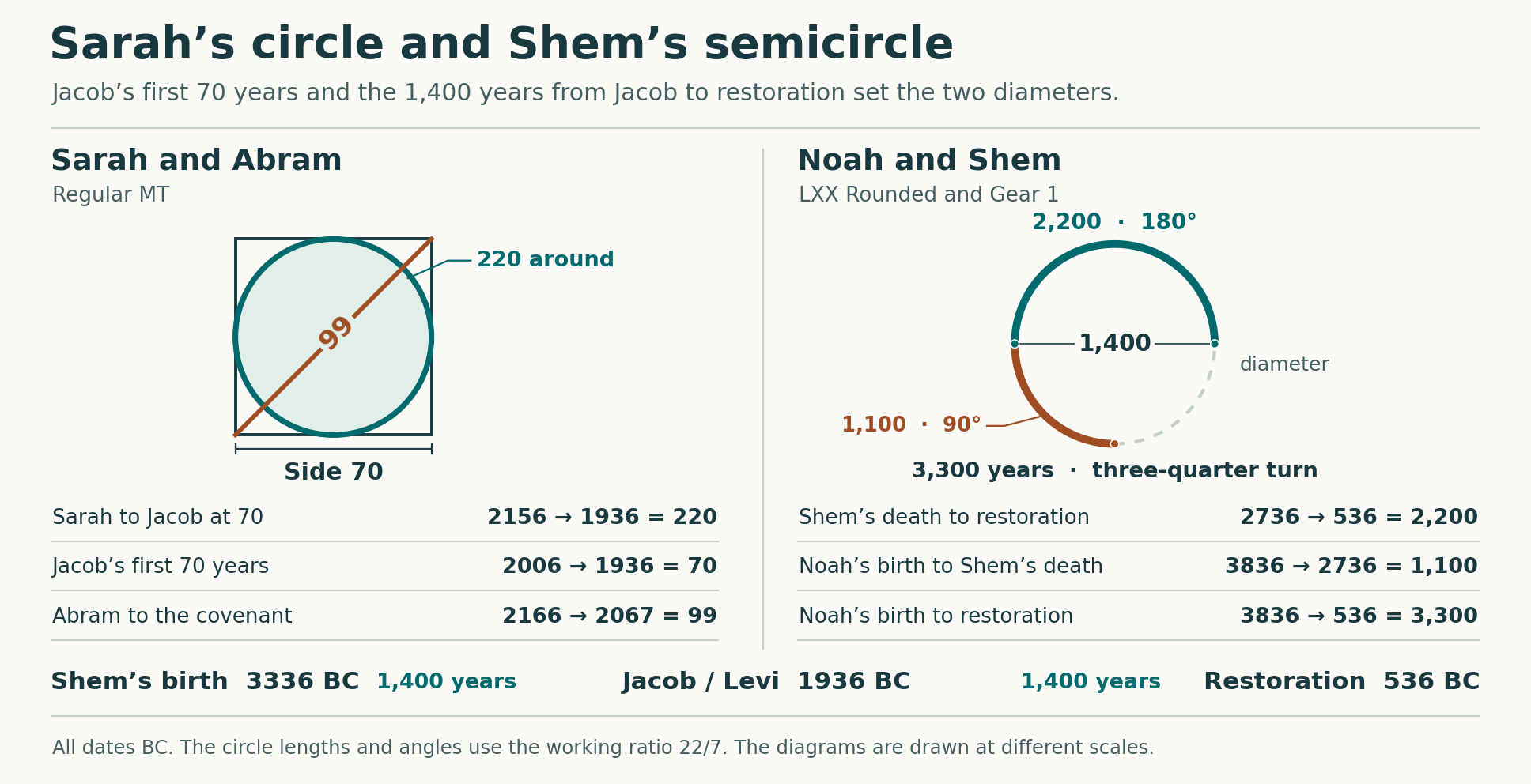
Noah and Shem on the LXX comparison. Regular Rounded and Gear 1 give the same dates here, with the full 430-year Egypt setting and +60 Terah off. Noah’s birth 3836 BC → Flood 3236 → Shem’s death 2736 gives 600 + 500 = 1,100. The Flood at 3236 BC also gives 1,300 to Jacob/Levi, at the same date as MT Rounded Lamech’s birth. From Shem’s death to the study’s restoration at 536 BC are 2,200. Jacob/Levi 1936 to restoration supplies the 1,400 diameter. At the working 22/7, the full circle measures 4,400. The dated arcs are therefore 90° + 180° = 270°. The larger semicircle equals ten of Sarah’s whole circumferences. Regular Rounded report IV, A.3 · Noah and Shem, selected Gear 1 · File 22 §3.3
Why these LXX dates support 1936 specifically. Shem’s birth places Jacob/Levi halfway to restoration, 3336 → 1936 → 536 BC = 1,400 + 1,400. A second calculation dispenses with the restoration date. Noah’s birth and death give 3836 → 2886 → 1936 BC = 950 + 950. Genesis supplies the first lifespan. Repeating it once is the test. With 536 BC fixed, the midpoint and repeated lifespan reach 1937 and 1938 BC in Gear 2, and 1938 and 1940 BC in Gear 3. The two calculations coincide on the Rounded/Gear-1 dates. Their common target is the independently tabulated MT Jacob-death/Levi-birth coordinate. Its 1,400 years to restoration already have a civil Mirror counterpart from AD 5 to AD 1405. Genesis 9:28–29 · LXX Gears, table A3 · MT cumulative comparison, File 51a §16.3
Next goal. Return to the Rounded MT and check whether its 700-year side has a named endpoint 1736 BC, counting from cumulative Abraham at 2436 BC.
19 November 2026 · Jacob at 1936 BC and the 700-year square
Agent 1-Trunk · Dean’s Jacob observation. With Lamech’s principal trunk role identified, Dean turns to Jacob. At Bethel God promises Jacob a return to the land. Jeremiah promises a return after Babylon’s seventy years. Jesus takes up Jacob’s vision of ascending and descending angels in speaking of the Son of Man. Genesis 28:10–15 · Jeremiah 29:10 · John 1:51
The Exodus and the cumulative tables both supply 1936 BC. From Jacob’s ordinary birth in 2006 BC, he is 70 in 1936 and 77 at the journey in 1929. Holding Exodus fixed, 1929 − 1446 = 483, 483 × 70/69 = 490, and 1446 + 490 = 1936 BC. The published +7 biography gives age 77 from projected birth in 2013 to projected departure in 1936. Independently, the whole-year Aaron-side cumulative table places Jacob’s death / Levi’s birth at 1936 BC in both Actual and Rounded MT. The Moses-side dates are 1933 Actual and 1931 Rounded. Published Key table §3.5 · File 51a §16.3
Two dated measures give the unit of the square. File 22 §3.3 gives 3,500 from cumulative Shem at 5436 BC to 1936 BC, and 1,400 from there to the 536 BC restoration. Their greatest common measure is 700. On this comparison Shem is the Rounded Moses-line date and 1936 is the Aaron-side Jacob/Levi date. File 22 §3.3 · File 51a §§16.2–16.3
| Measure on a square of side 700 | Named MT dates | Working ratio |
|---|---|---|
| Inscribed circle’s circumference | Rounded cumulative Shem 5436 BC to regular Rounded Lamech 3236 BC = 2,200 | 2,200/700 = 22/7 |
| Square’s diagonal | Rounded cumulative Abraham 2436 BC through Jacob/Levi 1936 BC to Exodus 1446 BC = 500 + 490 = 990 | 990/700 = 99/70 |
The chronological fractions are exact. The geometric lengths they approximate are 700π and 700√2. File 51a §16.3 already identifies 500 + 490 as the one-tenth counterpart of 5,000 + 4,900 on Enoch’s diagonal. Dean’s 3236 → 1936 BC = 1,300 completes the 3,500 as 2,200 + 1,300. The 1,300 is ten times Jacob’s age of 130 when he stood before Pharaoh. Joint π–√2 study · File 51a §§3.4 and 16.3 · Genesis 47:9
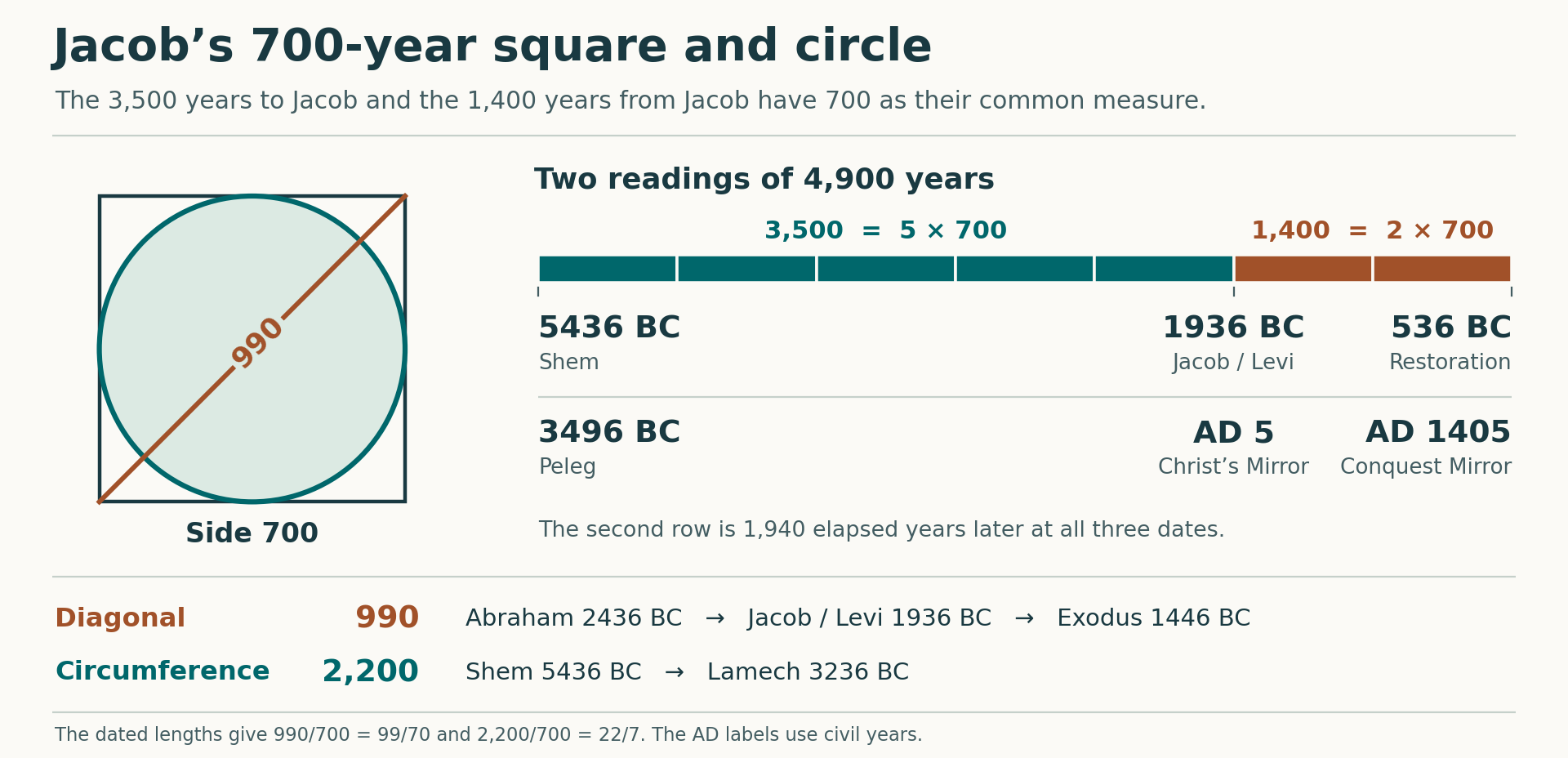
The same division on the Mirror. Move all three dates forward 1,940 elapsed years. Shem reaches Peleg 3496 BC, Jacob/Levi reaches civil AD 5 (Mirror of the 6 BC Christ datum), and restoration reaches civil AD 1405 (Mirror of the 1406 BC Conquest). Christ’s Mirror thus divides Peleg’s established 4,900 into the same 3,500 + 1,400. Civil crossings use BC + AD − 1. Published Enoch–Peleg division · Working draft, Peleg
The seventy years of exile. Jacob’s 2006/1936 BC dates are each 1,400 before 606/536 BC, respectively. From 1936 to 606 alone are 1,330. At ten times the original Key span, Shem held fixed gives 4,830 to 606 and 4,900 to 536. The seven-year gain at Bethel thus has a seventy-year counterpart over the project’s exile interval. File 22 §§3.2–3.3 · File 51a §16.2
Next goal. Test whether the 700-year side can also be measured directly from cumulative Abraham at 2436 BC to an independently dated event on the same Rounded MT chronology. The predicted year is 1736 BC.
19 November 2026 · Lamech’s death and the seventh span from Creation
Agent 1-Trunk · Dean’s observation. Lamech names Noah in hope of relief from the curse on the ground. Genesis gives Lamech another 595 years after Noah’s birth. Noah is 600 at the Flood. The regular Rounded MT preserves those five years between Lamech’s death in 2461 BC and the Flood in 2456 BC. Genesis 5:28–31 · Genesis 7:6 · File 51a §3.4
| All dates BC | Cumulative Creation | Regular Rounded Creation after 6 × 1,650 | After 7 × 1,650 | A further 1,050 |
|---|---|---|---|---|
| Upper | 14011 | 4111 | 2461 · Lamech dies | 1411 |
| Base | 14006 | 4106 | 2456 · Flood | 1406 · Conquest |
File 51a §16.10.1 already gives the base row through the Flood. The upper cumulative date comes from Aaron’s Rounded 125 years in place of Moses’ 120. On the regular chronology, 4111 is the opening boundary of the 4111/4106 BC Creation block. Dean’s reading identifies the named event at the end of the upper row’s seventh span. File 51a §§16.2 and 16.10.1
Why 11,550 matters. The trunk’s working circle has a diameter of 1,050 years and a semicircumference of 1,650. Their first common multiple is 11,550 = 7 × 1,650 = 11 × 1,050. Six semicircumferences give the 9,900-year diagonal at regular Creation. The seventh reaches Lamech’s death or the Flood. Published π–√2 geometry · Published √2 study
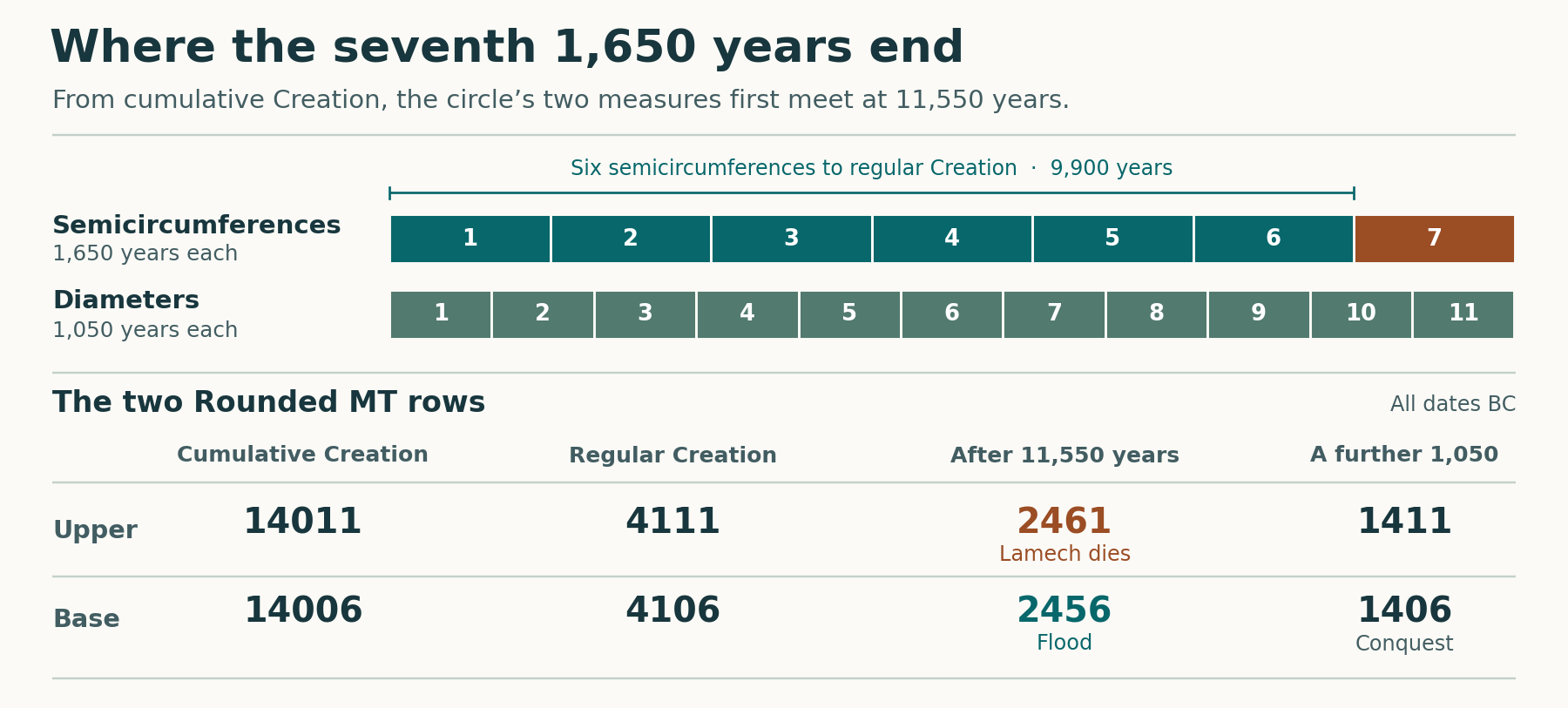
Keeping the Conquest fixed. With the same Noah birth at 3056 BC and the same primary Conquest at 1406 BC, the upper dates give 1,055 + 595 + 1,055 and the base dates give 1,050 + 600 + 1,050. Each pair of adjoining spans sums to 1,650. Counting exactly 1,050 onward from each event instead reaches 1411/1406 BC. The Rounded Conquest/rest block is 1406/1401 BC. File 51a §§3.4 and 17–18
Across the Mirror. File 51b §9.4 already pairs 1411/1406 BC with civil AD 6990/6995 at 8,400 years, and 11/6 BC with the same endpoints at 7,000. From Lamech’s death and the Flood, respectively, those endpoints are both 9,450 years away. Each event therefore divides the published 21,000 from cumulative Creation into 11,550 + 9,450, or 11 + 9 diameters. The whole measures three 7,000-year sides of the trunk’s square. File 51b §9.4
Next goal. Test whether a named MT date independently places a 7,000-year side on Lamech’s birth-to-Mirror span from 3236 BC to civil AD 6665. The Lamech birth comparison
19 November 2026 · The +60 Flood at Lamech’s sixteenth division
Agent 1-Trunk · Dean’s Flood–Exodus observation. First Peter connects Noah’s preservation through water with Christ’s resurrection. Paul recalls Israel’s passage through the sea and identifies Christ with the rock that accompanied them. The MT comparison brings these two deliverances together at the study’s Nativity reference. 1 Peter 3:20–21 · 1 Corinthians 10:1–4
Two rows, five years apart. With +60 Terah, regular Rounded Lamech’s birth and death are 3296 and 2521 BC. The Rounded Flood begins at 2516 BC, five years after his death. Elapsed years across the civil Mirror equal BC + AD − 1. File 51a §§3.4 and 11.3 · File 51b, regular Flood pair
| Starting event, +60 Terah | After 2,520 years (7 × 360) | After 3,960 years (11 × 360) |
|---|---|---|
| Lamech’s death, 2521 BC | 1 BC | civil AD 1440, Mirror of the 1441 BC comparison date |
| Rounded Flood, 2516 BC | civil AD 5, Mirror of 6 BC | civil AD 1445, Mirror of the primary Exodus at 1446 BC |
Keeping 6 BC on the BC side gives the reciprocal reading 1446 BC → 6 BC → civil AD 2515 = 1,440 + 2,520. A same-side count from 2516 to 6 BC gives 2,510. File 51b §1.1e already uses 1441 BC as a five-year companion on the cumulative Noah line. File 51a retains 1446 BC for the primary Exodus. File 51b §1.1e · File 51a, whole-span anchor clarification
Where the Flood fits. Exodus and the 6 BC datum are 1,440 years apart. For two spans in the ratio 11 to 7 that end together, their four-unit difference fixes each unit at 360. Counting seven units forward from 6 BC gives civil AD 2515, independently locating the Mirror of the +60 Rounded Flood. On the previously established 18 units from projected Lamech to Rounded Lamech’s Mirror, the primary Exodus, Christ, and the Flood’s Mirror divide the line into 5 + 4 + 7 + 2. The Flood is at division 16. The measured 3,960/2,520 = 11/7 gives a working semicircumference and diameter. Doubling the semicircumference gives 7,920/2,520 = 22/7. Both lengths are four-fifths of the preceding 9,900/3,150 circle. Lamech’s eighteen divisions · Lamech and the 6666 BC midpoint
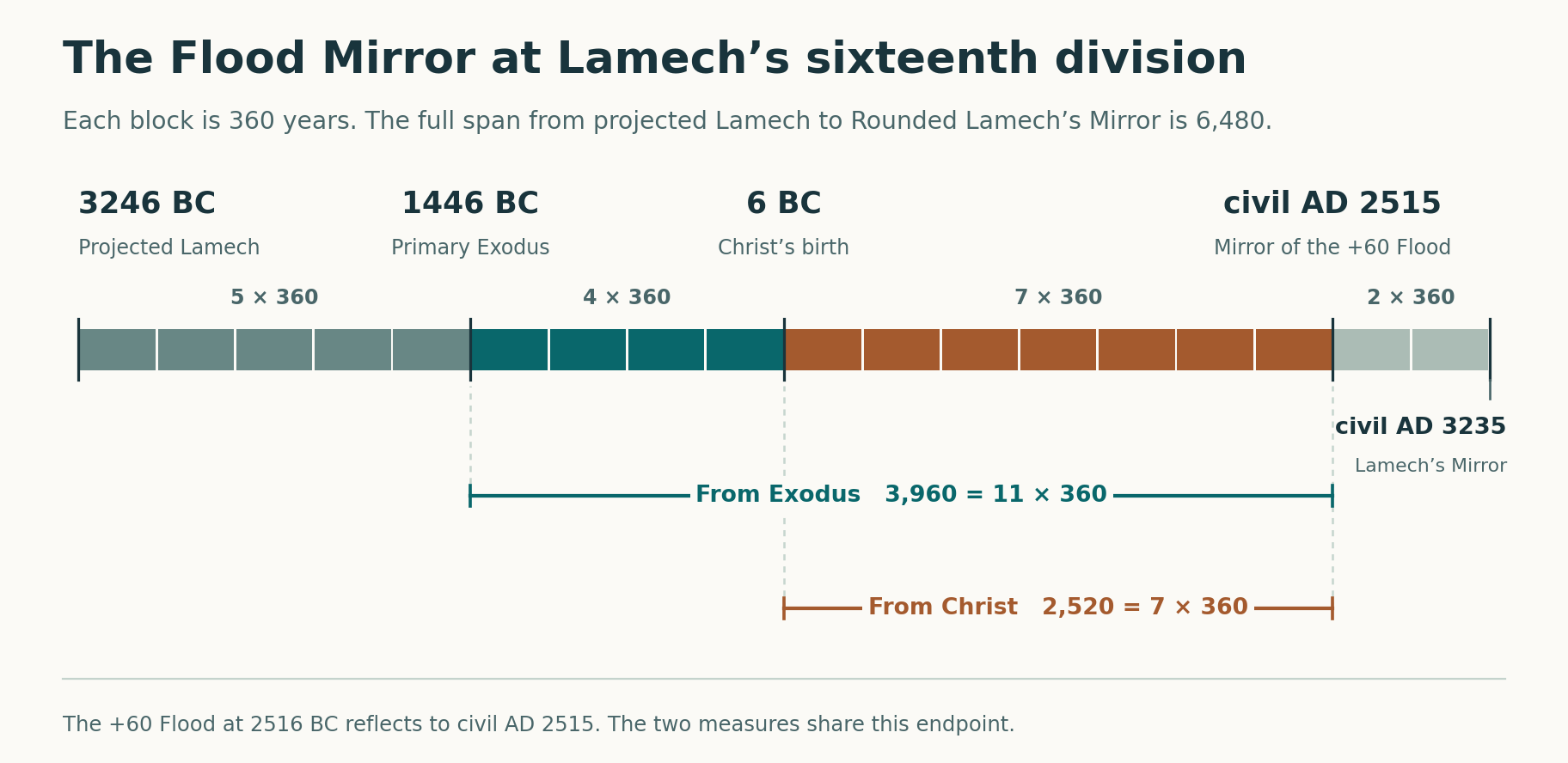
The Key-of-23 crossing and its ten-year companion. File 51a §13.3 already records the first 5,750-year span. Transferring +60 from the reflected Flood to Lamech preserves it. The published Exodus calculation gives 3246 BC for projected Lamech. 3306 BC carries that projection across the +60 transfer. File 51a §13.3 · Key table §2
| Civil Flood Mirror held fixed | From Rounded Lamech | From the +10 counterpart |
|---|---|---|
| AD 2515, +60 Flood | 3236 BC → 5,750 | 3246 BC → 5,760 |
| AD 2455, base Flood | 3296 BC → 5,750 | 3306 BC → 5,760 |
The Key gives 5,750 × 25/23 = 6,250, from 23 × 250 to 25 × 250. The same 250 years run from regular Rounded Enoch at 3486 BC to Lamech at 3236 BC. The gain of 500 divides into the 10 that reaches 5,760 = 16 × 360 and the 490 from there to 6,250. File 51a §3.4, Enoch and Lamech
Next goal. Return to the open test of the 7,000-year side on Lamech’s 9,900-year crossing to civil AD 6665. Check whether either predicted division is independently dated in the MT. Previous test coordinates
19 November 2026 · Lamech and the 6666 BC midpoint
Agent 1-Trunk · Dean’s observation. Lamech names Noah in hope of relief from the cursed ground. Genesis gives Lamech 777 years, Noah 950 and Shem 600. First Peter reads the preservation of Noah’s household through water in light of Christ’s resurrection. The calculations below use the MT Moses line. Its cumulative table places lifespans end to end. Regular Rounded Lamech at 3236 BC comes from the separate birth-date table. Genesis 5:28–31 · Genesis 9:28–29 · Genesis 11:10–11 · 1 Peter 3:20–21
The far endpoint comes from Enoch and the Flood. On the Rounded cumulative line, 8496 BC → 6666 BC → 4836 BC = 1,830 + 1,830. Reflecting this midpoint gives civil AD 6665. From regular Rounded Lamech the elapsed span is 3236 + 6665 − 1 = 9,900 years. The same 1,830 years separate Lamech from the Conquest at 1406 BC, which explains why Enoch’s Conquest Mirror has the same 9,900-year width. File 51b §8.5D already records a 6,665-year Enoch interval as half of 13,330. The same 13,330 is measured from cumulative Enoch at 8496 BC to the cumulative Flood’s civil Mirror at AD 4835. The BC midpoint identifies the AD date independently of choosing a 9,900-year span. File 51a §§3.4 and 16.2 · File 51b §8.5
Noah supplies the diameter. Cumulative Noah 6386 → cumulative Shem 5436 → cumulative Flood/Arphaxad 4836 → regular Lamech 3236 BC gives 950 + 600 + 1,600 = 3,150. Dean’s 2,200 years are the last two intervals. The trunk already measures a working circumference of 3,300 on Noah’s 1,050-year diameter. At three times that scale, 9,900/3,150 = 3,300/1,050 = 22/7. Starting at cumulative Noah and counting three of those diameters forward recovers Lamech’s printed date. Noah’s two dated 1,650-year spans · Working draft, square and circle
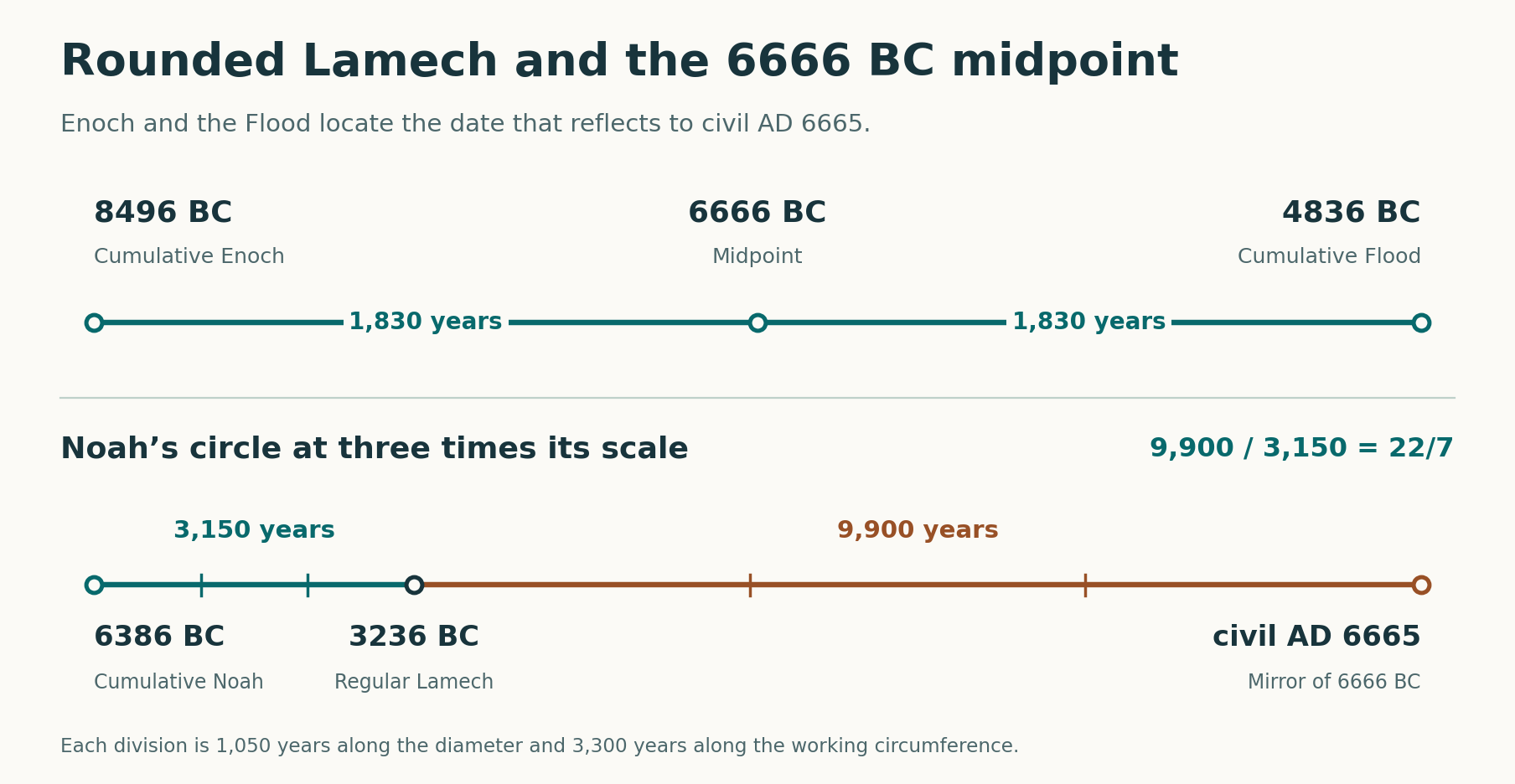
Where 6666 BC falls within Lamech’s cumulative lifespan. Hold 6666 BC fixed for the comparison. File 51a §16.2
| MT Moses line | Lamech → 6666 BC → Noah, all BC | Division of Lamech’s lifespan |
|---|---|---|
| Actual cumulative | 7158 → 6666 → 6381 | 492 + 285 = 777 |
| Rounded cumulative | 7161 → 6666 → 6386 | 495 + 280 = 775 |
Ten times the two Rounded parts gives 4,950, Enoch’s half-diagonal, and 2,800, the Creation Pillars diameter. The Actual cumulative Enoch and Flood dates are 8492 and 4831 BC, so the exact 6666 midpoint belongs to the Rounded line. File 51b §8.1 · Creation Pillars §§13–14
Two further checks. The established 3,430 = 70 × 49 from cumulative Flood 4836 to Conquest 1406 BC also runs from cumulative Shem 5436 to regular Jacob 2006 BC, and from the midpoint 6666 to regular Lamech 3236 BC. On the smaller circle, the 2,200 years contain a 700-year diameter from 4836 to 4136 BC, the regular Rounded Creation date with Adam’s localized +30 apparent age. This gives 2,200/700 = 22/7. The larger circle uses the base Rounded dates throughout. File 51a §§4.1, 4.5 and 16.2
Next goal. Test whether an independently dated MT point places the 7,000-year side on this same Lamech crossing. A side from 3236 BC would end at civil AD 3765. A side ending at AD 6665 would begin at 336 BC. These are test coordinates.
19 November 2026 · Lamech’s 18 spans of 360 years
Agent 1-Trunk · Dean’s observation. Joseph dies trusting that God will bring Israel into the land promised to Abram. Moses carries Joseph’s bones at the Exodus. Paul reads the promise to Abram as fulfilled in Christ. These events give the MT comparison its order. Genesis 50:24–26 · Exodus 13:19 · Galatians 3:16–17
The two Lamech dates. I read Dean’s 3346 BC as 3246 BC, the published projection of Actual MT Lamech at 3240 BC. At the fixed primary Exodus of 1446 BC, 1,794 × 300/299 gives 1,800. File 51a gives 3236 BC for regular Rounded Lamech. Its civil Mirror is AD 3235, so the elapsed span is 3246 + 3235 − 1 = 6,480 = 18 × 360. Using 3346 BC would give 6,580. This comparison uses the base MT dates with +60 Terah off. Published Key table §2 · File 51a §3.4
| MT event | Years from projected Lamech, 3246 BC | Years to Rounded Lamech’s civil Mirror, AD 3235 |
|---|---|---|
| Abram’s birth, 2166 BC | 1,080 = 3 × 360 | 5,400 = 15 × 360 |
| Joseph’s death, 1806 BC | 1,440 = 4 × 360 | 5,040 = 14 × 360 |
| Primary Exodus, 1446 BC | 1,800 = 5 × 360 | 4,680 = 13 × 360 |
| Christ’s birth, selected 6 BC datum | 3,240 = 9 × 360 | 3,240 = 9 × 360 |
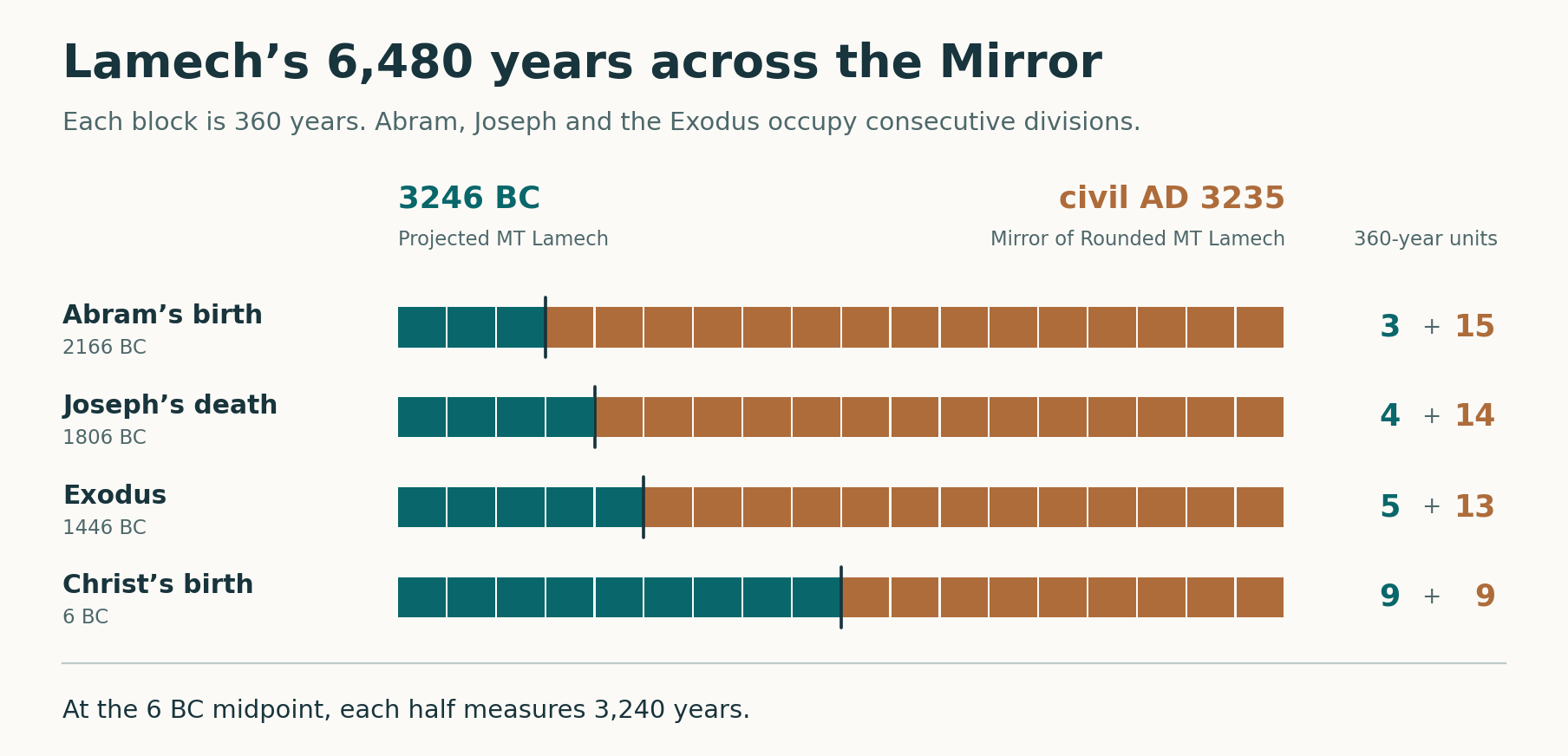
File 51a §7.5 independently places Joseph’s death 360 years after Abram’s birth and 360 before the Exodus. That supplies the middle 14 in Dean’s 15, 14, 13. Within the first nine units, Joseph and Exodus divide the way to Christ as 4 + 5 and 5 + 4. Reading the route in reverse across the Mirror gives the same 13 and 15 from Rounded Lamech at 3236 BC to civil AD 1445 and AD 2165. File 51a §7.5 · Joint study, 6 BC datum
Weight for the trunk. The ten-year difference between the Lamech dates fixes the civil midpoint at 6 BC. Of the three published Lamech–Exodus expansions, 1,950, 1,820 and 1,800, only the last divides evenly by 360. Its remaining four units from Exodus to Christ are the 40 years to the Conquest plus the trunk’s 1,400 years from Conquest to 6 BC. This supports Lamech as a trunk candidate independently of the proposed 8,800-year π connection, which remains provisional. Key table §2 · Creation Pillars in the working draft
Next goal. Check how File 51a’s Lamech–Flood–Abram Mirror fits these eighteen units, distinguishing the base Rounded Flood from its +60 Terah date.
19 November 2026 · Rounded Lamech and the two Exodus dates
Agent 1-Trunk · Dean’s ten-year observation. Lamech names Noah in hope of relief from the cursed ground. Genesis gives his age at Noah’s birth as 182. On the Actual MT Gear 2 line, Noah’s 3058 BC and those 182 years place Lamech at 3240 BC. On the Rounded line, Noah’s 3056 BC and the rounded age of 180 give 3236 BC. The published Key table separately projects Lamech six years earlier than Actual, to 3246 BC, with the primary Exodus fixed. The ten years can therefore be read directly as 6 + 2 + 2. Genesis 5:28–29 · File 51a §3.4 · Key table §2
| MT Lamech | With +60 on the far side | With +60 transferred to MT |
|---|---|---|
| Projected from Actual Gear 2 | 3246 BC → civil AD 5555 | 3306 BC → civil AD 5495 |
| Regular Rounded | 3236 BC → civil AD 5565 | 3296 BC → civil AD 5505 |
Each span is 8,800 by BC + AD − 1. Transferring +60 increases the BC numeral and decreases the AD numeral by 60. The 3306 BC entry carries the projected date across this transfer. The fixed-1446 Key calculation itself gives 3246 BC. Earlier Lamech test · File 51b §6B
Judah’s Exodus locates AD 5505 from the MT. Projected Lamech at 3246 BC stands 1,800 years before the primary Exodus at 1446 BC. Rounded Lamech with +60 at 3296 BC stands 1,800 years before Judah’s schematic Exodus at 1496 BC, independently obtained from the kings. The change at each BC endpoint is 60 − 10 = 50. Cumulative Rounded Enoch at 8496 BC already supplies 7,000 years to Judah’s Exodus. Carrying that same length forward places its endpoint at civil AD 5505 before Lamech enters the calculation. Both Exodus dates therefore divide an 8,800-year crossing into 1,800 + 7,000. This links the working circumference (8,800/2,800 = 22/7) to the measured side of Enoch’s square (9,900/7,000 = 99/70). File 34 §7.1 · Enoch’s measured side and diagonal
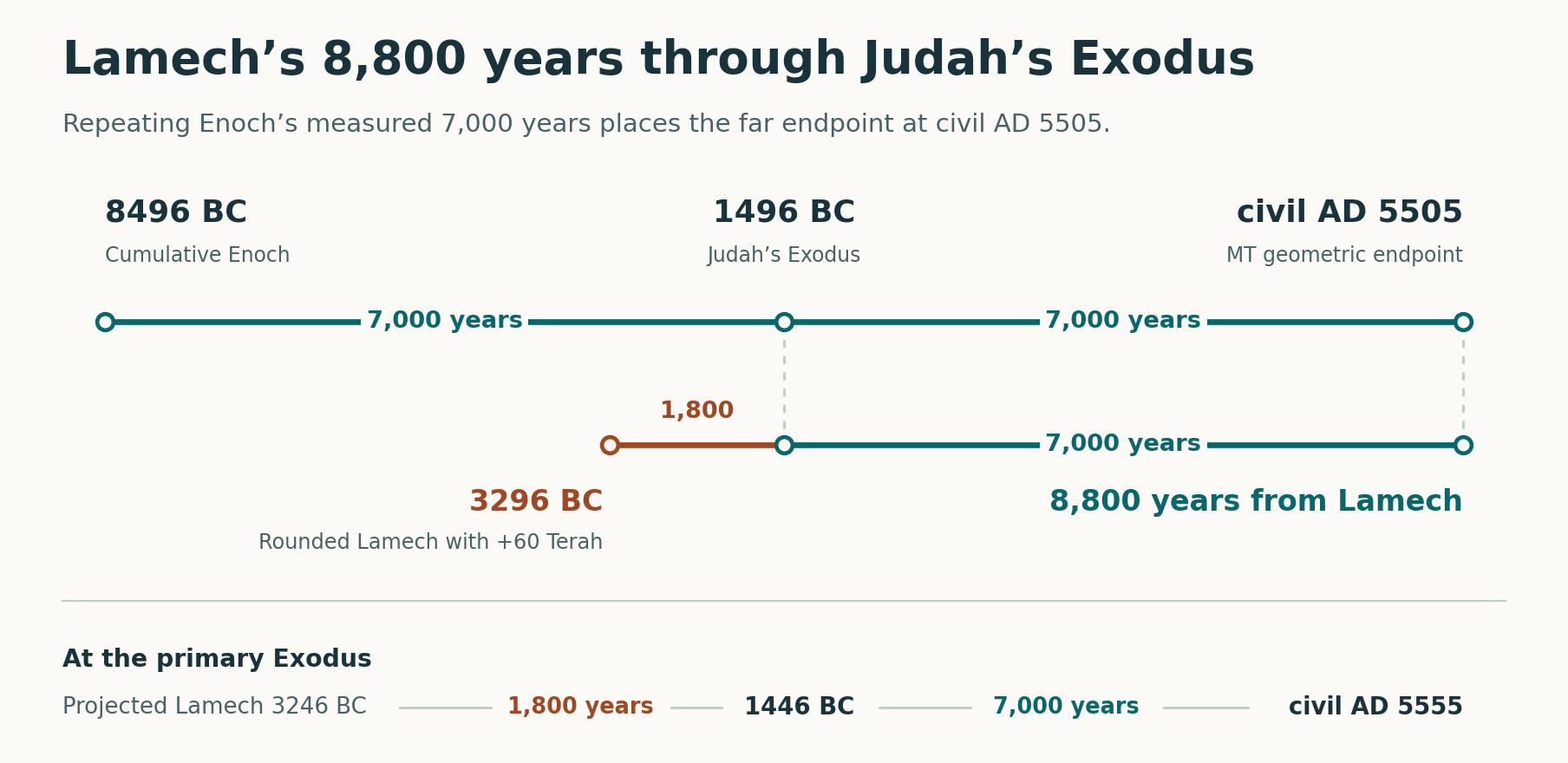
Which endpoints the LXX names. Civil AD 5555/5495 reflect the two Actual LXX Year 6 openings. The corresponding Rounded Creation mirrors are 5545/5485. Dean’s 5565/5505 lie ten years beyond the Actual mirrors, opposite the Rounded pair. I found no separate LXX event at the higher pair in the cited Creation tables. A check using the attested endpoints gives 8,790 both from 3236 BC to AD 5555 and from 3246 BC to AD 5545. The four 8,800s are related by translation. The separate MT construction of AD 5505 gives that endpoint additional weight. File 71 §1.2 · File 13 §10 · File 51b §6B
Check against the Creation Pillars. Move both ends of the published 4206 BC → civil AD 4595 circumference 960 years later and they land at 3246 BC → civil AD 5555. The very same 960, Jared’s Rounded lifespan, already takes cumulative Jared and the Rounded Flood (9456 → 2456 BC) to cumulative Enoch and Judah’s Exodus (8496 → 1496 BC). Creation Pillars §§13–14 · Working draft, Enoch
Assessment and next goal. Retain 8,800 as a strong trunk candidate. Test whether civil AD 5565, like AD 5505, can be recovered from named MT dates before imposing the circumference or transferring the sixty years.
19 November 2026 · Lamech at the LXX Creation Mirror
Agent 1-Trunk · Dean’s observation. In Genesis 15:13–16 the promise to Abram joins the four hundred years to his descendants’ return to the land. File 51a uses 1846 BC as the boundary 400 years before the primary Exodus. That distinction matters here because the projected Flood falls exactly halfway from Lamech to this boundary. Genesis 15:13–16 · File 51a §13.4
The two crossings. Reading Dean’s shorthand as astronomical −3245 and −3705 gives civil 3246 and 3706 BC. Elapsed years across the civil Mirror equal BC + AD − 1. A literal 3245 BC to AD 5555 measures 8,799. The LXX endpoints reflect the openings of Actual Year 6 in the full-430 chronology, at 5556 BC with +60 Terah and 5496 BC without it. File 71 §1.2 · Jared’s four Mirror pairings
| MT starting point | LXX Creation Mirror | Elapsed years |
|---|---|---|
| Projected Lamech, 3246 BC | civil AD 5555 | 8,800 = 22 × 400 |
| Rounded Jared, 3646 BC | civil AD 5555 | 9,200 = 23 × 400 |
| Rounded Jared with +60 Terah, 3706 BC | civil AD 5495 | 9,200 = 23 × 400 |
At the common endpoint, the extra 400 years run from Jared to Lamech. An 8,800-year span ending at AD 5495 would require a start at 3306 BC. This is an arithmetic counterpart only. Published Key table §2
Where the radius and diameter fall. With Exodus fixed at 1446 BC, the Key table gives projected Lamech at 3246 BC (1,794 → 1,800) and the projected Gear 2 Flood at 2546 BC (1,012 → 1,100). From Lamech through the Flood to 1846 BC are 700 + 700 = 1,400. The established MT diameter, from the apparent-age Creation pillar at 4206 BC to Conquest at 1406 BC, measures 2,800 = 7 × 400. Thus the new crossing yields the published working circle’s 8,800/2,800 = 22/7. The Pillars study obtains the same circumference separately from 8,096 × 25/23. Key table §§2–3 · Creation Pillars §§13–14
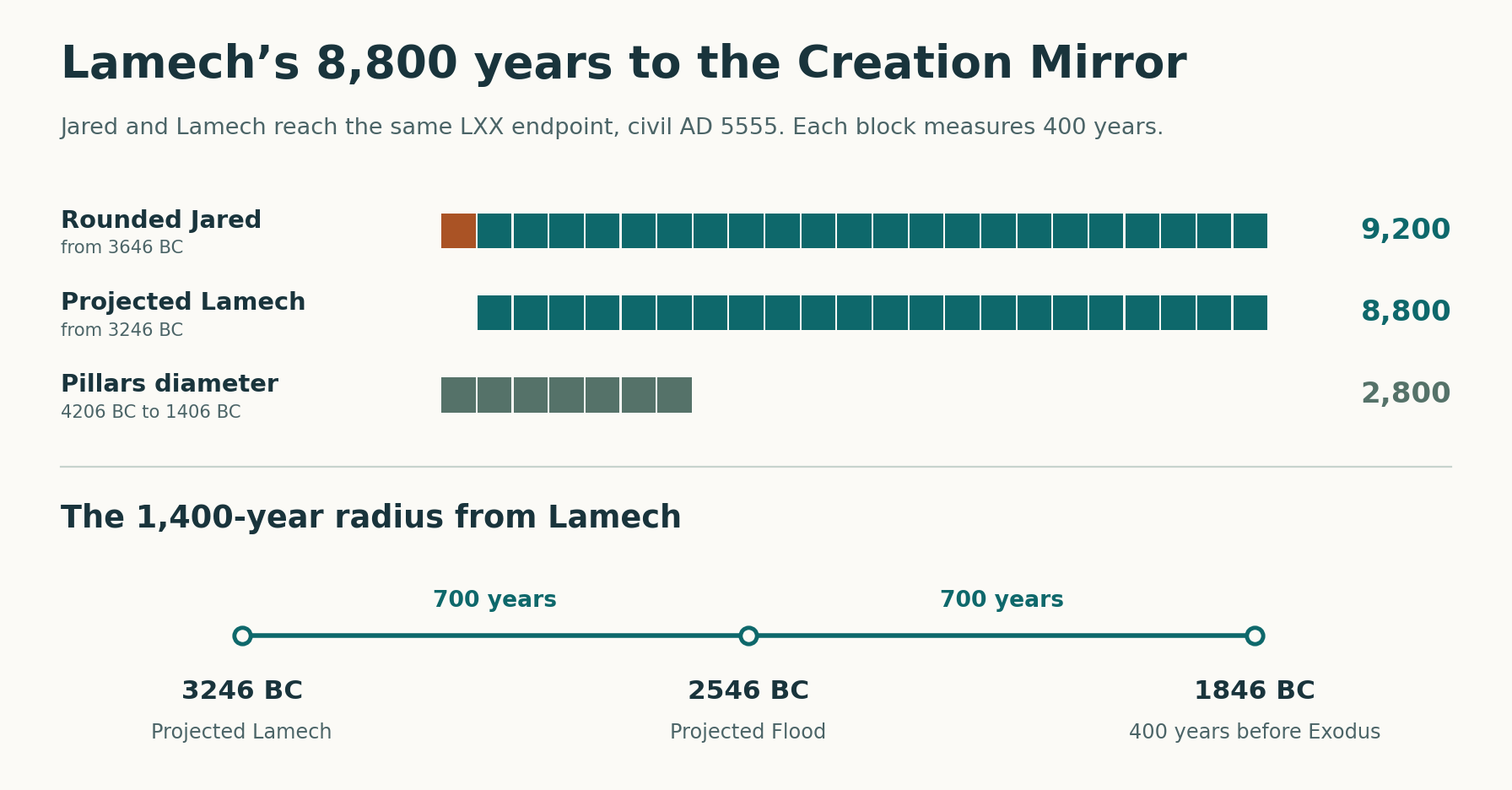
The same crossing also contains a full diameter centered on the study’s 6 BC date for Christ’s birth. 1406 BC → 6 BC → civil AD 1395 = 1,400 + 1,400. The far endpoint reflects 1396 BC, the Key table’s projected end of fighting, obtained by expanding the 46 years from Exodus to 1400 BC into 50. Key table §7, forward Conquest comparison
Where π and √2 meet. Projected MT Creation at 4346 BC already measures 9,900 to civil AD 5555. Starting at Lamech shortens the same line by 1,100 to 8,800. Both retain the 7,000 years from Exodus to that LXX Creation Mirror. The same endpoint therefore serves the trunk’s working diagonal (9,900/7,000 = 99/70) and circumference (8,800/2,800 = 22/7). Working draft, independent measures
Previous test. Moving Enoch 3546 → Lamech 3246 BC → civil AD 1405 to Peleg 3496 → projected Gear 1 Noah 3196 BC → civil AD 1455 moves all three coordinates 50 years later. Both half-diagonals read 300 + 4,650 = 4,950. Enoch and Lamech · Peleg and the two Conquest Mirrors
Next goal. Compare the dates reached by the earlier MT-only 8,096 → 8,800 expansion with Lamech’s direct crossing. Which dated points do the two constructions share?
19 November 2026 · Noah’s 350 years and the two Exodus dates
Agent 1-Trunk · The 700-year interval. Genesis gives Noah 600 years before the Flood and 350 afterward, for a life of 950 years. First Peter reads the preservation of Noah’s household through water in light of Christ’s resurrection. The chronological test begins with the stated 350 years. Genesis 7:6 · Genesis 9:28–29 · 1 Peter 3:20–21
Why both intervals measure 700. Hold the primary Exodus at 1446 BC. The Actual Gear 2 Flood at 2458 BC gives 1,012 × 25/23 = 1,100, moving the Flood to 2546 BC. Noah’s Gear 2 death at 2108 BC inherits the 88-year gain, giving 2196 BC, 350 years after the projected Flood. Relative to Rounded Noah’s death at 2106 BC, the change is 2 + 88 = 90. At the other end, primary Conquest 1406 → primary Exodus 1446 → Judah-route Exodus 1496 BC moves earlier by 40 + 50 = 90. The Kings calculation separately supplies 586 + 430 + 480 = 1496 BC. Moving both ends 90 years earlier preserves the original 700. Key table §3.3 · File 51a §3.4 · File 34 §7.1 · File 36 §9.3
What the two Exodus dates add. From 2546 BC, Judah’s Exodus is 1,050 = 3 × 350 years away. The primary Exodus is 1,100 = (22/7) × 350 years away. Their 50-year difference is exactly one seventh of the diameter. The published π study already gives 1,100/350 from Noah and Shem. On this line the projected Flood begins both measures. From projected Lamech at 3246 BC through the projected Flood and Noah’s death to Judah’s Exodus, the last quarter of Enoch’s 7,000-year side reads 700 + 350 + 700. Published π study §6 · Preceding Enoch–Lamech test
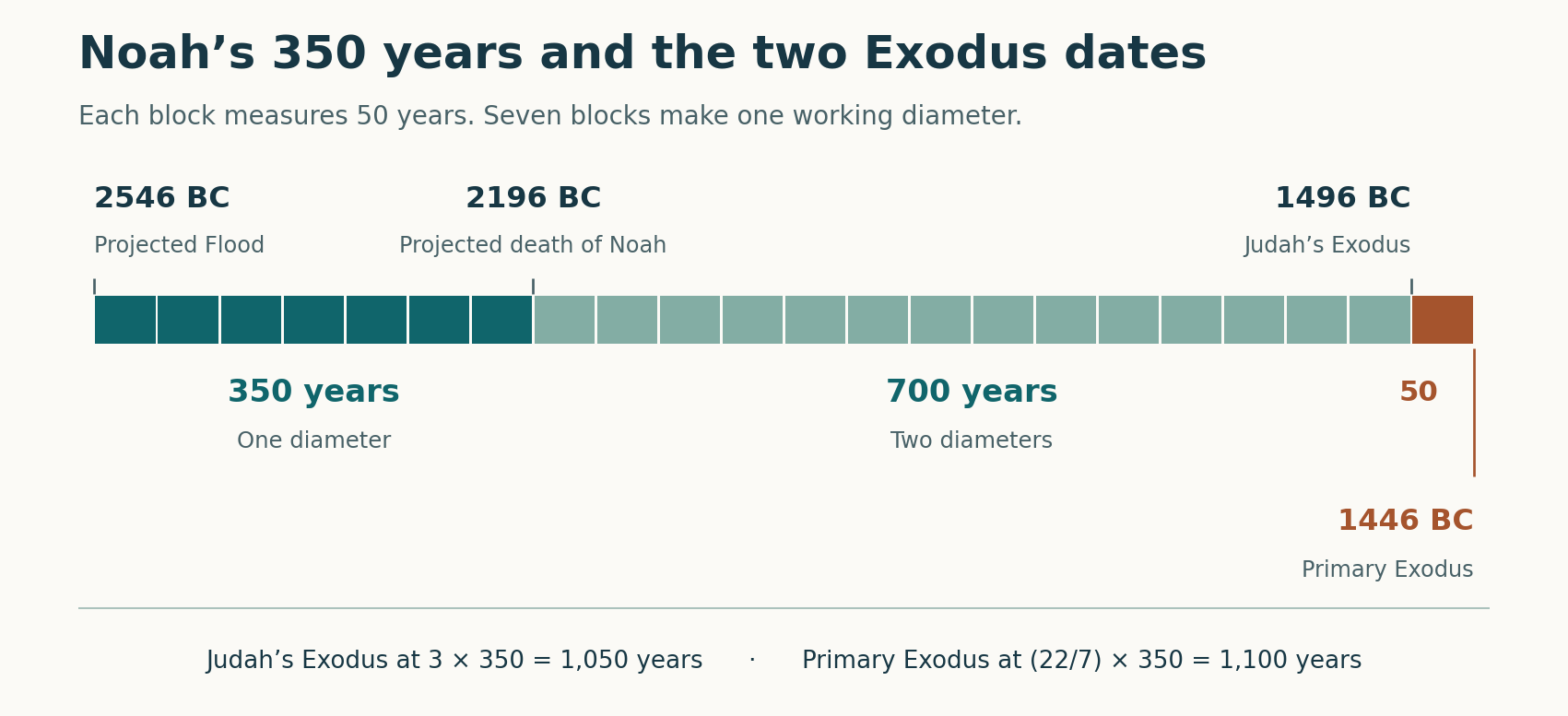
The whole Rounded backbone has an MT parallel. File 51b §11.4 explicitly gives 4196 BC for Rounded Creation with +60 Terah and Adam’s +30 apparent age. Noah’s comparison dates come from the Key table, and the last date comes from Judah’s kings. The same sequence of lengths can therefore be read from separately sourced MT settings. File 51b §11.4 · File 51a §§4.1 and 4.5
| Event | Base Rounded MT, BC | MT comparison, BC |
|---|---|---|
| Creation | 4106 | 4196 |
| Noah’s birth | 3056 | 3146 |
| Flood | 2456 | 2546 |
| Noah’s death | 2106 | 2196 |
| Terminal event | 1406 · primary Conquest | 1496 · Judah’s Exodus |
Both columns read 1,050 + 600 + 350 + 700 = 2,700. From cumulative Rounded Enoch at 8496 BC, the comparison instead gives 6,300 to projected Noah’s death, 7,000 to Judah’s Exodus and 9,900 to the primary Conquest Mirror at civil AD 1405. The diagonal equals nine of the small 1,100-year working circumferences. File 51b §§8.1 and 8.5 · Published √2 study
Next goal. Check whether Judah’s 50-year offset carries the dated 4,950-year half-diagonal from Enoch and Lamech to Peleg and projected Noah at the other Conquest Mirror. Peleg and the two Conquest Mirrors
19 November 2026 · Jared and Lamech on Enoch’s 9,900-year diagonal
Agent 1-Trunk · Direct interval test. Genesis gives Enoch 300 years of walking with God after Methuselah’s birth. Luke places Jared, Enoch and Lamech in Christ’s genealogy. File 51b §8.1 already establishes 4,950 + 4,950 from cumulative Rounded Enoch (8496 BC) through regular Rounded Enoch with +60 Terah (3546 BC) to the primary Conquest Mirror (civil AD 1405). The question was where Dean’s projected Lamech falls on this dated line. Genesis 5:21–31 · Luke 3:36–37 · File 51b §8.1
The shared 4,650 years. At fixed Exodus (1446 BC), the published Key table gives projected Jared 3846 BC from 2,208 × 25/23 and projected Lamech 3246 BC from 1,794 × 300/299. These points lie 300 years on either side of 3546 BC. The two outside intervals are equal by direct date arithmetic, 8496 − 3846 = 3246 + 1405 − 1 = 4,650. The latter interval belongs to both Enoch’s 9,900 and Lamech’s 6,900 to civil AD 3655. This partitions the diagonal before applying either geometric ratio. The two 300s match the duration in Genesis 5:22. Their chronological endpoints come from the model. Published Key table §2 · Preceding Lamech Mirror test
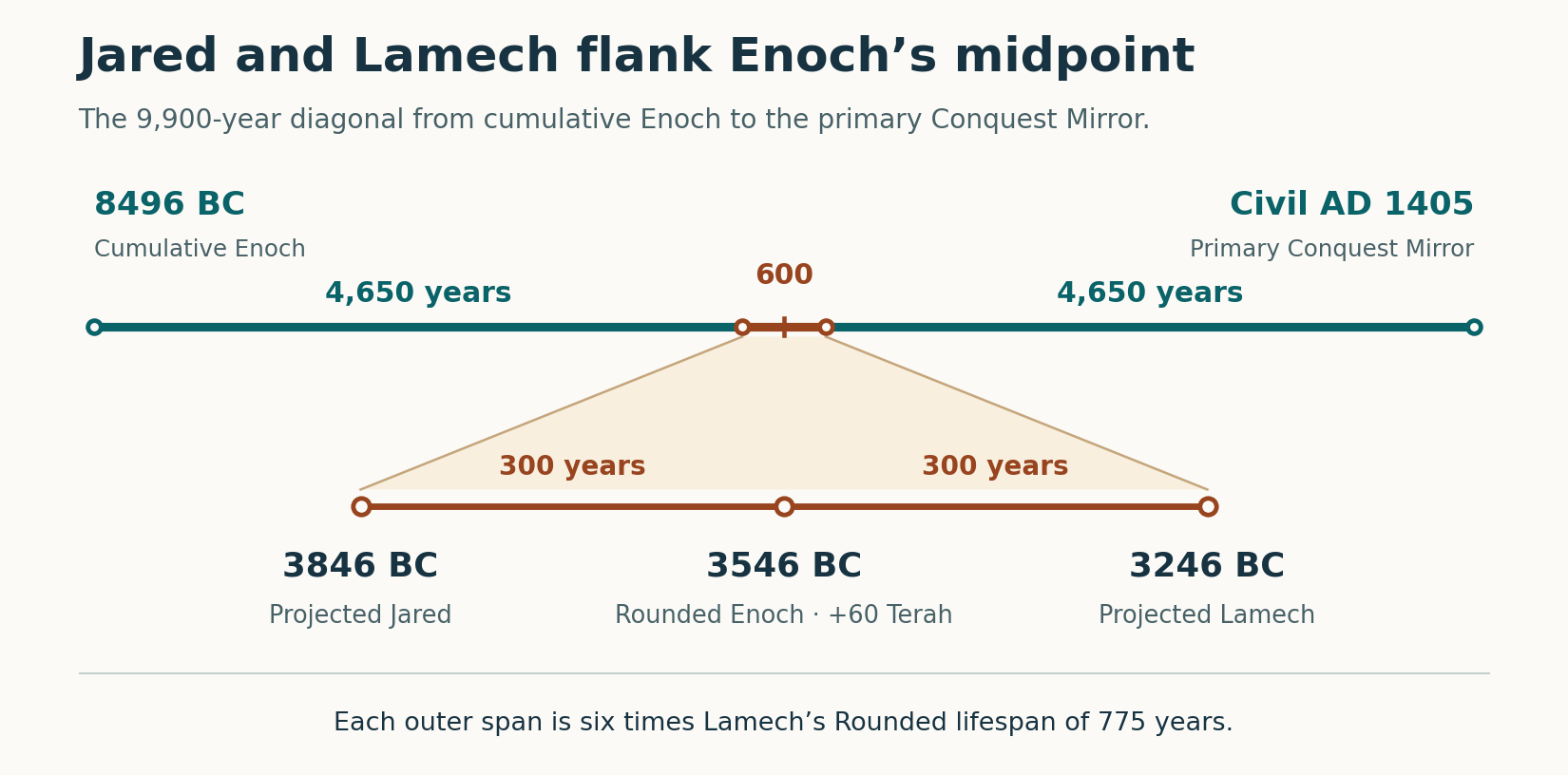
Two checks on the placement. Each outside interval equals 6 × 775, six times Lamech’s Rounded lifespan. His Actual lifespan is 777. Of the six pairs formed from the two direct Jared projections and three direct Lamech projections in the Exodus table, only 3846 and 3246 center on 3546 BC. On the square’s 7,000-year side, cumulative Enoch → projected Lamech → Judah-route Exodus (1496 BC) is 5,250 + 1,750. Lamech therefore marks three quarters of that side. The same 1,750 runs from projected Gear 1 Noah (3196 BC) to the primary Exodus (1446 BC), with both endpoints 50 years later. File 51a §3.4 · Key table §§2 and 7 · File 34 §7.1, Judah’s Exodus
The π study supplies a parallel. Its 7706 BC midpoint → Rounded Noah’s birth (3056 BC) → Rounded Flood (2456 BC) already gives 4,650 + 600. From that Flood to civil AD 2195 are another 4,650. The reflected date, 2196 BC, is Noah’s projected Gear 2 death in the Key table, where his Actual death at 2108 BC inherits the Flood’s +88. All four endpoints of this second 9,900 stand 790 years later than the corresponding endpoints on Enoch’s line. The repeated widths follow from that common shift. Published π study §§2 and 7 · Key table §3.3, inherited +88
Next goal. From cumulative Enoch, 2196 BC is also 6,300 years away. Trace the 700 years from there to Judah’s Exodus and check how the two 90-year changes relate it to Rounded Noah’s death (2106 BC) and the primary Conquest (1406 BC). Working trunk outline
19 November 2026 · Lamech and the two 6,900-year spans
Agent 1-Trunk · Dean’s observation. Lamech names Noah in hope of relief from the cursed ground. Luke includes father and son in Christ’s genealogy. The chart’s Year 875 is Actual MT Lamech at 3240 BC. With Exodus fixed at 1446 BC, 1,794 = 6 × 299 expands to 1,800 = 6 × 300, giving projected Lamech at 3246 BC. Regular Rounded Lamech is 3236 BC. The chart’s final 46 years run from Exodus to land-rest at 1400 BC. The gain of six matches the six years from entry to rest. 3240 → 1400 BC and 3246 → 1406 BC both measure 1,840 = 80 × 23. This is how Lamech’s Exodus calculation reaches the primary Conquest. Genesis 5:28–31 · Luke 3:36–37 · Key table, §§2 and 7 · File 51a §3.4
The two spans. The published √2 study measures 6,900 from cumulative Rounded Jared (9456 BC) to Shem’s birth (2556 BC). Dean’s crossing measures 3246 + 3655 − 1 = 6,900 to Jared’s civil Mirror. Its source is projected Jared at 3656 BC, obtained by holding Gear 1 Noah fixed. The spans share 690 years from Lamech to Shem, leaving 6,210 on each side. At 70/69, the first reads 6,300 + 700 and the second 700 + 6,300. Published √2 study, cumulative Jared and Shem · Jared’s two dates
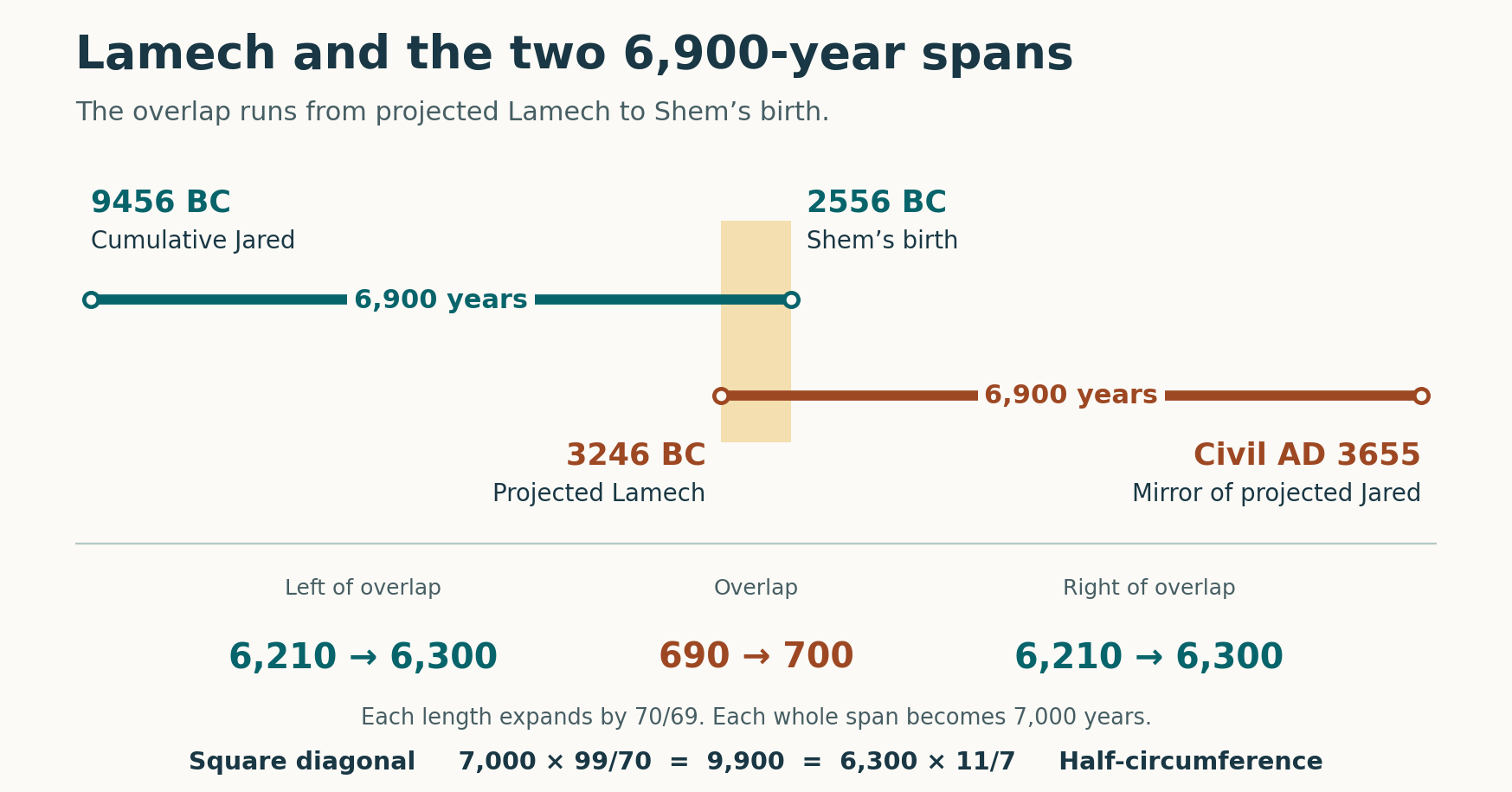
How the square and circle reach 9,900. The whole gives the square’s 7,000-year side. The longer part gives the 6,300-year diameter measured from Enoch’s +60 taking at 3181 BC to the civil Mirror of his base taking, AD 3120. At the trunk’s working ratios, 7,000 × 99/70 = 9,900 = 6,300 × 11/7. The diagonal and half-circumference both equal three of Noah’s 3,300-year circumferences. The draft dates that 9,900 from cumulative Enoch (8496 BC) to the primary Conquest Mirror (civil AD 1405). File 51b §8.5 · Dated trunk outline
Noah’s death. Lamech to Conquest gives 1,840 × 25/23 = 2,000. Lamech to Shem gives 690 × 70/69 = 700. These are the two sides of Rounded Creation 4106 → Noah’s death 2106 → Conquest 1406 BC. Actual Noah’s death at 2108 BC gives 702 to Conquest. Neither death date stands a multiple of 23 years from either primary anchor. File 51a §§3.4 and 13.3 · Published √2 study, Noah’s 2,000 and 700
Two checks. Lamech → Shem → Conquest → Jared’s Mirror is 690 + 1,150 + 5,060 = 23 × (30 + 50 + 220). The last 5,060 divided by the 1,610 from Gear 1 Noah (3056 BC) to Exodus gives 220/70 = 22/7. The π study also records 5,060 under its Jared–Conquest midpoint convention. Second, holding civil AD 3655 fixed and expanding 6,900 by 25/23 gives 7,500 back to 3846 BC, the projected Jared independently obtained from Actual Jared at 3654 BC with Exodus fixed. File 52b, Shem’s 1,150 · Key table, Jared and Gear 1 Noah · Published π study
Status and next test. Lamech’s 3246 BC is a supported trunk candidate. Can a dated MT interval connect his Mirror construction directly to cumulative Enoch’s 9,900 years before either geometric ratio is applied? Shared trunk priority
19 November 2026 · Dean’s direction on the trunk
Agent 2-Trunk · Dean’s direction. Jared’s 1,820 + 1,820 subdivision and the proposed search at 1826 BC belong with the branches for later study. The earlier suggestion to look for a named event at 4996 BC, halfway along Enoch’s 7,000-year side, is also filed here for later review. Earlier outline entry · Jared and the covenant Mirror
Next goal. Identify the dated anchors that make the same 9,900 years three working circumferences on Noah’s regular Rounded MT line and the working diagonal on a 7,000-year side. Follow those measures from cumulative Enoch to Judah’s Exodus and the primary Conquest Mirror. Dean will direct the next observation. Revised draft agenda · File 51a §§4.1–4.3 · File 51b §8
19 November 2026 · Outline of the Rounded MT trunk
Agent 2-Trunk · Draft revision. Reviewed both windows’ entries through Jared and the covenant Mirror. The draft now leads with Noah’s two 1,650-year spans and Jacob’s matching division, then follows 9,900 from cumulative Creation to regular Creation and from cumulative Enoch to the primary Conquest Mirror. The 7,000-year side and Peleg’s 5,000/4,900 division are drawn on the same scale. Revised outline and diagram · 9,900-year bridge · File 51b §8
What the Jared tests add. Rounded Jared centers the 1,400-year diameter that pairs with 4,400 to Judah’s Conquest Mirror. He also begins the 3,640-year diameter to 6 BC that pairs with 5,720 to the covenant Mirror. The division at 2946 BC links the two. The diameter/semicircumference pairs for Noah and the two Jared constructions are 15, 20 and 52 times (70, 110). The four translated Jared rows have distinct dated endpoints. The 7,820/9,200 Creation crossings retain their supporting role. Jared section with the four rows · File 51a §§3.4, 16.2 and 21.2 · Published covenant projection
Next question. Does 1826 BC independently name a regular MT event at the center of 3646 → 6 BC, as Isaac’s death at 1886 BC does on the +60 Jared row? Next review
19 November 2026 · Jared and the covenant Mirror at 2076 BC
Agent 1-Trunk · Dean’s observation. Genesis 17:21 places Isaac’s promised birth a year after the covenant of circumcision. The MT chronology places the covenant at 2067 BC and the birth at 2066 BC. With Exodus fixed at 1446 BC, the published Key calculation gives 2067 − 1446 = 621, 621 × 70/69 = 630, and 1446 + 630 = 2076 BC. Dean confirmed 2076 BC as the intended coordinate. Its ten-year separation from Isaac’s birth consists of the nine-year expansion and the one year from promise to birth. Galatians 3:16 reads the Abrahamic promise in light of Christ. Genesis 17:21 · Genesis 21:2–5 · Galatians 3:16 · Published Key table, §2
The four crossings. Agent 2-Trunk’s preceding test projected Jared at 3656 BC by holding Gear 1 Noah at 3056 BC while expanding 598 years to 600. File 51a tabulates regular Rounded Jared at 3646 BC. Their +60 Terah counterparts are 3716 and 3706 BC. Measured to the same Nativity at 6 BC, the base Jared dates give 3,650 and 3,640 years. Dean’s 16, 76 and 66 BC are comparison dates that preserve 3,640 in the other rows. Latest Jared and Creation Mirror test · File 52c §3.15.1 · File 51a §§3.4 and 21.2
| Jared, BC | After 3,640 years, BC | After 5,720 years, civil AD | BC coordinate reflected |
|---|---|---|---|
| 3656 · projected | 16 | 2065 | 2066 · Isaac’s birth |
| 3646 · Rounded | 6 | 2075 | 2076 · projected covenant and cumulative Rounded Jacob, Moses line |
| 3716 · projected, +60 Terah | 76 | 2005 | 2006 · Jacob’s birth |
| 3706 · Rounded, +60 Terah | 66 | 2015 | 2016 · Arphaxad’s regular Rounded death |
The circle. Each row gives 5,720/3,640 = 11/7. At the working value 22/7 for π, 3,640 is the diameter, 1,820 the radius and 5,720 the half-circumference. On the Rounded base row, 3646 − 6 = 3,640 and 3646 + 2075 − 1 = 5,720. The last column identifies each BC source, while the AD column uses the civil count with no year zero. The four equal widths follow by translation. The evidence for a trunk connection lies in which named dates they reach. Published square-and-circle technical appendix
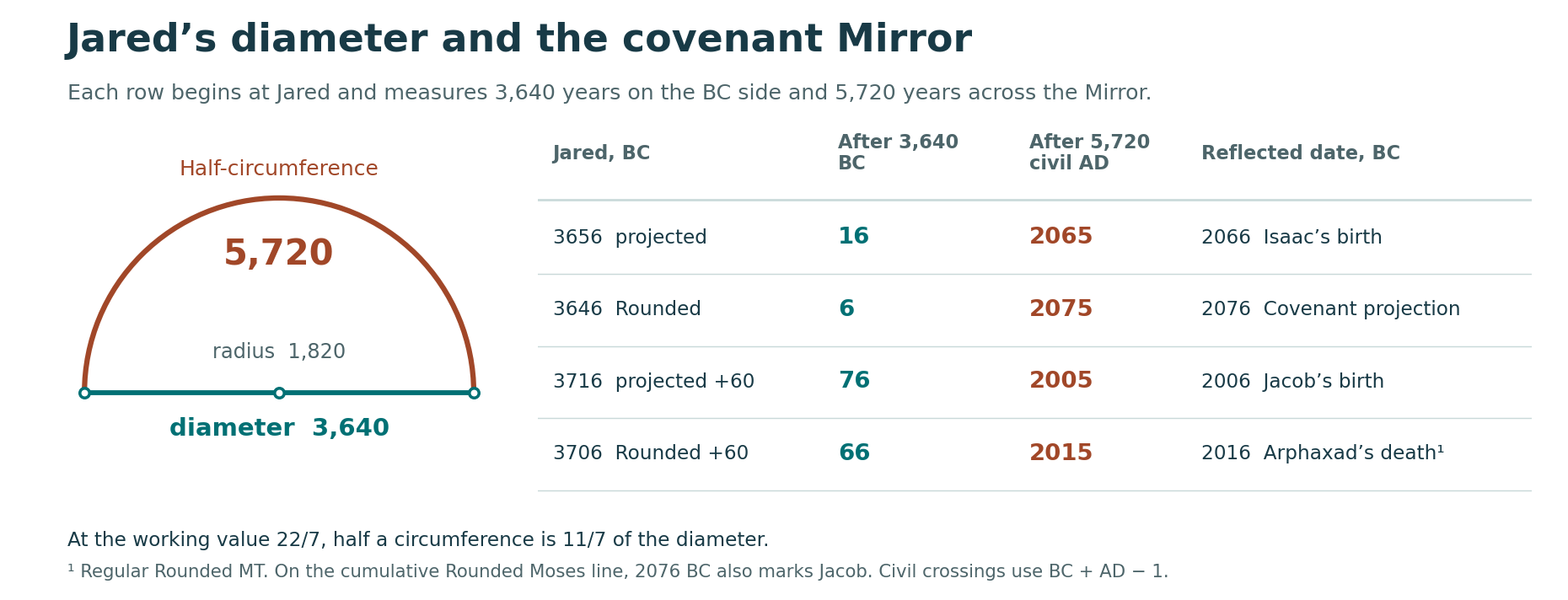
Two checks on the patriarchal dates. The projected Jared rows exchange Isaac and Jacob. On the BC side, 3656 → Jacob 2006 and 3716 → Isaac 2066 both span 1,650. Across the Mirror, base Jared reaches Isaac and +60 Jared reaches Jacob. File 51a §13.4 already measures 4,300 years from Terah to each corresponding Mirror, and each projected Jared stands 1,420 years before the corresponding Terah date (2236 or 2296 BC). Independently, §16.2 gives 2076 BC for cumulative Rounded Jacob, and §3.4 gives 2016 BC for Arphaxad’s Rounded death. Genesis 25:26 · File 51a §§3.4, 13.4 and 16.2 · Draft, Jared and Noah before Jacob and Isaac
Next question. On the +60 Rounded row, Isaac’s death at 1886 BC bisects 3706 → 66 BC into 1,820 + 1,820. Does the base midpoint at 1826 BC, between Rounded Jared and the 6 BC Christ datum, also have a named MT event? File 51a §3.4, Isaac’s row
19 November 2026 · Jared and the Creation Mirrors
Agent 2-Trunk · Dean’s observation. Genesis gives Enoch, Jared’s son, 365 years before God takes him. The calendar in 1 Enoch 82:6 counts 364 days to the year. Luke names father and son in Christ’s genealogy. Measured to the study’s Nativity date of 6 BC, File 51a §21.2 already gives 3,640 = 10 × 364 from regular Rounded Jared at 3646 BC. Holding Gear 1 Noah fixed in the preceding test gives 3654 + 2 = 3656 BC from Actual Gear 2 Jared, hence 3,650 = 10 × 365. File 52b §2.8 also reaches 3656 from the Conquest through Jacob and Noah. Dean reads the two spans together as an Enochian witness to Jared’s place on the trunk. Genesis 5:18, 23–24 · Luke 3:37 · 1 Enoch 82:6 · File 51a §§3.4, 8.1 and 21.2 · File 52b §2.8 · Preceding Jared test
The Mirror widths. File 51b §6B already measures 8,280 years from Rounded MT Adam at 4166 BC (+60 Terah) to civil AD 4115, and 9,660 from the same Adam to civil AD 5495. Both AD endpoints reflect Actual Year 6. File 51a gives 460 years from Adam to Jared. Moving only the BC start from Adam to Jared at 3706 BC therefore gives 7,820 = 17 × 460 and 9,200 = 20 × 460. Changing just the reflected Creation from MT to native LXX adds 1,380 = 3 × 460. File 51b §§2 and 6B · File 51a §§4.4, 8.1 and 17.3
| Where +60 Terah falls | Regular MT Jared, BC | MT Creation Mirror, civil AD · 7,820 years | Native LXX Creation Mirror, civil AD · 9,200 years |
|---|---|---|---|
| At reflected Creation | 3646 · Rounded | 4175 · Actual Year 6 | 5555 · Actual Year 6 |
| At reflected Creation | 3656 · projected | 4165 · Rounded | 5545 · Rounded |
| At Jared | 3706 · Rounded | 4115 · Actual Year 6 | 5495 · Actual Year 6 |
| At Jared | 3716 · projected | 4105 · Rounded | 5485 · Rounded |
All four rows use BC + civil AD − 1. The ten-year difference between Jared’s two coordinates is offset by ten years in the opposite direction at Creation. Transferring the +60 from reflected Creation to Jared likewise preserves each width. The Actual Creation dates use the regular Gear 2 Nisan opening of Year 6. The Rounded dates use File 51a’s Adam coordinate. The LXX column retains the full 430-year Sojourn and the native second Cainan’s 130 years. File 71 §§1.1–1.2 · File 51b §§1–2 and 6B
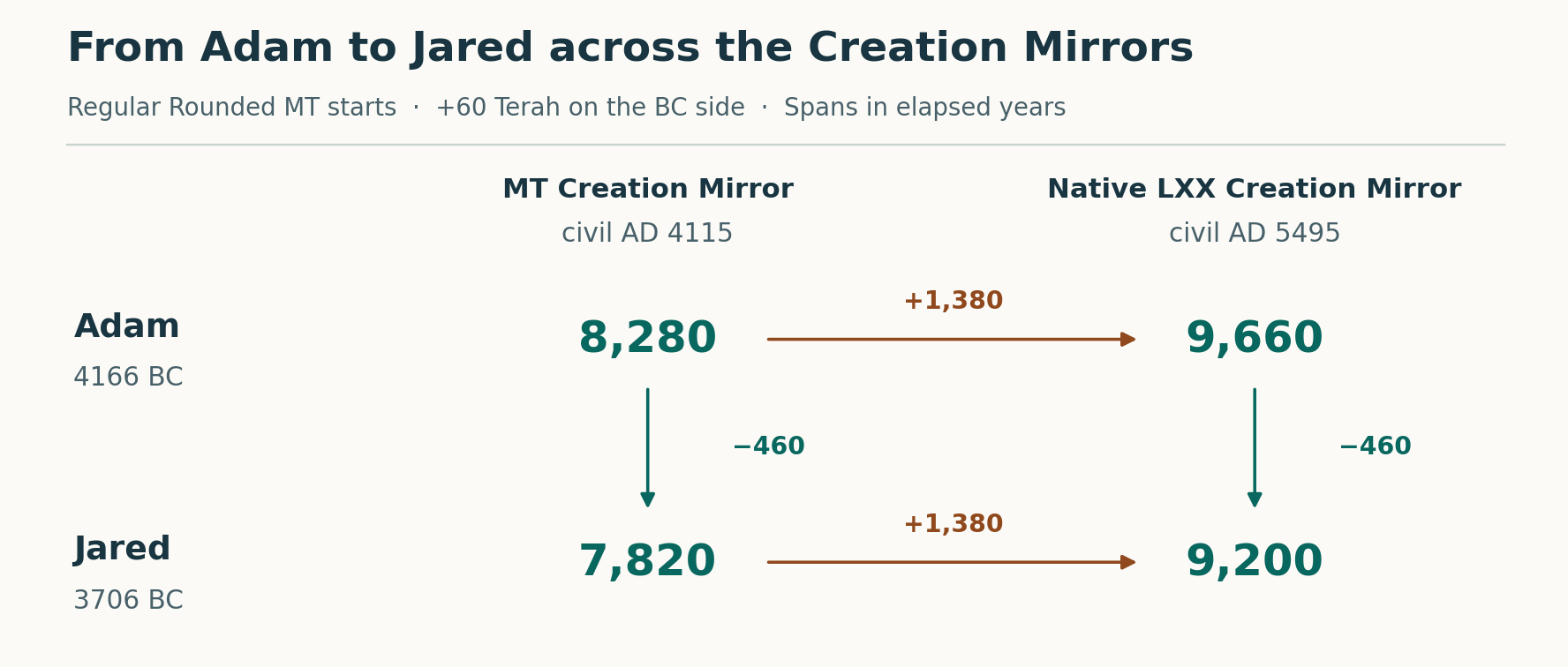
Rounded Jared centers the previously measured 1,400-year diameter. Projected Jared stands 1,650 years before Jacob. Dean takes the 364/365 pairing and the Mirror widths as support for those two placements. Jared’s diameter · Jared to Jacob
Next question. Do the Isaac and Jacob Mirrors in File 51a §13.4 recover the trunk’s 1,050- and 1,650-year measures from independently named endpoints? File 51a §13.4
19 November 2026 · Holding Noah fixed connects Jared to Jacob and Isaac
Agent 2-Trunk · Dean’s observation. File 52c §3.15.1 already gives Actual MT Gear 2 Jared 3654 → Gear 1 Noah 3056 → Gear 2 Flood 2458 BC as 598 + 598. With Noah fixed, each 598 × 300/299 becomes 600. The ends are projected Jared 3656 BC and the Gear 1 Flood 2456 BC. Holding the Gear 2 Flood instead gives Jared 3658. The Noah-held result therefore recovers the mean of 3654 and 3658 by a dated route. File 52c §§3.15.1–2 · File 71 §2.7
The +60 parallel. The source becomes 3714 → 3116 → 2518 BC. Holding Noah gives 3716 → 3116 → 2516 BC, and the full Flood-held projection gives 3718. The two measures now end at Isaac, 2066 BC, as their base counterparts end at Jacob, 2006 BC. Each Noah-held Jared spans 1,650 and each Gear 1 Noah spans 1,050. Genesis 25:26 supplies the father–son 60. File 51a §8.5 already uses these paired endpoints at 230 years. Genesis 25:26 · File 51a §8.5 · Working draft and diagram
Next question. Do the documented Isaac and Jacob Mirrors in File 51a §13.4 give the same widths from independently named endpoints?
19 November 2026 · Jared on either side of 1,650 years
Agent 2-Trunk · Dean’s clarification. The regular Rounded MT already gives 1,650 and 1,050 years at Creation, Noah, Jacob and the Conquest. These are 33 and 21 blocks of 50. From the Actual Gear 2 Jared at 3654 BC and the fixed-Flood projection at 3658 BC to Jacob at 2006 BC are 1,648 and 1,652 years. Each is noteworthy on that scale. Their mean, 3656 BC, gives exactly 1,650. Actual Gear 2 Noah gives 1,052 and Rounded Noah gives 1,050. File 51a’s tabulated Rounded Jared is 3646 BC. The earlier Gear 1 calculation supplies a separate exact comparison. File 22 §7.12 · File 51a §§3.4 and 4.1 · Revised working draft and diagram
Next question. Does the 1,650/1,050 pattern at Jacob share a further dated endpoint with the 1,400-year diameter centered on Rounded Jared at 3646 BC? Jared’s 700 years and the Conquest Mirror
19 November 2026 · Jared’s 700 years and the Conquest Mirror
Agent 1-Trunk · Dean’s observation. The regular Actual MT Creation completion at 4114 BC is 2,668 years before the primary Exodus at 1446 BC. With Exodus fixed, the Priestly Key of 23 gives 2,668 × 25/23 = 2,900 and places expanded Creation at 4346 BC. File 51a independently tabulates regular Rounded Jared at 3646 BC. Dean’s reading therefore has an MT basis for each endpoint. File 22 §9.2 · File 51a §8
What was already published. The π study gives 4346 → 3646 → 1446 BC as 700 + 2,200, obtaining 3646 there as an expanded LXX midpoint. The √2 study takes 2,200 × 7/22 = 700 forward from Rounded Jared and explicitly reaches 2946 BC. The first 700 precedes the 2,200. The second occupies its first 700 years. Together they place Jared at the center of a 1,400-year diameter. The 2946 BC division remains a derived coordinate on this MT line. Published π study · Published √2 study
What the Mirror adds. Judah’s Conquest at 1456 BC already supplies the draft’s civil Mirror endpoint AD 1455. From expanded Creation to Exodus and from Exodus to that Mirror are two equal spans of 2,900. Reflecting 4346 BC about Jared gives 2946 BC. Reflecting the same 4346 BC about Exodus gives civil AD 1455. The two resulting dates are twice as far apart as Jared and Exodus. This explains why 2946 + 1455 − 1 = 4,400. The full working circle gives 4,400/1,400 = 22/7. The independently named Judah endpoint gives the doubling its chronological significance. Both measurements are half those of the draft’s MT Creation Pillars circle (2,800 diameter and 8,800 circumference). File 36 §9.3 · Working draft, Peleg and the Conquest Mirror · Creation Pillars comparison
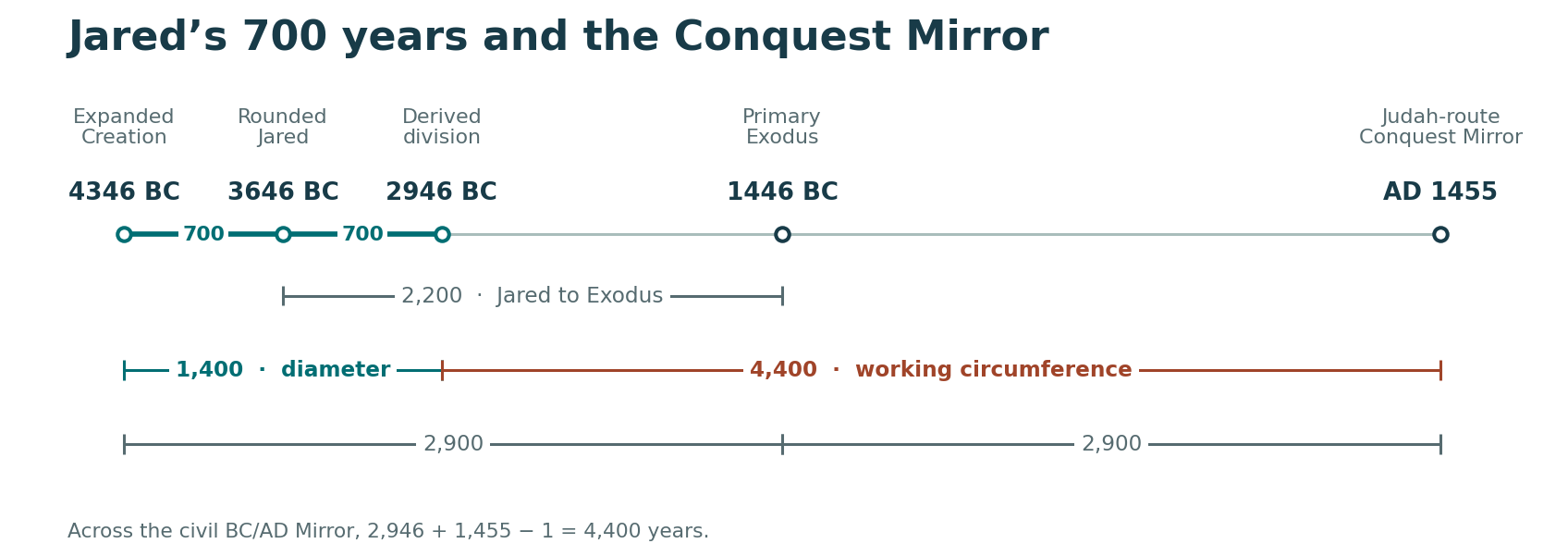
From Conquest to Christ. Dean’s two spans agree exactly. From 4346 to the primary Conquest at 1406 BC are 2,940 years. Moving both endpoints forward 1,400 years gives 2946 to the selected Christ datum at 6 BC, also 2,940 = 6 × 490. The Rounded Flood supplies a further check at each end of Jared’s diameter. Cumulative Flood 4836 → 4346 → Jared 3646 → 2946 → regular Flood 2456 BC reads 490 + 700 + 700 + 490. File 22 §9.4 · File 51a §§8 and 16
Next question for Dean’s direction. Both the 4,400-year circumference from 2946 BC and the draft’s 4,950-year half-diagonal from Peleg at 3496 BC end at civil AD 1455. Their difference is the 550 years between those two BC dates. Does the chronology independently mark that 550 as a geometric measure? Working draft
19 November 2026 · Jacob on the regular MT trunk
Agent 2-Trunk. Dean identified two regular Rounded MT spans of 1,650. Creation 4106 → Noah 3056 → Flood 2456 BC and Noah 3056 → Jacob 2006 → Conquest 1406 BC both give 1,050 + 600. File 51a already identifies Noah as the Creation–Jacob midpoint. Jacob to the Conquest gives a second 600 through 130 + 430 + 40. Within Noah → Flood → Jacob → Conquest the divisions are 600 + 450 + 600. File 51a §§4.1 and 4.3 · 9,900-year bridge, A1
On Actual MT Gear 2, Jared and projected Jared bracket 1,650 to Jacob at 1,648 and 1,652. Repeating the conversion at the Gear 1 Flood start, 2456 BC, gives projected Jared 3656 → Noah 3056 → Jacob 2006 = 600 + 1,050. Regular Rounded Jared is 3646 BC. File 18 §3.1.4 · File 22 §7.12 · Working draft and diagram
Next question. Does the Flood narrative give an independent reason to choose the Gear 1 start for Jared’s projection?
18 November 2026 · Jared, Enoch and Peleg
Draft review window · Opening handoff from the parallel Work window
Where we stand. Peleg’s tabulated 3496 BC prompted Dean’s test. On the regular Actual MT line, with the Gear 2 Flood fixed at 2458 BC and +60 Terah off, Jared’s 1,196 years to the Flood expand to 1,200 by 300/299. Dean’s proposal carries Jared’s 162 years to Enoch through that conversion, giving 2458 + 1200 − 162 = 3496 BC. Here 3496 BC is a supported projection for regular Enoch and a tabulated date for cumulative Peleg. File 22 §7.12 · File 51a §§3.4 and 16.2
What it explains in the trunk. Actual cumulative and regular Enoch stand 5,000 years apart (8492 − 3492). Rounded cumulative Enoch and projected regular Enoch preserve that distance (8496 − 3496). The +60 Terah regular Rounded Enoch at 3546 BC stands 50 years from 3496 BC, accounting for the overlap in the Conquest Mirror diagram. Enoch, Peleg and the Jared–Flood diagram
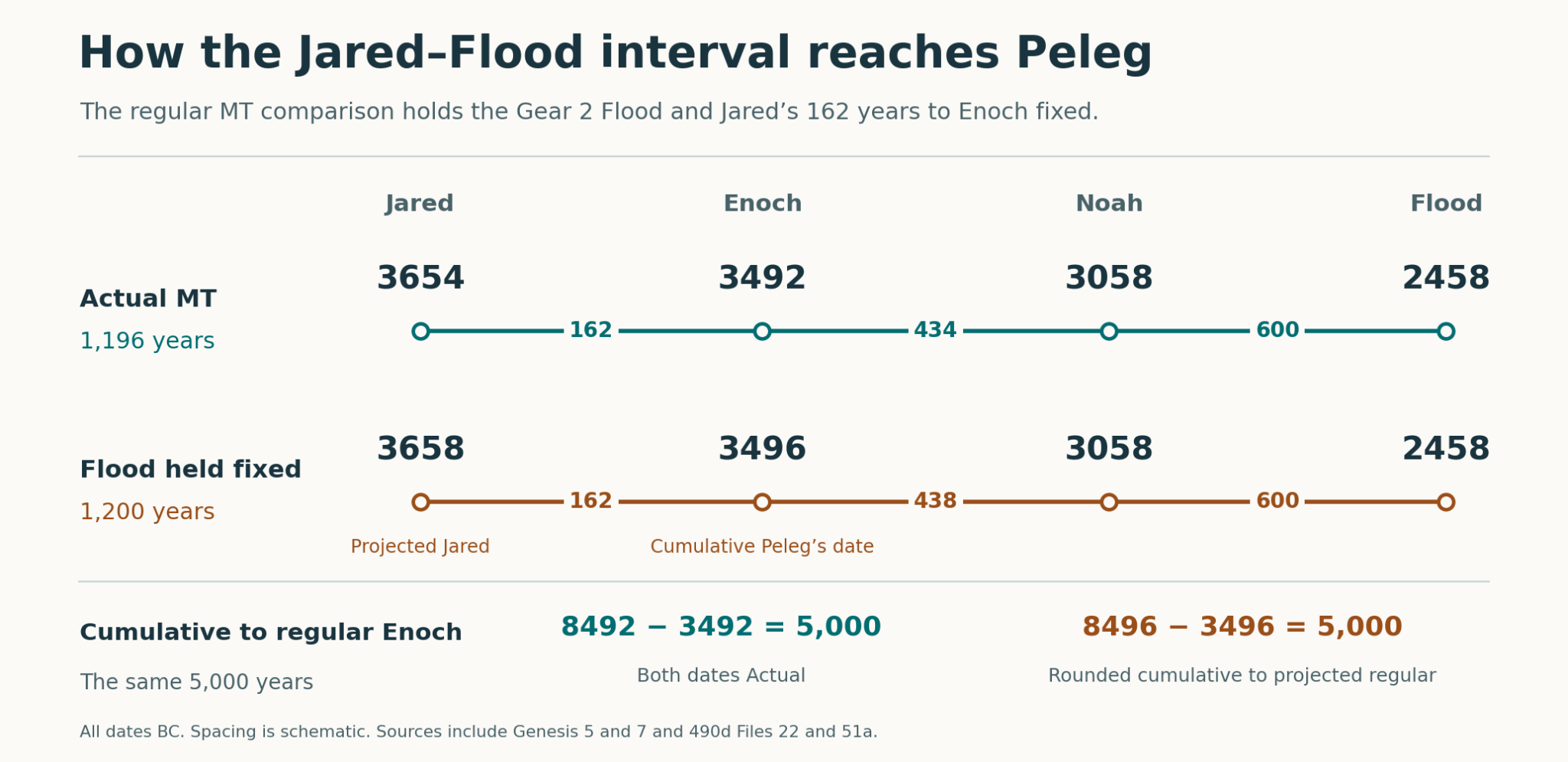
Next direction. Await Dean’s next observation about the Rounded MT trunk and its Mirror.