The Rounded MT trunk
Working draft 20 · 22 November 2026
The square, the circle and the Mirror in the 490d Unified Chronology
From Adam to Christ
After the loss of Eden, Lamech names Noah in hope of relief from the cursed ground. Noah’s household survives the Flood. Through Shem the story passes to Abram and to the land promised to Jacob. Moses leads Israel out of Egypt in 1446 BC. Forty years later Joshua leads the people across the Jordan in 1406 BC. Matthew recalls Israel’s exodus in the life of Jesus. Luke traces Jesus’ family back through Jacob, Noah and Enoch to Adam. Genesis 5:28–31 · Genesis 7:6–7 · Genesis 11:10–26 · Genesis 28:13–15 · Joshua 4 · Luke 3:23–38 · Matthew 2:15
Genesis repeatedly introduces a family with “These are the generations of.” The question running through this study is whether those generations also preserve a numerical outline. A diameter of seven schematic centuries corresponds to a semicircle of eleven and a full circle of twenty-two. Dean proposes that this outline preceded its expression in the years of Noah’s life. Genesis gives Noah’s age at the Flood as six hundred. The Exodus and Conquest anchor the comparison in Israel’s history. The Conquest reaches farther into the cumulative chronology and its Mirror, while the Exodus brings together Jared, Abraham and Jacob. Genesis 7:6 · Exodus 12:40–42 · Joshua 4:19–24
This draft brings the individual constants studies together on one map. The Rounded chronology of the Masoretic Text (MT) supplies its starting dates. The circle and square give the map its shape through π and √2. The chapters on alpha, the golden ratio (Φ) and the reciprocal of e ask where the same named intervals also carry those relationships. Genesis and the Gospels supply the names. The uniform centuries and the reflection about the study’s Nativity date of 6 BC belong to the reconstruction.
Outline of the trunk
Read the map first in 100-year generations. Cumulative Rounded MT Creation at 14006 BC is 126 centuries before the Conquest. Regular Rounded MT Creation at 4106 BC is 27 centuries before it. The two Creation dates are therefore 99 centuries apart. Start with the master map or its enlarged negative side and two-sided Mirror.
- Adam to Moses. Locate the diameter, semicircle and full circle in the 27 named centuries. Shelah’s midpoint shows how to reflect those generations. Generational outline · Table of centuries · Six whole generations
- Shelah to the Gospel genealogies. Follow Enoch across the Mirror to Luke’s Adam, then locate Matthew’s Abraham and the midpoint shared by his two counts. Shelah’s center · Luke’s two diagrams · Matthew and Luke
- The constants on this map. Count Jubilees to Shelah, trace the Fibonacci intervals, then follow the 5,500 years from Luke’s Adam to Matthew’s midpoint. Alpha and the 137/138 counts · Φ and the Fibonacci spans · The reciprocal of e
- Other witnesses. Compare the Samaritan Pentateuch (SP) and native Septuagint (LXX) with the Rounded MT, then read how Jubilees connects the twenty-two works of Creation with the generations to Jacob. SP and LXX · Jacob in Jubilees
- The Flood and the family of the promise. Follow Noah’s 600 years into the cumulative chronology and the lines of Jared, Abraham, Joseph and Joshua. Noah · Shem, Enoch and Peleg · Jared and Abraham’s family · Joseph to Joshua
- The Temple and Christ. The regular chronology brings Isaac and Joshua to Solomon’s foundation. Six boundaries carry Abraham and Jacob’s family history forward to the Temple and the opening of Jesus’ ministry. Temple and return · Isaac and Joshua · The ministry of Christ · Findings and open questions
The appendices give the calculations behind Enoch’s square and Noah’s circles, Jared and Lamech, Jacob’s calendar, generation lengths and calendar conventions, and the provisional ranking and research record.
How to read the dates. Regular MT chronology follows the birth intervals in the Masoretic genealogy. Cumulative MT places the lifespans end to end. Actual uses the source ages and specified chronological setting. Rounded uses the project’s separately tabulated scaffold. Projected identifies a date produced by an operation with a stated fixed endpoint. For an unstated biblical detail, the study first tests the earliest boundary the text permits, next a clear narrative parallel, then later canonical corroboration. Exact arithmetic establishes the relations within each setting. Their theological unity is an interpretation. Canonical source index · File 51a, regular and cumulative tables
A shared boundary is the same dated point on two intervals. A translation moves both endpoints by the same stated number of years. Where only lengths or proportions agree, the comparison establishes a measure.
On the diagrams, Christ at 6 BC is zero. Subtract a BC year from 6 to find its signed position. Cumulative Creation at 14006 BC is −14,000, regular Creation at 4106 BC is −4,100, and the Conquest at 1406 BC is −1,400. Reflection simply reverses the sign. Thus +1,400 means 1,400 years forward from 6 BC.
In tables labeled civil AD, the project reflects B BC to civil AD (B − 1). Thus 1406 BC pairs with civil AD 1405. The elapsed span across the eras is BC + civil AD − 1. The symmetric Rounded display labels this same boundary AD 1406 and uses BC + Rounded AD − 2. Where the source also distinguishes Nisan and Tishri, Appendix D gives the full calendar phases. File 51b, Mirror conventions and §8 · File 22, cumulative Creation
The master map from cumulative Creation to Christ
Read the full map from left to right, beginning at −14,000, cumulative Rounded MT Creation (14006 BC). From there, 7,000 years reach Jared on Luke’s century scale at −7,000, 9,900 reach regular Rounded MT Creation at −4,100, and 11,000 reach −3,000, the Arphaxad/Flood marker in the 27-name schematic. One dated length, 7,000, supplies both a square side and a semicircle diameter. The two readings are 9,900/7,000 = 99/70 ≈ √2 and 11,000/7,000 = 11/7 ≈ π/2. A square of side 7,000 has a true diagonal of about 9,899.495. The published joint study already derives 99/70 from the two MT Creation dates and their relation to the 6 BC datum. Here Luke supplies a name at the 7,000-year boundary. File 51a §16.2 · Published square-and-circle study §2 · Gospel count tables
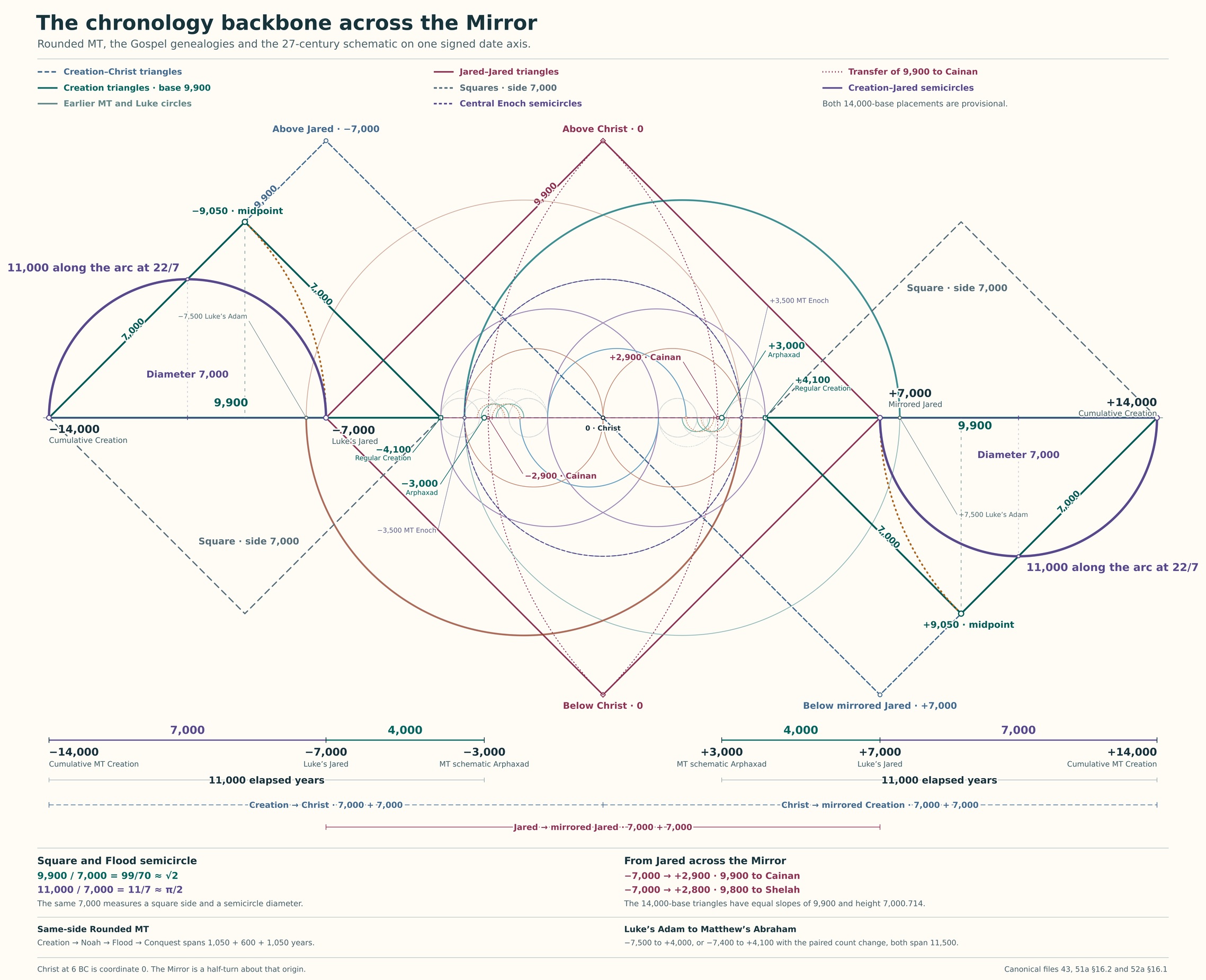
The green triangles have a 9,900-year base between the Creations and equal sides of 7,000. The 14,000-year base admits two proposed placements. From cumulative Creation to Christ it has Jared at its midpoint. Moving it forward 7,000 years puts Jared at both ends across the Mirror and Christ at its midpoint. From −7,000 to mirrored second Cainan at +2,900 gives one of the two 9,900-year sides by compass transfer. The reflected side gives the other. The apex falls above zero in this placement. Its height is a geometric measure. Interactive map and layer controls · Full-size map for print
Matthew begins at Abraham. On the century scale his two counts place Abraham at −4,000 or −4,100, the two schematic Adam positions when Moses’ close is held fixed. Luke runs back to Adam and God. The Gospel comparison shows which pairings of Luke’s Adam and mirrored Matthew’s Abraham preserve 11,500 years. The six whole generations show how the same semicircle can be read forward from Adam and backward from Moses. The SP and LXX projections apply the proportions of the MT–Gospel map to two further manuscript chronologies. Dean proposes the Sumerian King List (SKL) as the next enlargement of the core map. That geometry remains exploratory, and the SKL inquiry is paused. Closing SKL observation
Reading the Mirror maps
Begin with the enlarged negative side. From cumulative Rounded MT Creation at −14,000, trace the 7,000 years to Luke’s Jared at −7,000 along the ruler. The same interval supplies a side of the square and the diameter of the semicircle. Follow the purple arc to read its 11,000-year measure. The chart ends at Christ, the ruler’s 0 (6 BC).
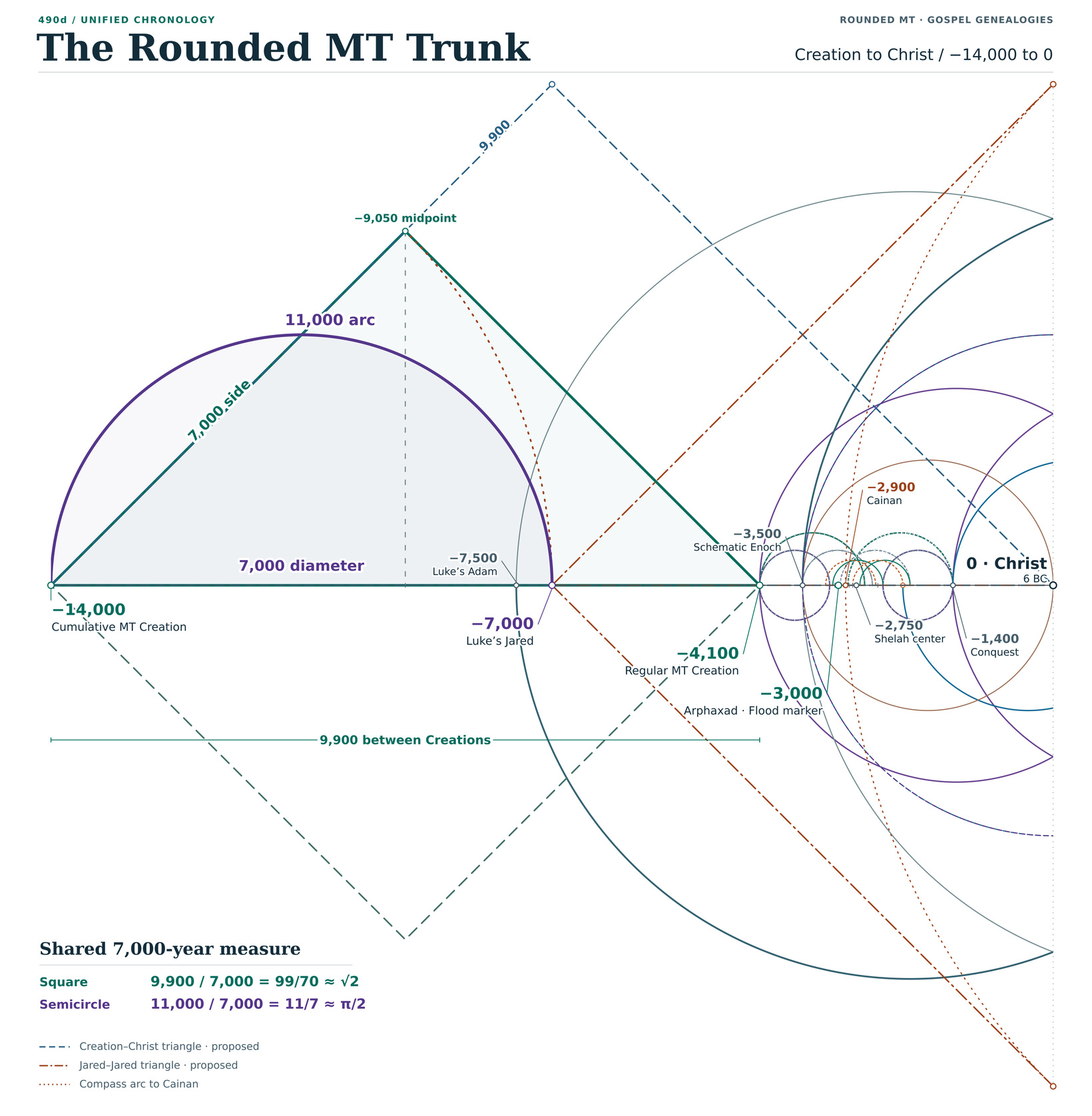
Open the enlarged view · Print the vector PDF
Use the two-sided plate to follow those curves beyond Christ into the positive half of the Mirror. Its inset enlarges the 2,700 years between regular Rounded MT Creation at −4,100 and the Conquest at −1,400. Halfway between them, −2,750 falls in Shelah’s schematic century, 1,350 years from either end. Shelah centers this local span. Christ centers the full Mirror.
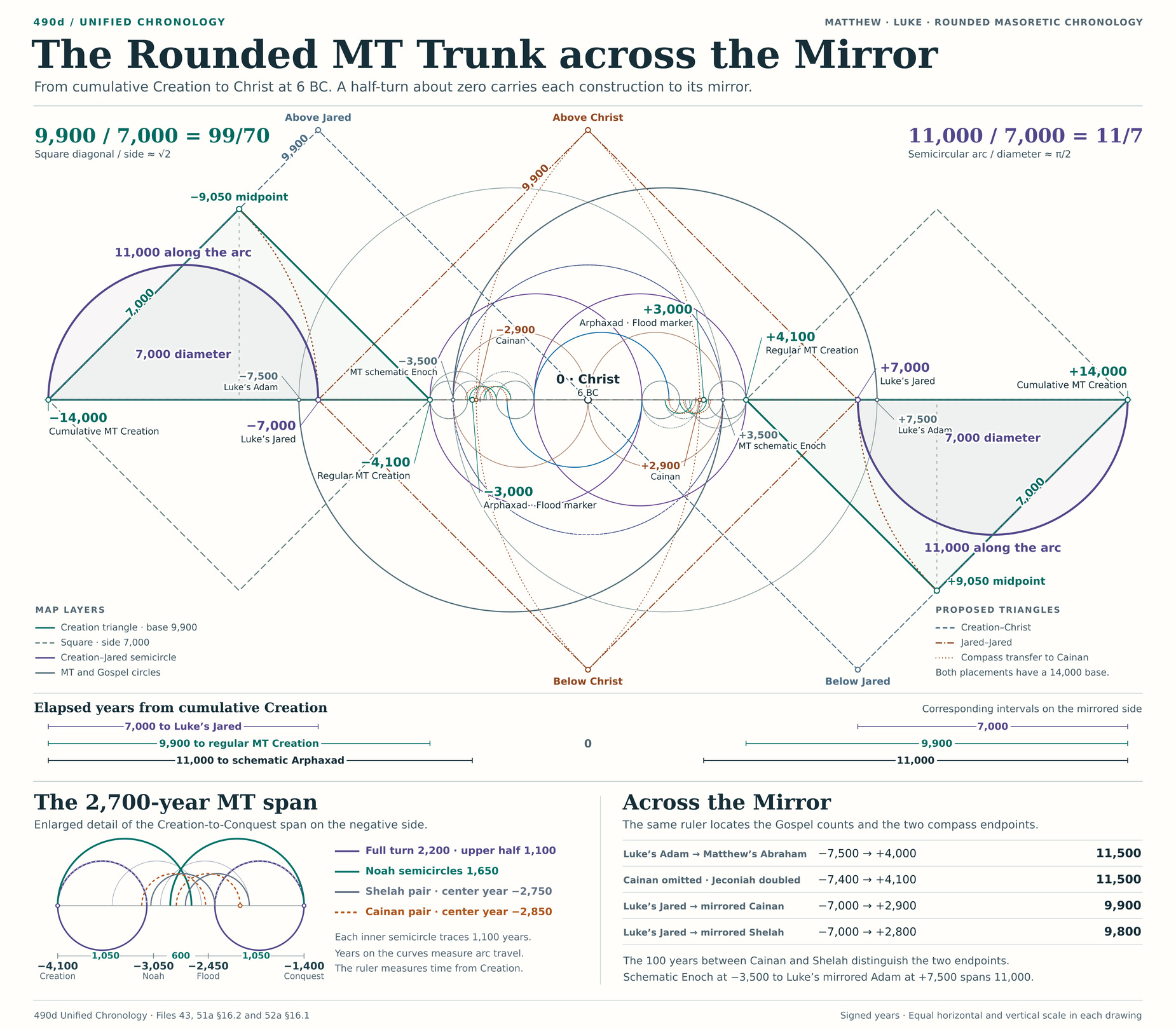
Open the two-sided view · Print the vector PDF · Explore the original interactive map
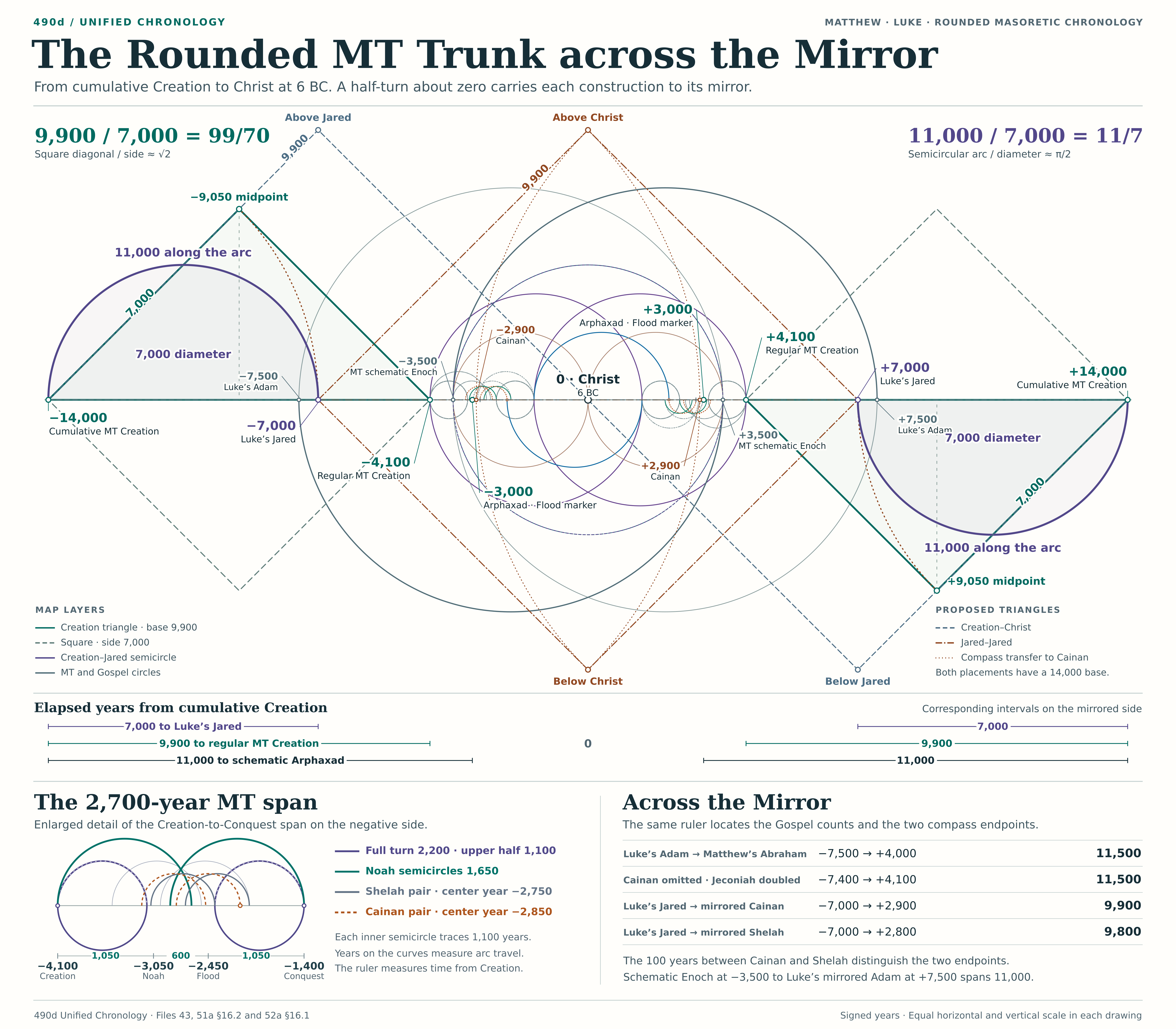
Two anchors govern the generation scales. The MT schematic counts back from the Conquest at 1406 BC (−1,400). Matthew and Luke count from Christ at 6 BC (0). When comparing the three, use the same generation length on each ruler. The century is primary here because the dated interval from regular Rounded MT Creation to Conquest is exactly 2,700 years. Origins of the 100-, 70- and 40-year generations · Calculation from each anchor
The generations from Adam to Moses
Enoch is seventh from Adam, and his account breaks the sequence of deaths: God takes him. Shem’s line carries the family through the Flood and the scattering at Babel. Terah’s account brings Abram to the threshold of the promise. At the other end of the genealogy, Moses dies and Joshua leads Israel into the land. The line from Abram through Moses also contains seven names: Abram, Isaac, Jacob, Levi, Kohath, Amram and Moses. Genesis 15 sets the four hundred years beside the promised return in the fourth generation. That juxtaposition motivates the use of a century as a generation in this reconstruction. Genesis 5 · Genesis 11 · Genesis 15:13–16 · Exodus 6:16–20 · Jude 14
With second Cainan, son of Arphaxad, included as a single schematic generation, the 27 centuries run from 4106 to 1406 BC. Read inward from Adam: 700 years reach Enoch’s close at 3406, and 1,100 reach Shem’s close at 3006. Read backward from Moses: 700 reach the Terah–Abram boundary at 2106, and 1,100 reach the Peleg–Reu boundary at 2506. The two outer measures therefore recur in reverse order: 700 + 400 + 500 + 400 + 700. The dates mark schematic generational boundaries. For example, the regular Rounded table places Enoch’s taking at 3121 BC. Generational boundary check · File 51a
The full circle can likewise be read in both directions. From Adam, 2,200 years reach the close of Isaac’s century at 1906 BC. Back from Moses, 2,200 reach the opening of Jared’s at 3606 BC. Omitting second Cainan, as in the transmitted MT, leaves 26 names. Holding Moses fixed then places schematic Adam at 4006 BC and the forward 2,200 ends at Jacob’s close in 1806 BC. The central five centuries become four. Both outer sevens and elevens survive. The regular Rounded MT Creation date stays at 4106 BC. Isaac and Jacob at the 22nd close
Genesis gives the count a literary setting in its תולדות headings. Ishmael and Isaac bury Abraham. A generation later, Esau and Jacob bury Isaac. These two pairs give the final four major accounts their names. As File 70 records, Esau’s second heading gives eleven occurrences across the ten major accounts. Terah’s heading is sixth, with five on either side. The seven generations from Abram through Moses can be counted independently of those headings. Whether the author repeated Esau’s heading specifically to produce eleven remains open. Genesis 25 · Genesis 35–36 · File 70, Appendix B.1
| Measure in years | Generations of 100 years | Regular Rounded MT at Noah |
|---|---|---|
| Diameter | 700 | 1,050 |
| Semicircular arc | 1,100 | 1,650 |
| Circumference | 2,200 | 3,300 |
The proposed restructuring preserves both the proportion and the 2,700-year span. Each circle measure grows by one half. Both columns give 11/7 for arc divided by diameter and 22/7 for circumference divided by diameter. What changes is the position of the two arcs. On the 27-century outline, two 1,100-year arcs leave 500 years between Shem’s close and Peleg’s close. On the regular Rounded line, two 1,650-year arcs overlap for 600 years from Noah’s birth to the Flood. Thus 1,100 + 500 + 1,100 and 1,650 + 1,650 − 600 both span Creation to Conquest. Once Noah’s 600 occupies the middle of a symmetric 2,700 years, each flank must be (2,700 − 600)/2 = 1,050. Read by successive events, the result is 1,050 + 600 + 1,050. File 51a, regular MT tables
The regular chronology itself preserves one link between the forms. File 52b records 500 years from Noah’s birth to Shem’s, 100 to the Rounded Flood and 500 more to Shem’s death: 1,100 years. Genesis also gives Noah 350 years after the Flood. Those two measures give 1,100/350 = 22/7. The recurrence within Noah’s own family is why this draft treats the generational circle as the likely earlier design. The arithmetic establishes the relationship between the forms. Their order of composition is the historical proposal. Genesis 9:28 · File 52b §5.4.3
The twenty-seven centuries and their center
Luke traces Shelah through Cainan to Arphaxad and calls Adam the son of God. File 69 counts 27 human positions from Adam through Moses when second Cainan is included. Its figurative God position brings the count to 28. On the century scale, 4206–4106 BC represents this position before Adam. The table assigns one century to each human name. Its dates mark the opening and close of each allotted generation. Second Cainan’s 130 years to the next birth already belong to the native LXX chronology. The century assigned here is a different measure. Luke 3:35–38 · File 69 §3.4A · File 18 §0.1
| Generations 1–9 · BC | Generations 10–18 · BC | Generations 19–27 · BC |
|---|---|---|
| 1 Adam · 4106–4006 | 10 Noah · 3206–3106 | 19 Nahor · 2306–2206 |
| 2 Seth · 4006–3906 | 11 Shem · 3106–3006 | 20 Terah · 2206–2106 |
| 3 Enosh · 3906–3806 | 12 Arphaxad · 3006–2906 | 21 Abram · 2106–2006 |
| 4 Kenan · 3806–3706 | 13 Second Cainan · 2906–2806 | 22 Isaac · 2006–1906 |
| 5 Mahalalel · 3706–3606 | 14 Shelah · 2806–2706 | 23 Jacob · 1906–1806 |
| 6 Jared · 3606–3506 | 15 Eber · 2706–2606 | 24 Levi · 1806–1706 |
| 7 Enoch · 3506–3406 | 16 Peleg · 2606–2506 | 25 Kohath · 1706–1606 |
| 8 Methuselah · 3406–3306 | 17 Reu · 2506–2406 | 26 Amram · 1606–1506 |
| 9 Lamech · 3306–3206 | 18 Serug · 2406–2306 | 27 Moses · 1506–1406 |
Which end stays fixed? Omit second Cainan and hold Moses’ close at 1406 BC. Adam opens at 4006, and the generations from Shelah through Moses keep their dates. Thus Shelah opens at 2806 in both counts, moving from fourteenth to thirteenth. The reverse circumference of 2,200 years from Moses still reaches 3606, now the opening of Mahalalel. Hold Adam at 4106 instead, and Jacob occupies the entire twenty-second century, 2006–1906 BC. Moses’ twenty-sixth then closes at 1506 BC. This second comparison explains why Jacob can occupy the same 2,200-year boundary as Isaac in the table above. The two reverse counts · The whole twenty-second generation
Shelah at the center. Stay on the 27-name table and compare midpoints. Jared, second Cainan and Terah fall at 3556, 2856 and 2156 BC. Moving each marker to the next generation gives Enoch, Shelah and Abram at 3456, 2756 and 2056 BC, again 700 years apart. The two pairs of arcs also move forward a century. Jared’s opening to Reu’s opening (3606–2506) and Lamech’s close to Terah’s close (3206–2106) each span 1,100 years. Their successors give Enoch to Serug (3506–2406) and Noah to Abram (3106–2006). Their shared 700 years divide at 2756 BC, the midpoint of Shelah’s century, the full Adam–Moses span and Noah’s regular Rounded 600 years to the Flood. Dean reads the succession from Jared’s day to Enoch’s witness, and from Terah’s household to Abram’s call, in light of Christ’s suffering for others. The dates establish the symmetry. Drawing by dated node · Five substitutions · 1 Peter 3:18–20
The proposed pre-generation also meets an independently tabulated interval. From cumulative Rounded Creation in 14006 BC to the 4206 BC pillar are 9,800 years = 98 × 100 = 20 × 490. Another century reaches regular Rounded Creation in 4106 BC. File 22 separately derives 12,558 × 70/69 = 12,740 = 26 × 490. File 09 obtains a twenty-seventh 490 by adding Cainan’s cumulative 460 and a separate 30-year apparent-age allowance. The 9,800 gives the century and the 490-year generation a common measure. File 22 §8.4 · File 09 §3A.5.3 · Creation Pillars appendix
Joseph’s family supplies a dated comparison. On the regular Actual MT line, the end of Creation Year 6 at 4115 BC precedes Joseph’s birth at 1915 BC by 2,200 years. On that same Actual line, moving 4121–4115 BC forward 2,200 years gives 1921–1915 BC, the proposed birth of Reuben through the birth of Joseph. With 4115 held fixed, the 2,024 years to Abram’s call in 2091 BC likewise give 2,024 × 25/23 = 2,200, reaching Joseph. His Actual life spans 1915–1805 BC and his Rounded life 1916–1806 BC. On the Rounded line, 2,300 years run from Creation to Joseph’s death and exactly 400 more to Moses’ death. Jacob gives Joseph two tribal portions through Ephraim and Manasseh. Their inheritance suggests a theological reading of the extra century while the genealogy of Moses continues through Levi. Genesis 48:5 · File 03 · File 51a §7.6 · Year 6 and Jacob’s sons
Two semicircles across six whole generations
Enoch’s taking, the Flood, the division in Peleg’s days, Abram’s birth and Moses’ death give the six centuries their narrative setting. The century scheme places Enoch’s taking where Methuselah’s century opens, and Abram’s opening where Terah’s century closes. Arphaxad marks the Flood through Shem’s household. Genesis dates his birth two years after the Flood. Genesis places the division in Peleg’s lifetime and recounts the scattering at Babel, leaving its precise year within his life open. Genesis 5:21–24 · Genesis 10:25 · Genesis 11:1–10, 27 · Deuteronomy 34
The earlier six-boundary check read inward from Adam’s opening and Moses’ close. The same proportions hold throughout the centuries. Count forward from Adam (#1) to Methuselah (#8) and Arphaxad (#12), or backward from Moses (#27) to Terah (#20) and Peleg (#16). Compare openings with openings, midpoints with midpoints, or any other matching point. In either direction seven centuries give 700 and eleven give 1,100. At 22/7, the two 1,100-year arcs together measure 2,200 on a common diameter of 700.
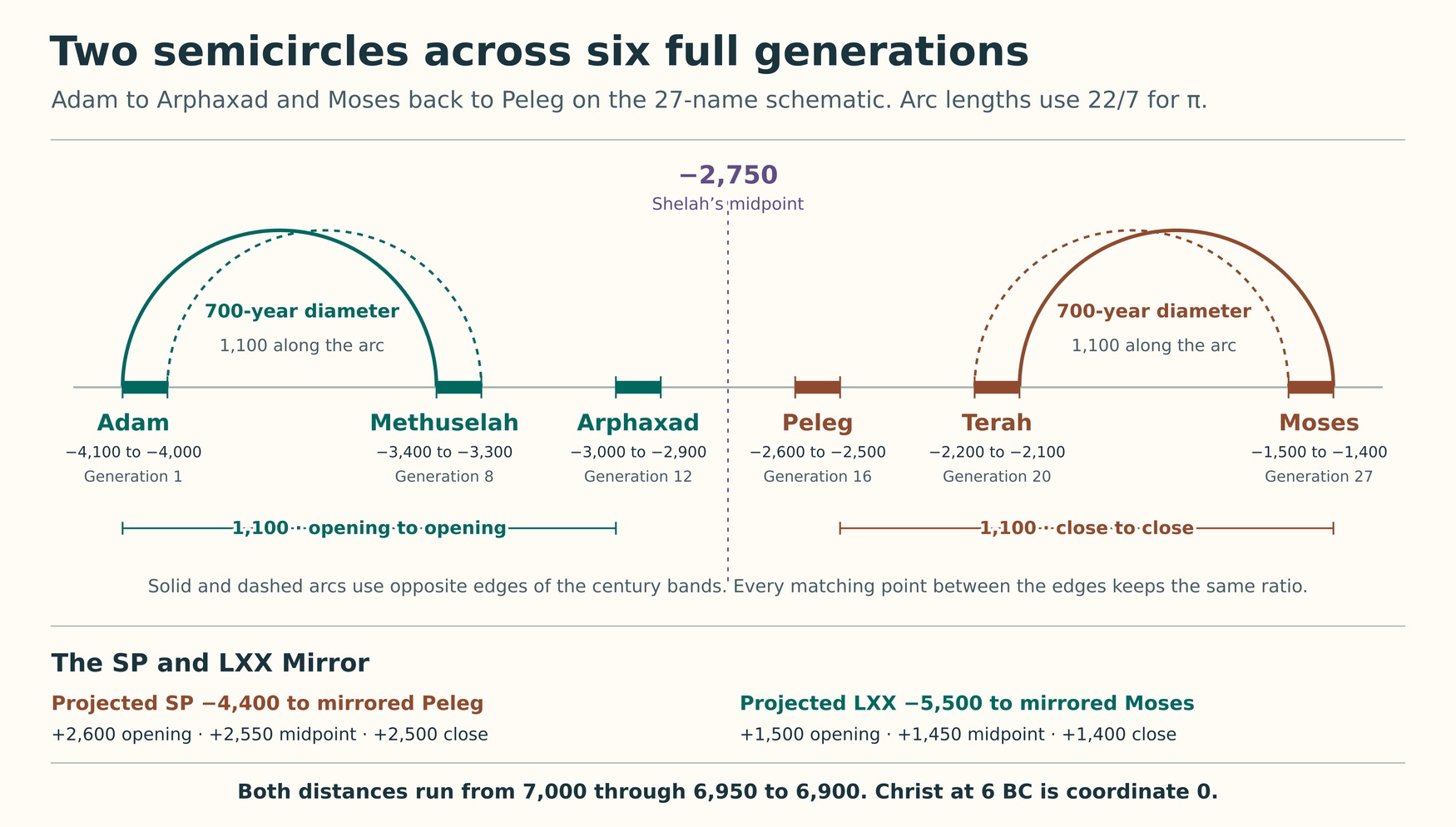
Reflection about −2,750, midway through Shelah’s century, reverses each pair of generations from opening to close. Adam’s opening at −4,100 reflects to Moses’ close at −1,400. Methuselah’s opening at −3,400 reflects to Terah’s close at −2,100. Arphaxad’s opening at −3,000 reflects to Peleg’s close at −2,500. This same center bisects the interval from projected LXX Creation at −5,500 to Christ at zero. Full-size six-generation diagram
From Shelah’s center to Luke’s Adam across the Mirror
Genesis follows Adam’s line forward to Enoch, whom God takes. Luke begins after Jesus’ baptism and traces the line backward through Enoch and Adam to God. The preceding diagram paired generations within the MT by reflecting about Shelah. Here the center of reflection moves to Christ at zero, with Shelah appearing on both sides. Genesis 5:21–24 · Luke 3:21–38 · Signed Mirror and spacing
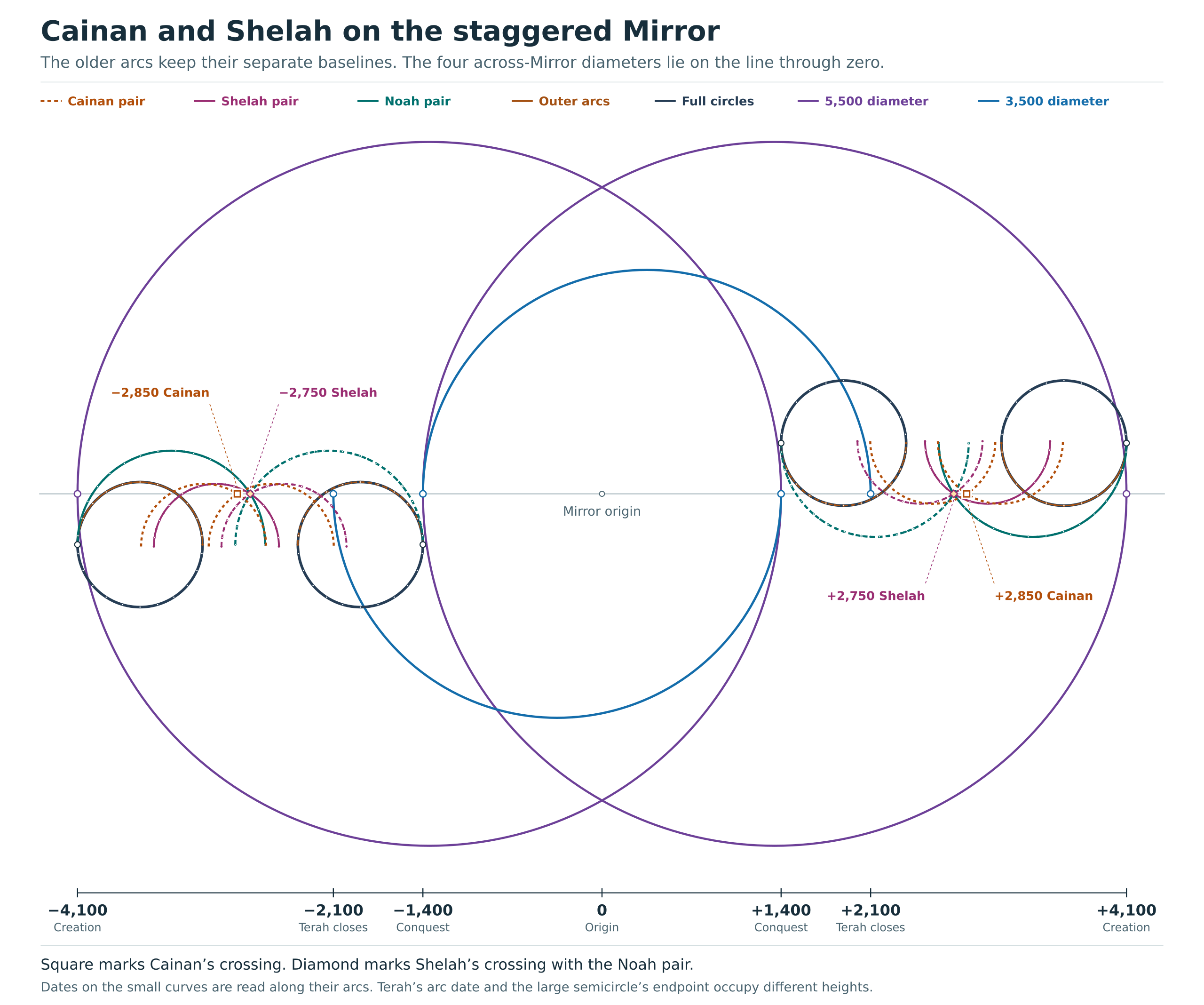
Why does Shelah at 2756 BC matter to a circle across the Mirror? One generational semicircumference and one Noah semicircumference add to 1,100 + 1,650 = 2,750. Put Shelah at −2,750 and reflect him to +2,750. The distance is 5,500, exactly the sum of the two full circumferences, 2,200 + 3,300. Their diameters likewise add to 700 + 1,050 = 1,750, giving 5,500/1,750 = 22/7. The two Cainan midpoints at ±2,850 instead stand 5,700 apart. This is a reason, internal to the geometry, to keep both names on the chart and center the 2,700-year whole on Shelah. Diagram of the complete 5,500 diameter
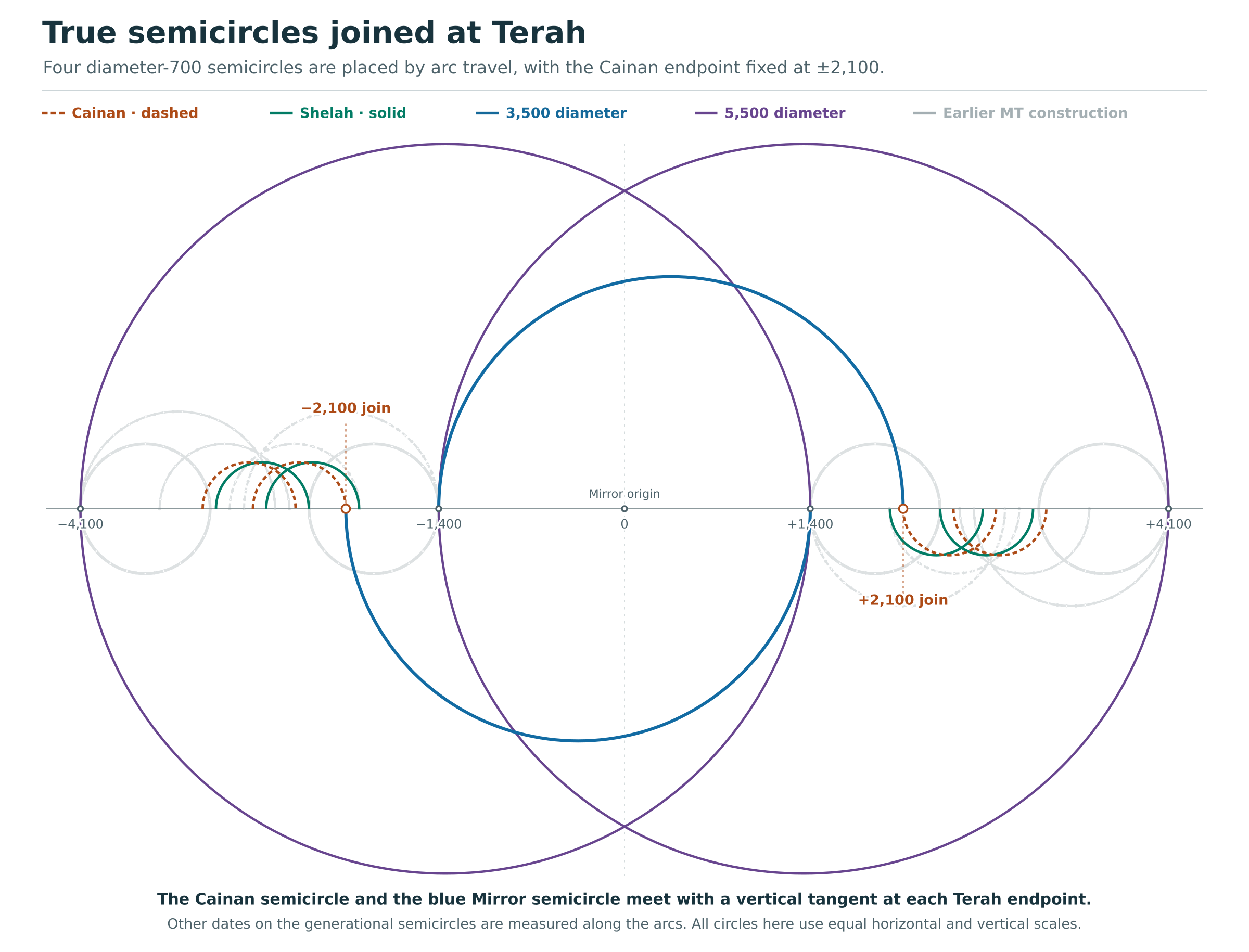
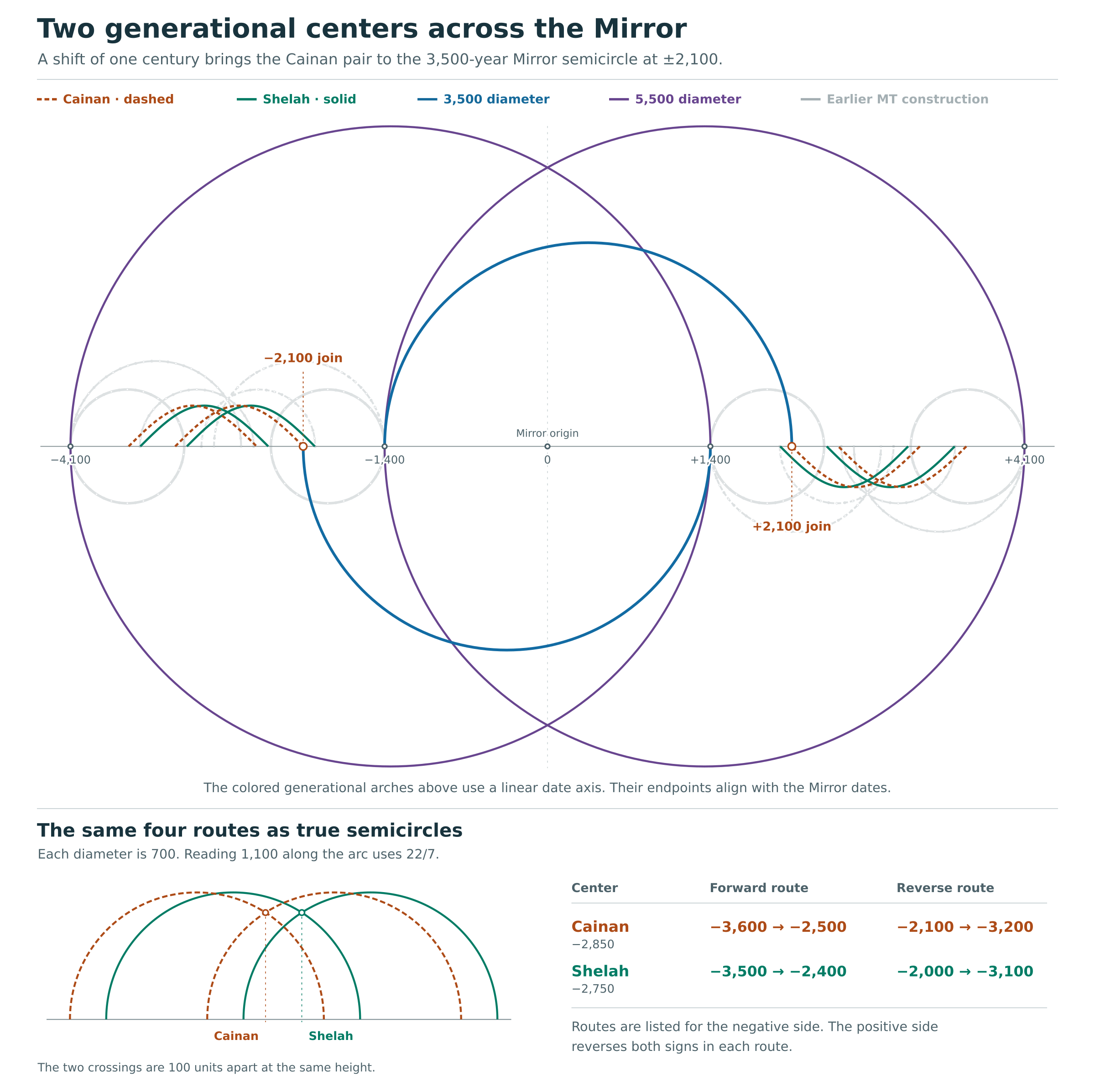
The same 5,500 is the diameter from Creation on one side to the opposite Conquest, −4,100 to +1,400, repeated from −1,400 to +4,100. A semicircle spanning −1,400 to +2,100 has diameter 3,500 and working arc 5,500. Its reflection ends at −2,100. These Terah boundaries are the inward ends of the Cainan-centered paths. The Shelah-centered paths reach one century farther inward, to ±2,000. The common-horizontal drawing shows the join at Terah. The staggered drawing shows the crossings at Cainan and Shelah one century apart. In both, the straight dates and the lengths measured along curves have distinct roles. Staggered companion drawing · Date-axis overview
How Luke gives 11,000 a genealogical endpoint
In the project’s selected Luke count, Adam stands 75 intervals before Christ. Changing the interval from 70 to 100 years moves him from −5,250 to −7,500. In the 27-century MT reconstruction, Adam stands at −4,100 and Enoch’s century runs from −3,500 to −3,400. With second Cainan retained in both counts, Luke’s Adam to schematic MT Adam is 3,400 years, the same distance as that Enoch’s close to Christ. Luke’s own Enoch occupies −6,900 to −6,800. Distinguishing the two Enochs on the ruler makes the large figure readable. File 43, Gospel genealogy tables · Luke and the two Enoch intervals
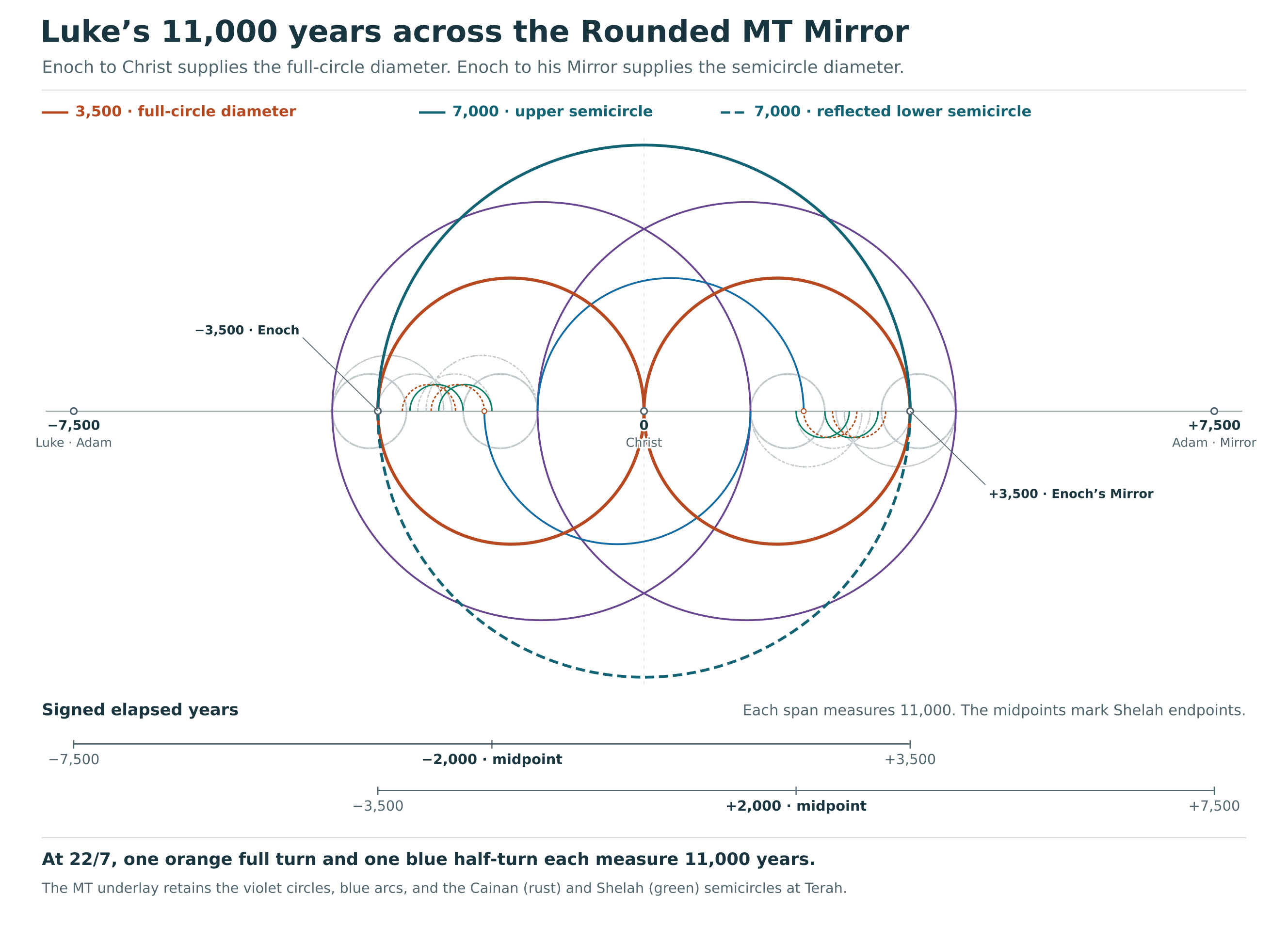
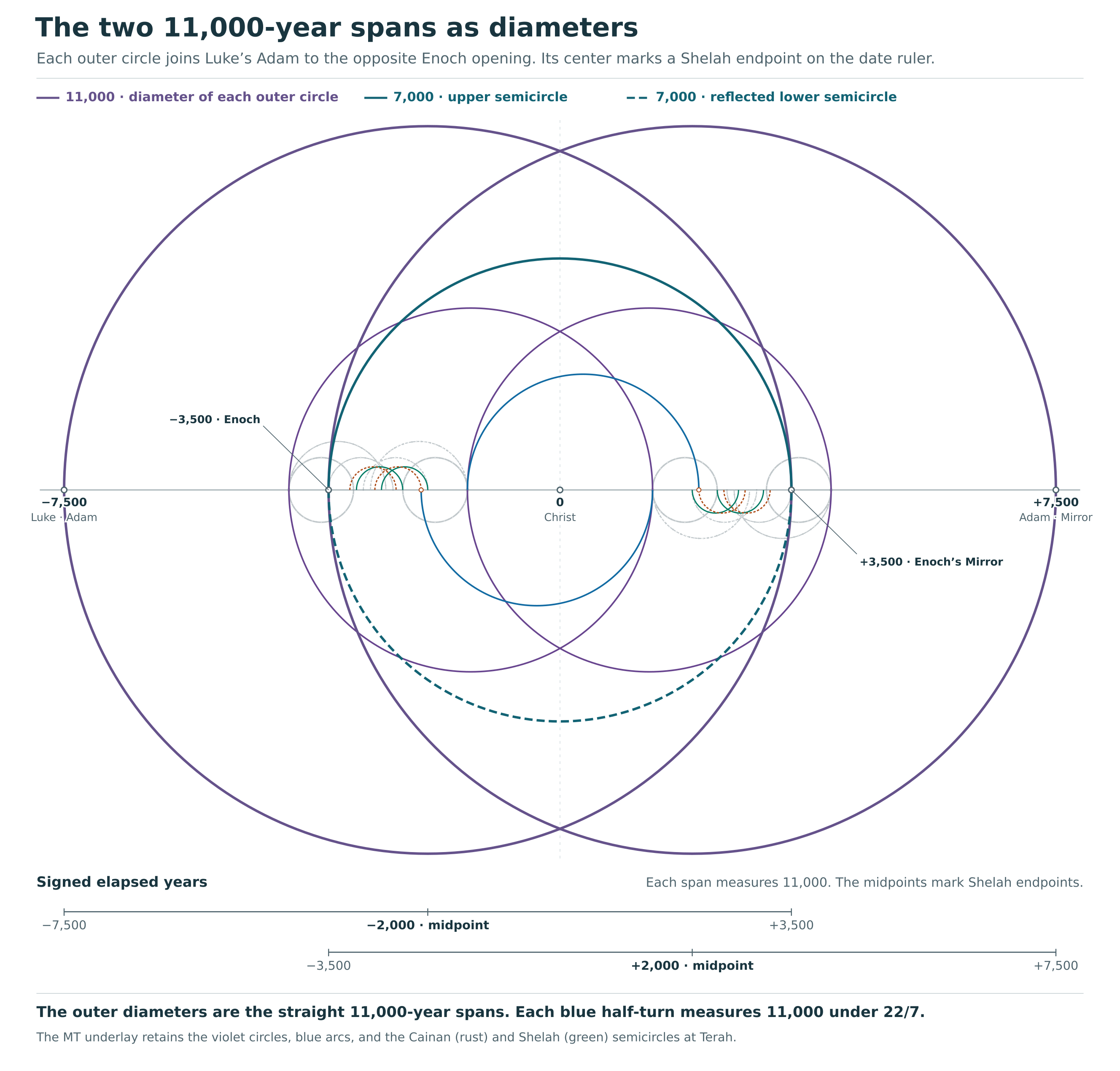
Read from MT Enoch’s opening at −3,500 to the reflection of Luke’s Adam at +7,500. The interval is 11,000. The reflected reading goes from −7,500 to +3,500. The two plates preserve those endpoints and show two different geometric uses for their distance.
| Print plate | What to measure | What 11,000 represents |
|---|---|---|
| 1 · Arc length | Enoch to Christ gives a diameter of 3,500 on either side. Enoch to reflected Enoch gives a diameter of 7,000. | A full turn at diameter 3,500 or a half-turn at diameter 7,000, using 22/7. |
| 2 · Straight diameter | The straight spans −7,500 to +3,500 and −3,500 to +7,500 each measure 11,000. | Each span is the diameter of a circle with radius 5,500. Their centers, −2,000 and +2,000, coincide with the inward ends of the Shelah-centered paths. |
Two-page print PDF · Original print package
The equalities 11,000/3,500 = 22/7 and 11,000/7,000 = 11/7 are exact. The plotted circular curves use Euclidean geometry, for which the circumference is π times the diameter. The genealogical argument concerns the rational measures supplied by the chosen years. Published square-and-circle study
Matthew and Luke at the Christ boundary
Matthew follows the promise forward from Abraham through David and the exile to Jesus Christ. Luke begins with Jesus after his baptism and traces the line backward through Abraham, Enoch and Adam to God. Dean reads these opposed directions as the literary counterpart of the Mirror. Matthew’s Abraham coincides on the diagram with schematic Adam at two positions. The comparison stops at Abraham, where Matthew’s genealogy begins. Matthew 1:1–17 · Luke 3:21–38
Abraham and the midpoint of the two Gospel spans
File 43 counts 75 intervals from Adam to Jesus among 76 human figures in its selected single-Ram form of Luke. Second Cainan stands between Arphaxad and Shelah. The figurative generation of God adds one interval before Adam. The Berean Standard Bible has two names, Admin and Arni, where this ledger has one, and also retains second Cainan. Matthew gives three groups of fourteen. Counting Jeconiah once yields 41 distinct main-line figures and 40 intervals. Counting him on both sides of the exile gives 42 occupied positions and 41 intervals. Published Gospel count tables, §§2–4 · File 69 §§1.8–1.9
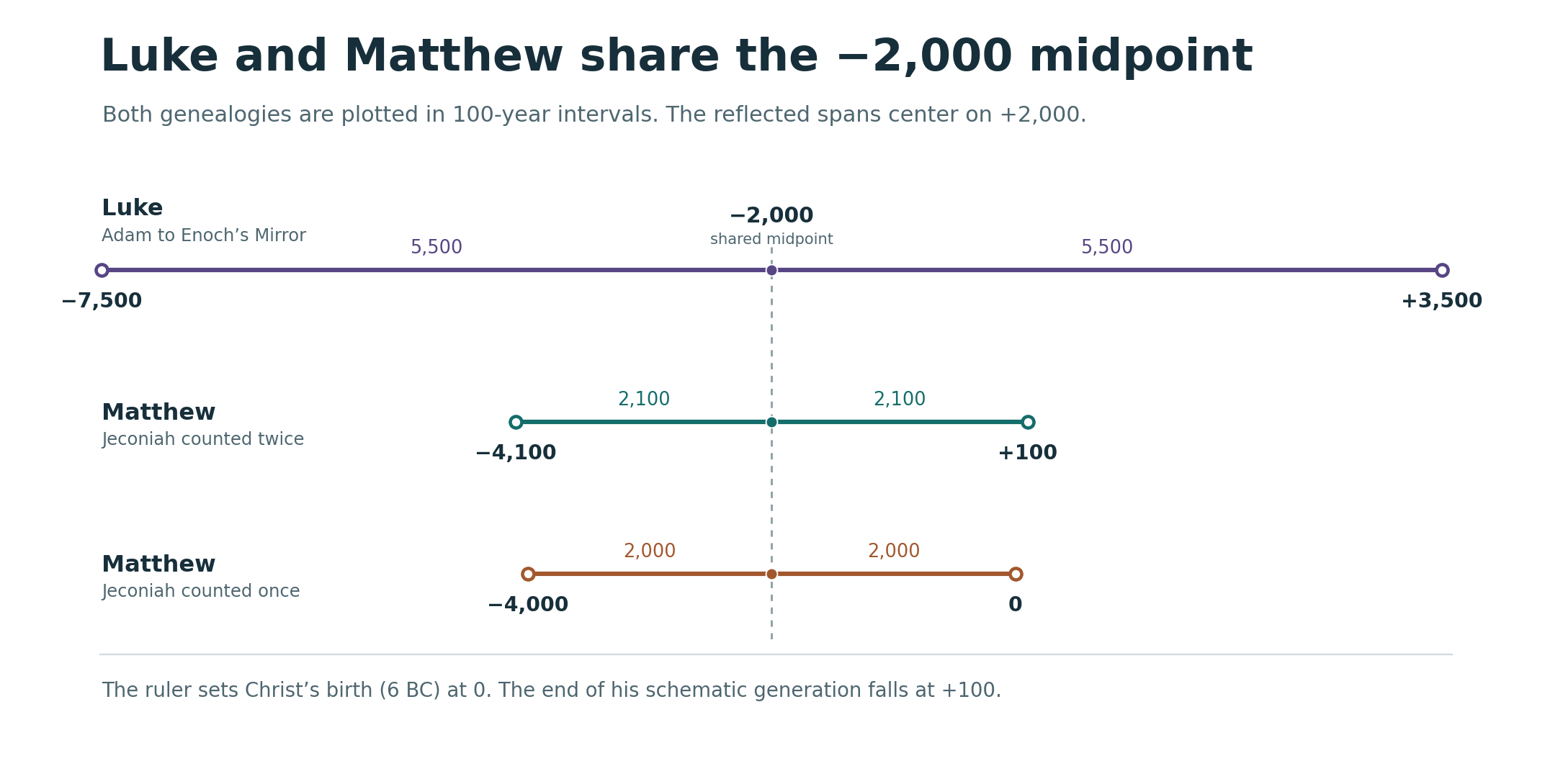
At 70 years per interval, Luke’s Adam and figurative God boundary stand at 5256 and 5326 BC. With the Nativity at 6 BC and each interval enlarged to 100 years, their signed positions are −7,500 and −7,600. Matthew’s two Abraham positions at 2806 and 2876 BC become −4,000 and −4,100. On the MT diagram these are the Adam openings without and with second Cainan respectively, with Moses held at −1,400. File 69 §3.4D places the midpoint of both Matthean spans at −1,400 on the 70-year Gospel scale, coinciding with the MT Conquest in 1406 BC. On the 100-year Gospel scale the midpoint is −2,000, coinciding with regular MT Jacob’s birth in 2006 BC. The Gospel midpoint changes with the unit. Both MT dates stay fixed.
| Span | Signed boundaries on the century scale | Midpoint |
|---|---|---|
| Matthew, Abraham to Christ’s opening | −4,000 to 0 | −2,000 |
| Matthew, exile overlap, Abraham to Christ’s close | −4,100 to +100 | −2,000 |
| Luke’s Adam to the reflected MT-based Enoch opening | −7,500 to +3,500 | −2,000 |
Reflection gives +2,000 on the other side. The points at ±2,000 are the ends nearest Christ of the two 1,100-year paths paired about Shelah on their respective sides of the Mirror. Shelah’s own midpoints stand at ±2,750. File 69 §3.4D · Midpoint calculations
Why 11,500 survives the change of count
File 43 §5.1 adds Luke’s 5,250 and Matthew’s 2,800 years to the Nativity, giving 8,050. Across the map’s Mirror, the same 115 intervals span 11,500 years (5 × 2,300) at 100 years per generation, 8,050 at 70 and 4,600 at 40. Dean’s second comparison advances both endpoints by one century. One interval leaves the selected Luke count when second Cainan is omitted for this comparison, and one enters Matthew when Jeconiah occupies both exile positions. The distance survives while the midpoint moves. File 43 §5.1 · Comparison of the two counts
| Luke’s Adam | Matthew’s reflected Abraham | Distance | Midpoint |
|---|---|---|---|
| −7,500 | +4,000 | 11,500 | −1,750 |
| −7,400 | +4,100 | 11,500 | −1,650 |
The Key of 23 adds ten generation lengths to either count. Since 115 × 25/23 = 125, 11,500 becomes 12,500 (+1,000), 8,050 becomes 8,750 (+700), and 4,600 becomes 5,000 (+400). File 43 §§5.1–5.2 already gives the 70-year expansion and calls its gain the “Seal700.” File 15 §2.2 gives 1,000, 700 and 400 as the tenfold units. File 43 §§5.1–5.2 · File 15 §2.2
Where the gain falls. For the 75 + 40 count, read the preceding pair in its reflected orientation. Luke’s Adam stays at +75g. Assign the whole gain of 10g to Matthew’s side and Abraham’s projected endpoint moves from −40g to −50g. The distance from Luke’s fixed point becomes 125g. Reflect the new endpoint to +50g about Christ. The distance between −50g and +50g is 100g, ten times the one-sided gain.
| Years per Gospel interval | Luke fixed | Matthew, initial → expanded | Luke to expanded Matthew | Expanded Matthew to its Mirror |
|---|---|---|---|---|
| 100 | +7,500 | −4,000 → −5,000 | 12,500 | −5,000 to +5,000 = 10,000 |
| 70 | +5,250 | −2,800 → −3,500 | 8,750 | −3,500 to +3,500 = 7,000 |
| 40 | +3,000 | −1,600 → −2,000 | 5,000 | −2,000 to +2,000 = 4,000 |
These are signed Gospel coordinates measured from Christ at zero. The projected endpoint on Matthew’s side belongs to Dean’s geometric reading. The 74 + 41 count also gains 10g overall. Assigning it wholly to Matthew in that case gives −51g, or 102g to its reflection. The 100g symmetry belongs specifically to the 75 + 40 count.
Dean relates the 1,000 to the lifespans from Adam to Noah. None of the recorded lifespans reaches 1,000 years. Adam lives 930 years and Noah 950. As a Second Temple witness, Jubilees 4:29–30 explicitly reckons Adam’s life as 70 years short of a thousand. Dean reads the gain of 700 years as seven centuries echoing God’s rest on the seventh day. The gain of 400 is both 10 × 40 and 4 × 100. God tells Abram that his descendants will be strangers in a land other than their own for 400 years and will return in the fourth generation. Genesis 5 · Genesis 9:29 · Jubilees 4:29–30, trans. VanderKam · Genesis 2:2–3 · Genesis 15:13–16 · File 15 §3
Enoch’s opening and Christ’s allotted century
Genesis says that God took Enoch. Hebrews describes his escape from death through faith. On Luke’s 70-year scale, File 54 already measures 4,830 years from Enoch’s opening to Christ. With Christ fixed, the Key of 23 expands that span to 4,900 at Jared or 5,250 at Adam. On the century scale, each ratio starts afresh from 6,900. Multiplication by 70/69 gives 7,000. Multiplication by 25/23 gives 7,500. Genesis 5:18–24 · Hebrews 11:5 · File 54 §6.1
Enoch’s opening is the starting event in both Luke counts. With Cainan retained, the span reaches Christ’s opening at 0. With him omitted, it reaches +100, the schematic close of Christ’s allotted generation. Holding +100 fixed and counting back 7,000 restores −6,900, Enoch’s opening in the retained count and Jared’s in the shorter one. Dean reads Christ bearing the displaced century as a figure of substitutionary death, and Enoch’s return to his former coordinate as a figure of resurrection. +100 marks the end of a model generation. For the historical Passion the study uses AD 33 or AD 30. 1 Peter 3:18 · Dean’s clarified endpoint reading
| Fixed endpoint | 6,900 back | 7,000 back | 7,500 back |
|---|---|---|---|
| Luke, Christ opens at 0, Cainan retained | −6,900 Enoch | −7,000 Jared | −7,500 Adam |
| Luke, Christ closes at +100, Cainan omitted | −6,800 Enoch | −6,900 Jared | −7,400 Adam |
| MT-based Mirror, +3,400 fixed | −3,500 Enoch | −3,600 Jared | −4,100 Adam |
| MT-based Mirror, +3,500 fixed | −3,400 | −3,500 | −4,000 |
In each of the first three rows, counting backward from Enoch takes one century to Jared’s opening and five more to Adam. The same 500 + 100 sequence is visible on the regular Rounded MT comparison where 4106 − 3646 = 460 years from Adam to Jared, enlarged to 500 by 25/23. The last begins at Enoch’s close in the longer MT-based scheme and reaches the shorter scheme’s Adam coordinate. File 22 §7.10 already applies both ratios to 6,900 in its cumulative Jared–Cainan construction. Dean’s observation locates them at Enoch’s boundaries on the two genealogical rulers. File 22 §7.10 · MT Mirror endpoints
Jared is sixth from Adam and second Cainan thirteenth, each sixth in a group of seven. Shelah follows Cainan as fourteenth on the longer list and takes the thirteenth position on the shorter one. Genesis places the making of humankind on Day 6 and the rest on Day 7. It also recounts the Fall and God clothing Adam and Eve. Files 69–70 assign the latter events to Day/Year 13 and 14 in the reconstruction. Dean reads the move from exposure to covering alongside the Passover on Nisan 14 and Christ’s giving himself for others. The text supplies the events, the calculation supplies the two ordinal positions, and the proposed correspondence connects them. Genesis 3:21 · 1 Corinthians 5:7 · File 70 §3.4
Alpha, 137 Jubilees from Creation to Shelah
After Abel’s death, Eve names Seth as the offspring God has given her. Genesis gives Adam’s age at Seth’s birth as 130 years. In the published Actual MT reconstruction, the seven symbolic years from the opening of Creation in 4121 BC to its completion in 4114 BC precede those 130 years to Seth in 3984 BC. 7 + 130 = 137. Scripture also gives 137 as the lifespan of Ishmael, Levi and Amram. Counting Ishmael alongside the Actual MT Adam–Moses line, 137 occurs three times. The other repeated lifespan, 239, occurs twice, for Peleg and Reu. Luke follows the line of Seth through Enoch to Christ. These are the textual points of departure for examining 137 on the map. Genesis 4:25 · Genesis 5:3 · Genesis 25:17 · Exodus 6:16, 20 · Luke 3:36–38 · Published alpha study, §§2–3
Counting fifty-year Jubilees from MT Creation
Leviticus names the fiftieth year the Jubilee. In the 27-name schematic, a century holds two such periods. Retain second Cainan here, hold regular Rounded MT Creation at −4,100 and measure across Christ at 0 (6 BC). On the original side, Shelah’s midpoint at −2,750 bisects Creation to the Conquest at −1,400. On the reflected side, the distance from Creation to that midpoint is exactly 137 Jubilees. Leviticus 25:8–10, 23 · The 27 named centuries
| Starting at regular MT Creation (−4,100) | At 137 units | At 138 units |
|---|---|---|
| 50 years per unit | 6,850 → +2,750, Shelah’s reflected midpoint | 6,900 → +2,800, Shelah’s reflected opening |
| 60 years per unit | 8,220 → +4,120, 20 years into the reflected century before Adam | 8,280 → +4,180, 20 years before its far end |
Two operations on the same 6,900 reach other named boundaries. Multiplying by 70/69 gives 7,000 years to +2,900, the reflected opening of second Cainan. Multiplying by 25/23 gives 7,500 years to +3,400, the reflected close of Enoch and opening of Methuselah. In the 60-year row the two endpoints divide +4,100 to +4,200 into 20 + 60 + 20. Half the two lengths are 4,110 and 4,140 years. The published alpha study already measures these from regular MT Year 6 (4116 BC) and its +30 apparent-age setting (4146 BC) to 6 BC. Alpha study, §§10, 12
The first 137-fold length also has a smaller counterpart on the same side of Christ. From Luke’s Adam (−7,500) to regular Rounded MT Adam (−4,100) are 3,400 = 136 × 25 years. Another 25 reaches the first quarter of MT Adam’s allotted century (−4,075), giving 3,425 = 137 × 25. At his midpoint (−4,050) the distance is 3,450 = 138 × 25. These are calculated positions inside Adam’s century. A separately dated 3,425 belongs to the Actual cumulative MT. The fifteen lifespans from Arphaxad through Moses total 3,425 years, the distance from the cumulative Flood boundary in 4831 BC (Moses/Nisan) to the Conquest in 1406 BC. Alpha study, §11 · Quarter-century calculation
Luke’s centuries from Adam and Enoch
Luke names second Cainan between Arphaxad and Shelah and ends by calling Adam the son of God. On Luke’s century ruler the two MT Jubilee lengths double. The first line below holds Adam fixed. The next two hold the opening of the figurative generation of God fixed. In a reflected century the close appears first when reading toward the right. Luke 3:35–38 · Gospel count tables, §5
| Luke’s starting boundary | Distance and endpoint at 137 units | Distance and endpoint at 138 units |
|---|---|---|
| Adam, −7,500 · 100 years per unit | 13,700 → +6,200, Shelah’s opening and second Cainan’s close | 13,800 → +6,300, second Cainan’s opening |
| Figurative God, −7,600 · 100 years per unit | 13,700 → +6,100, Shelah’s close | 13,800 → +6,200, Shelah’s opening |
| Figurative God, −7,600 · 110 years per unit | 15,070 → +7,470, 130 short of +7,600 | 15,180 → +7,580, 20 short of +7,600 |
Enoch’s century shows why the choice of boundary matters. Genesis gives Enoch 365 years before God takes him. His allotted century in Luke’s schematic runs from −6,900 to −6,800. Adding 13,000 to both boundaries carries the whole century onto reflected Shelah, +6,100 to +6,200. It takes seven centuries from Adam or eight from the figurative God opening to reach Enoch’s close. Thus 700 + 13,000 = 13,700 and 800 + 13,000 = 13,800 reach the same +6,200. For the 110-fold row, add a further 1,370 or 1,380 to the preceding row’s distances. Dean hears an echo of Adam’s 130 years to Seth in the 130 years still to run from +7,470 to +7,600. It takes 30 years to Adam’s reflected opening at +7,500 and another 100 to +7,600. Genesis 5:21–24 · Whole-century comparison
Dean’s conclusion. Dean now places the 137/138 relationship at the root of the Rounded MT–Gospel trunk. His alpha study, published on 27 October, had already proposed the pair and measured its thirtyfold spans of 4,110 and 4,140 years. The geometry fixed Shelah’s midpoint on other grounds. On 20 November the map placed it halfway from Creation to the Conquest, 2,750 years from Christ, the sum of the generational and Noah semicircumferences (1,100 + 1,650). On 22 November the count from Creation reached Shelah’s reflected midpoint and opening in 137 and 138 Jubilees. Luke’s already allotted centuries supplied the two doubled distances. Finding both counts at these previously established positions confirms the earlier hypothesis to Dean’s satisfaction. The checks draw on the same genealogies and measure agreement within this reconstruction. Published alpha study, §12 · Shelah on 20 November · Map on 21 November · Jubilee count on 22 November
Dean reads the 137 Jubilees from regular Creation to reflected Shelah as the Creator’s signature and claim of authorship over sacred time and its geometry. Leviticus associates the Jubilee with God’s claim to the land. Extending that ownership to the numerical design is Dean’s theological conjecture, compatible in his reading with human scribes composing and transmitting the text. In physics the measured inverse fine-structure constant, α⁻¹, is approximately 137.036. The chronology uses the exact integers 137 and 138. The resemblance motivates the name alpha here. Leviticus 25:23 · NIST, inverse fine-structure constant · Dean’s interpretation
Phi and the Fibonacci spans on the same map
Genesis marks the close of Enoch’s life with his taking and moves from Terah’s household to the call of Abram. On the MT century schematic, Enoch’s close (−3,400) and Terah’s close (−2,100) flank Shelah’s midpoint (−2,750) by 650 years on each side. Reflect Terah’s close across Christ. The path −3,400 → 0 → +2,100 now gives 34 + 21 = 55 centuries. The same 650 separates Shelah’s reflected midpoint (+2,750) from Enoch’s reflected close (+3,400) in the Jubilee calculation above. Genesis 5:24 · Genesis 11:27–32 · Genesis 12:1–4 · Six whole generations
Luke’s Adam (−7,500), Matthew’s common midpoint (−2,000, also the fixed regular MT birth of Jacob in 2006 BC), and reflected Luke Enoch (+6,900) divide a larger span into 55 + 89 = 144 centuries. From the same Adam to the reflected Conquest (+1,400) and then to that Enoch, the order reverses to 89 + 55. The six positions along the ruler are −7,500 (Luke’s Adam), −4,100 (regular MT Creation), −2,000 (Jacob), +1,400 (Conquest), +3,500 (MT schematic Enoch) and +6,900 (Luke Enoch). Their five successive gaps are 34 + 21 + 34 + 21 + 34 centuries. The sums 55, 89 and 144 are consecutive Fibonacci numbers. Their ratios, 89/55 and 144/89, approximate the golden ratio Φ. On the Gospel ruler of g years, Luke’s Adam, Matthew’s midpoint and reflected Luke Enoch stand at −75g, −20g and +69g. Omitting second Cainan while holding Christ fixed gives 54 + 88 = 142 intervals. The 55/89 division thus depends on the retained count. Abraham and the Gospel midpoint · Gospel count tables
The published Φ study already gives the 89 + 21 + 34 division from 15806 through 6906 and 4806 BC to the Conquest in 1406 BC. That construction uses the projected 6906 BC Shem pivot and the two generated positions at 15806 and 4806 BC. Adding 8,300 to all four positions on the signed ruler gives −7,500, +1,400, +3,500 and +6,900. The old lengths now join Luke’s Adam, the reflected Conquest, reflected MT Enoch’s opening and reflected Luke Enoch’s opening. The same translation carries the article’s 15806 BC, Gear 1 Noah’s death in 2106 BC and regular Jacob’s birth in 2006 BC to −7,500, +6,200 and +6,300. Thus its published 13,700 and 13,800 are exactly the two spans from Luke’s Adam to Shelah and second Cainan above. This comparison locates an established Fibonacci division on the existing map. Published Φ study, §18 · Technical appendix P · Signed coordinates in the scratchpad
The reciprocal of e from Luke’s Adam to the Mirror
Genesis begins with God calling light into darkness. After the Fall, God clothes Adam and Eve. John returns to Creation’s opening when he describes the light of Christ shining in the darkness. Dean connects those passages with the reciprocal of Euler’s number, e. When light attenuates exponentially as it passes through a material, its intensity after one attenuation length is 1/e of its initial value, about 36.79%. Matthew’s midpoint, which divided the Fibonacci spans, also divides the distance from Luke’s Adam to his reflected century. Genesis 1:1–5 · Genesis 3:21 · John 1:1–5 · Published e study, §4
Begin at Luke’s Adam, −7,500, retaining second Cainan and counting 100 years per generation from Christ at zero (6 BC). The 5,500-year radius reaches −2,000, Matthew’s midpoint and the signed position of regular MT Jacob’s birth. Another 9,450 years reaches +7,450, halfway through reflected Adam’s century. From end to end the span is 14,950 = 299 × 50 = 13 × 1,150. Its first part is 5,500 = 110 × 50. Thus 5,500/14,950 = 110/299 ≈ 0.367893, about 0.00368% above 1/e. The published study had already obtained 220 + 378 = 598 from 6666 through 6446 to 6068 BC. Here the same division, multiplied by 25, meets named positions in Luke and Matthew. Gospel midpoint · Derivation on the signed ruler
Hold −7,500 fixed. The Key of 23 gives 14,950 × 300/299 = 15,000, carrying +7,450 to Adam’s exact reflection at +7,500. The middle of the span moves from −25 to Christ at zero. The radius occupies 11/30 of this completed span.
Reading the radius outward from either Adam gives ±13,000. The cumulative Rounded MT supplies a second measure of those positions. From 14006 through 7006 to 6 BC are 7,000 + 7,000 years, the two symbolic Creation weeks already identified in the Φ study. Counting outward from Christ, ±13,000 completes the thirteenth millennium, one short of ±14,000. Dean reads that final thousand as the passage from the Fall on schematic Day/Year 13 to covering and restoration on Day/Year 14, prefiguring Passover on Nisan 14 and Christ bearing the curse. Genesis gives the sequence of transgression and clothing. The day assignments belong to that typological reading. Φ study, §12 · Joint π–√2 study, §10 · Galatians 3:13
Isaac’s binding and Christ’s half-generation
Read the same radius inward. +7,450 − 5,500 = +1,950, the reflection of Isaac’s midpoint. In the 27-name schematic, Isaac’s century opens at −2,000, reaches −1,950, and closes at −1,900. Add 2,000 throughout and the three positions become 0, +50, +100 in Christ’s generation. Fifty measures half of each allotted century. Genesis assigns Isaac no age at the binding, and John gives no age of fifty for Jesus at his death. Isaac’s midpoint
At Moriah, Isaac lives because Abraham offers the ram in his place. Jubilees puts the challenge on the twelfth of the first month and the arrival on the third day. This places the binding at Passover, reckoned late on Nisan 14 by VanderKam and on the fifteenth by Fitzmyer. Isaiah’s Servant gives his life for others. Acts 8 quotes Isaiah’s question about his generation alongside the taking of his life, and Philip applies the passage to Jesus. Dean reads the aligned midpoints through that sacrificial correspondence. John also joins the Temple with Christ’s body and its raising. File 13 pairs the forty-six years in John 2 with the threshold of fifty in John 8 by 46 × 25/23 = 50. Genesis 22:9–13 · Jubilees 17–18 and the two date readings · Isaiah 53:7–10 · Acts 8:32–35 · File 13, §§6.5, 8.1 and the two sayings in John
Isaac and the midpoint from Adam to Christ
Luke traces Jesus’ descent back to Adam, and Paul calls Christ the “last Adam.” With second Cainan retained, the 75 schematic generations from Luke’s Adam to Christ span 7,500 years. Half the span is 3,750 years, or 37½ generations. On the positive side of the Mirror, move from reflected Adam at +7,500 toward Christ at zero. Subtracting 5,500 reaches +2,000, the reflected opening of Isaac’s century on the MT-based 27-name schematic. From the midpoint at +3,750 to Isaac’s opening are 1,750 years. Thus the Adam–Isaac interval divided by the midpoint–Isaac interval gives 5,500/1,750 = 22/7, the same rational approximation to π previously found across Shelah. The negative side repeats the distances at −7,500, −3,750 and −2,000. The separate whole-to-half ratio is 7,500/3,750 = 2, equivalently 22/11. All positions are signed distances from the 6 BC Christ anchor. Luke 3:23–38 · 1 Corinthians 15:45–47 · The earlier Shelah construction
Luke’s seventy-year generations and the Enochian week
The two Gospel spans preserve the ratio when their generations are counted in 70 or 40 years from Christ. Each row begins at Luke’s Adam, passes through Matthew’s midpoint and ends at the midpoint of reflected Adam’s generation. The outer pair is found by carrying the radius beyond the two Adam openings. For the inner pair, subtract the radius from reflected Adam’s midpoint and reflect the result across zero. An MT comparison at either smaller scale must still count from the Conquest at 1406 BC. The two fixed anchors · File 54, Luke’s seventy-year count
| Years per Gospel generation | Radius / span to reflected midpoint | Outer pair | Inner pair |
|---|---|---|---|
| 100 | 5,500 / 14,950 | ±13,000 | ±1,950 |
| 70 | 3,850 / 10,465 | ±9,100 | ±1,365 |
| 40 | 2,200 / 5,980 | ±5,200 | ±780 |
On Luke’s seventy-year scale, the span from −9,100 to +9,100 equals 18,200 = 50 × 364 years. The span from −1,365 to +1,365 equals 2,730 = 7½ × 364 years. Counting one schematic year per Enochian calendar day, Christ divides the smaller span into 15 quarters of 91 on either side. File 29 already names 2,730 the Reconciled Week in its Actual MT setting, from 4176 BC (Year 6 with +60 Terah) to the Exodus in 1446 BC. What Luke adds here is the placement of that span equally on either side of Christ. The full inner span is 3/20 of the full outer span. The approximation to 1/e belongs to the radius divided by the span to Adam’s reflected midpoint. File 29, §§4.2, 6.4 · The seventy-year construction
The SP and native LXX as branches of the Rounded MT geometry
The journey to the promised land supplies the common endpoint for this comparison. In the 27-name table, Moses’ allotted century closes at the Conquest, 1406 BC. Eleven generations earlier, Peleg’s century carries the division of the nations. These two generations give us points on the existing map against which to compare the SP and native LXX Creation dates. Twenty-seven centuries · Genesis 10:25 and the nations · Deuteronomy 34
Use the corresponding lower members of the regular Rounded Creation blocks in File 51a, with +60 Terah off. They are 4106 BC (MT), 4411 BC (transmitted SP) and 5486 BC (native LXX). Second Cainan’s 130 years to the next birth already belong to the LXX. From the 6 BC datum these three dates read −4,100, −4,405 and −5,480. The projections below operate on the differences from the fixed MT date. The five-year adjustment of the SP difference belongs to the century scheme. Report IV already gives the 25/23 conversion of the 1,380-year LXX difference. File 51a §§17.2–17.6 · Report IV §37
| Comparison from the fixed MT Creation | Operation on the offset | Projected Creation | Span to its own signed Mirror |
|---|---|---|---|
| SP · century grid | 305 rounded to 300 | −4,400 | 8,800 |
| LXX · 70/69 | 1,380 × 70/69 = 1,400 | −5,500 | 11,000 |
| LXX · 25/23 | 1,380 × 25/23 = 1,500 | −5,600 | 11,200 |
Read the 70/69 row first. From −5,500, 7,000 years reach mirrored Moses’ opening at +1,500, 9,900 reach mirrored SP Creation at +4,400, and 11,000 reach mirrored LXX Creation at +5,500. Add 8,500 to each of the four coordinates on the master map’s Creation–Jared–Creation–Arphaxad ruler and these four coordinates result. Thus both 99/70 and 11/7 recur with the same 7,000-year reference. File 51a Appendix A.3 already gives an SP–LXX 9,900 on its civil Mirror, using different boundaries.
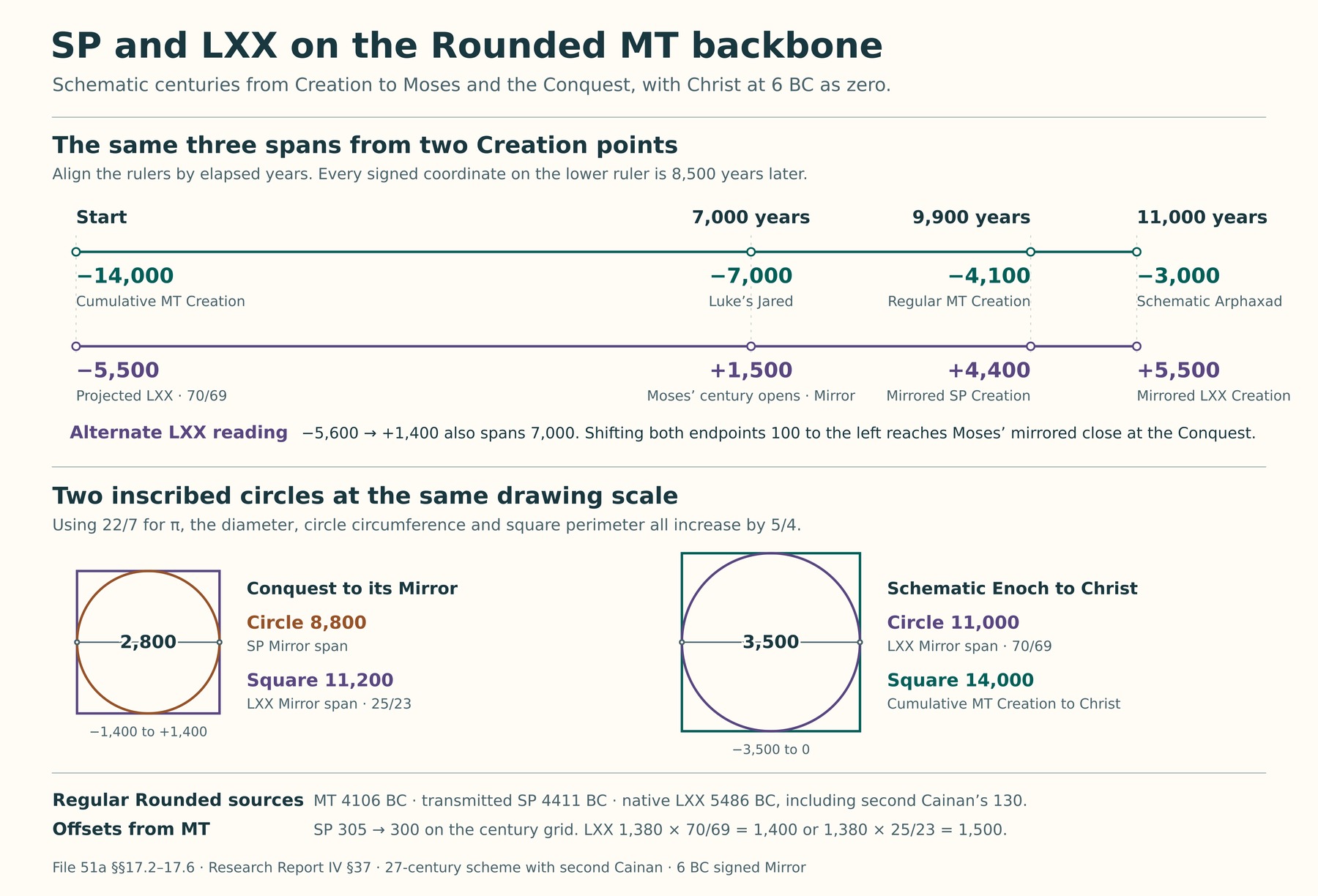
The whole centuries of Peleg and Moses provide a second check. From SP −4,400 to Peleg’s mirrored opening at +2,600 is 7,000, and to his close at +2,500 is 6,900. From LXX −5,500 to Moses’ mirrored opening at +1,500 is likewise 7,000, and to his close at +1,400 is 6,900. The distance is 6,950 at both midpoints and stays equal at every matching point. The 1,100 between Peleg and Moses is also the 1,100 between the projected Creations. Holding −5,500 fixed, 6,900 × 70/69 = 7,000 carries Moses’ close to his opening. Holding the mirrored Conquest at +1,400 fixed sends the starting point to −5,600, the coordinate reached independently by the 25/23 reading. Peleg and Moses on the same ruler
The two Conquest poles, −1,400 and +1,400, give a circle of diameter 2,800 inside a square of side 2,800. At 22/7 the circle measures 8,800 around, the SP Mirror span. The square’s perimeter is 11,200, the alternate LXX span. Enlarge the figure by 5/4 and the diameter becomes 3,500, from schematic Enoch to Christ. The circumference becomes 11,000, the 70/69 LXX span, and the square perimeter becomes 14,000, cumulative Rounded MT Creation to Christ. These equalities follow from the stated projections. The comparison derives these secondary branches by holding the MT reference spans fixed and projecting the offsets of the transmitted SP and native LXX. Comparison plate for print · Published square-and-circle study §9
Jacob completes the twenty-second generation
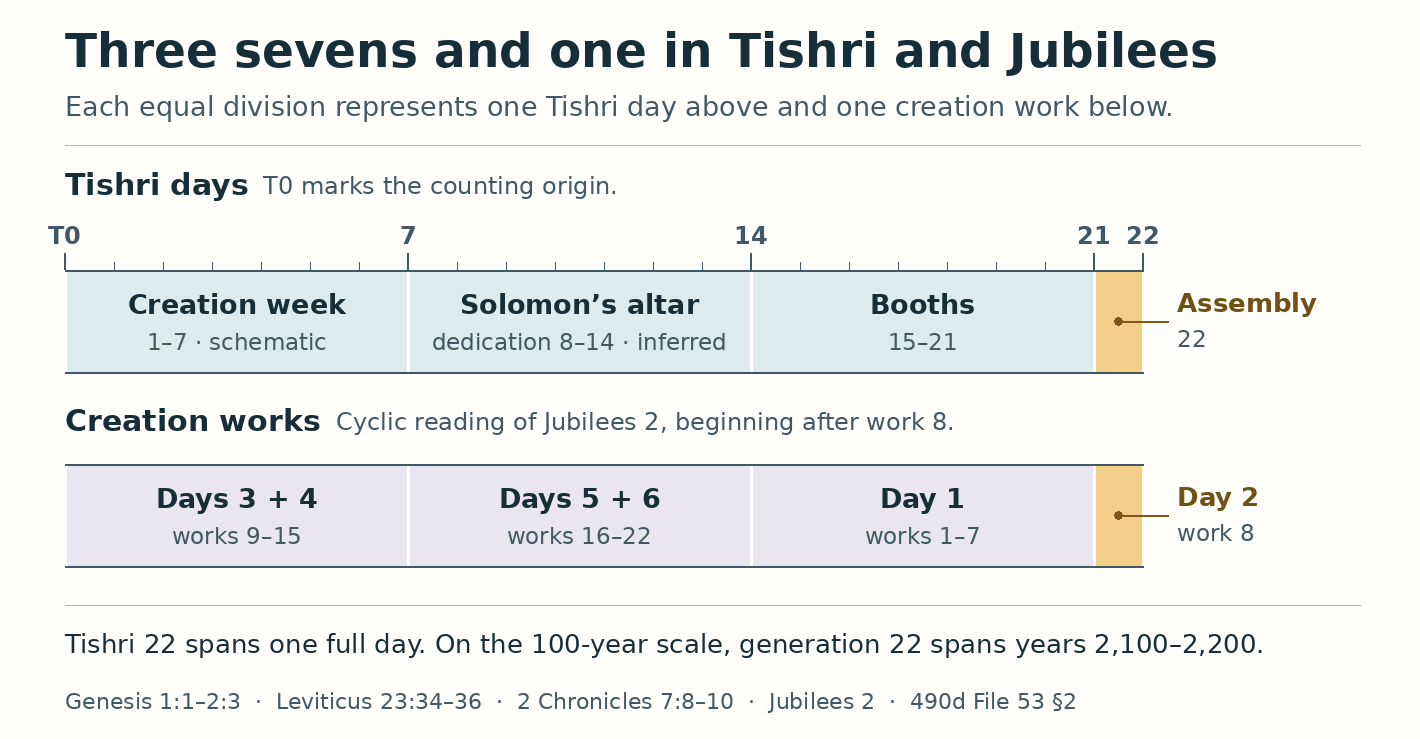
God finishes his work in six days and rests on the seventh. Jubilees 2:23 pairs the twenty-two works of Creation with twenty-two ancestral heads from Adam through Jacob. Dean reads Jubilees as a Second Temple witness to how Jewish interpreters understood the scriptural chronology. File 53 already sets out the two lists and distinguishes this count from the narrative in Jubilees 8, which retains second Cainan. In the century scheme, twenty-one completed generations bring us to year 2,100. The whole twenty-second generation, years 2,100–2,200, brings the count to 2,200/700 = 22/7. With Creation held at 4106 BC, that century runs 2006–1906 BC. Jacob occupies it when second Cainan is omitted from the count. On the regular MT reconstruction this century runs from Jacob’s birth to the proposed birth of Benjamin, encompassing the formation of Israel’s household. With Cainan retained at the same origin, Isaac occupies the twenty-second position and Jacob follows. Jubilees 2:1–23 · File 53 §§2–3
The daily counts of works are 7, 1, 4, 3, 3 and 4. Pairing Days 3–4 and 5–6 gives 7 + 1 + 7 + 7. Day 2’s sole work, the firmament dividing the waters, is eighth. Follow the circle from work 9 and the same groups read 7 + 7 + 7 + 1. Read from the original opening, the arcs 0–11 and 7–18 have four works in common. At 150 years per work their lengths become 1,650, with 600 years shared. Their four boundaries reproduce regular Rounded MT Creation, Noah, Flood and Conquest at 4106, 3056, 2456 and 1406 BC. File 53 §§2, 6 · Published square-and-circle study §2
Jubilees also locates Abram’s call in 1906 BC and his death in 1806 BC on its own 3856 BC Creation chronology. Its 100 years to Abram’s death and 400 more to the shared 1406 BC Conquest repeat the intervals marked on the Rounded MT line by Benjamin’s proposed birth and Joseph’s death. File 20 §7B · File 53 §11
At Bethel on the twenty-second of the seventh month, God names Jacob Israel, and an angel gives him seven tablets. Jacob celebrates a further day and attaches it to the festival. The law assigns Booths to Tishri 15–21 and its eighth-day assembly to 22. Tishri 22 fills the interval from 21 completed days to 22, just as Jacob’s century fills the interval from twenty-one completed generations to twenty-two. Dean places Creation schematically on Tishri 1–7. File 63 records Solomon’s seven days of altar dedication and seven of festival. Reading those two weeks consecutively places the dedication on 8–14. Jubilees 32:16–29 · Leviticus 23:34–36 · 2 Chronicles 7:8–10 · File 63, Appendix D.6
Jubilees 8:19 calls Eden the Holy of Holies and counts Zion among the places created holy. The cherubim, palms and flowers on Solomon’s Temple walls give the proposed first week an Eden setting. 1 Kings 6:29 · Bethel and Solomon’s dedication
The MT Bronze Sea gives 30/10 = 21/7. The lampstand has seven lamps and 22 almond cups, including a fourth cup on its central shaft. Dean also reads the seven angelic orders within Day 1 as the diameter. The early sources examined leave that geometric assignment open. Sea and lampstand · Angelic orders and the historical evidence
The hundred-year reading therefore rests on three different kinds of evidence. The names and their sequence come from the genealogies. The 27 allotted centuries and the reflection about 6 BC generate the measured circles. Jubilees joins Jacob’s generation to Creation through its own count of twenty-two. The tenfold semicircle through Isaac and Joshua returns to 11/7 at Solomon’s foundation. First comes a dated comparison within Genesis itself. Noah was six hundred when the Flood came.
Noah and the two governing dates
Regular Rounded MT Creation stands at 4106 BC. Noah’s Rounded birth at 3056 BC, the Rounded Flood at 2456 BC and the Conquest at 1406 BC give 1,050 + 600 + 1,050. Genesis 7:6 supplies the central age. Creation to Flood and Noah’s birth to Conquest each span 1,650. Counting both spans gives 3,300. Counting their shared 600 just once gives 2,700 elapsed years. With 1,050 as the reference diameter, 3,300/1,050 = 22/7, the working approximation to π. Three such circumferences give 9,900. On Actual MT Gear 2, Creation completion at 4114 BC stands 1,656 years before the Flood at 2458 BC. 9,900-year technical appendix · File 51a
On the Rounded MT cumulative Moses line, 14006 BC → 6 BC spans 14,000 years. The midpoint at 7006 BC gives the square its 7,000-year side. From the same start to regular Rounded Creation at 4106 BC are 9,900 years. The square uses 99/70 for its working diagonal-to-side ratio, with 140/99 < √2 < 99/70. In the original side-70 square, 99² exceeds 2 × 70² by one. From the midpoint to Christ, regular Creation divides the other 7,000 years into 2,900 + 4,100, with 4,100/2,900 = 41/29. Published √2 study · Joint square-and-circle study
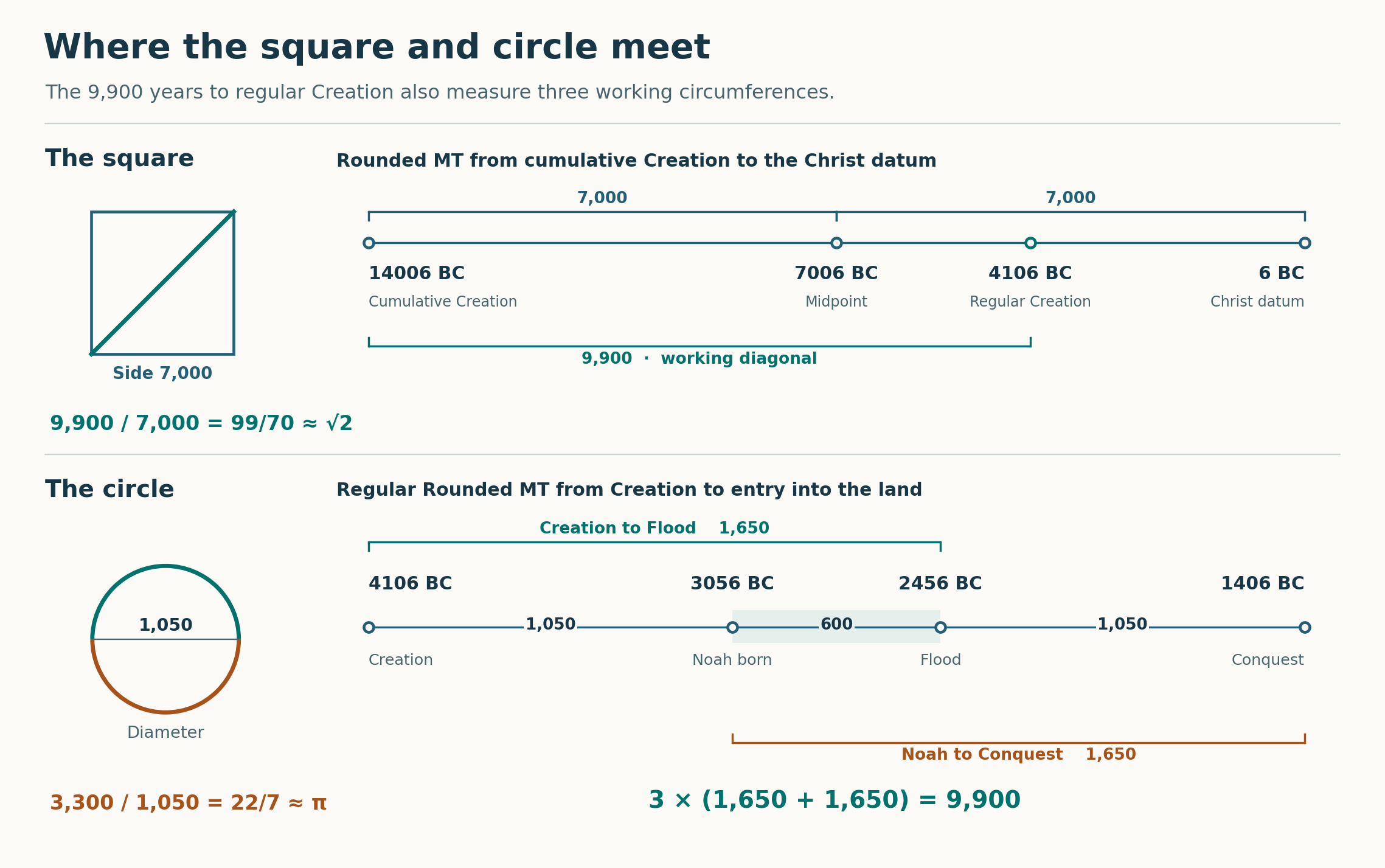
The Conquest also connects the circle directly to the Christ datum. Genesis 9:28 gives Noah 350 years after the Flood. Flood to Conquest is three 350s, and Conquest to 6 BC is four more. That makes 2,450. The midpoint of the 12,600 years from cumulative Creation to Conquest is 7706 BC, giving 7,700 to 6 BC. Here the published π fraction is 7,700/2,450 = 22/7. At whole-year precision the π study uses Arphaxad’s 2456 BC birth. The Rounded table places its Flood at the same numeral. Genesis 9 · Published π study, §§2–5
The two Mosaic dates also have a biblical calendar setting. Numbers dates the departure from Egypt to the fifteenth day of the first month. Joshua dates the arrival from the Jordan to the tenth day of that month and records Passover on the fourteenth at Gilgal. The memorial stones recall the crossing. The end of the manna marks Israel’s first food from the land. In the project 1406 BC names this entrance and the close of Moses’ life. The military campaigns extend beyond the crossing. Numbers 33:3 · Deuteronomy 34 · Joshua 4:19–24 · Joshua 5:10–12
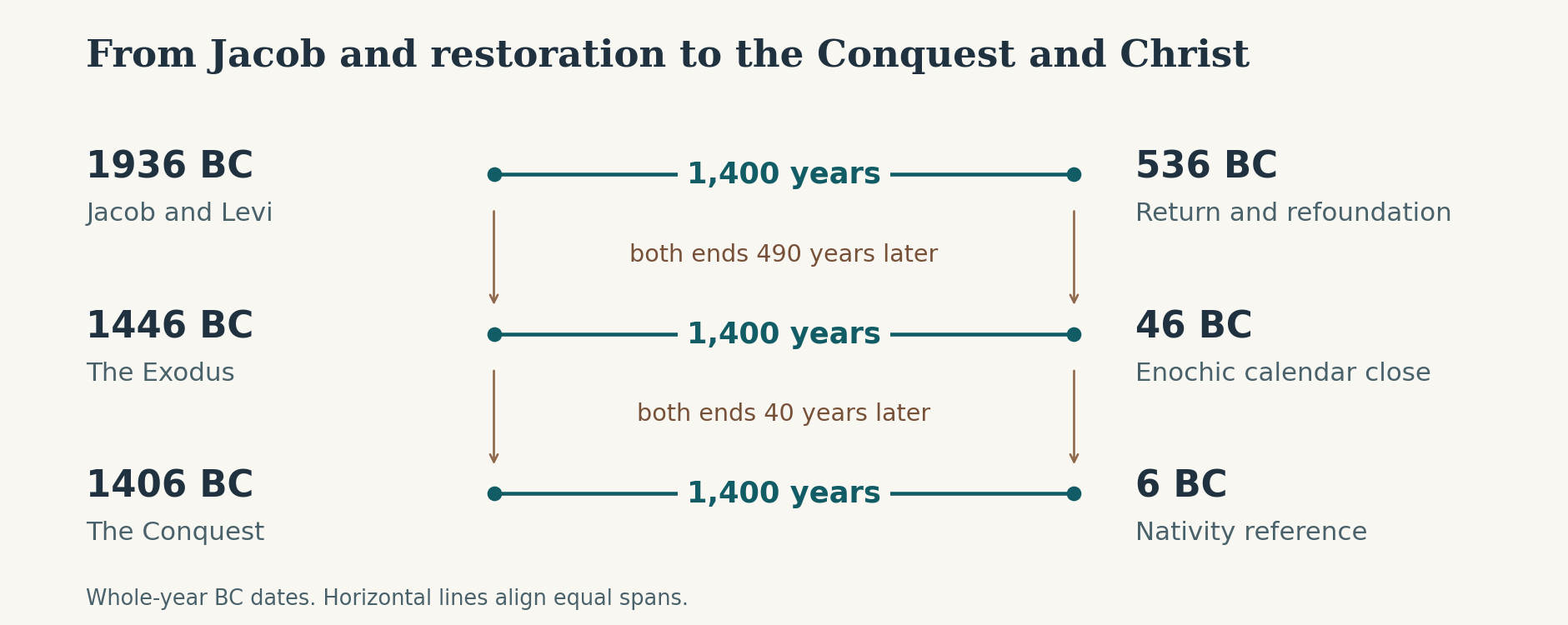
Three dated spans each measure 1,400 years. Begin with cumulative Aaron-line Jacob/Levi 1936 BC → restoration 536 BC. Move both ends forward 490 years and the result is Exodus 1446 BC → File 68’s schematic close 46 BC. Move both ends forward the forty wilderness years and it becomes Conquest 1406 BC → Nativity reference 6 BC. The final two intervals overlap for 1,360 years, from the Conquest to 46 BC. The same forty is visible in the biblical journey and in the model’s two closing dates. The 1,400 is also two sides of the smaller 700-year square. File 68, primary seventy-year count · Jacob and the 700-year square
From cumulative Shem to Enoch and Peleg
Genesis follows Shem through the Flood and into the line of Abraham. Noah was 600 when the waters came. For Shem, Genesis gives 100 years to Arphaxad’s birth and another 500 afterward. The cumulative MT lays the lifespans end to end. On its Rounded Moses line, Shem’s 600 years run from 5436 to 4836 BC, where File 51a places Arphaxad and the cumulative Flood. Genesis 7:6 · Genesis 11:10–26 · File 51a §§3.4 and 16.2
These two uses of 600 connect Noah’s circle with Enoch’s square. The table follows the interval from cumulative Shem to regular Noah, then to Jacob. The calculation below shows how another 2,900 years from the cumulative Flood to Jacob/Levi complete half of Enoch’s 7,000-year side. Noah’s circle · Shem’s half-side
| Rounded MT reckoning | Beginning of the 600 years | End of the 600 years |
|---|---|---|
| Cumulative, Moses line | 5436 BC · Shem | 4836 BC · Flood / Arphaxad |
| Regular | 3056 BC · Noah’s birth | 2456 BC · Flood |
| Regular | 2006 BC · Jacob’s birth | 1406 BC · Conquest |
Move both ends of the first row forward 2,380 years to read the second, then another 1,050 to read the third. File 51a already measures 3,430 = 7 × 490 from the cumulative Flood to the Conquest. Cumulative Shem to regular Jacob gives the matching 3,430 on the left. Jared’s place in this comparison is also fixed. His regular Rounded 3646 BC lies halfway between the two Flood dates, 1,190 years from each. File 51a, cumulative Flood and Conquest · Jared at the Conquest and covenant Mirrors
At 4836 BC the circle and square meet in a single dated sequence. In Noah’s circle the working semicircumference exceeds the diameter by 1,650 − 1,050 = 600. In Enoch’s square the working diagonal exceeds its side by 9,900 − 7,000 = 2,900, measured from Judah’s Exodus at 1496 BC to civil AD 1405, the Mirror of the primary Conquest at 1406 BC. Read those same two lengths in succession from Shem to the cumulative Aaron date for Jacob’s death / Levi’s birth. 5436 → 4836 → 1936 BC gives 600 + 2,900 = 3,500, exactly half the side. The two intervals share the dated boundary at 4836 BC. Reading that boundary as the place where the two geometric differences join is the proposed fit. File 22 §3.3 · Enoch’s 7,000 and 9,900
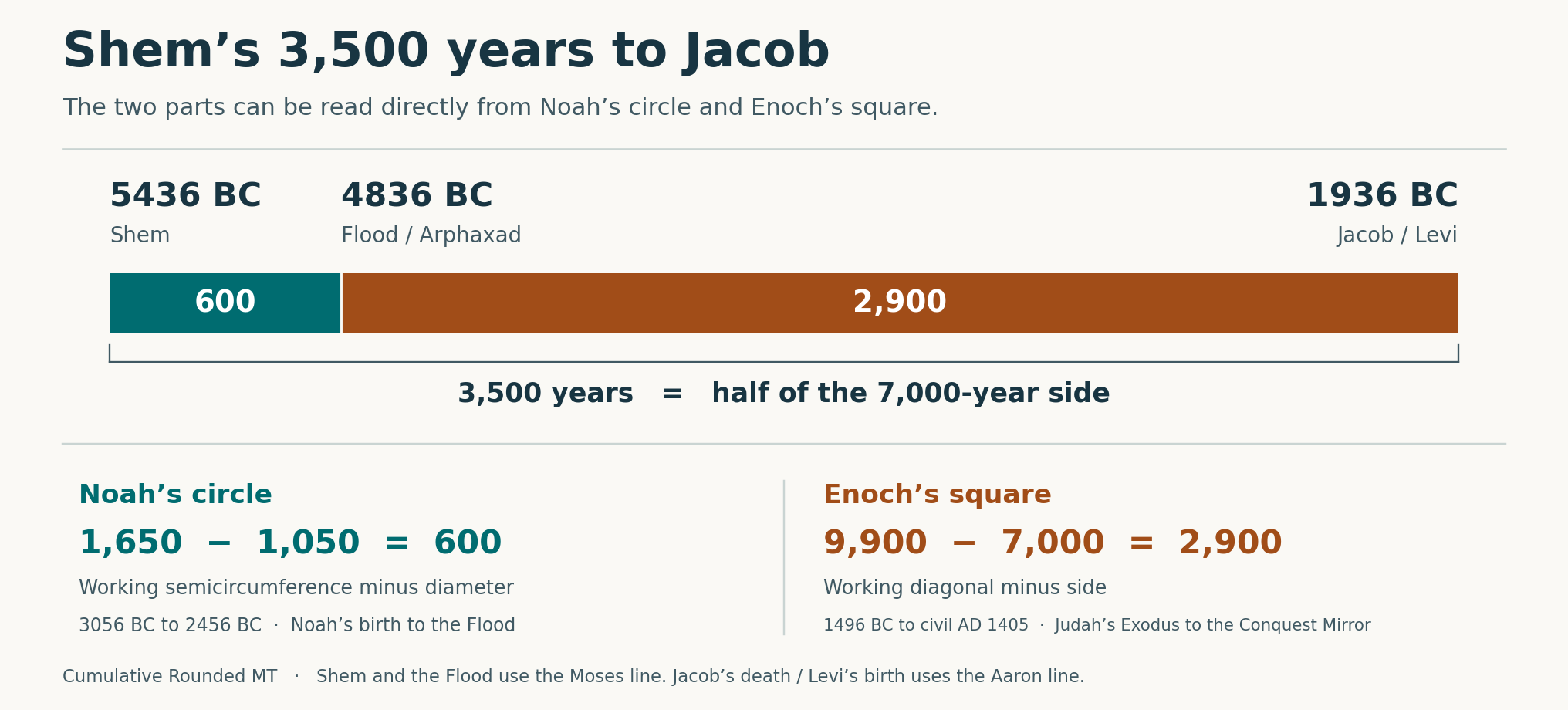
The choice of line is measurable. The 3,500 requires cumulative Moses-line Shem and Aaron-line Jacob/Levi. Keeping both ends on either one of those lines gives 3,505. In regular Actual Gear 2, Genesis 11:10’s two-year distinction appears as Flood 2458 BC and Arphaxad 2456 BC. The Rounded regular table co-registers Flood and Arphaxad at 2456. Fifty-step record, questions 5–7 · Genesis 11:10–11
Enoch carries the trunk across the Mirror
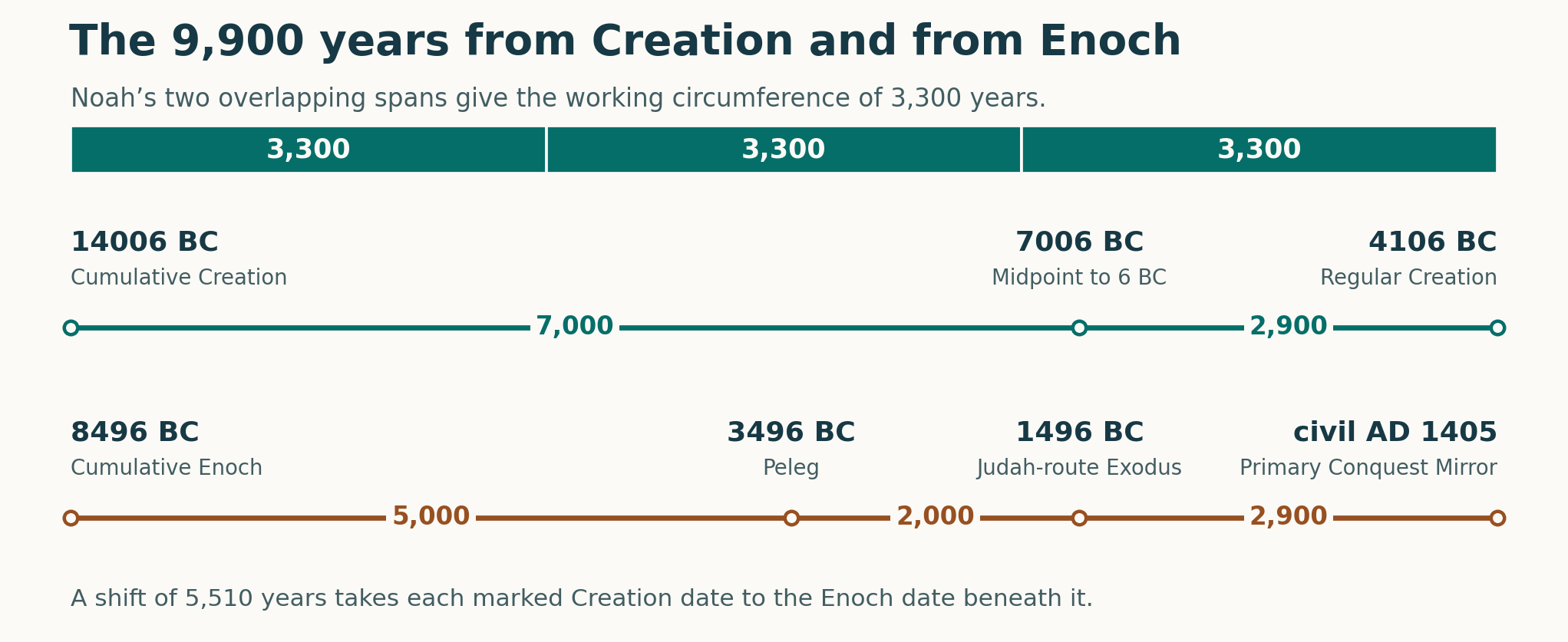
The move from cumulative Creation to cumulative Enoch is 5,510 years, the sum of the six Rounded lifespans from Adam through Jared. Move the entire sequence 14006 → 7006 → 4106 BC forward that amount. It becomes 8496 BC → 1496 BC → civil AD 1405. Both read 7,000 + 2,900. Thus the 9,900 between the two Creation chronologies ends, on Enoch’s row, at the Mirror of the 1406 BC crossing. Full dated translation · File 51b
Why 1496 BC matters. The published √2 study gives 7,000 years from cumulative Jared at 9456 BC to the Rounded Flood at 2456 BC. Moving both endpoints forward by Jared’s Rounded 960 years gives 8496 → 1496 BC. Independently, the Kings of Judah reckoning reaches its schematic Exodus in 1496 BC by the count 586 + 430 + 480. Another 2,900 years reach civil AD 1405. The square’s side and diagonal can therefore both be measured from Enoch. The other 2,900-year crossing, primary Exodus 1446 BC to Judah’s Conquest Mirror at civil AD 1455, begins 7,050 years after Enoch. That route totals 9,950. File 34, Mosaic Bridge · File 36, §9 · Published √2 study
| From Enoch at 8496 BC | Interval just traversed | Total |
|---|---|---|
| Peleg at 3496 BC | 5,000 | 5,000 |
| Judah-route Exodus at 1496 BC | 2,000 | 7,000 |
| Primary Conquest Mirror at civil AD 1405 | 2,900 | 9,900 |
Peleg divides Enoch’s diagonal at 3496 BC, 5,000 years from Enoch and 4,900 from the Conquest Mirror. Within the first 5,000, Noah’s 600 years lie between two spans of 2,200. Sarah and Abraham recover the same inner boundaries at one tenth the scale. Noah’s six hundred inside Enoch’s five thousand
Peleg divides the measures
Genesis explains Peleg’s name by the division of the earth in his days. Jubilees 8:8–11 connects his birth with the beginning of that division and then recounts Noah’s threefold allotment. Neither passage dates a specific episode at Babel to Peleg’s birth year. The cumulative Moses line gives 3496 BC for his birth in both Actual and Rounded MT. Rounding his lifespan from 239 to 240 changes the next patriarch’s coordinate. Genesis 10 · Jubilees 8
The joint study reads Enoch’s 5,000 + 4,900 as a hundred periods of fifty followed by a hundred periods of forty-nine, the two Jubilee counts. Judah’s Exodus at 1496 BC divides the latter 4,900 into 2,000 from Peleg and 2,900 to the Conquest Mirror. Genesis 10:25 · Leviticus 25:8–11 · Published Enoch–Peleg division
Peleg supplies a dated path to the Exodus as well. Shem’s 3,500 ends at 1936 BC and Peleg’s 3,500 begins at 3496 BC. The years they actually share are 3496 → 1936 = 1,560, already named in File 22. Regular Lamech at 3236 divides that common interval into 260 + 1,300. Another 490 from Jacob/Levi reaches the primary Exodus. From Jared the full sequence is 3646 → 3496 → 2436 → 1936 → 1446 BC = 150 + 1,060 + 500 + 490. Each event in that sequence has a dated place, even though it crosses from regular Jared to cumulative Peleg and then to the cumulative Aaron line. File 22 §3.5 · Fifty-step record, questions 11–25
Noah and Peleg across the same 950 years
Noah was six hundred when the Flood came, and he lived another 350 years. File 51a places regular Rounded Peleg in 2356 BC, 100 years after the Flood. The interval from Peleg to the Conquest equals Noah’s whole life. Read the two spans through the events that divide them. Noah 3056 → Flood 2456 → Noah’s death 2106 BC = 600 + 350. Peleg 2356 → Jacob 2006 → Conquest 1406 BC = 350 + 600. The second span begins and ends 700 years after the first. They overlap for the 250 years from Peleg’s birth to Noah’s death. Genesis associates Peleg with division and Jacob with the promise of the land. Genesis 9:28–29 · Genesis 10:25 · Genesis 28:13–15 · File 51a §§3–5
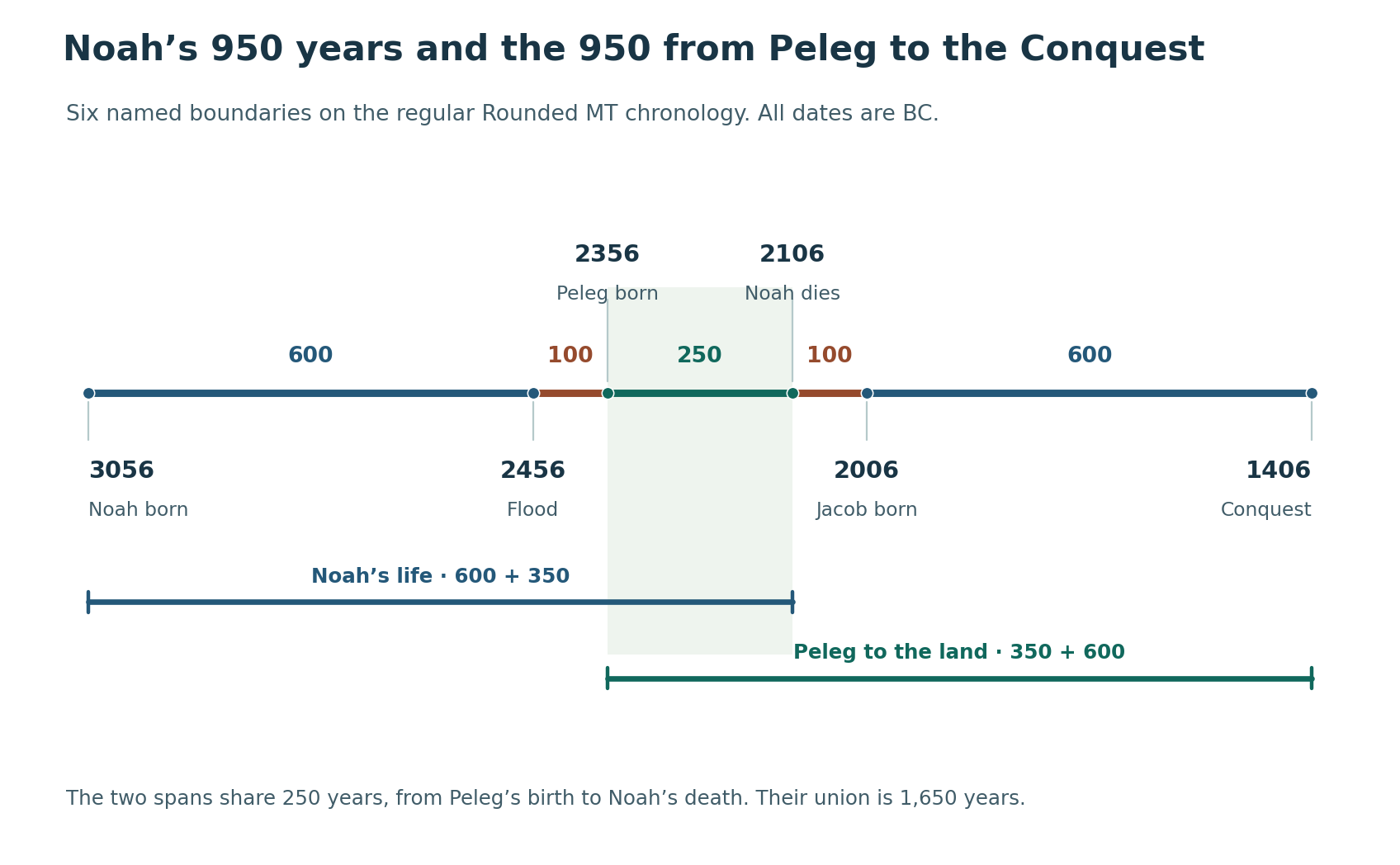
An enclosing 5,000 years places the two figures on one scale. From Luke’s schematic Adam 5256 BC to the calendar boundary 256 BC, regular Noah and the Flood divide the span into 2,200 + 600 + 2,200. Moving all four dates 3,240 years earlier gives Enoch 8496 → 6296 → 5696 → Peleg 3496 BC. On that same move Peleg’s regular birth and Noah’s death, 2356 → 2106, become 5596 → 5346. The first date opens the second 7,000-year side to civil AD 1405. The second ends a 3,150-year diameter from Enoch. His one 9,900 consequently gives both 9,900/3,150 = 22/7 and 9,900/7,000 = 99/70. The 5,000 and its 600 · The diameter and its independently recovered endpoints
Jared and Lamech in the family of the promise
Jared and the two Conquest Mirrors
Jared stands at the center of the 2,380 years between the cumulative and regular Flood dates. Inside that interval his two 700s give the diameter of his circle. His 2,200 to the primary Exodus contains Abraham and Jacob’s 990. The same Exodus bisects 5,800 to Judah’s Conquest Mirror. His separate Actual MT calculation with the Flood fixed reconnects Enoch to Peleg. Jared’s two circles · Jared, Enoch and Peleg
The two Conquest Mirrors have distinct roles. Enoch’s terminal 2,900 runs from Judah’s Exodus 1496 BC to the primary Conquest Mirror, civil AD 1405. Moving both ends 50 years later gives primary Exodus 1446 BC to Judah’s Conquest Mirror, civil AD 1455. Keeping the primary Exodus and substituting the primary Conquest Mirror gives 2,850. On Jared’s line the 4,400 divides into 1,500 + 2,900 at the primary Exodus. Its first part, 2946 → 1446 BC, reaches Peleg’s dated 1,500 by moving both ends 1,450 years later. Enoch and Peleg at the primary Mirror
Jared and Enoch. In 1 Enoch 6:6 the Watchers descend on Hermon in Jared’s days. Jubilees 4:15 likewise names his generation and describes an original commission to teach justice. The traditions give Jared chronological significance as the name of an epoch. In 1 Enoch 12–16 Enoch acts as scribe and intermediary, and 72–82 makes him the recipient of instruction about the heavenly courses. Jubilees 4:17–24 credits him with recording celestial signs, seasons and calendrical divisions and bearing testimony concerning the Watchers. Those traditions explain the chronological importance attached to Enoch. The 7,000, 9,900 and their BC/AD positions come from the project’s tables. 1 Enoch 6 · 1 Enoch, including 12–16 and 72–82 · Jubilees 4 · Sirach 49:14
Lamech names Noah
Lamech first appears as the regular Rounded birth at 3236 BC, the end of Shem’s 2,200. His death closes the seventh 1,650-year span from cumulative Creation, five years before the Flood on the parallel count. His projected birth at 3246 BC marks three quarters of Enoch’s 7,000-year side. Lamech’s death · Lamech on Enoch’s square
Rounded Lamech divides Shem’s 4,900 years to restoration. From cumulative Moses-line Shem at 5436 BC to regular Rounded Lamech at 3236 BC are 2,200 years. From Lamech to 536 BC are 2,700. The second pair of dates is exactly 870 years later at both ends than regular Creation 4106 BC and the Conquest 1406 BC. On this later row the cumulative Aaron boundary at 1936 BC divides the 2,700 into 1,300 + 1,400. Thus the same 4,900 can be read through Lamech as 2,200 + 2,700 or through Jacob/Levi as 3,500 + 1,400. The two divisions and their controls
Lamech, Methuselah and Noah. Genesis 5:28–29 has Lamech name Noah in hope of relief from the ground’s curse. In 1 Enoch 106–107, Lamech is alarmed by the newborn, consults his father Methuselah, and through him receives Enoch’s assurance of Noah’s parentage and his family’s survival of the coming judgment. The Aramaic Genesis Apocryphon, 1Q20 column II, preserves another telling in which Lamech himself questions Batenosh and she insists on his paternity. These ancient readers gave Lamech a speaking role in the preservation promised to Noah. 1 Enoch 106–107 · Genesis Apocryphon, column II, with introduction
The family relationships matter to the geometry. Methuselah’s regular Rounded life is 3421–2456 BC and ends at the Flood. Cumulative Rounded Methuselah occupies 8131–7161 BC, a distinct lifespan of 970. Together with Enoch’s 365 and cumulative Lamech’s 775 it accounts for the 2,110 by which Enoch’s diameter moves onto cumulative Noah and regular Lamech. The three generations in the ancient birth story supply the three terms in the cumulative count. File 51a, regular and cumulative lifespan tables · Lamech’s square
Abraham and Sarah receive the promise
The regular chronology gives Abraham’s birth at 2166 BC, his call at seventy-five in 2091, and the covenant of circumcision at ninety-nine in 2067. Sarah at 2156, Isaac at 2066 and Jacob at 2006 mark the named generations. Cumulative Aaron-line Abraham begins at 2436. The covenant projected with the Exodus held fixed reaches 2076, also the date of cumulative Moses-line Jacob. Paul’s reading of the promised seed in Christ gives this family its place in the larger argument. Genesis 12:1–4 · Genesis 17:17–21 · Galatians 3:16 · File 22
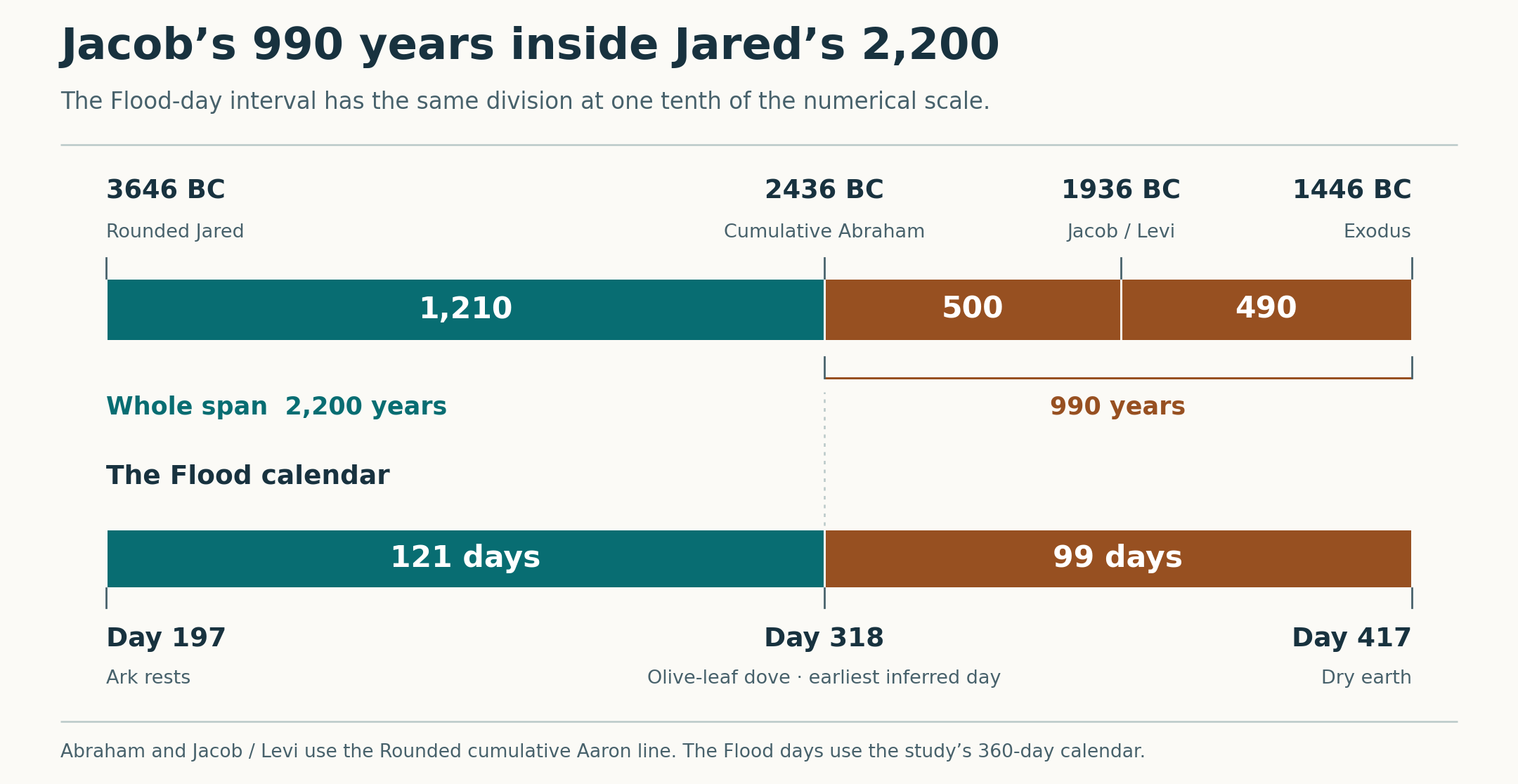
Abraham and Jacob locate a whole diagonal inside Jared’s 2,200. From regular Rounded Jared 3646 BC through cumulative Aaron Abraham 2436 BC, Jacob’s death / Levi’s birth 1936 BC, and the primary Exodus 1446 BC are 1,210 + 500 + 490. The final 990 is the working diagonal on side 700 and a tenth of Enoch’s 5,000 + 4,900. All 990 years lie inside Jared’s dated span and end at his Exodus. The published π study places the Exodus-held projected Flood at 2546 BC, exactly 1,100 from either end. Abraham stands 110 years after that midpoint, which accounts for the division into 1,210 + 990. File 51a §16.3 · Published π study
Within that 990 the family circle has dated boundaries of its own. From cumulative Aaron Abraham at 2436 BC, through regular Sarah 2156 BC and Jacob/Levi 1936 BC, to Exodus 1446 BC are 280 + 220 + 490. The 220 runs through Isaac’s birth, Jacob’s birth and Jacob’s age seventy. The outer spans give four and seven seventies, so the whole family interval measures 11 × 70 + 220 = 10 × 99. Jacob’s age seventy coincides with the cumulative Aaron change from Jacob to Levi. Genesis 17:15–21 · Sarah’s family dates
File 51a gives a second named 500 + 490 on the regular line, Noah 3056 → Shem 2556 → Isaac 2066 BC. Moving all three dates 620 years later gives Abraham, Jacob/Levi and the Exodus. The 700 itself can be measured directly from regular Rounded Noah’s death 2106 BC to the Conquest 1406 BC. The 2,200 serves as a full working circumference on diameter 700 and as a semicircumference on Jared’s 1,400. File 51a §16.3 · Jacob’s 700-year square
Jacob at Bethel and the 700-year square
At Bethel God promises to bring Jacob back to the land. The study dates his journey to Haran to 1929 BC, age 77. Its 483 = 69 × 7 years to Exodus become 490 = 70 × 7 under 70/69. Holding Exodus at 1446 BC gives 1936 BC, when Jacob was 70 on his ordinary biography. Independently, the cumulative Aaron table puts Jacob’s death and Levi’s birth at 1936 BC in both Actual and Rounded MT. These are two ways to reach the same year. Genesis 28:10–15 · Key table §§2 and 3.5 · File 51a §§16.2–16.3
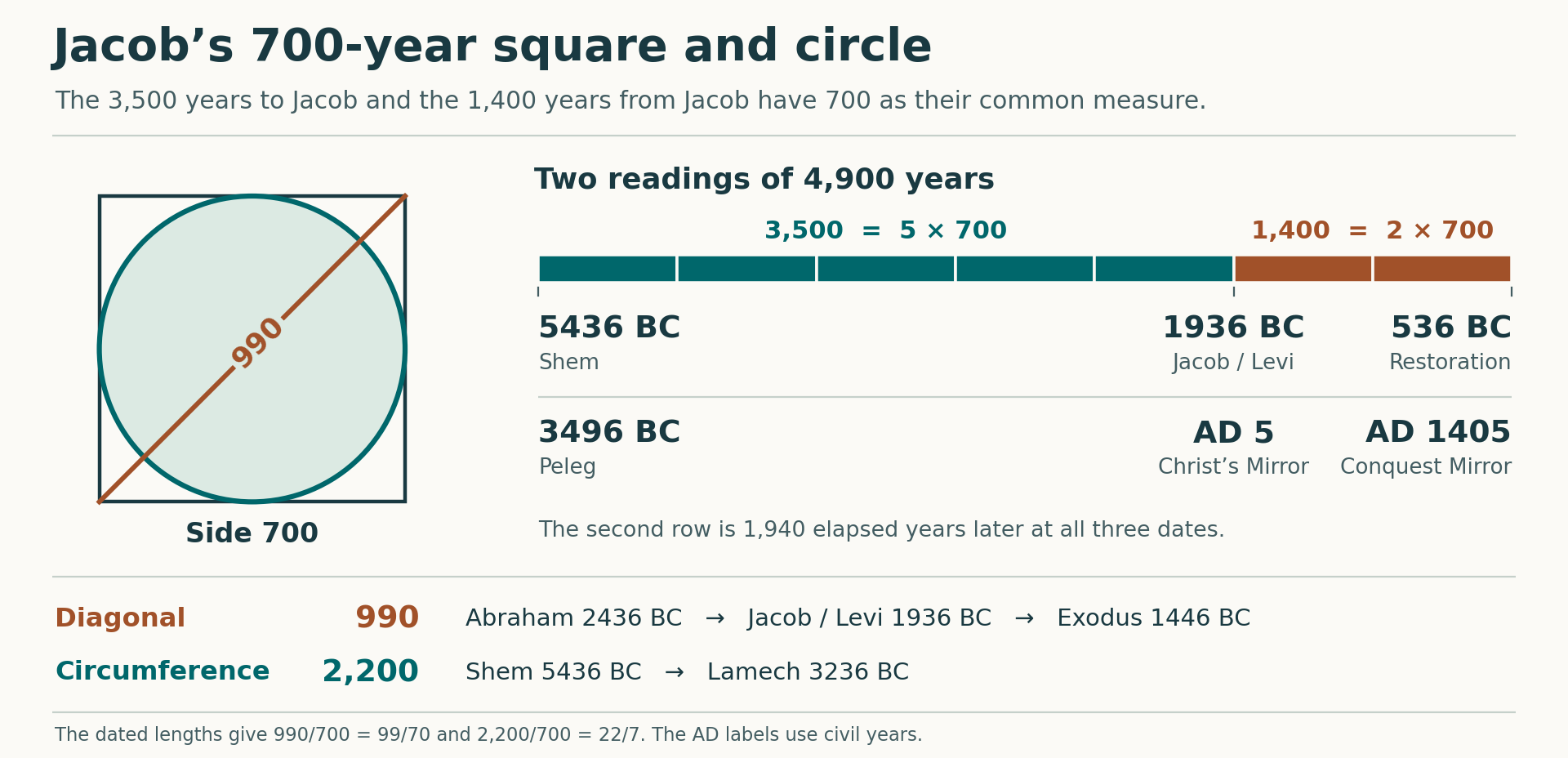
Cumulative Rounded Shem at 5436 BC (Moses line), Jacob/Levi at 1936 BC (Aaron line) and the study’s restoration at 536 BC give 3,500 + 1,400. Their greatest common measure is 700. Two dated intervals supply a circumference and a diagonal for a square of that side. Shem to regular Rounded Lamech at 3236 BC gives 2,200, leaving 1,300 to Jacob/Levi. On the cumulative Aaron line, Abraham 2436 → Jacob/Levi 1936 → Exodus 1446 BC gives 500 + 490 = 990. The ratios are 2,200/700 = 22/7 and 990/700 = 99/70. File 51a already identifies the second interval as one tenth of Enoch and Peleg’s 5,000 + 4,900. File 22 §3.3 · File 51a §16.3
The same half-side divides Peleg’s 4,900 at the Mirror. From Shem through Jacob/Levi to restoration the intervals are 3,500 + 1,400. Move those three boundaries forward 1,940 elapsed years. Shem reaches Peleg at 3496 BC, Jacob/Levi reaches civil AD 5, the Mirror of the 6 BC Christ datum, and restoration reaches civil AD 1405, the primary Conquest Mirror. Thus the stretch that begins with Shem’s 600 years on the BC side reappears as the whole 3,500 from Peleg to Christ’s Mirror. The last 1,400 links that Mirror to the Conquest Mirror. On the BC side Jacob’s birth and age 70 also stand 1,400 years before the two ends of the study’s exile, 2006 → 606 BC and 1936 → 536 BC. File 22 §3.3 · Published Enoch–Peleg division · Scratchpad calculations
Joseph carries the promise from Egypt to the land
Jacob tells Pharaoh he is 130, placing his descent into Egypt at 1876 BC, 130 years after his regular birth. The project’s full Egyptian sojourn runs 1876 → 1446 BC = 430. At the end of Genesis, Joseph makes Israel swear to take his bones with them when God brings them up. Moses carries them out at the Exodus. Joshua 24 records their burial at Shechem, on land associated with Jacob. Hebrews singles out this very act of faith. The narrative holds the Egyptian and Canaanite ends together. Genesis 47:9 · Genesis 50:24–26 · Exodus 13:19 · Joshua 24:29–32 · Hebrews 11:22
Two earlier dates connect the family’s descent to the geometry. Jacob’s regular birth in 2006 BC begins the 600 years to the Conquest. His cumulative Aaron boundary at 1936 BC divides Abraham’s 990 into 500 + 490 and begins the 1,960-year diameter to civil AD 25, the study’s age-thirty reference. Joseph and Joshua then link the family’s two lands through lifespans of equal length. Jacob on the regular MT · Noah and Jacob at AD 25
| Regular Rounded life | Birth | Death | Years |
|---|---|---|---|
| Joseph | 1916 BC | 1806 BC | 110 |
| Joshua | 1476 BC | 1366 BC | 110 |
Both dates in Joshua’s life are 440 years later than their counterparts in Joseph’s. Joseph’s death at 1806 BC also bisects Abraham 2166 → Exodus 1446 into 360 + 360. The Conquest to Solomon’s foundation, 1406 → 966, has the same length of 440 as the displacement between the two lives. The first comparison moves two dated endpoints together. The second compares a length. File 51a §§7.5–7.6 · 1 Kings 6:1
Joshua at the close of the cumulative chronology
Joshua’s two dates explain his place on Peleg’s row. His regular death falls in 1366 BC. File 22 §9A.3 reaches 1296 BC by counting Joshua’s whole 110 years from Moses’ death at the Conquest in 1406 BC. Thus 1476 → 1406 → 1366 → 1296 BC gives 70 + 40 + 70. Noah’s Creation–Conquest pattern, 1,050 + 600 + 1,050, is fifteen times as large. The same Conquest closes Noah’s span and opens Joshua’s cumulative 110. Move regular Rounded Lamech in 3236 BC forward by the same 1,940 years as Shem and the result is Joshua’s cumulative close at 1296 BC. Peleg 3496 BC → Joshua 1296 BC → civil AD 5 → civil AD 1405 preserves the 2,200 + 1,300 + 1,400 measured from Shem through Lamech and Jacob/Levi to restoration. Joshua 24:29 · File 22 §9A.3 · Published √2 study §8
Joshua gives Noah’s circumference two dated ends. Where the 2,200 years from Peleg end, another 3,300 run from 1296 BC to civil AD 2005, the Mirror of regular Jacob’s birth in 2006 BC. The corresponding diameter runs from Noah to Jacob, 3056 → 2006 BC = 1,050. Dean’s observation gives the 3,300 years of Noah’s two overlapping spans a single continuous crossing. File 22 §9A.3 · Joshua 24:29
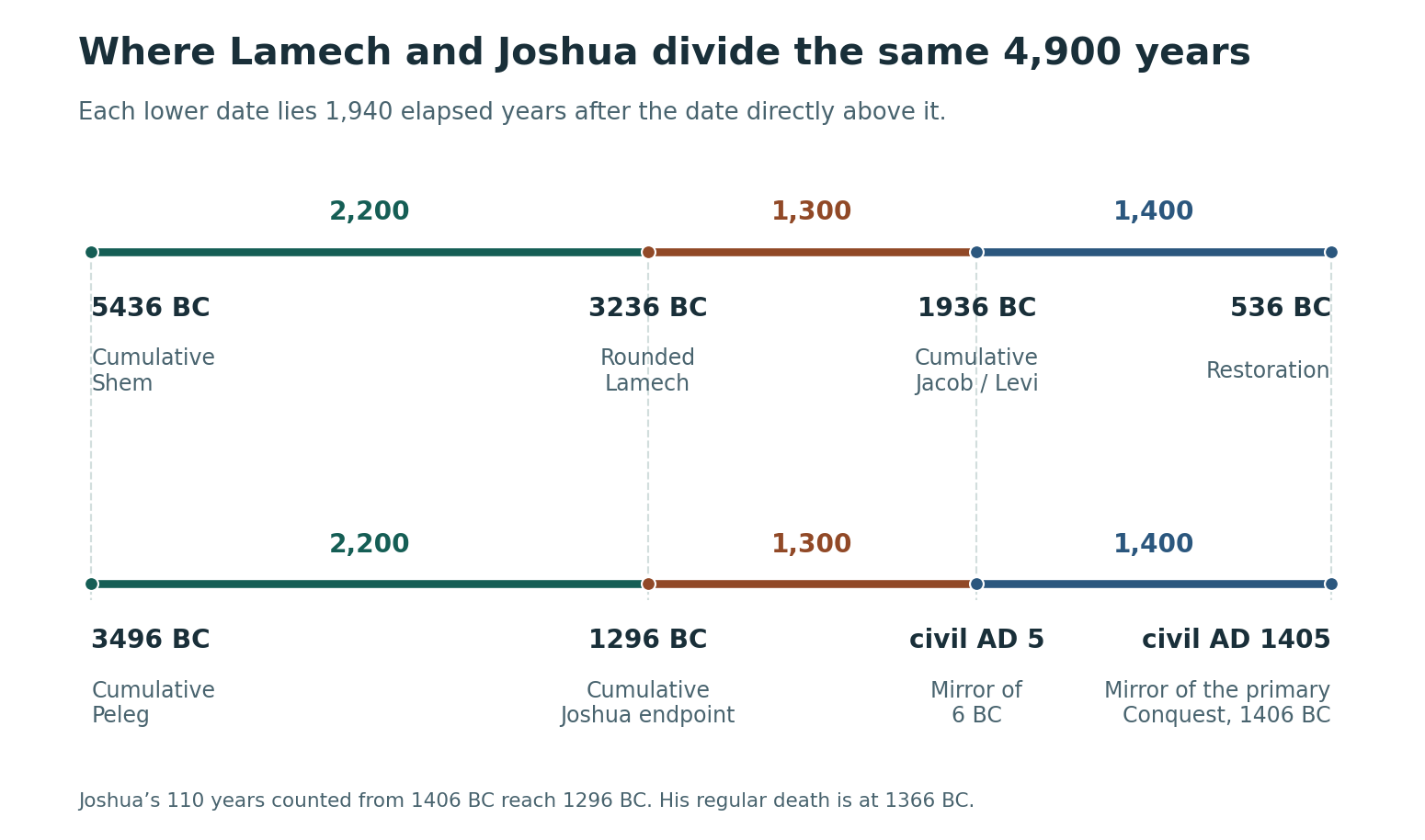
The civil labels 1296 BC → AD 2005 give 3,300 elapsed years. Moving both ends one year later gives 1295 BC → civil AD 2006. Under the symmetric Rounded convention, the original pair reads 1296 BC → Rounded AD 2006. Both conventions preserve the length. Mirror methods · Dean’s Joshua–Jacob crossing
Moses’ life in the project reads 1526 → 1486 → 1446 → 1406 BC, in three forties. Joshua crosses the Jordan at the last of those boundaries. The project locates his birth thirty years before the Exodus. Moving both ends of 1476 → 1446 BC forward by 1,470 elapsed years gives 6 BC → civil AD 25, from the Nativity reference to the opening of Christ’s ministry. In the larger reading Peleg 3496 → Judah Exodus 1496 → civil AD 5 moves forward twenty years at all three places to calendar head 3476 → Joshua 1476 → civil AD 25. Both rows give 2,000 + 1,500. Extending that twenty to the primary Conquest Mirror would yield AD 1425, with no registered Conquest there. Fifty-step record, questions 43–46 · Deuteronomy 34:7 · Acts 7:23–36
Solomon’s Temple and the return from exile
First Kings measures the beginning of Solomon’s Temple from the Exodus, in the 480th year and the fourth year of Solomon’s reign. In the project’s ordinary whole-year display the foundation is 966 BC. On the 1,400 years from Jacob/Levi to restoration, four successive dates now read 1936 → 1446 → 966 → 536 BC = 490 + 480 + 430. The Temple falls inside Shem’s final 1,400 and gives that interval a named sanctuary. 1 Kings 6:1, 37–38 · Ezra 3:8–13 · File 19, the two foundations
Solomon’s foundation connects Jacob and Christ in two ways. From cumulative Aaron-line Jacob/Levi at 1936 BC to the foundation at 966 BC are 970 years. Another 970 reach civil AD 5, the Nativity Mirror. Those outside dates are the corresponding Jacob/Levi and Christ boundaries on the established 1,940-year translation from Shem’s row to Peleg’s. From the same Temple to the draft’s ministry year, civil AD 25, are 990. This second measurement preserves the interior of the Abraham diagonal as well as its two ends.
| Place in the 990 | Abraham and Jacob | The same date moved forward 1,470 elapsed years |
|---|---|---|
| Start | 2436 BC · cumulative Aaron-line Abraham | 966 BC · Solomon lays the foundation |
| 280 | 2156 BC · regular Sarah | 686 BC · end of Hezekiah’s extended life |
| 360 | 2076 BC · projected covenant / cumulative Moses-line Jacob | 606 BC · opening of the project’s exile span |
| 430 | 2006 BC · regular Jacob born | 536 BC · restoration / refoundation |
| 500 | 1936 BC · regular Jacob age 70 / cumulative Aaron Jacob–Levi | 466 BC · File 68 close of the 536–466 schematic generation |
| 990 | 1446 BC · primary Exodus | Civil AD 25 · ministry reference |
The 500 + 490 can be followed through three complete rows. Regular Noah, Shem and Isaac at 3056 → 2556 → 2066 move together 620 years onto Abraham, Jacob/Levi and the Exodus at 2436 → 1936 → 1446. All three then move 1,470 onto 966 → 466 → AD 25. That 1,470 was already the draft’s Exodus-to-ministry interval. The Temple year and the intervening 466 each had a source before this comparison. The translated dates represent several different Israelite events. Their correspondence is between whole-year positions.
Both geometrical measures survive here. Sarah → Jacob → Jacob at seventy gives 150 + 70, and the later row reads 686 → 536 → 466 = 150 + 70. The working circumference and diameter are 220/70 = 22/7. File 68 also gives 676 BC as the close of a schematic generation (746–676) and File 58 independently tabulates that year 70 before 606. From 676 BC to AD 25 are 700 years. The 990 from the Temple and this 700 have the same civil AD 25 endpoint, giving 990/700 = 99/70, the upper working approximation to √2. Calling 676 a calendar boundary keeps its evidence distinct from the Temple foundation and Hezekiah’s life. The square and the circle are now visible on one Temple-to-ministry reading. Working draft, Jacob at AD 25 · File 51a §16.3 · File 68, Appendix D, especially the Week 6 and Week 7 generation rows · File 58, Tishri ledger
The return date belongs to the project’s restoration and refoundation reading. Ezra distinguishes Cyrus’s authorization, the return, the altar, and the laying of the foundation under Zerubbabel and Jeshua. Jeremiah’s seventy years give the theological setting for 606 → 536. The fall of Jerusalem and the burning of the First Temple stand at 586 BC, dividing the seventy as 20 + 50. The sequence also gives Hezekiah a place. The years 701 → 686 mark the fifteen years of life added in the project’s reading of 2 Kings 20 and Isaiah 38. His death at 686 begins the translated 220-year circle. Jeremiah 25:11–12 · 2 Kings 20:1–11 · 2 Kings 25 · Ezra 1–3 · File 19
The exodus under Joseph’s descendants and the return from Babylon furnish a useful comparison of two 430s. From descent to Joseph’s Rounded death to Exodus, 1876 → 1806 → 1446 = 70 + 360. From Temple to the opening of servitude to restoration, 966 → 606 → 536 = 360 + 70. Both outside dates move forward 910 years. The inside cuts reverse order. The Actual Joseph death at 1805 gives 71 + 359 in the first row. File 51a §§7.5–7.6 · File 68 §9H.3
Isaac and Joshua measure the same semicircle
Abraham is a hundred when Isaac is born. Genesis locates Isaac’s binding in the land of Moriah, and Chronicles names Mount Moriah as the site of Solomon’s Temple. At the Jordan, Joshua calls for twelve stones, one for each tribe. The dates in this comparison are regular MT year labels shared by the Actual and Rounded patriarchal rows. The Temple comparison uses 966 BC, the project’s whole-year count to the foundation in Ziv. The Tishri assembly belongs to the later dedication. Genesis 21:5 and 22:2 · Joshua 4:1–8 · 2 Chronicles 3:1–2 · File 51a §§2.6A, 7.6
| Regular MT comparison | First interval | Remaining interval | Whole |
|---|---|---|---|
| Isaac born 2066 → Joshua dies 1366 → Temple founded 966 BC | 700 | 400 | 1,100 |
| Joshua born 1476 → enters the land 1406 → dies 1366 BC | 70 | 40 | 110 |
The 700 and the 110 close at the same event. Both rows give an arc-to-diameter ratio of 11/7, and both parts of Joshua’s life are repeated tenfold. File 08 already records the 400 years from Joshua’s death to the Temple. The published √2 study gives the 110/70 and its fifteenfold counterpart at Noah, 1,650/1,050. Dean’s observation adds the tenfold reading through Isaac. Joshua 24:29 supplies his age of 110. His age at entry and the BC years of his birth and death follow the project’s regular reconstruction in File 63 §3.6. File 08, Joshua and the Temple · File 63 §3.6 · Published Joshua comparison
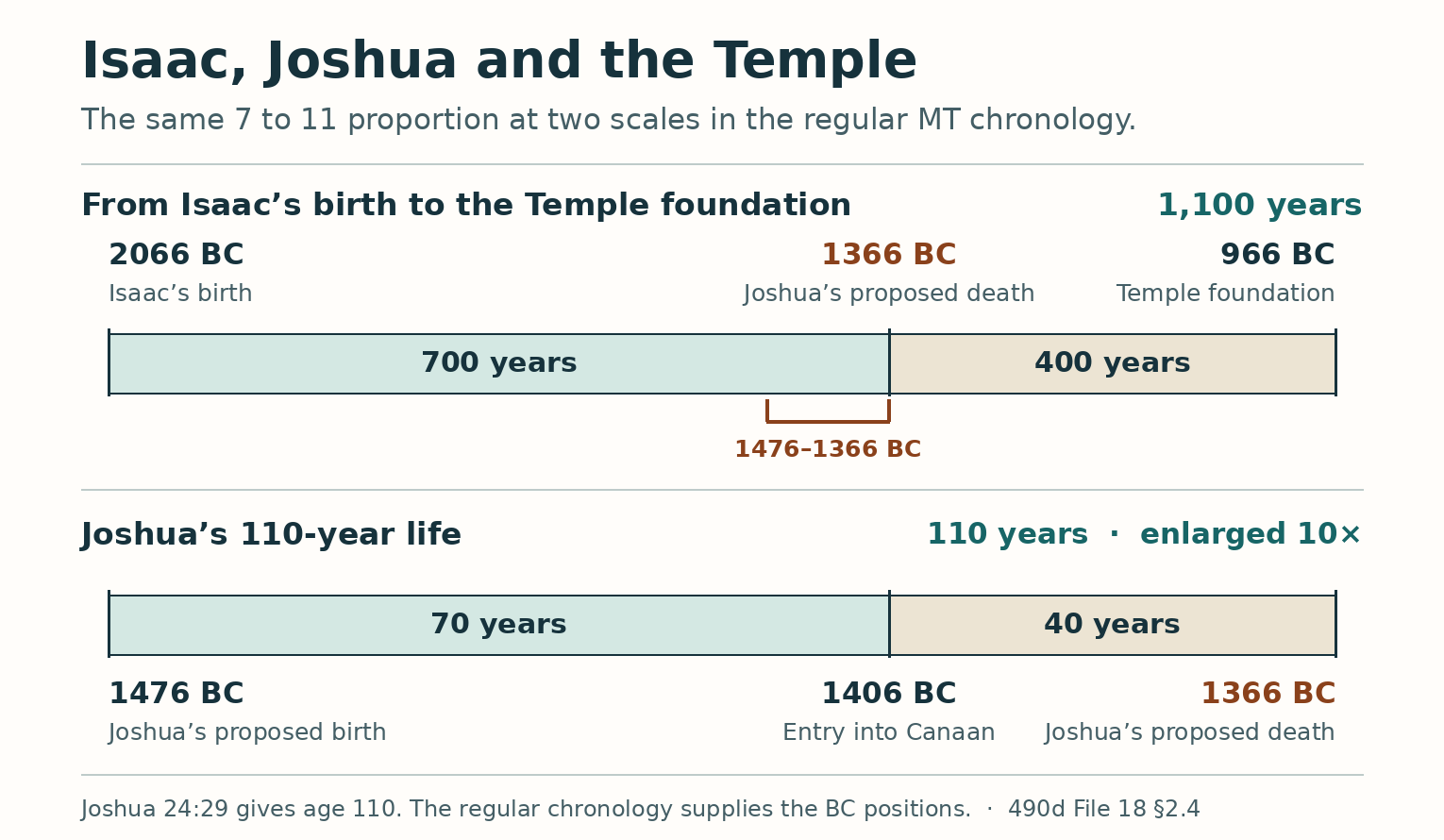
Count back from 966 BC in centuries. Eleven reach Isaac (2066 BC), and twelve reach Abraham (2166 BC). Count back instead in forties. Eleven reach the Conquest (1406 BC), and twelve reach the Exodus (1446 BC). The twelfth unit in each reckoning has a narrative counterpart in Abraham’s age at Isaac’s birth and Israel’s wilderness generation. Reading the paired twelves in light of the twelve tribes is the proposed interpretation. Regular chronology tables · Isaac and Joshua at the two scales
The Temple and exile on both Conquest Mirrors
The two Conquest Mirrors give a check with four boundaries. On Enoch’s reading Judah’s schematic Exodus reaches the Mirror of the primary Conquest, 1406 BC / civil AD 1405. On Jared’s reading the primary Exodus reaches the Mirror of Judah’s schematic Conquest, 1456 BC / civil AD 1455. The Temple and the destruction or restoration move with the outer dates. File 68 §9H.4 supplies the two BC itineraries. File 68 §9H.4 · File 08, Kings reckoning
| Boundary | Enoch’s route | Jared’s route | Years from last boundary |
|---|---|---|---|
| Exodus | 1496 BC · Judah | 1446 BC · primary | — |
| Temple foundation | 1016 BC · schematic | 966 BC · ordinary | 480 |
| Jerusalem | 586 BC · destruction | 536 BC · restoration | 430 |
| Conquest Mirror | Civil AD 1405 · primary | Civil AD 1455 · Judah | 1,990 |
The four boundary dates in each route enclose 2,900 years. Every boundary in Jared’s column is fifty elapsed years later. Pairing the primary Exodus with the primary Conquest Mirror gives 2,850. Pairing Judah’s Exodus with Judah’s Conquest Mirror gives 2,950. These two failed substitutions explain why each successful reading needs its particular Mirror. Mirror comparison, questions 26–30
Jacob and Noah at the ministry of Christ
Peleg also begins the circle that closes at civil AD 25. From Peleg to that date are 3,520 years. The diameter, 1,120, is the dated interval from Noah to Jacob/Levi. The difference between Jared’s two semicircumferences gives the same 3,520 from the primary Exodus to the covenant Mirror. Their overlap runs from the Exodus to Christ’s age-thirty datum. Abraham’s 990-year diagonal and Sarah’s 220-year circle both lie inside Jared’s shorter semicircumference. Abraham and Sarah · Peleg, Jared and Jacob at AD 25 · Illustrated reading and twenty-five checks
Daniel’s seventy sevens give Dean a narrative parallel for the 483 → 490 at Bethel. Luke names Jacob and Noah in the genealogy following his account of Jesus beginning his ministry at about thirty. On the study’s early Nativity reference, 6 BC to civil AD 25 is exactly 30 elapsed years. The precision belongs to the chosen dates. Daniel 9:24–27 · Luke 3:23–36
From 1936 BC, the Exodus at 1446 BC is the first of four 490-year spans ending at civil AD 25. File 68 already gives the intervening 956 and 466 BC as schematic closes of the sanctuary and restoration periods. To that same AD endpoint, regular Rounded Noah at 3056 BC gives 3,080 years and Jacob/Levi at 1936 BC gives 1,960. Thus 3,080/1,960 = 11/7, the working semicircumference divided by its diameter. That first 490 ends at the same primary Exodus as Jared’s 2,200 and Abraham’s 990. The calculation also runs backward. Noah and Jacob/Levi are 1,120 years apart. Since that difference represents four units (11 − 7), one unit is 280. Seven units after 1936 BC recover AD 25 without using the Nativity date. File 68, Appendix D.2–D.4 · Rounded Noah
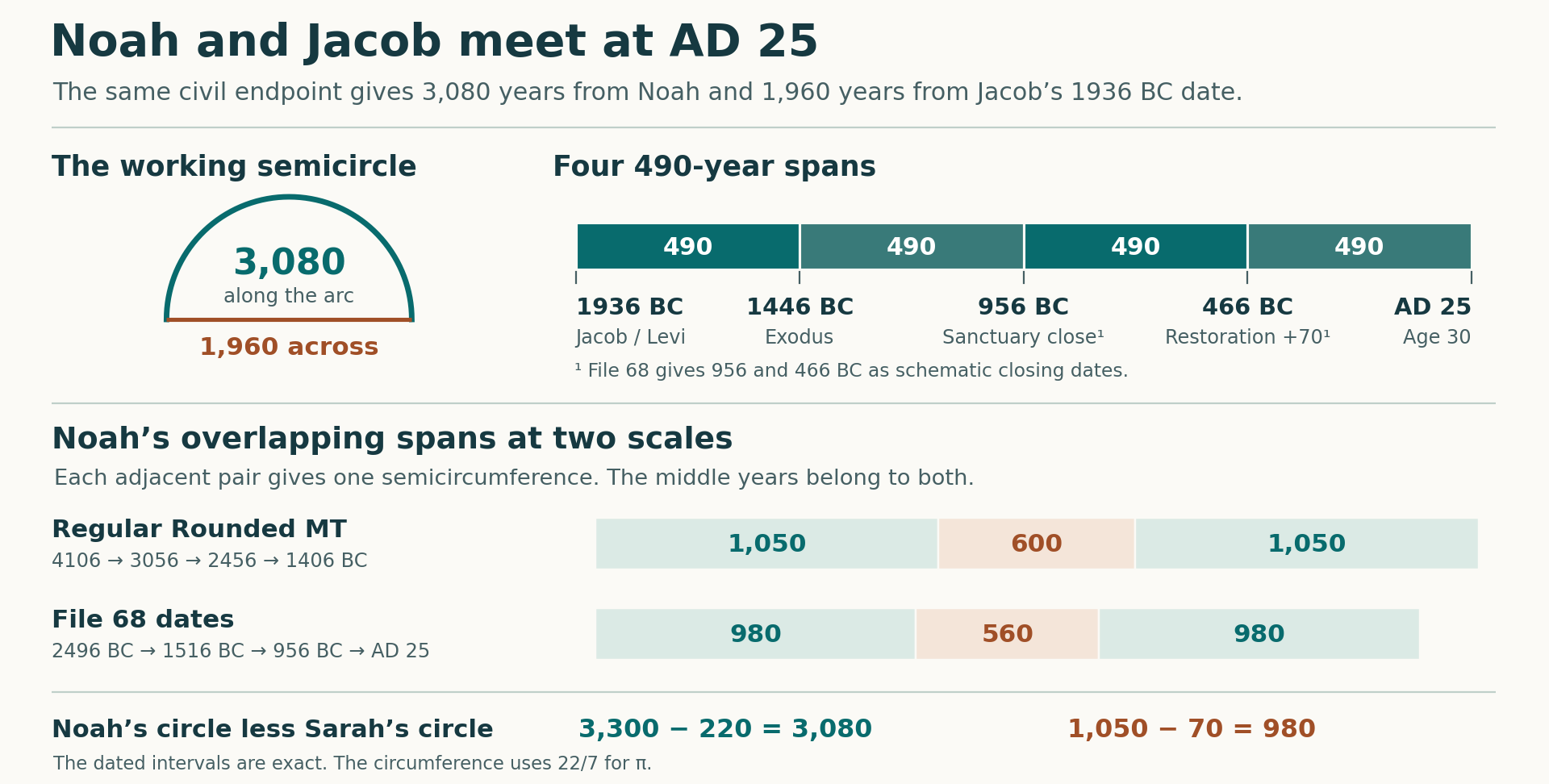
At the primary Exodus one dated interval belongs to all three lines: 1936 → 1446 BC = 490 is the last 490 of Abraham’s diagonal inside Jared’s semicircle and the first 490 on Jacob’s approach to AD 25. At the Jordan, 1406 BC closes the overlapping spans that give Noah’s 3,300, begins Joshua’s cumulative 110 and begins the 1,400 to the Nativity. Its civil Mirror closes Enoch’s 9,900. These roles warrant giving the Conquest at least the weight of the Exodus. Together the two dates carry the story of release from bondage and entrance into the promised land. The complete circle from Peleg · The three 1,400s
Luke places the genealogy after the baptism of Jesus. Matthew recalls Israel’s call out of Egypt in the life of Christ. Hebrews takes up the question of rest beyond Joshua’s entry. In Dean’s reading these texts give the circle and square their Christological direction. 6 BC is the study’s Nativity head, civil AD 5 its reflected coordinate and civil AD 25 its age-thirty ministry reference. The cross and resurrection give the story its theological consummation. File 13 prefers a Nisan Passion in civil AD 33 and also allows AD 30. This dated Temple-to-ministry construction ends at the ministry reference. The Gospel century comparison uses a separate schematic measure for Christ’s allotted generation. Matthew 2:15 · Luke 3:1–3, 21–38 · Hebrews 4:8–11 · File 13
What the map establishes
The circle and square share a 7,000-year measure from cumulative Rounded MT Creation to Luke’s schematic Jared. Read that length as a square side and it accompanies the 9,900 years between the two MT Creations. Read it as a semicircle diameter and it accompanies the 11,000 years to the Arphaxad/Flood marker. The working ratios are 99/70 for √2 and 11/7 for half of π. Their common starting point and shared 7,000-year measure are what bind the two figures together. Master map
The other studies return to positions already fixed on that map. Shelah’s midpoint and opening receive the 137th and 138th Jubilees from regular Creation across the Mirror. Matthew’s midpoint divides a span into 55 and 89 centuries and also puts 5,500 years between it and Luke’s Adam. Read those 5,500 against the 14,950 years to reflected Adam’s midpoint, and the fraction is 110/299, close to 1/e. Read them against the 1,750 years from Isaac’s schematic opening to the midpoint of Adam’s span to Christ, and the fraction is 22/7. These equalities hold under the stated counts. Dean reads their recurrence as evidence of purpose, and the 137 Jubilees in particular as the Creator’s signature. Alpha · Fibonacci divisions · Luke and Isaac
Questions that remain
Does an early witness explicitly count a hundred-year generation from an opening to a closing boundary in either Gospel’s genealogy? Genesis 15 motivates the century, and Jubilees independently pairs the twenty-two works and heads. The explicit use of those boundaries in a Gospel genealogy remains open. Noah and Shem’s 1,100 years and the Temple calendar remain available as separate tests.
The second question concerns the six boundaries from Abraham and Jacob to the Temple and Christ in the 1,470-year comparison. Its calendar precision remains open. The 966/536 whole-year foundation display preserves both the 970 + 970 midpoint and the 990 to AD 25. File 19 also gives a second-month foundation pair at 967/537. Luke dates John’s appearance to Tiberius’s fifteenth year and gives Jesus’ age approximately. The calendar test is whether one consistently specified Temple and Gospel calendar setting preserves the midpoint and the translated family geometry together. The smaller open questions are retained in Appendix E. Calendar precision · Luke 3
Appendix A. The dates inside Enoch’s square and Noah’s circles
From cumulative Creation to cumulative Enoch
The six Rounded lifespans from Adam through Jared total 930 + 910 + 905 + 910 + 895 + 960 = 5,510. This places cumulative Enoch at 8496 BC. The same 5,510 years carry regular Creation at 4106 BC to the Conquest Mirror and Noah’s birth at 3056 BC to the Flood Mirror. Applying this single shift to the original sequence explains why its inner four events appear in reverse order.
| Years from start | From cumulative Adam | From cumulative Enoch |
|---|---|---|
| 0 | 14006 BC · cumulative Creation | 8496 BC · cumulative Enoch |
| 7,000 | 7006 BC · midpoint to Christ datum | 1496 BC · Judah-route Exodus |
| 9,900 | 4106 BC · regular Creation | AD 1405 · Conquest Mirror |
| 10,950 | 3056 BC · Noah born | AD 2455 · Flood Mirror |
| 11,550 | 2456 BC · Flood | AD 3055 · Mirror of Noah’s birth |
| 12,600 | 1406 BC · Conquest | AD 4105 · regular Creation Mirror |
Enoch’s own life marks two halves. File 51b §8.1 already places regular Rounded Enoch at 3546 BC on the +60 Terah branch, exactly 4,950 years from cumulative Enoch and 4,950 from the Conquest Mirror. After 365 years God takes him. His +60 taking at 3181 BC to the civil Mirror of the base taking at 3121 BC spans 6,300 years. File 51b §8.5 records that measure. The 4,950 years equal three of Noah’s 1,650-year semicircumferences, and 6,300 equals six of his 1,050-year diameters. Enoch’s half-diagonal therefore also measures a working quarter-circumference, with 4 × 4,950 / 6,300 = 22/7. At full scale the corresponding quarter is 9,900 and the diameter 12,600. Genesis 5:23–24 · File 51b, §§8.1–8.5
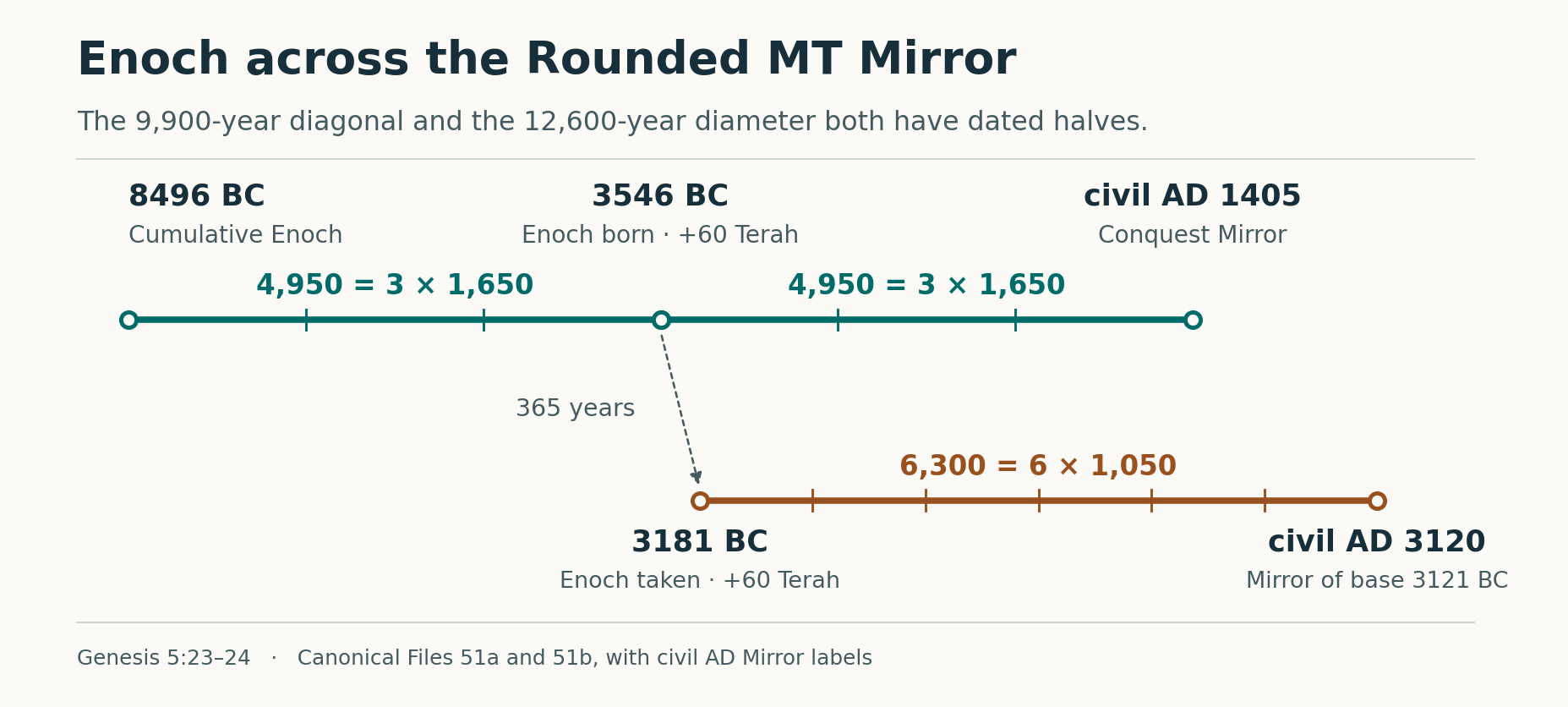
The overlapping intervals on Peleg’s row
Moving Shem’s 4,900 years forward 1,940 puts Lamech’s division at Joshua’s cumulative endpoint, 1296 BC, and Jacob/Levi’s at civil AD 5, the Mirror of the Nativity reference. At Joshua this incoming 2,200 gives way to the 3,300 from 1296 BC to civil AD 2005, the Mirror of regular Jacob’s birth. The dated diameter from Noah to Jacob is 1,050. Lamech and Joshua
From Judah’s Exodus to Christ’s Mirror, two readings share the same 1,500 years. Follow Peleg 3496 BC → Judah’s Exodus 1496 BC → Christ’s Mirror civil AD 5 → primary Conquest Mirror civil AD 1405. The successive intervals are 2,000 + 1,500 + 1,400. The first two give the 3,500 from Peleg to Christ’s Mirror, corresponding to Shem through Jacob/Levi. The last two give 2,900, the part of Enoch’s diagonal beyond the 7,000-year side. Judah’s Exodus begins their common interval, and Christ’s Mirror closes it. Dated divisions at Peleg
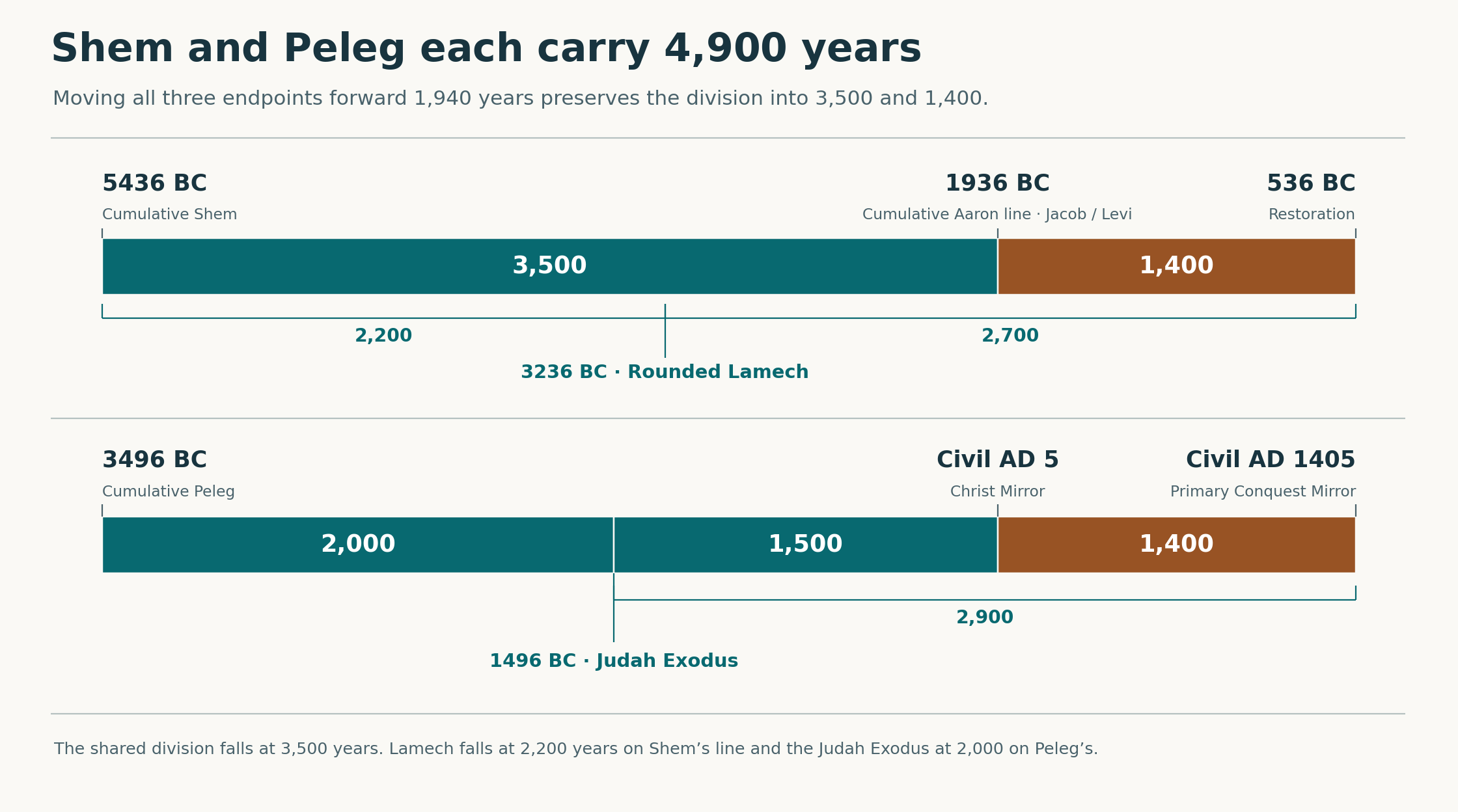
Judah’s Conquest supplies the 50-year overlap. The same royal reckoning places the Conquest at 1456 BC, whose civil Mirror is AD 1455. Cumulative Enoch to Peleg measures 5,000 years. Regular +60 Enoch at 3546 BC to this Conquest Mirror also measures 5,000. The two spans share the 50 years between 3546 and 3496 BC. Their union is 4,950 + 50 + 4,950 = 9,950. This repeats the overlapping form of Noah’s spans at a different scale. The 9,900 diagonal still ends at the primary Conquest Mirror. File 36, §9 · Recorded overlap test
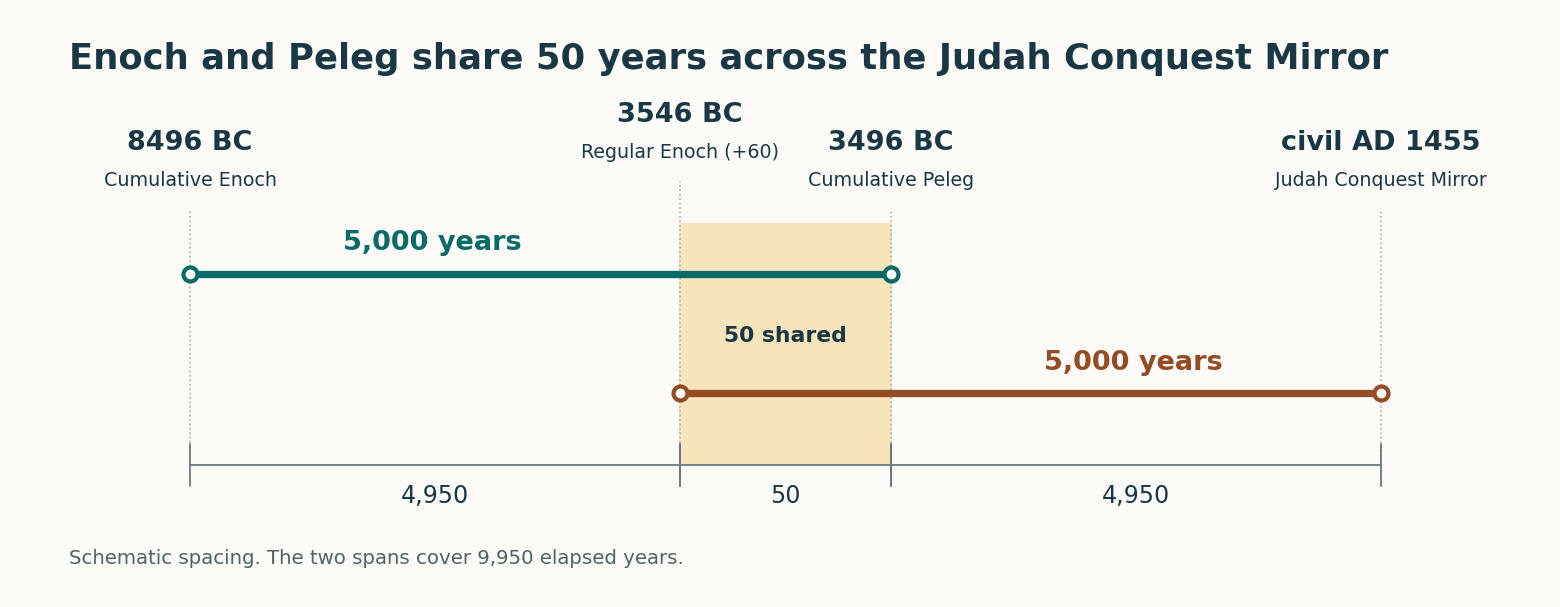
Noah’s six hundred inside Enoch’s five thousand
Genesis gives the middle interval directly. Noah was 600 when the Flood came. File 54 counts back from the study’s 6 BC Nativity reference to the Lukan schematic Adam at 5256 BC. File 68 counts forward from restoration at 536 BC to the opening of Week 7, Day 5, at 256 BC on its original seventy-year schedule. These ends enclose 5256 → Noah 3056 → Flood 2456 → 256 BC, a division of 2,200 + 600 + 2,200. Genesis 7:6 · File 54 §1.1 · File 68 Appendix C.10
Move all four dates 3,240 years earlier. The ends land on cumulative Enoch 8496 BC and Peleg 3496 BC. The inner two, 6296 and 5696 BC, locate the image of Noah’s birth and Flood between them. The displacement is the already measured span from Exodus-held projected Lamech 3246 BC to 6 BC. This gives both proposed divisions of the 5,000 a place in the same reading. The two dates are derived boundaries. Lamech on the square · Four dates translated together
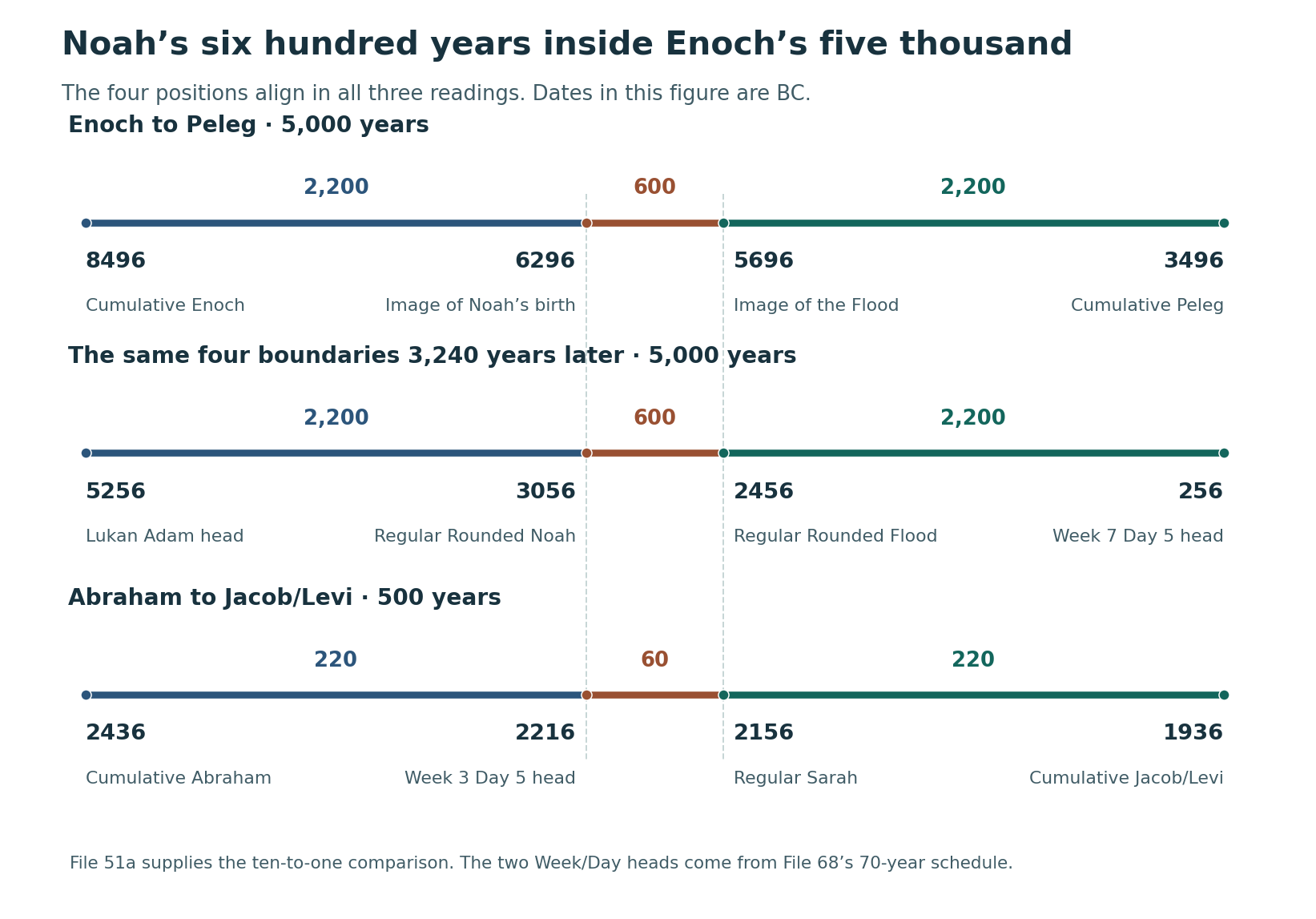
Sarah supplies a second way to find the Flood position. File 51a §16.3 pairs Abraham–Jacob/Levi–Exodus with Enoch–Peleg–Conquest Mirror at ten times the scale. Regular Sarah at 2156 BC divides the smaller 500 as 280 + 220. This gives 2,800 + 2,200 on the larger line and fixes 5696 BC without the Lamech calculation. File 68’s 2216 BC opening of Week 3, Day 5, reaches 6296 BC in the same way. The other end of the diagonal also has a smaller counterpart. Joshua at 1296 BC corresponds to 1716 BC, the midpoint of Lamech’s reflected circumference. File 51a §16.3 · Sarah’s family dates · File 68 Appendix C.6
| Enoch’s 9,900 | Abraham’s 990 | Years to next boundary |
|---|---|---|
| 8496 BC · cumulative Enoch | 2436 BC · cumulative Abraham | 2,200 / 220 |
| 6296 BC · image of Noah’s birth | 2216 BC · schematic boundary | 600 / 60 |
| 5696 BC · image of the Flood | 2156 BC · regular Sarah | 2,200 / 220 |
| 3496 BC · cumulative Peleg | 1936 BC · cumulative Jacob/Levi | 2,200 / 220 |
| 1296 BC · cumulative Joshua endpoint | 1716 BC · midpoint of Lamech’s reflected circle | 2,700 / 270 |
| civil AD 1405 · primary Conquest Mirror | 1446 BC · primary Exodus | — |
The first, third and fourth portions of the diagonal each measure 2,200, the working circumference on 700. The other two portions, 600 and 2,700, add by length to Noah’s 3,300. The full diagonal equals three of Noah’s circumferences and measures 9,900/7,000 = 99/70 on Enoch’s square. The first 5,000 ends at Peleg. The side continues 2,000 to Judah’s Exodus at 1496 BC. Its final 2,050 from regular +60 Enoch 3546 BC to that Exodus becomes Peleg 3496 → primary Exodus 1446 BC when both dates move 50 years later. The two Conquest Mirrors consequently close their respective 2,900s at civil AD 1405 and 1455. File 51b §8 · File 22 §3.5.3
Noah’s death gives the diameter from Enoch
Noah’s whole life ties the two measures together. The 950 years of Noah’s life reappear from regular Peleg to the Conquest. Those two spans share 250 years, from Peleg’s birth to Noah’s death. Both ends of this interval can also be recovered from cumulative Creation and followed through Enoch’s row, where they locate the second 7,000-year side and the 3,150-year diameter. Dean’s crossing from Joshua to Jacob’s Mirror supplies the final one of the three 3,300s. Noah and Peleg · The diameter from Enoch · Three complete circles
Carry two more regular dates through the established 3,240-year shift from the Lukan Adam 5256 BC to cumulative Enoch 8496 BC. Regular Peleg 2356 BC reaches 5596 BC. Noah’s death 2106 BC reaches 5346 BC. The first image stands 2,900 after Enoch and begins a second 7,000-year side to the primary Conquest Mirror. The second gives a diameter that starts at Enoch. Its 3,150 years are the 2,200 to Noah’s birth plus all 950 of his life on the corresponding Lukan row. File 54 §1.1 · The two full-life measurements
| From cumulative Enoch at 8496 BC | Endpoint | Years |
|---|---|---|
| Circle diameter | 5346 BC · translated death of Noah | 3,150 |
| Square side | 1496 BC · Judah-route Exodus | 7,000 |
| Circumference and diagonal | Civil AD 1405 · primary Conquest Mirror | 9,900 |
The same crossing supplies 9,900/3,150 = 22/7 and 9,900/7,000 = 99/70. The diameter has a counterpart on Lamech’s circle. Move it forward by the 2,110 years of cumulative Rounded Enoch, Methuselah and Lamech, 365 + 970 + 775. Both its ends move to cumulative Noah 6386 → regular Lamech 3236 BC. Lamech’s 9,900 begins at this very endpoint. File 51a §16.2 · Lamech’s circumference
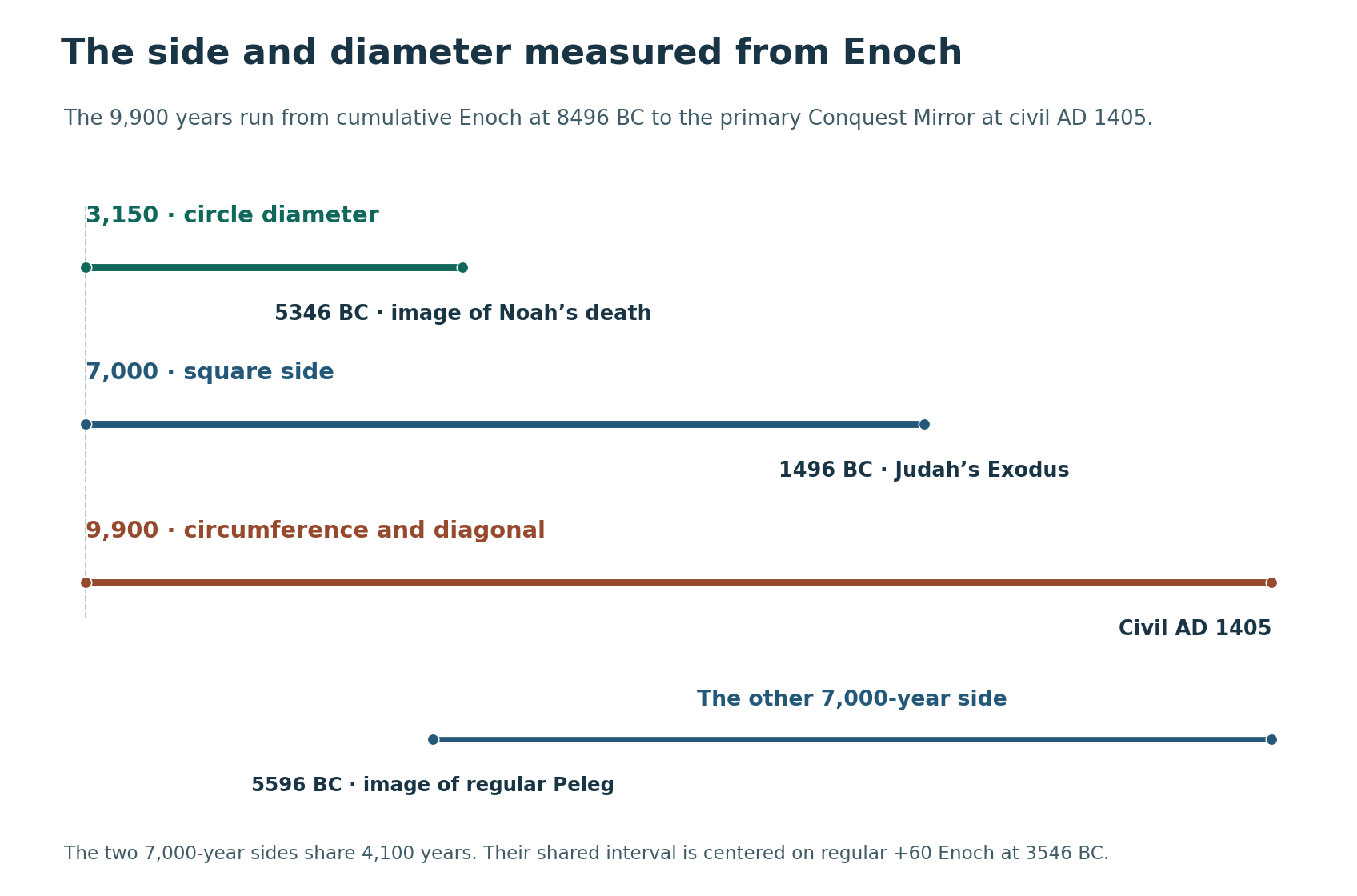
The second side overlaps the first from 5596 through regular +60 Enoch 3546 to Judah’s Exodus 1496 BC, exactly 2,050 + 2,050. At one tenth the scale Abraham’s two 700s share 2146 → 1736 BC = 410. File 68 supplies the 2146 BC boundary on its original seventy-year calendar. The regular Abraham 2166 → entry 1876 BC moves 430 years forward to 1736 → Exodus 1446 BC. Move the 410 itself 1,500 years earlier and it becomes Jared 3646 → Lamech 3236 BC, the dated interval actually shared by Shem’s and Jared’s two 2,200s. File 22 §3.5.3 · File 68 Appendix C.6 · The overlap and both endpoints
The Creation chronology recovers the same two places. File 51b §9.6 independently derives 11106 BC from its Incarnation projections and explicitly measures 7,000 years from there to regular Creation at 4106 BC. The published π study places 7706 BC halfway from cumulative Creation 14006 to the Conquest 1406 BC. Bisect the first half and the quarter falls at 10856 BC. The 250 years between these independently constructed dates are the same 250 years that Peleg and Noah share in the regular chronology.
| Where the interval is read | First boundary | Second boundary | Years |
|---|---|---|---|
| From cumulative Creation | 11106 BC · opening of the 7,000 to regular Creation | 10856 BC · quarter of Creation to Conquest | 250 |
| Both dates 5,510 years later, on Enoch’s row | 5596 BC · opening of the 7,000 to the Conquest Mirror | 5346 BC · end of the diameter from Enoch | 250 |
| Both dates a further 3,240 years later | 2356 BC · regular Peleg born | 2106 BC · regular Noah dies | 250 |
At the Creation end, the 3,150-year diameter is one quarter of the 12,600 to the Conquest. The 7,000-year side is half the 14,000 to the 6 BC Nativity reference. The 9,900 ends at regular Creation. These named outer dates reproduce both working ratios before using either patriarch’s interior position. File 51b §9.6 · Published π study, the 7706 BC midpoint · Three dated placements
Three complete Noah circles
At the ten-to-one scale it takes 330 years to reach regular Noah’s death at 2106 BC from cumulative Abraham 2436 BC. On Enoch’s diagonal this places a first complete 3,300 at 5196 BC. The final 3,300 comes from Dean’s Joshua 1296 BC → civil AD 2005. Reflect it in reverse order to Jacob 2006 BC → civil AD 1295, then move both ends forward 110 years. The result, 1896 BC → civil AD 1405, closes at the primary Conquest Mirror. The middle 3,300 therefore runs from 5196 to 1896 BC with regular +60 Enoch, 3546 BC, halfway. File 51a §16.3 · The Joshua extension in File 22 §9A.3
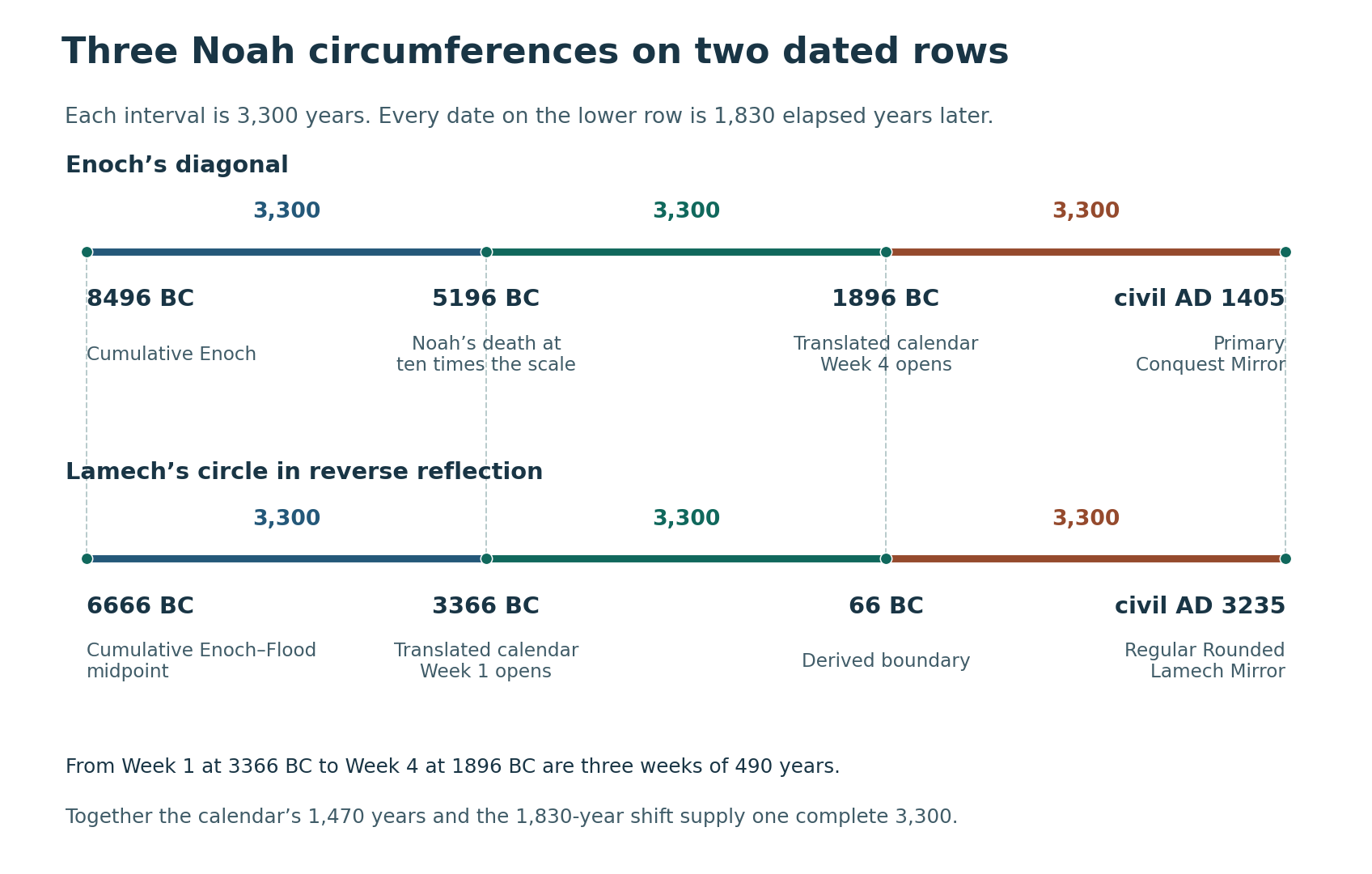
File 68 dates 3366 and 1896 BC as the openings of Weeks 1 and 4 on its 110-year-later seventy-year schedule. The first dates an interior place on Lamech’s 9,900, the second an interior place on Enoch’s. Their 1,470 and the 1,830 between the two rows give one Noah circumference. Moving the entire 1,470 forward 1,920 gives primary Exodus 1446 BC → civil AD 25. Jacob/Levi’s 490 precedes this same Exodus. In the study’s Christocentric reading the genealogy, the land and the Exodus converge in the generation of Christ. File 68 §§6.2–6.3 and Appendix D · Three circumferences and the civil dates
File 01 supplies the second small division as well. Cumulative Abraham 2436 → regular Noah’s death 2106 → adjusted Abraham’s death 1776 → primary Exodus 1446 BC gives 330 + 330 + 330. The 1776 BC placement belongs to the −215 Abraham biography. Substituting his ordinary MT death at 1991 BC gives 330 + 115 + 545. The full-scale 1896 BC boundary retains its separate support from Joshua and the calendar. File 01, Abraham’s regular and adjusted biographies · Endpoint comparison
The three 3,300s on Enoch’s row divide one continuous 9,900. Dean’s original 1296 BC → civil AD 2005 runs from Joshua’s cumulative close to Jacob’s Mirror. Reflection and a common 110-year displacement produce the last part on Enoch’s row. An additional 3,300 on the original chain gives 4596 BC → 1296 BC → civil AD 2005. In the reversed civil reflection the corresponding sequence is 2006 BC → AD 1295 → AD 4595. The final date prints as AD 4596 under the symmetric Rounded convention and has the status of a derived endpoint. Record of the 1296/1295 and 4596 labels
Appendix B. Jared and Lamech with different fixed endpoints
The two diameters from Jared
Genesis places Jared in the line that survives the Flood. Later God promises Abraham and Sarah that Isaac will be born the following year. Israel enters the promised land under Joshua, and Paul reads the promise to Abraham in light of Christ. Two measurements from regular Rounded Jared at 3646 BC bring these events into the geometry. Genesis 5:15–24 · Genesis 17:19–21 · Galatians 3:16
The inner circle on diameter 70 has working circumference 220. With 99 as the working diagonal, 10 × 99 = 11 × 70 + 220. At Enoch’s scale this gives 9,900 − 7,000 = 700 + 2,200. Shem’s 2,900 is divided just this way at 4136 BC, File 51a’s local +30 apparent-age Creation date on the regular Rounded table. Move all three boundaries, 4836 → 4136 → 1936 BC, forward 490 years. They become projected Creation 4346 → Rounded Jared 3646 → primary Exodus 1446 BC. Jared’s position is therefore attested at the division on the second row. File 51a §4.5 · File 22 §9.2
Jared centers the 1,400-year diameter. With Exodus fixed at 1446 BC, File 22 §9.2 projects MT Creation at 4346 BC. From there to Rounded Jared are 700 years. The published √2 study gives another 700 from Jared to the calculated division at 2946 BC. The two ends, 4346 and 2946 BC, are 1,400 apart. From 2946 BC to Judah’s Conquest Mirror at civil AD 1455 are 4,400 years, giving 4,400/1,400 = 22/7. Jared to Exodus supplies its half-circumference of 2,200. From the cumulative Flood to the regular Flood, 4836 → 4346 → 3646 → 2946 → 2456 BC reads 490 + 700 + 700 + 490. Jared’s diameter lies inside the 2,380-year shift that also carries cumulative Shem to regular Noah. The π study reaches 3646 by an expanded LXX midpoint. File 51a independently supplies the MT Jared date used here. File 22 §9.2 · Published π study · Published √2 study · Judah endpoint and paired Flood dates · Shem and the two Floods
The primary Exodus bisects 5,800 years. Projected Creation 4346 BC → primary Exodus 1446 BC → Judah’s Conquest Mirror civil AD 1455 gives 2,900 + 2,900. On these very dates, the calculated 2946 BC cuts the whole into 1,400 + 4,400, the diameter followed by its working circumference. The first 2,900 runs through Jared as 700 + 2,200. Cumulative Flood 4836 BC → Jacob/Levi 1936 BC supplies the same first half with both dates 490 years earlier. Published √2 study · Mirror and endpoint checks
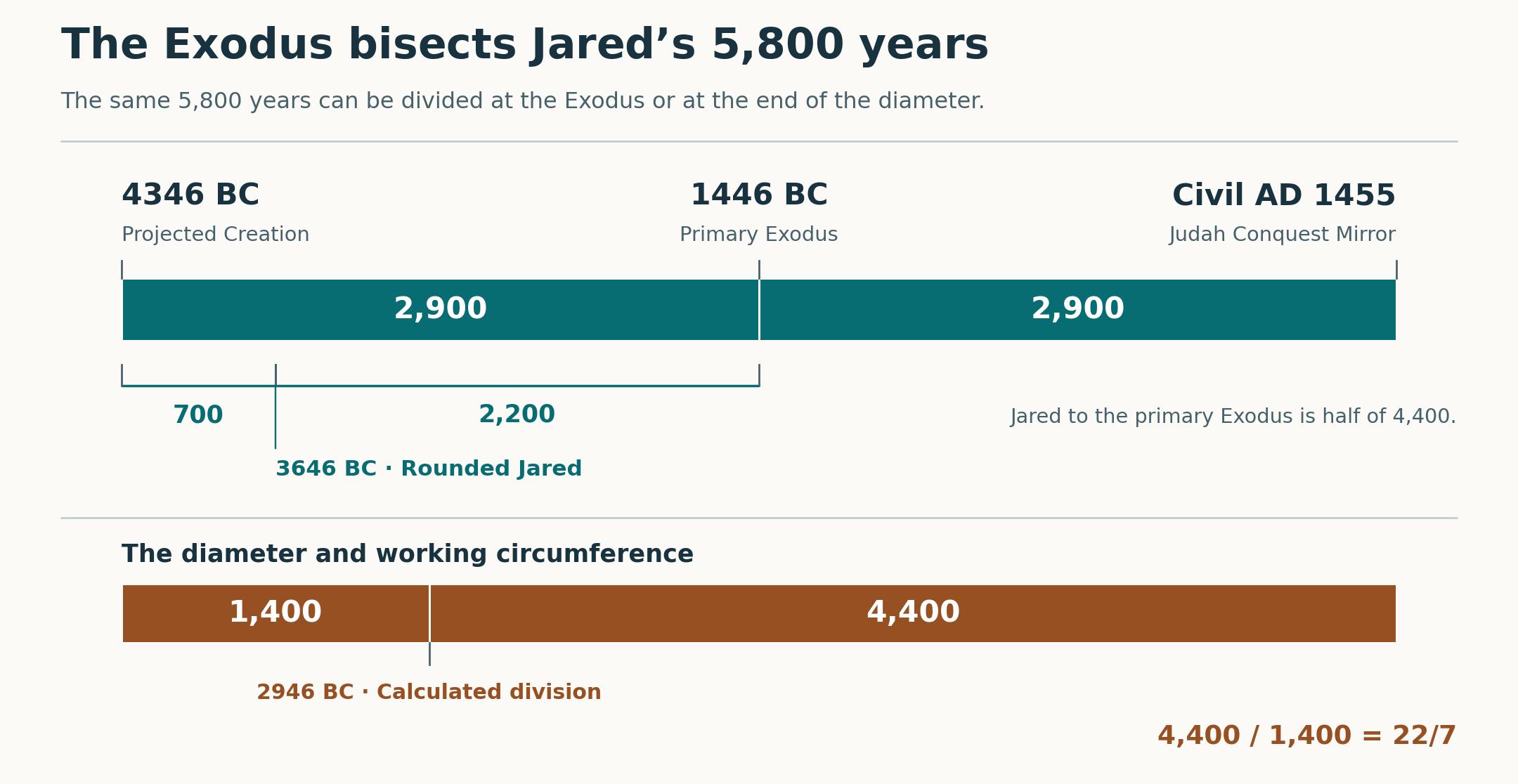
Jared begins the 3,640-year diameter. The same division leads to the Nativity reference, 3646 → 2946 → 6 BC = 700 + 2,940. The last 2,940 also runs from expanded Creation at 4346 BC to the primary Conquest at 1406 BC. File 51a §21.2 records the full 3,640. Its working semicircumference is 5,720, which reaches civil AD 2075 from Jared. Two source readings identify the reflected 2076 BC. Fixing Exodus, the published Key table takes the covenant of circumcision at 2067 BC and expands its 621 years by 70/69 to 630, giving 2076 BC. Separately, File 51a §16.2 places cumulative Rounded Jacob at 2076 BC on the Moses line. File 51a §§16.2 and 21.2 · Key table §2 · Agent 1-Trunk’s covenant test
| Regular MT Jared, BC | After 3,640 years, BC | After 5,720 years, civil AD | Reflected event or date |
|---|---|---|---|
| 3646 · Rounded | 6 | 2075 | 2076 BC · projected covenant and cumulative Rounded Jacob |
| 3656 · projected | 16 | 2065 | 2066 BC · Isaac’s birth |
| 3706 · Rounded, +60 Terah | 66 | 2015 | 2016 BC · regular Rounded death of Arphaxad |
| 3716 · projected, +60 Terah | 76 | 2005 | 2006 BC · Jacob’s birth |
Only the base Rounded row ends its diameter at the study’s Nativity date. The other BC ends move with Jared. The four equal widths follow by translation. What the projected rows add is the exchange of named patriarchs. On the BC side, 3656 and 3716 reach Jacob and Isaac respectively in 1,650 years. Across the Mirror, they reach Isaac and Jacob respectively in 5,720. File 51a §13.4 locates those same Mirrors 4,300 years from Terah on the corresponding settings. File 51a §§3.4 and 13.4
Noah’s diameter and semicircumference (1,050, 1,650) and the two Jared pairs (1,400, 2,200) and (3,640, 5,720) are respectively 15, 20 and 52 times the same pair (70, 110). The common scale explains their ratio. The dated connections to Jacob, the two Conquests, the covenant and the 6 BC reference give the comparison its chronological weight. Published geometric scale
How the Jared and Flood interval reaches Peleg
Genesis supplies two constraints: Jared is 162 when Enoch is born, and Noah is 600 when the Flood comes. In 1 Enoch 6:6 the Watchers descend in Jared’s days. That tradition gives the Jared–Flood comparison a narrative setting without identifying a particular year of Jared’s life. The numerical starting point is the regular Actual MT Gear 2 chronology with no +60 Terah. Genesis 5:18 · Genesis 7:6 · 490d’s Jared and Enoch tables
The established operation. Jared at 3654 BC stands 1,196 = 4 × 299 years before the Flood at 2458 BC. File 22 §7.12 applies the Enochian Key-of-23 ratio 300/299 to this interval, giving 1,200 = 4 × 300. With the Flood held fixed, the gain of four places projected Jared at 3658 BC. File 22, §7.12
Dean’s projection. Carry the stated 162 years from projected Jared to Enoch: 2458 + 1200 − 162 = 3496 BC. Keep Noah’s 600 years fixed as well. Noah remains at 3058 BC and the four added years fall between Enoch and Noah, increasing 434 to 438. The published operation supplies the gain. Dean’s proposal preserves the 162 across that operation. On that condition, 3496 BC is a supported projection for regular Enoch. Peleg’s tabulated date of 3496 BC prompted this test. Once the Flood is fixed at 2458 BC and Jared’s 162 years are preserved, the calculation reaches 3496 BC without using Peleg’s date as an input.
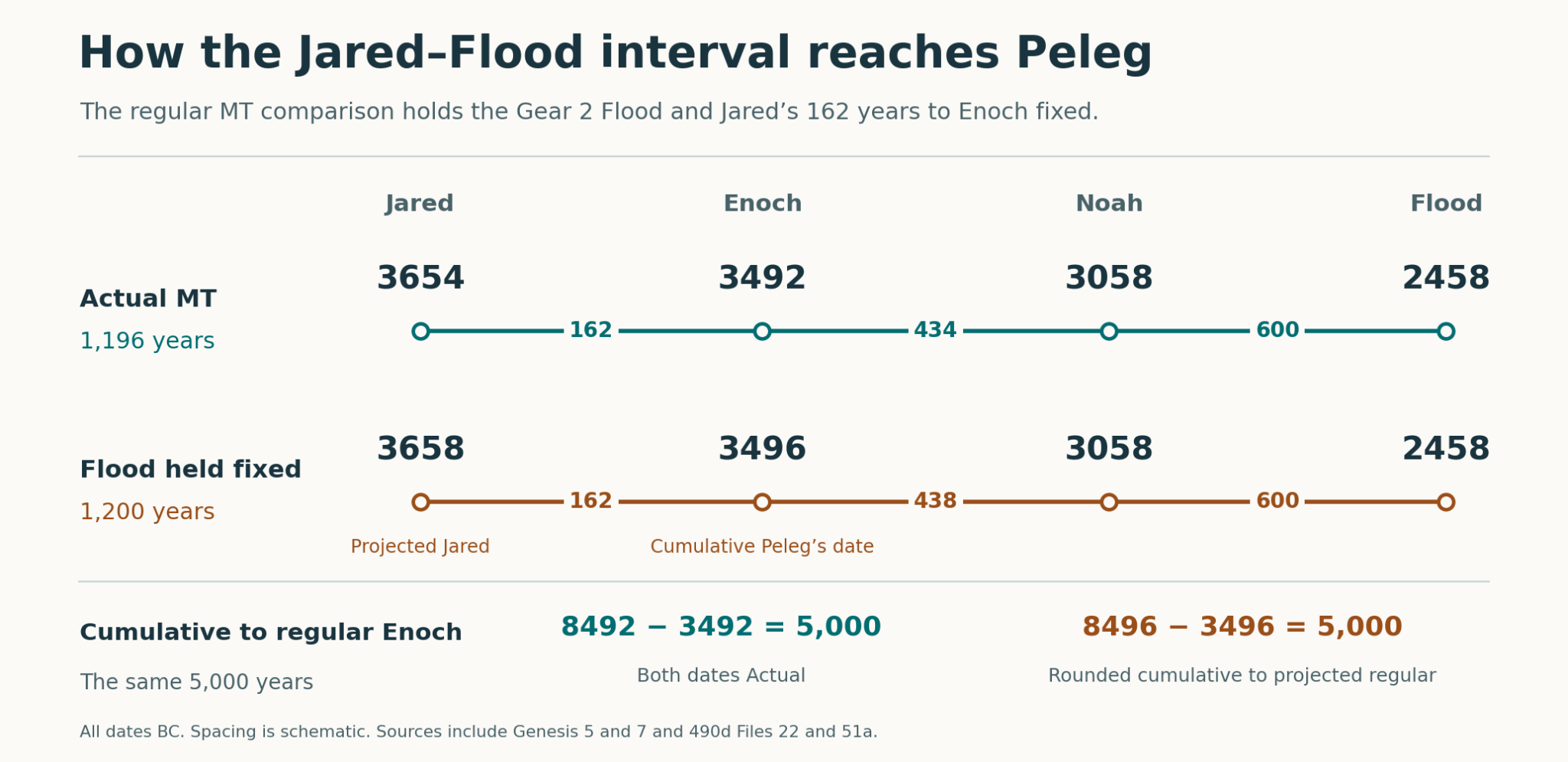
What the projection explains. Actual cumulative Enoch at 8492 BC and Actual regular Enoch at 3492 BC are already 5,000 years apart. On the cumulative line, rounding Seth from 912 to 910 and Jared from 962 to 960 places Enoch four years earlier at 8496 BC. On the regular line, the Jared–Flood operation places projected Enoch four years earlier at 3496 BC. Thus 8492 − 3492 = 8496 − 3496 = 5,000. The latter endpoint carries two distinct descriptions: a tabulated cumulative Peleg and a projected regular Enoch. File 51a, §§3.4 and 16.2
This also accounts for the size of the overlap from the common base Rounded Enoch at 3486 BC. One route adds 60 years to reach 3546 BC. The other adds six to reach Actual Enoch at 3492 BC, then four by the projection to reach 3496 BC. The separation is 60 − (6 + 4) = 50. This explains an overlap already measurable from the two tables. It does not require revising Enoch’s Actual or Rounded birth date.
File 22 §7.12 assigns the hundred-year difference between 1,196 × 300/299 = 1,200 and 1,196 × 25/23 = 1,300 to Noah’s age at Shem’s birth. Both calculations check. Genesis 11:10 gives the age of one hundred to Shem at the birth of Arphaxad. Textual check in the Mirror memo · Genesis 11:10
Lamech’s death and the seventh span from Creation
Lamech names Noah in hope of relief from the ground’s curse. Genesis gives him 595 years after Noah’s birth and gives Noah 600 years to the Flood. On the regular Rounded MT those five years run from Lamech’s death in 2461 BC to the Flood in 2456 BC. They distinguish the ends of two otherwise equal counts from Creation. Genesis 5:28–31 · Genesis 7:6 · File 51a §§3.4 and 16.10.1
Start at cumulative Rounded Creation, 14011 BC on the Aaron line or 14006 BC on the Moses line. Six spans of 1,650 reach the two ends of the regular Rounded Creation block, 4111/4106 BC. The seventh reaches 2461/2456 BC. File 51a gives the Moses count through the Flood. Dean identifies Lamech’s death at the end of the count from the upper cumulative date. The total, 11,550 = 7 × 1,650 = 11 × 1,050, is the first common multiple of Noah’s working semicircumference and diameter. File 51a §§16.2 and 16.10.1
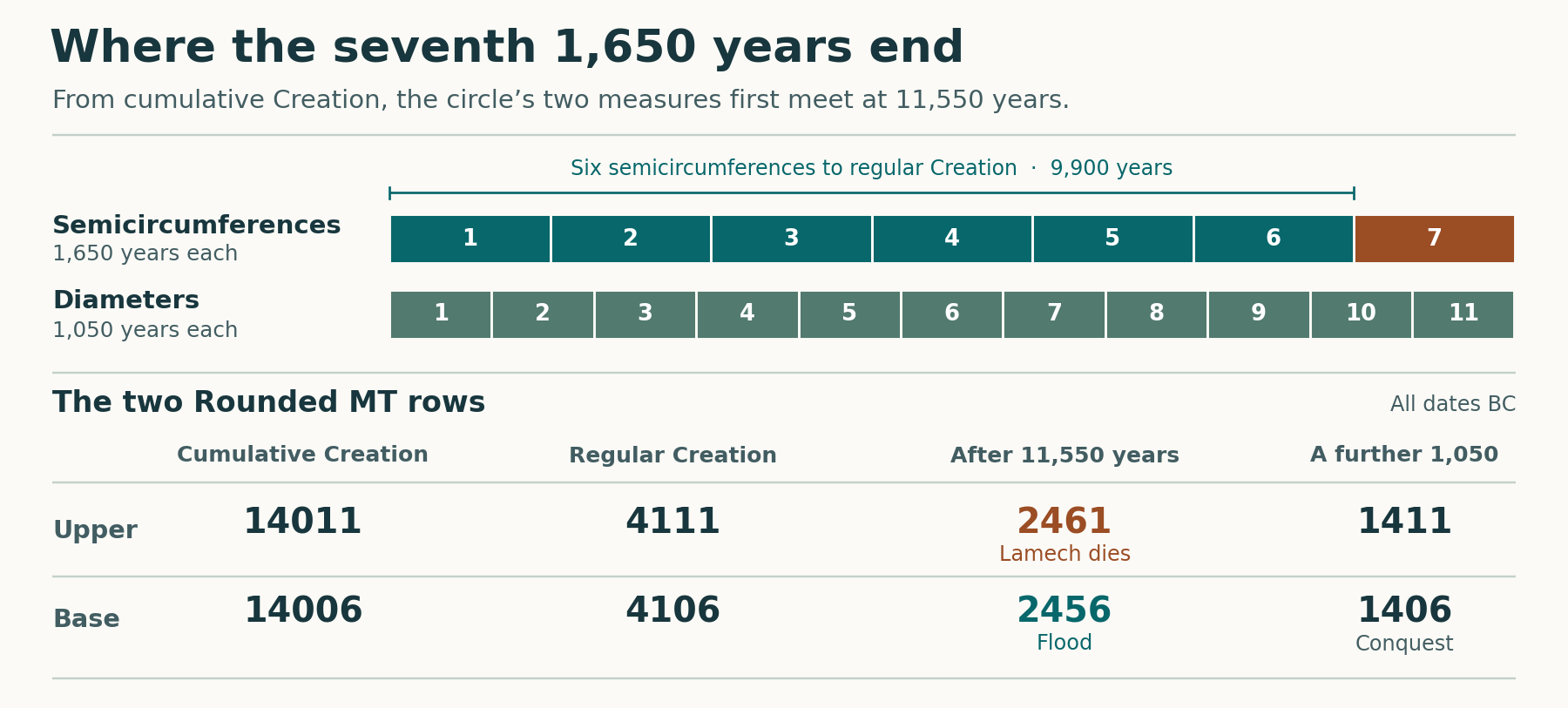
Hold Noah’s birth at 3056 BC and the Conquest at 1406 BC. Through Lamech’s death the three intervals are 1,055 + 595 + 1,055. Through the Flood they are 1,050 + 600 + 1,050. Both give two overlapping spans of 1,650. Counting a further 1,050 from each event instead lands at 1411/1406 BC. File 51b also gives the two cumulative Creation dates a common reach of 21,000 years, to civil AD 6990/6995 respectively. Lamech’s death and the Flood divide each crossing into 11,550 + 9,450, or eleven diameters followed by nine. File 51b §9.4 · Scratchpad calculations
Lamech on Enoch’s square and diagonal
Luke places Lamech between Methuselah and Noah in the genealogy of Jesus. The MT tables give Lamech’s birth at 3240 BC on Actual Gear 2 and 3236 BC on the regular Rounded chronology. A third date comes from fixing the Exodus at 1446 BC. Lamech’s 1,794 years to Exodus are six spans of 299. The Key of 23 expands them to six spans of 300, placing projected Lamech at 3246 BC. Luke 3:36–37 · Key table §2 · File 51a §3.4
Keep Rounded Jared 3646 BC and the Exodus 1446 BC fixed. Rounded Lamech 3236 BC divides their 2,200 into 410 + 1,790. Those 410 years are exactly what Jared’s 2,200 shares with Shem’s 2,200 ending at Lamech. Actual Gear 2 Lamech 3240 BC gives 406 + 1,794. Projected Lamech 3246 BC gives 400 + 1,800 and stands 700 before the separately projected Flood 2546 BC. Both projections hold the same Exodus fixed. Lamech and the projected Flood · The three partitions
His position on the square can be measured before using either ratio. From cumulative Rounded Enoch at 8496 BC to projected Lamech are 5,250 years. From Lamech to Judah’s Exodus at 1496 BC are 1,750. Lamech therefore stands three quarters of the way along Enoch’s 7,000-year side. On the 9,900-year diagonal, the same Exodus Key table projects Jared at 3846 BC. Projected Jared and Lamech fall 300 years on either side of regular Rounded Enoch at 3546 BC (+60 Terah). The two outside spans to cumulative Enoch and the Conquest Mirror at civil AD 1405 are each 4,650. File 51b §8.1 · Judah-route Exodus · Scratchpad diagram and dates
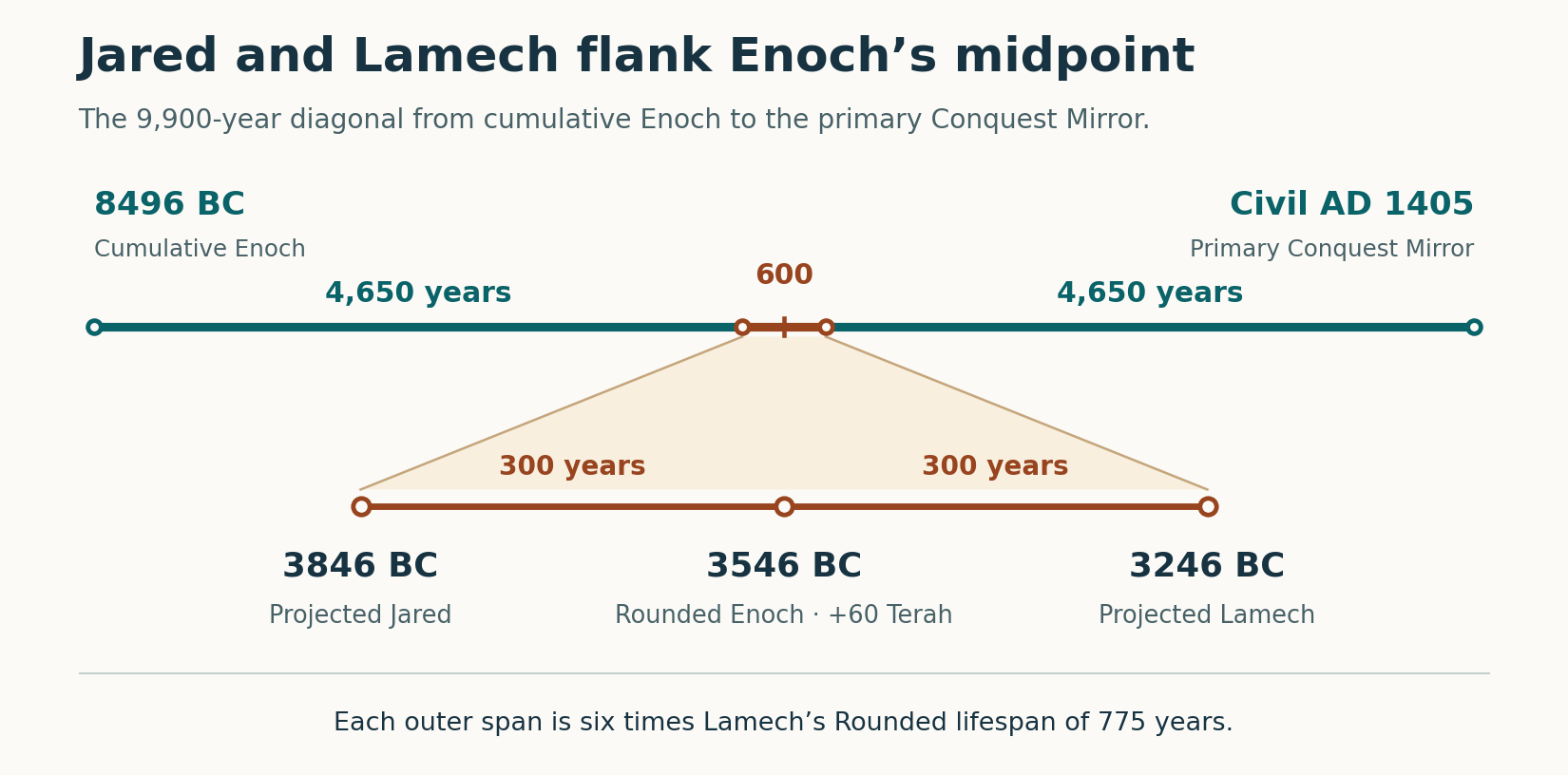
Shem and Noah supply a check. Cumulative Rounded Jared 9456 BC to regular Rounded Shem 2556 BC, and projected Lamech 3246 BC to the civil Mirror of Noah-held Jared 3656 BC at AD 3655, each measure 6,900. Their shared 690 years run from Lamech to Shem. Applying 70/69 gives 6,300 + 700 in the first span and 700 + 6,300 in the second. Each whole interval thus gives the square’s 7,000-year side. The 6,300 is independently measured across the Mirror at Enoch’s taking. Lamech to Conquest gives 1,840 × 25/23 = 2,000. Those 2,000 and 700 can also be read directly from Rounded Creation 4106 → Noah’s death 2106 → Conquest 1406 BC. Published √2 study · Two 6,900-year spans and Noah’s death
The two Lamech births meet at the Christ datum. From projected 3246 BC to 6 BC, then to the civil Mirror of Rounded 3236 BC at AD 3235, each half is 3,240 = 9 × 360. The primary Exodus is five units from the start. The Mirror of the +60 Rounded Flood (2516 BC, civil AD 2515) falls at unit sixteen. From Exodus and from 6 BC to that Flood Mirror the spans are 3,960 and 2,520, a working semicircumference and diameter in the ratio 11/7. The eighteen divisions · The Flood at division sixteen
Lamech’s circle reaches Shem’s restoration interval. Cumulative Enoch 8496 BC and Flood 4836 BC put their midpoint at 6666 BC. Regular Rounded Lamech 3236 BC to its civil Mirror AD 6665 gives 9,900 on the dated 3,150 from cumulative Noah 6386 BC to Lamech. Read the circumference in reverse reflection, 6666 BC → civil AD 3235. Its midpoint is 1716 BC, the date corresponding to Joshua under the ten-to-one comparison. Lamech and the 6666 BC midpoint · The six corresponding dates
Move Enoch’s whole diagonal forward 1,830 years, half the interval from cumulative Enoch to the cumulative Flood. Enoch’s midpoint at 3546 BC reaches 1716 BC. Joshua’s 1296 BC reaches restoration’s Mirror, civil AD 535. The primary Conquest Mirror reaches civil AD 3235, Lamech’s Mirror. Read the closing 2,700 back across the Mirror to recover the same dated Lamech 3236 → restoration 536 BC already inside Shem’s 4,900. The two possible 7,000-year spans can now be dated from Abraham’s family and the Enochic calendar. Lamech on Shem’s row · Endpoint tests
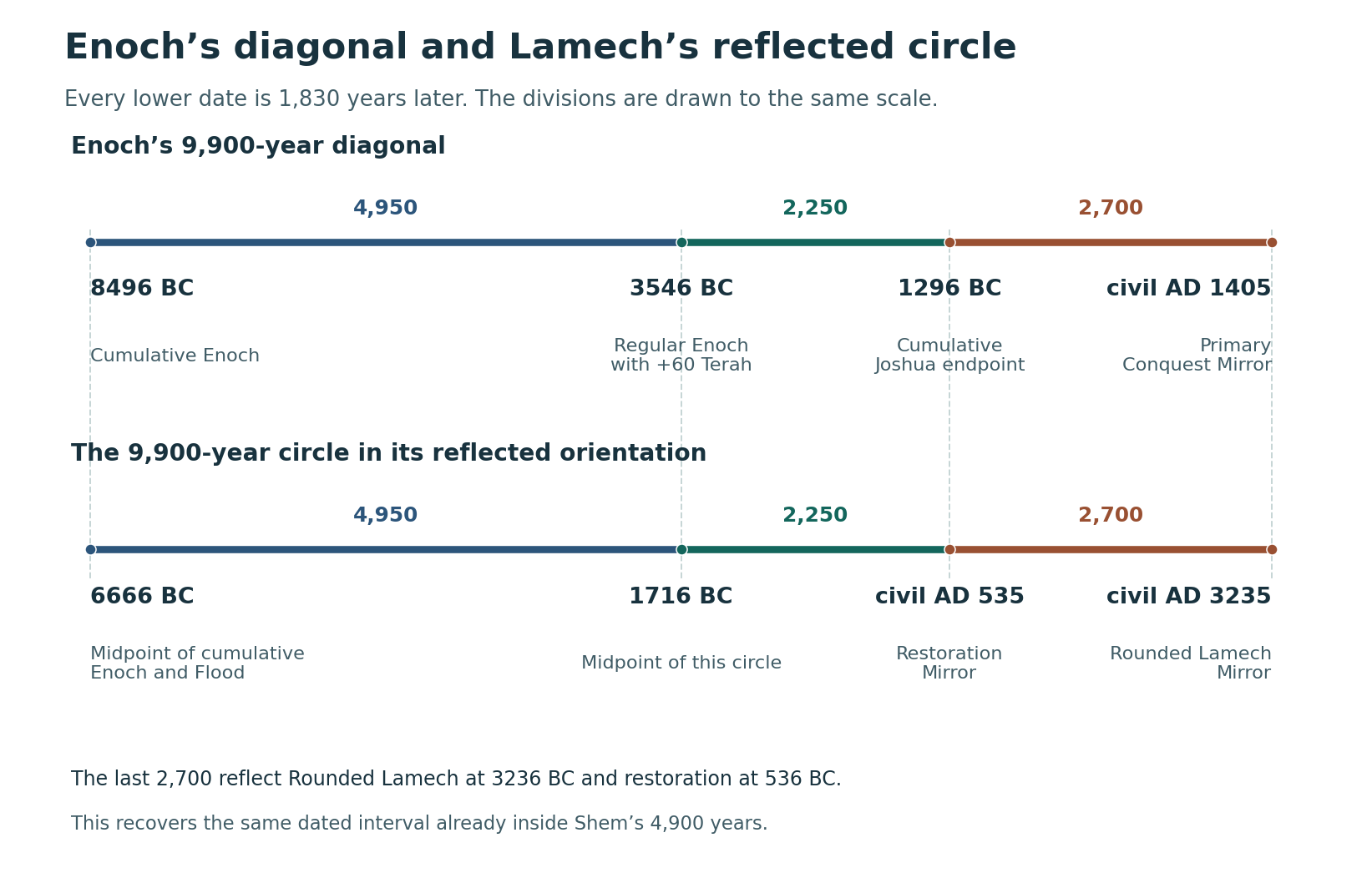
Abraham’s family locates the two 7,000-year sides. Abraham was 100 at Isaac’s birth, Isaac 60 at Jacob’s birth, and Jacob 130 at the Egyptian entry. File 69 records their 290 years from 2166 to 1876 BC. Move both ends of File 68’s original seven-week span 3476 → 46 BC earlier by 290. The results, 3766 and 336 BC, divide Lamech’s crossing when the former is reflected. 3236 BC → 336 BC → civil AD 3765 → civil AD 6665 = 2,900 + 4,100 + 2,900. Lamech begins the first 7,000 and 336 BC begins the second. Moving Enoch’s already dated Peleg and Exodus positions onto the reflected Lamech row recovers both calendar results. The two interior places have the status of derived dates. Genesis 21:5 · Genesis 25:26 · Genesis 47:9 · File 69, Abraham to entry · Lamech’s two side placements
On the +60 Terah comparison, Lamech’s death 2521 BC and Flood 2516 BC are five years apart. The latter reaches civil AD 5 after 2,520 and civil AD 1445, the primary Exodus Mirror, after 3,960. Noah’s deliverance through water and Israel’s departure come together in the Christian reading of 1 Peter 3:20–21 and 1 Corinthians 10:1–4. On the distinct LXX comparison, Exodus-held Lamech 3246 BC reaches civil AD 5555, the Mirror of the selected LXX Creation opening, after 8,800. Projected Flood 2546 BC bisects 3246 → 1846 BC = 700 + 700. These crossings retain their +60 or LXX settings. The Flood at Lamech’s sixteenth division · Lamech at the LXX Creation Mirror
Appendix C. Jacob’s three diameters and the Enochic calendar
Jacob on the regular MT trunk
After Creation and the Fall, Noah’s household survives the Flood. God promises Jacob the land his descendants will enter. Jesus takes up Jacob’s vision of angels ascending and descending when he speaks of the Son of Man. The chronological point here is Jacob’s birth at 2006 BC. Genesis 7:6–7 · Genesis 28:12–15 · John 1:51
Two Rounded spans. File 51a already identifies Noah’s birth at 3056 BC as the midpoint between Creation at 4106 BC and Jacob at 2006 BC. Dean’s observation shows that moving Creation, Noah and the Flood forward together by 1,050 years gives Noah, Jacob and the Conquest. Each row divides 1,650 into 1,050 + 600. Genesis gives Noah’s age at the Flood directly. Jacob’s 600 years to the Conquest have their own reckoning in the selected MT chronology, 130 to the descent into Egypt + 430 to the Exodus + 40 to the Conquest. Within Noah’s 1,650 years to the Conquest, the Flood comes 600 years from the beginning and Jacob’s birth 600 years from the end. The four events divide the span as 600 + 450 + 600. Jacob thus marks the second way to divide the same semicircumference. File 51a §§4.1 and 4.3 · 9,900-year bridge, A1 and A3
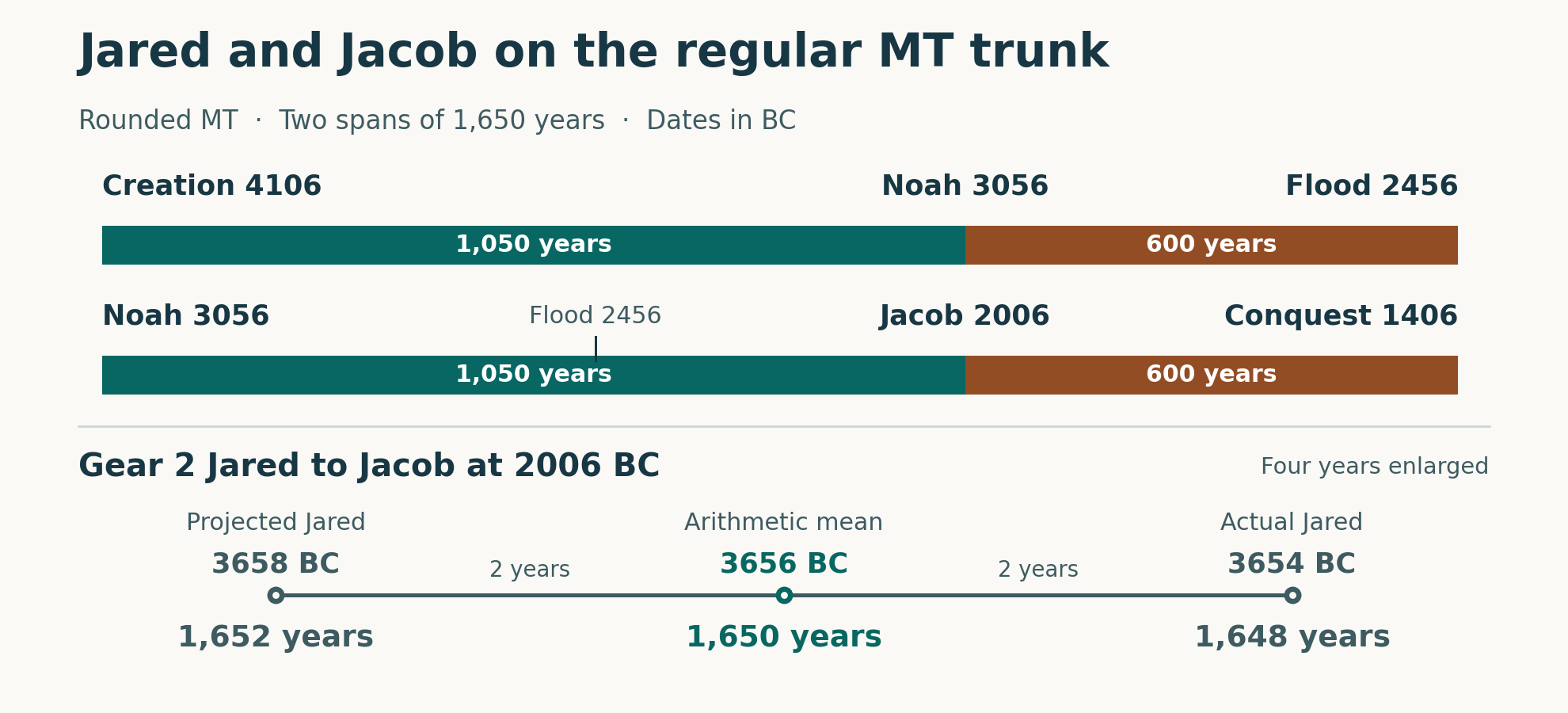
The lower half of the diagram shows the two Gear 2 readings around Jacob’s 1,650. The Jared and Noah comparison gives their derivation and the corresponding measurement to Isaac.
The three diameters that begin at Noah
File 68 lists the following three schematic dates. On these spans they fall at the pairwise midpoints. 2496 BC bisects Noah to Jacob/Levi, 1516 BC bisects Noah to AD 25, and 956 BC bisects Jacob/Levi to AD 25. In chronological order these three dates and AD 25 give 980 + 560 + 980. Every part is 14/15 of the original 1,050 + 600 + 1,050. The two overlapping spans now give 1,540 + 1,540 = 3,080. The same length serves as a full working circumference on 980 and a semicircumference on 1,960. File 68, Appendix D.4 · Scratchpad arithmetic and reciprocal Mirrors
Peleg gives this circle a dated beginning. From Peleg 3496 BC → regular Rounded Noah 3056 BC → Jacob/Levi 1936 BC → civil AD 25 are 440 + 1,120 + 1,960 = 3,520. The whole is a working circumference on the internal Noah–Jacob diameter, 3,520/1,120 = 22/7. Read backward from civil AD 25 with that diameter and the same fraction recovers Peleg. From Peleg the half-side is 3,500 to civil AD 5. The full circumference adds twenty years to reach the age-thirty datum. File 51a §§3.4 and 16.2 · Luke 3:23
| Diameter beginning at Noah, 3056 BC | Years | Elapsed circumference | Years |
|---|---|---|---|
| To 2076 BC · projected covenant / cumulative Moses-line Jacob | 980 | Noah 3056 BC → civil AD 25 | 3,080 |
| To 2006 BC · regular Jacob’s birth | 1,050 | Joshua 1296 BC → civil AD 2005 | 3,300 |
| To 1936 BC · Jacob age 70 / cumulative Aaron Jacob–Levi | 1,120 | Peleg 3496 BC → civil AD 25 | 3,520 |
All three diameters start at the same Noah. The three family endpoints are separated by 70 + 70. Each increase of 70 in diameter adds 220 in circumference, the length already measured from Sarah to Jacob at age seventy. The middle row explains why 1296 BC belongs in the trunk. It joins Peleg’s division directly to Noah’s circle at Jacob’s Mirror. File 51a §§3.4 and 16.2 · Exodus-held covenant and Bethel
Jared begins two working semicircumferences at 3646 BC. The smaller ends at the primary Exodus after 2,200 years. The larger ends at the civil Mirror of the projected covenant, AD 2075, after 5,720. Their difference is 3,520 and their radii differ by 1,820 − 700 = 1,120. Both ends of Peleg’s 3,520 move forward 2,050 to give the interval between these two endings. File 22 already measures that 2,050 from Peleg through Jacob/Levi to Exodus as 1,560 + 490. The overlap, 1446 BC → civil AD 25 = 1,470, is the last three of Jacob’s four 490s. In the study’s Christocentric reading, the dated overlap carries the promise through the Exodus to the generation of Christ. Jared’s two circles · File 22 §3.5.3 · Galatians 3:16–18
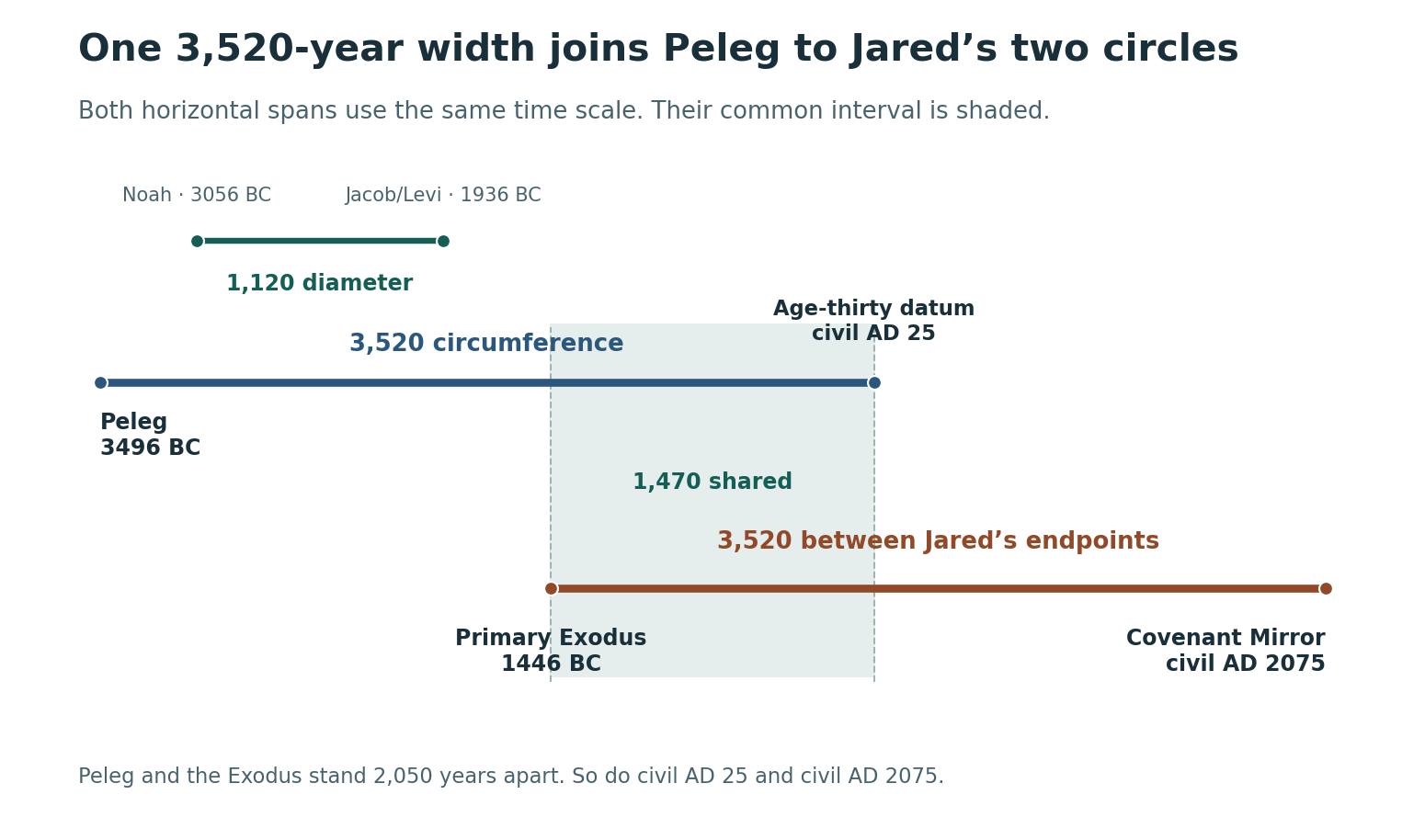
The calendar close at 46 BC
The primary Exodus joins Jared’s semicircle to its diameter. File 68 opens its original forty-nine generations at 3476 BC on the primary seventy-year count and 3574 BC on the companion seventy-two-year count. It places one symbolic generation before each beginning, at 3546 and 3646 BC. The first is already regular +60 Enoch, midpoint of the 9,900. The second is regular Rounded Jared. Count fifty from these earlier dates and both end at 46 BC. File 68 Appendices B.6 and C.1 · Published 70- and 72-year framework
Follow Jared’s dated route. 3646 → 1446 → 46 BC gives 2,200 + 1,400. His semicircumference closes at the primary Exodus and a whole diameter’s length begins there. Both ends of the previously measured diameter, projected Creation 4346 → 2946 BC, move forward 2,900 to 1446 → 46 BC. That displacement is Enoch’s diagonal minus its side. The resulting 2,200/1,400 = 11/7 is half the working π ratio. The common endpoint comes from File 68’s calendar. File 22 §9.2 · Calendar and diameter calculation
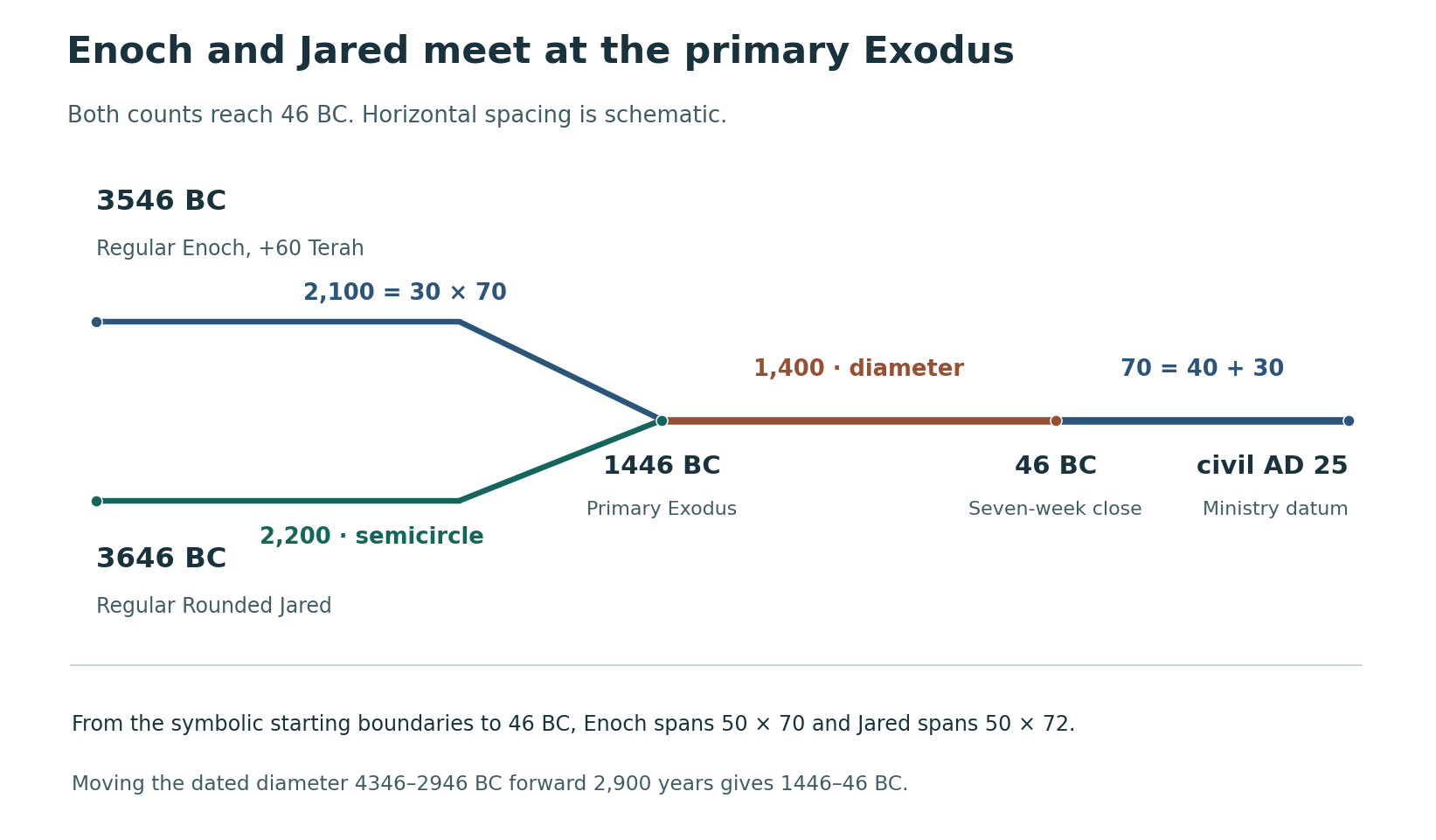
File 68 then counts 46 BC → 6 BC → civil AD 25 = 40 + 30, a secondary extension of the original seven weeks. This places Jacob’s entire approach to Christ on one sequence, Jacob/Levi 1936 → primary Exodus 1446 → 46 BC → civil AD 25 = 490 + 1,400 + 70. Its total 1,960 is also the span between the source’s 2216 and 256 BC Day 5 openings. Both those calendar boundaries move forward exactly four seventy-year generations to Jacob/Levi and civil AD 25. Luke’s “about thirty” supplies the narrative setting for the final thirty elapsed years. File 68 Appendices D.1–4 · Luke 3:23
The reconstructed Flood position also supplies the start of Jared’s longer span on Peleg’s row. Moving 5696 BC → Peleg 3496 BC → civil AD 25 forward by 2,050 years gives Jared 3646 BC → primary Exodus 1446 BC → civil AD 2075. Each full sequence reads 2,200 + 3,520 = 5,720. The 3,520s literally overlap from the Exodus to civil AD 25. Jared to Jacob at civil AD 25
Appendix D. Generation lengths and calendar conventions
Fixed MT dates and the three Gospel generation scales
Matthew traces the line from Abraham to Christ. Luke traces it from Christ back to Adam. File 15 derives three generation lengths from the years of service of Abraham, Jacob and Moses, measured from call to death. Their lengths are 100, 70 and 40 years, in the proportion 10 : 7 : 4. File 15 §§1.1, 2.1 and 6.1–6.2
- Abraham · 100 years. Abram leaves Haran at 75 and dies at 175. The regular MT chronology places these events at 2091 and 1991 BC. Genesis 12:4 · Genesis 25:7
- Jacob · 70 years. Genesis places Jacob at Bethel on his flight toward Haran and gives his age at death as 147. File 04 reconstructs his age at the flight as 77, giving 1929 to 1859 BC in the regular MT chronology. Genesis 28:10–22 · Genesis 47:28 · File 04, Jacob
- Moses · 40 years. God commissions Moses at the burning bush. Exodus gives his age as 80 when he and Aaron speak to Pharaoh. Moses dies at 120. The regular MT span from the Exodus to his death runs from 1446 to 1406 BC. Exodus 3:1–10 · Exodus 7:7 · Deuteronomy 34:7
The MT dates remain fixed. Regular Rounded MT Creation at 4106 BC, Noah’s birth at 3056 BC, the Flood at 2456 BC and the Conquest at 1406 BC give 1,050 + 600 + 1,050 = 2,700 years. Genesis gives Noah’s age at the Flood as 600. The 27-name reconstruction fits 27 equal centuries between Creation and the Conquest by including second Cainan between Arphaxad and Shelah. The corresponding line in the transmitted MT has 26 names. The MT circles and squares keep their dated positions. Any proposed intersection with the 70- or 40-year Gospel figures must be checked against the fixed 1406 BC Conquest. Genesis 7:6 · File 51a, Rounded MT tables · Twenty-seven named centuries
Cumulative Rounded MT Creation at 14006 BC and the Conquest at 1406 BC enclose 12,600 years. This one dated span can be counted as 126 centuries, 180 seventies or 315 forties. In each count the endpoints and elapsed years are identical. Counting the same span
The Gospel scaling law. With Christ fixed at 6 BC, let n be the number of Gospel intervals from a named ancestor to Christ and g the years assigned to each interval. On the historical side the signed coordinate is xg = −n × g and the year is (6 + n × g) BC. Its Mirror is +n × g. Changing only the Gospel unit from g to h gives xh = (h/g) × xg. Each row below follows one Gospel count.
| Gospel boundary | Intervals to Christ | 100-year (BC) | 70-year (BC) | 40-year (BC) |
|---|---|---|---|---|
| Luke’s Adam, second Cainan included | 75 | 7506 | 5256 | 3006 |
| Luke’s Adam, second Cainan omitted in the comparison | 74 | 7406 | 5186 | 2966 |
| Matthew’s Abraham, Jeconiah in both exile positions | 41 | 4106 | 2876 | 1646 |
| Matthew’s Abraham, Jeconiah counted once | 40 | 4006 | 2806 | 1606 |
| Christ, fixed Gospel origin | 0 | 6 | 6 | 6 |
File 43 starts from 70 years per interval. It places Luke’s Adam at 5256 BC on its selected count, and Matthew’s Abraham at 2876 or 2806 BC. At 100 years per interval the 41-interval Matthew count places Abraham at 4106 BC, coinciding with regular Rounded MT Creation. On the 41-interval Gospel ruler, Matthew’s Abraham moves to 2876 BC at 70 years per interval and 1646 BC at 40. The comparison below shows how these Gospel positions relate to an MT count from the Conquest. The SKL keeps its source reign lengths. Published Gospel count tables · File 43
Counting back from the Conquest
Moses dies and Israel crosses the Jordan into the land promised to the fathers. Dean takes that Conquest boundary, 1406 BC, as the fixed endpoint of the MT schematic. On the century chart, 27 intervals reach from the Conquest back to regular Rounded MT Creation at 4106 BC, and 126 reach back to cumulative Rounded MT Creation at 14006 BC. Here the 27 and 126 count schematic intervals. The source MT keeps its two Creation dates and its 1,050 + 600 + 1,050 sequence through Noah and the Flood. Deuteronomy 34 · Joshua 4 · File 51a, Rounded MT tables
For each comparison use the same generation length g in the MT schematic, Matthew and Luke. Count back from the Conquest to (1406 + 27g) BC for regular Creation and (1406 + 126g) BC for cumulative Creation. Their separation is 99g. Luke’s Adam, with second Cainan retained, is 75 intervals back from Christ at 6 BC, or (6 + 75g) BC. The two fixed endpoints are 1,400 years apart at every generation length. On the signed ruler they are −1,400 for the Conquest and 0 for Christ.
| Years per interval | MT regular Creation (BC) | MT cumulative Creation (BC) | Gap between MT Creations | Luke’s Adam (BC) | Luke to regular MT |
|---|---|---|---|---|---|
| 100 | 4106 | 14006 | 9,900 | 7506 | 3,400 |
| 70 | 3296 | 10226 | 6,930 | 5256 | 1,960 |
| 40 | 2486 | 6446 | 3,960 | 3006 | 520 |
The 100-year row reproduces the two tabulated Rounded MT dates. The 70- and 40-year MT entries are projections anchored at the Conquest. They can also be read to the close of Jesus’ allotted generation.1 On the 70-year row, Luke’s Adam at 5256 BC precedes the regular MT projection at 3296 BC by 1,960 years = 4 × 490. The difference on each row is 48g − 1,400. Matthew’s 41-interval Abraham coincides with regular MT Creation on the century row. At 70 and 40 years per interval Matthew’s Abraham falls 420 and 840 years later than the corresponding regular MT projection, since the difference is 1,400 − 14g. Gospel count tables · Gospel counts and the two midpoints
Check against the century map. Luke’s Jared at 7006 BC bisects the 14,000 years from cumulative Rounded MT Creation to Christ at 6 BC. At 70 years per interval the corresponding sequence is 10226 → 4906 → 6 BC, from the cumulative MT projection through Luke’s Jared to Christ. The two spans are 5,320 and 4,900 years, a difference of 420. The square’s working proportion survives. The gap between the two MT projections is 99g, and Luke’s Jared to Christ is 70g, giving 6,930/4,900 at 70 years and 3,960/2,800 at 40. Jared bisects the full span only on the century row. Moving 4,900 years forward from the 70-year cumulative projection at 10226 BC reaches 5326 BC, the coordinate of Luke’s figurative generation of God on that ruler. The two readings share an endpoint. The 70- and 40-year readings support the comparison. The century reading is the basis of the final chart. Luke’s genealogy table · Century map
Christ at 6 BC and the calendar origin at 1 BC
Christ’s row in the generation table has zero intervals to Christ in every scale. To express the same fixed date relative to the civil calendar origin, distinguish the signed astronomical year from the number of elapsed years before zero. Astronomical year 0 is 1 BC.
| Reading | Calendar origin | Christ, 100-year | Christ, 70-year | Christ, 40-year |
|---|---|---|---|---|
| Astronomical year (signed) | 0 | −5 | −5 | −5 |
| Elapsed years before astronomical zero | 0 | 5 | 5 | 5 |
| Civil year (BC) | 1 BC | 6 BC | 6 BC | 6 BC |
The 1 in 1 BC names the civil year of the calendar origin. The five years from Christ at 6 BC to that origin are calendar years. The generation table counts from Christ himself (n = 0 for Christ), on all three scales. For any fixed historical date, the two signed readings satisfy x1 = x6 − 5. Thus the dated Conquest at 1406 BC reads −1,400 from 6 BC and −1,405 from 1 BC.
A different calendar origin. An abstract pair of points 1,400 years on either side of 1 BC reads 1401 BC / civil AD 1400. An equal pair centered at 6 BC reads 1406 BC / civil AD 1395. The first pair illustrates a translation of a ruler. The MT Conquest remains at 1406 BC. File 51a §10.8 independently uses 6/1406 BC and 1/1401 BC in its whole-span inverse calculation. In the civil Mirror convention of Files 51a and 51b, 1406 BC reflects to civil AD 1405, and 1401 BC to civil AD 1400. File 51a, whole-span anchors and civil Mirror · File 51b, civil Mirror convention
The Creation Pillars and the Flood calendar
The Creation Pillars. In the established MT comparison the apparent-age pillar at 4206 BC stands 100 years before regular Rounded Creation. It extends the 2,700 years to Conquest into a 2,800-year diameter. Its 1,400-year radius is independently present from Conquest to 6 BC. The Creation-Pillars appendix obtains the circumference by a separate civil Mirror path: 4206 BC → civil AD 3891 = 8,096, as does 4106 BC → civil AD 3991. Applying 25/23 gives 8,800. Thus 8,800/2,800 = 22/7, forty times the 220 circumference and 70 diameter of the working inner circle. Creation Pillars, §§13–14
Enoch’s closing 2,900 extends from Judah’s schematic Exodus at 1496 BC through 796 BC to the primary Conquest Mirror at civil AD 1405. The 796 BC boundary lies 700 years after the Exodus and is independently listed as the Joash/Amaziah succession in File 18’s conventional kings table. Continue from 796 through that Conquest Mirror to civil AD 4105 or AD 4205, the whole-year images of base Creation and the apparent-age pillar. The two readings measure 2,200 + 2,700 = 4,900 and 2,200 + 2,800 = 5,000 on dated, translated rows. Translating Enoch’s original 8496-to-3496 interval there moves both ends 7,700 years. The original interval now has both derived cuts, 6296 and 5696 BC. On the Noah row the two overlapping 2,800s are 5256 → 2456 and 3056 → 256 BC. Move both ends of the first span forward 1,050 years to the apparent-age Creation Pillar and the Conquest, 4206 → 1406 BC. A further 1,150-year shift gives the second span. The overlap is exactly Noah’s birth to the Flood. The three 2,800-year placements · File 18 §2.5.3 · Pillar comparison and source check
The Flood calendar. In the published side-70 construction the working diagonal is 99 and the inner circumference is 220. On the study’s 360-day Flood calendar, the ark rests on Day 197 and the earth is dry on Day 417. The earliest permitted bird sequence puts the olive-leaf dove on Day 318. Its inferred placement divides the 220 days as 121 + 99. Ten times those numerical lengths gives 1,210 + 990 = 2,200, the dated division at Abraham between Jared and the Exodus. This compares proportions across the day and year counts. Its middle day depends on the earliest eligible bird sequence. The trunk’s whole-year equations stand on the genealogy and the Conquest. Genesis 8 · Joint study, Flood-day geometry · Technical phase ledger
A second Exodus placement. File 22 §9.2 fixes the primary Exodus and expands 4114 − 1446 = 2,668 by 25/23 to 2,900. This generates 4346 BC. From there through 1446 BC to civil AD 5555, the order is 2,900 + 7,000 = 9,900. Only the far endpoint here calls on the LXX. It reflects its Actual Year 6 opening at 5556 BC in the full-430, native-Cainan, +60 Terah setting. This is a comparison with the MT trunk and reverses the ordering on Enoch’s line. File 22, §9.2 · File 71, comparison states
Jared and the Creation Mirrors. From Rounded Jared at 3646 BC to the study’s Nativity date at 6 BC are 3,640 years (10 × 364), as File 51a §21.2 records. Projected Jared at 3656 BC gives 3,650 (10 × 365), recalling Enoch’s lifespan. Starting at Jared, 460 years after Adam, shortens File 51b’s 8,280-year MT crossing to 7,820 and its 9,660-year crossing to native LXX Creation to 9,200. Dean retains the 364/365 pairing and the 7,820/9,200 crossings as support for the Jared dates. The circle measurements use the dated paths above. Four dated Mirror pairings
What the seven years establish. In the Actual MT envelope, Peleg’s 3501n–3494n BC pairs with civil AD 1400n–1407n. The parallel 3502t–3495t BC pairs with civil AD 1399t–1406t. Each matched crossing yields 4,900. Translating the latter endpoint of every pair by Judah’s +50 gives 4,950 by calculation. Actual cumulative Enoch to Peleg measures 4,996 throughout corresponding positions. The exact two 5,000s with a 50-year overlap have been verified at the specified Rounded Moses-line placement. The other published Rounded pair, 8501/3501 BC, would need a regular Enoch at 3551 BC to repeat that overlap. Its event identity remains open. Peleg–Babel appendix · Boundary test
On Actual Gear 2 the regular sequence from Creation completion through Noah and the Flood to the Conquest is 1,056 + 600 + 1,052. It retains Noah’s stated age but gives overlapping lengths of 1,656 and 1,652. The equal pair of 1,650s is specific to the Rounded scaffold. Likewise the one-unit square excess belongs to 99² − 2 × 70². Scaling both lengths by 100 scales that squared excess to 10,000. The schematic Flood-day comparison corresponds by proportion to the family divisions. Fifty-step record, questions 47–49
Jared and Noah before Jacob and Isaac
Genesis gives Noah’s age as 600 at the Flood and Isaac’s age as 60 at the birth of Jacob. This second age supplies a named endpoint for the +60 Terah comparison. Isaac and Jacob retain their respective births at 2066 and 2006 BC. The earlier Jared and Noah dates move 60 years, and the comparison passes from son to father. File 51a §8.5 already uses this pairing for Terah’s 230 years to Jacob (2236 → 2006 BC) and to Isaac (2296 → 2066 BC). Genesis 7:6 · Genesis 25:26 · File 51a §8.5
The Gear 2 readings around 1,650. Noah’s 1,650 and 1,050 equal 33 and 21 blocks of 50. From Actual Jared 3654 BC to Jacob 2006 BC are 1,648 years. From projected Jared 3658 BC, with the Gear 2 Flood fixed at 2458 BC, there are 1,652. Their mean date, 3656 BC, gives 1,650. Gear 2 Noah 3058 BC gives 1,052 to Jacob and Gear 1 Noah 3056 BC gives 1,050. Regular Rounded Jared is 3646 BC. These Actual MT comparisons use Nisan whole-year labels, the full 430-year sojourn and +60 Terah off. File 22 §7.12 · File 18 §3.1.4 · File 51a §§3.4 and 4.1
Hold Noah fixed. The research desk’s File 52c §3.15.1 already records 3654 → 3056 → 2458 BC = 598 + 598, with Jared and the Flood on Actual MT Gear 2 and Noah on Gear 1. Its expansion table holds 12026 BC fixed. Dean’s present use holds Noah fixed instead. Each 598 equals 2 × 299 and becomes 600 under 300/299. Moving 600 years back from Noah gives projected Jared at 3656 BC. Moving 600 years forward reaches the Gear 1 Flood at 2456 BC. Expanding the whole 1,196 years with the Gear 2 Flood fixed gives 3658 BC. The Noah-held result thus lands exactly halfway between Actual Jared at 3654 BC and the Flood-held result at 3658 BC. File 52c §§3.15.1–2 · File 22 §7.12 · File 71 §2.7
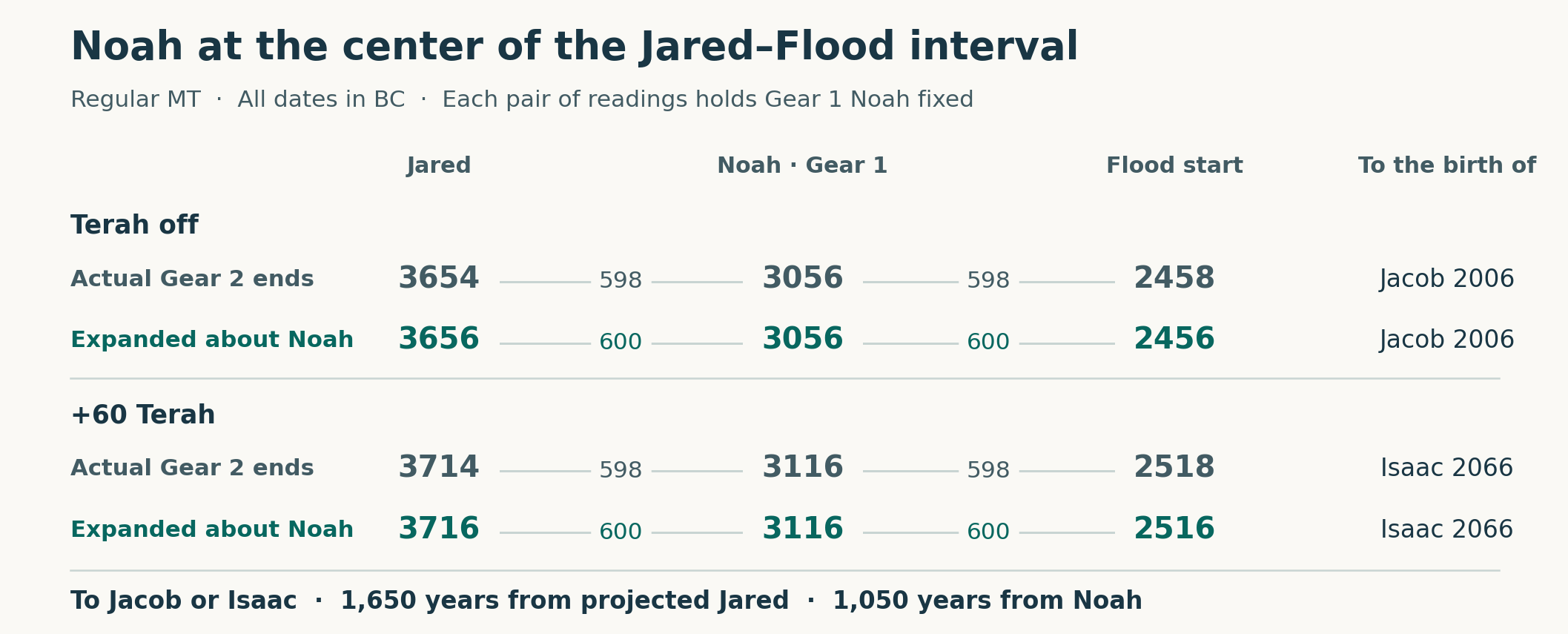
The same two measures at Isaac. On +60 Terah, Actual Jared at 3714 BC and the projection at 3718 BC with the Gear 2 Flood fixed give 1,648 and 1,652 years to Isaac. Gear 1 Noah at 3116 BC gives the exact middle result, 3116 + 600 = 3716 BC, and stands 1,050 years before Isaac. Actual Gear 2 Noah at 3118 BC gives 1,052. All four widths match the base comparisons to Jacob. The regular Rounded Jared births are 3646 and 3706 BC. The 3656 and 3716 BC values are arithmetic means and Noah-held projections. File 71 §§2.1 and 2.7 · File 51a §§3.4 and 4.4
The Rounded dates also make Noah the midpoint in both settings. Creation 4106 → Noah 3056 → Jacob 2006 BC and Creation 4166 → Noah 3116 → Isaac 2066 BC each give 1,050 + 1,050. The working circle continues to use 2 × 1,650 / 1,050 = 22/7. Translating both endpoints by 60 preserves their difference. The evidence Dean sees for intent is that Genesis itself supplies the named father and son at exactly that separation. File 51a §§4.1, 4.3 and 4.4
Supporting comparisons at Noah and Sarah
Noah’s 350 years and the two Exodus dates. With the primary Exodus fixed, the published Key takes the Actual Gear 2 Flood at 2458 BC to 2546 BC. Carrying the 88-year gain to Noah’s death preserves the 350 years in Genesis 9 and gives 2196 BC. From cumulative Rounded Enoch at 8496 BC, projected Noah’s death is 6,300 years away and Judah’s Exodus at 1496 BC is 7,000. The last 700 also runs from Rounded Noah’s death at 2106 BC to the primary Conquest at 1406 BC. From the projected Flood, the two Exodus dates measure 1,050 to Judah’s and 1,100 to the primary Exodus. The last gives another working circumference on Noah’s 350-year diameter. Genesis 9:28–29 · Key table §3.3 · Both Exodus dates and the 350-year interval
Sarah’s family supplies a smaller circle. Sarah at 2156 BC to Isaac’s birth, Jacob’s birth and Jacob’s age 70 gives 90 + 60 + 70 = 220. The final 70 is the diameter. Genesis gives Abraham’s age at the covenant as 99. The two Exodus-held projections, covenant 2076 BC and Bethel 1936 BC, bracket Jacob’s birth at 2006 BC by 70 + 70. This gives the same family a working 220/70 for π and 140/99 < √2 < 99/70. These are also the differences between the two Noah circles. Subtracting Sarah’s 220 and 70 from Noah’s 3,300 and 1,050 gives the 3,080 and 980 measured at AD 25. A separate LXX comparison in the scratchpad gives 1,100 + 2,200 from Noah’s birth through Shem’s death to restoration, three quarters of the working circle on 1,400. It uses the LXX Rounded/Gear 1 dates for Noah and Shem. Genesis 17:1, 17 · Family dates and the LXX comparison
Whole years and named calendar boundaries
File 19 retains 967 BC to 537 BC, both in the second month, as the project’s more precise foundation-to-foundation 430. Its schematic 1016 to 586 runs from the second month to the summer destruction and is approximately 430 at that precision. The four-date comparison above uses whole-year labels. Keeping 1936 and AD 5 fixed while substituting 967 gives 969 + 971. Keeping AD 25 fixed changes the Temple-to-ministry span from 990 to 991. 1 Kings 6:1, 37–38 · Ezra 3:8–13 · File 19, Temple month comparison · File 68 §9H.4
On the Actual cumulative MT chronology, Year 6 opens at 14007t / 14006n BC and closes at 14006t / 14005n BC. Here t marks Tishri and n Nisan. Following corresponding boundaries down a column gives a full year. Changing only one endpoint from Tishri to Nisan can change a span by half a year. The civil or symmetric Rounded naming rule, the season, and the choice of opening or close are separate decisions. Mirror methods and phase diagram · File 18 §6A
The national and Temple dates have their own limits. Joshua’s crossing and the departure from Egypt occur on different days of the first month. The 1406/1446 comparison is exact at the displayed year precision. On the 1,470-year translation, Isaac at 2066 reaches 596 BC, one year from the documented Jerusalem deportation under Jehoiachin in 597 BC. A match to 586 BC would require a family date of 2056 BC, which the draft has not independently identified as a major event. The destruction has a dated place on the four-boundary Judah route. Numbers 33:3 · Joshua 4:19 · Jerusalem deportations · The two Temple routes
Appendix E. Ranked nodes and research record
How to read the provisional ranking
The ranking records Dean’s current judgment about which events belong to the trunk. A biblical event carries particular weight when it fixes a shared boundary or both ends of an interval that can be moved together. Noah’s age of 600 at the Flood is the most explicit starting measure. The Conquest and Exodus share rank 2, with 1406 BC listed first for its wider role in the cumulative chronology and across the Mirror. Second Temple witnesses help explain the standing of Jared, Enoch and Lamech. The counts of 137 Jubilees to Shelah and the Fibonacci divisions give further evidence at boundaries already on the map. The order remains open to revision. 137 Jubilees to Shelah · Fibonacci divisions · Full ranking with the reasons for each placement
| Rank | Person or boundary | Dates in BC unless marked AD |
|---|---|---|
| 1 | The Flood at Noah’s age 600 | 2456 regular Rounded and 4836 cumulative Moses |
| 2 | Joshua and Israel enter the land | 1406 and civil AD 1405 |
| 2 | Moses and Israel leave Egypt | 1446 |
| 4 | Creation and Adam | 4106 regular and 14006 cumulative, with companion boundaries at 4111 and 14011 |
| 5 | Birth of Christ | 6 and its civil Mirror AD 5 |
| 6 | Noah born | 3056 regular and 6386 cumulative |
| 7 | Solomon’s Temple foundation | 966, with 967 on the adjacent second-month count |
| 8 | Beginning of Jesus’ ministry | Civil AD 25, project age-thirty reference |
| 9 | Enoch | 8496 cumulative, 3486 regular, 3546 regular with +60 Terah |
| 10 | Jacob born | 2006 and civil AD 2005 |
| 11 | Shem and Arphaxad | 2556–1956 regular and 5436–4836 cumulative |
| 12 | Jacob at Bethel and Jacob/Levi | 1929 for the actual-based journey, 1936 on the Exodus-held projection and the cumulative Aaron line |
| 13 | Jacob’s household enters Egypt | 1876 |
| 14 | Peleg and the division | 3496 cumulative and 2356 regular |
| 15 | Jared | 3646 regular and 9456 cumulative |
| 16 | Return and refoundation | 536, with 537 on the adjacent second-month count |
| 17 | Abraham and the covenant | 2166 birth, 2091 call and 2067 covenant on the regular line, with 2436 cumulative Aaron and 2076 projected |
| 18 | Noah dies | 2106 |
| 19 | Isaac born | 2066 |
| 20 | Jerusalem falls and the First Temple burns | 586 |
| 21 | Joseph’s life and oath | 1916–1806 regular Rounded |
| 22 | Lamech names Noah | 3236–2461 regular Rounded, 3240 Actual birth, 3246 projected birth |
| 23 | Judah’s schematic Exodus and Conquest | 1496 and 1456, Conquest Mirror at civil AD 1455, schematic Temple at 1016 |
| 24 | Joshua’s cumulative close | 1296 and civil AD 1295 |
| 25 | Opening of Babylonian servitude in the seventy-year count | 606 |
| 26 | Sarah | 2156 |
| 27 | God takes Enoch | 3121 base and 3181 on +60 |
| 28 | Hezekiah’s deliverance and extended life | 701–686 |
| 29 | Creation’s midpoints and Enoch’s second side and diameter | 7006 and 7706 (midpoints), 11106 (File 51b projection), 10856 (derived quarter point), 5596 and 5346 (translated boundaries) |
| 30 | Moses’ life | 1526, 1486, 1446, 1406 |
| 31 | Joshua’s regular life | 1476–1366 |
| 32 | Enochic calendar | 3476 or 3574 to 46, with schematic closes at 676 and 466 |
| 33 | Luke’s schematic Adam and the enclosing calendar boundary | 5256–256 and the translated cuts at 6296 / 5696 |
| 34 | Creation and Flood projections locating Jared | 4136, 4346, 2946 and 2546, with the separate Creation pillar at 4206 |
| 35 | Lamech’s reflected circumference | 6666 / AD 6665, AD 3235, 1716, 336 / AD 3765 |
| 36 | Three full Noah circumferences | 5196 and 1896 (divisions), 3366 (calendar companion) |
| 37 | Methuselah | 3421–2456 regular, 8131–7161 cumulative |
| 38 | Interior divisions in Abraham’s 990 | 2216, 2146, 1736, 1716, adjusted 1776 |
Reu’s regular Rounded birth at 2326 BC falls two Enoch lifespans after Noah’s birth. His cumulative coordinate is 3256 BC. Genesis 11:18–21 places him in the genealogy. The available dates have yet to associate a distinct act of Reu with two parts of the map. The Fall and covering, Isaac’s binding, the promise to David, and Christ’s death and resurrection carry greater narrative weight. The Isaac–Christ comparison places the two schematic midpoints exactly. Isaac’s age at the binding remains unstated in Genesis. An independently dated event would carry a different kind of chronological weight here. Genesis 11 · File 13, Passion settings
An open test on the regular MT line
File 51a records Noah 3056 → Shem 2556 → Isaac 2066 BC on the regular MT line, giving 500 + 490 = 990. Dividing those same 990 years into three equal spans would put the two divisions at 2726 and 2396 BC. The question left open in Draft 7 is whether both dates have an independent basis on this regular line. File 51a §16.3 · Why the Abraham comparison needs the adjusted death
The calendar comparison concerns a separate question about the precision of the Temple and Gospel dates.
How the draft developed
19 November 2026
Working draft 3 assembled Noah, cumulative Shem, Enoch and Peleg and first grouped their cardinal branches. Earlier fitting notes · Jacob’s square · Jared’s circles
Working draft 4 incorporates the twenty fitting steps. The primary Exodus now connects Jared’s circle to Abraham and Jacob’s diagonal. Rounded Lamech marks a division on Shem’s row, while projected Lamech marks a separate position on Enoch’s square. The civil Mirrors at AD 1405 and AD 1455 retain their respective Conquest routes. Twenty-step fitting report · Shared fitting notes
Working draft 5 adds the four dated boundaries from Shem to Peleg, the family circle inside Abraham’s diagonal, the full working circumference from Peleg to civil AD 25 that connects Jared’s two semicircles, and Dean’s dated 3,300 from Joshua to Jacob’s Mirror. Core reading and research record · Shared scratchpad
Working draft 6 locates Noah’s 600 inside Enoch’s 5,000, follows all six positions on the two diagonals, reconnects Lamech’s 9,900 to Shem’s restoration interval, and locates the 46 BC boundary where Jared’s diameter meets the final seventy to civil AD 25. Illustrated reading and questions 26–50 · Shared scratchpad
20 November 2026
Working draft 7 follows Noah’s whole life through regular Peleg to the side and diameter at Enoch. The 250 years from Peleg’s birth to Noah’s death also have two independently defined ends at cumulative Creation. Abraham’s 290 years locate both 7,000s on Lamech’s circle. Dean’s Joshua–Jacob crossing places the last 3,300. Illustrated reading and questions 51–75 · Shared scratchpad
Working draft 8 puts 1406 BC and 1446 BC together at the center of the reading. It integrates the research-priority review, ancient witnesses, Joseph and Joshua, the Temple, exile and return, the six-date translation to Christ’s ministry, and the 1,400-year intervals beginning at Jacob/Levi, Moses’ Exodus and Joshua’s Conquest. The earlier figures, tables and calculations are distributed between the reading and these appendices.
Working draft 9 places the generational π outline before Noah’s circle and compares the two constructions on the same 2,700 years.
21 November 2026
Working draft 10 brings the 27 named centuries, the Shelah-centered Mirror and both Luke print plates into the main reading. It compares Matthew’s two Abraham positions and Luke’s two Enoch-to-Christ readings, then tests the place of the whole twenty-second generation against Jubilees. The Temple section records the tenfold Isaac–Joshua semicircle. Dated research record
Working draft 11 takes the Rounded MT and Gospel map as its organizing diagram. The six-generation and SP and LXX studies explain the whole-century semicircles and their correspondence from Peleg to Moses. Dean’s editorial direction
Working draft 12 identifies the Rounded MT–Gospel map as the core trunk and the SP and native LXX comparisons as secondary branches of its geometry. The SKL remains a proposed enlargement. Dean has paused that inquiry at the closing scratchpad entry.
Working draft 13 adds two views of the master map. The enlarged negative side follows the ruler from cumulative Creation to Christ. The two-sided plate follows the curves across zero and locates Shelah within the 2,700-year Creation–Conquest span. Dated scratchpad entry
Working draft 14 adds the 100-, 70- and 40-year comparison at a fixed 6 BC origin. Draft 16 withdraws its rescaling of MT endpoints and retains the count of the fixed 12,600 years. Dated scratchpad entry
Working draft 14.1 gives the signed, elapsed and civil readings for Christ at 6 BC and distinguishes that fixed-date key from the optional five-year translation of an abstract ruler. Draft 16 clarifies that the MT dates remain fixed. Scratchpad decision
22 November 2026
Working draft 15 states the generation scaling law, credits File 15 for its three units of service and applies the law to the Rounded MT Creation–Noah–Flood–Conquest spans. Draft 16 withdraws that application. Dated scratchpad entry
Working draft 15.1 names the century as the leading unit of the core map and distinguishes the Rounded MT interval from the equal centuries assigned to the 27-name schematic. Draft 16 retains the centuries and corrects the scope of the 70- and 40-year readings. Dated scratchpad entry
Working draft 15.2 gives the 115 Gospel intervals across the Mirror at all three generation lengths. Dated scratchpad entry
Working draft 15.3 gives the Key of 23 gains at each Gospel scale and Dean’s biblical reading of the tenfold units. Dated scratchpad entry
Working draft 16 keeps the MT dates fixed and scopes the three units to the Gospel comparison. Holding Luke’s 75-interval Adam fixed locates the ten-interval gain on Matthew’s side. Dated correction
Working draft 17 counts the MT schematic intervals back from the fixed Conquest and compares them with the Gospel intervals counted from Christ. Dated scratchpad entry
Working draft 17.1 gives the reading order for the final chart and closes the shorter-unit inquiry. Dated scratchpad entry
Working draft 17.2 adds an endnote to the Conquest-anchored projections on the close of Jesus’ schematic generation. Dated scratchpad entry
Working draft 17.3 extends the existing endnote to the schematic generation before Adam. Dated scratchpad entry
Working draft 18 follows 137 and 138 from the MT Jubilees into Luke’s genealogy and places the published Fibonacci divisions on the map. Dated scratchpad entry
Working draft 18.1 records Dean’s conclusion about 137 and 138 and the order in which the geometry and the Jubilee counts were established. Dated scratchpad entry
Working draft 19 adds the reciprocal of e on the Gospel ruler, Isaac’s midpoint and the Enochian week around Christ. Dated scratchpad entry
Working draft 19.1 identifies Isaac’s schematic opening and the midpoint from Adam to Christ as another placement of the previously established 5,500/1,750 ratio. Dated scratchpad entry
Working draft 20 brings the findings of the constants studies into one reading order, introduces the signed Mirror before the master map and collects the detailed generation-scale comparisons in Appendix D. Editorial record
Original twenty-step record · Fifty-question reading · First 25 core questions · Core questions 26–50 · Core questions 51–75 · Ranking and sources · Reorganization outline
To the close of Jesus’ schematic generation. Measured from 6 BC, the 70-year generation closes at civil AD 65 and the 40-year generation at civil AD 35. These are schematic endpoints. For elapsed years across the era boundary, add the BC and AD labels and subtract one. On the 70-year reading, the regular and cumulative MT projections at 3296 and 10226 BC stand 3,360 and 10,290 years (3 × 7 × 490) before AD 65. The latter projection counts back from the Conquest, giving 1406 + 126 × 70 = 10226 BC. On the 40-year reading, 2486 and 6446 BC stand 2,520 (7 × 360) and 6,480 years (18 × 360) before AD 35. File 21’s 25,920-year model assigns 6,480 years to a quarter cycle. File 43, 70-year Gospel ledger · File 21, Protocol 3.3
Dean’s Birth and Cross of Christ in Symbolic Time, §12, Table 12, already records 5,040 years from 6446 BC to the Conquest and the Key of 23 route from 6446 to 7006 BC. This comparison reaches 6446 BC by counting 126 × 40 = 5,040 years back from the fixed Conquest at 1406 BC. From 6446 to 6 BC are 6,440 years. Holding 6 BC fixed, 6,440 × 25/23 = 7,000 reaches 7006 BC, halfway between cumulative Rounded MT Creation at 14006 BC and Christ at 6 BC. Published calculation, §12
By analogy with Luke calling Adam the son of God, the MT schematic allows one generation before regular Adam. Counting 1406 + 28g gives its opening. The three pairs, from that opening to Adam, are 4206 → 4106 BC, 3366 → 3296 BC and 2526 → 2486 BC. The century pair uses the existing 4206 BC Creation pillar. From 3366 and 2526 BC to Christ at 6 BC are 3,360 and 2,520 years, exactly the respective spans from Adam to the close of Christ’s generation above. The figures are 10 × 336 and 7 × 360. Dean compares the first with the 336-day priestly cycle. Here 3,360 counts elapsed years. Luke’s Gospel table, §4 · File 12, priestly cycle↩︎